
- You do not need “more keywords.” You need the right words in the right places, tied to proof.
- Use 10 mirror points to match a job post naturally without copying its voice or inflating your skills.
- Run a “human read” test: If a recruiter can circle three lines that feel pasted, you have crossed into stuffing.
Why ATS Keywords Become a Trust Problem (Not Just a Parsing Problem)
I have watched candidates do the same thing over and over: They hear “ATS,” panic, and start sprinkling keywords like seasoning. The result is a resume that technically contains the right terms, but reads like it was assembled by a robot trying to pass an exam.
Here’s the twist: Even when you “win” the scan, you can still lose the human. And that is why ATS resume keywords are not just about matching. They are about credibility.
One candidate, Jenesis, was applying for a Program Manager role. She added “cross-functional stakeholder management” in four different bullets because the job post repeated it. Her experience was real, but the repetition made it look rehearsed. The recruiter feedback we got later was blunt: “Feels copied.” That one word, copied, is what this guide is built to prevent.
“I thought repeating the same terms would help me rank higher. I didn’t realize it made me sound less real.”
💡 Pro Tip: ATS matching works best when the keyword is attached to a concrete action, tool, metric, or decision. A keyword floating on its own is a red flag for both systems and people.
Keyword Matching vs Keyword Stuffing: The Difference Recruiters Actually Notice
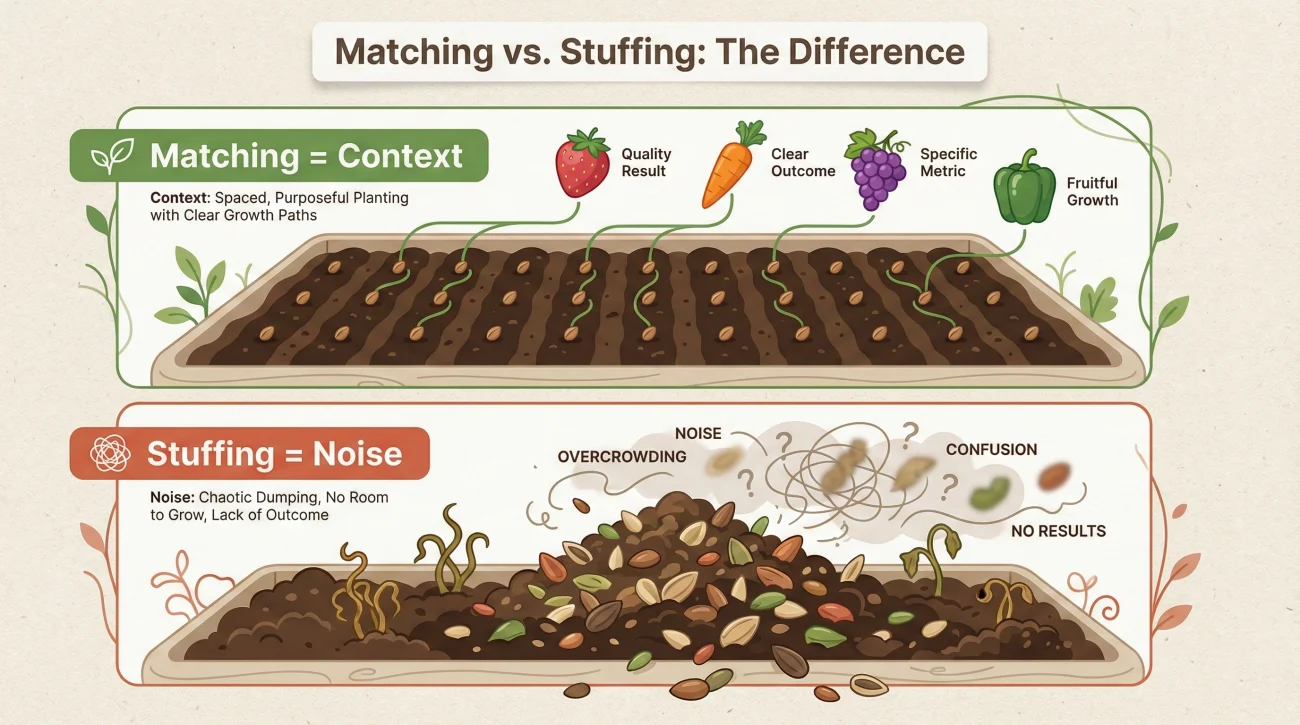
Keyword matching is when your resume uses the role’s language because you genuinely did the work. Keyword stuffing is when your resume uses the role’s language because you are trying to look like you did the work.
I know that sounds like a small difference. In practice, it shows up in patterns that are easy to spot in under a minute.
| What it looks like | How it lands | What to do instead |
|---|---|---|
| Same keyword repeated in multiple bullets with no new meaning | Feels pasted, low signal | Use the keyword once, then prove it with a metric or deliverable |
| Skill lists that mirror the job post line-by-line | Looks inflated, “checkbox resume” | Keep the list tight, move proof into experience bullets |
| Buzzwords without objects (e.g., “strategic, innovative, scalable”) | Reads like filler, not competence | Attach verbs to outcomes: shipped, reduced, automated, resolved |
| Random tool names sprinkled with no context | Feels like SEO, not work history | Place tools where they were used: built dashboards in X, automated reports with Y |
| Copying the job summary into your summary | Instant “template” vibe | Keep summary about your scope and results, then align keywords in bullets |
Another story: A colleague of mine in HR, Marcus, once said he can tell stuffing by the “nouns that never show up again.” A resume would claim “risk management, compliance, governance,” but none of the bullets describe a risk register, an audit, a policy update, or an incident response. That gap between nouns and reality is what sinks trust.
The Restraint Rules: How to Use Keywords Without Sounding Like You Borrowed a Personality
If you remember one thing, remember this: Your resume is not a keyword container. It is a proof document. The keywords are just labels for the proof.
Rule 1: Mirror the role language once per section, not everywhere
Pick a few places where alignment matters most: your headline, your most recent title line, and selected bullets. If you are forcing the same phrase into multiple bullets, you are probably overdoing it.
Rule 2: Treat job titles and tool names as “exact match zones”
Job titles, certifications, and tool names are the safest exact matches because they are factual. If the role says “Salesforce,” do not hide behind “CRM tools.” You can write both, but make sure the concrete term appears.
Rule 3: Translate soft-skill phrases into behaviors
Job posts love phrases like “cross-functional collaboration.” Your resume should show what that meant: weekly stakeholder reviews, decision logs, tradeoff memos, handoffs across time zones, or driving alignment across engineering and product.
Rule 4: Cap your keyword density with a human test
Print your resume or read it like a skeptical recruiter. If you can circle three phrases that feel copy-pasted from the post, your density is too high. That is the simplest test I know that works reliably across industries.
⚠️ Warning: If you add a separate “ATS Keywords” section, many recruiters will interpret it as a signal you are optimizing the document instead of the work. It is rarely worth the trade.
The 10 Mirror Points: What to Match (And Where It Belongs)

Most advice says “match the job description.” That is too broad. Instead, match these ten categories. You will cover what ATS systems and recruiters tend to search for, without rewriting your resume into a job-post clone.
- Role title: Match the target title in your headline if it is honest for your level.
- Core tools: The specific platforms or languages that appear repeatedly.
- Core outputs: Dashboards, roadmaps, playbooks, SOPs, pipelines, campaigns, audits.
- Scope nouns: Regions, product lines, customer segments, team size, budget size.
- Metrics verbs: Reduced, increased, automated, stabilized, accelerated, improved.
- Domain terms: The industry language that signals you understand the environment.
- Compliance or risk terms: Only if you actually worked in that context.
- Workflow terms: Agile rituals, incident response, QA gates, release cadence.
- Stakeholder map: Who you worked with: legal, finance, engineering, vendors, clients.
- Seniority signals: Ownership words: led, owned, accountable for, mentored, hired.
Now the key: You do not need all ten for every job. You need the ones that are central to the role and true for you. That is how you avoid ATS keyword stuffing while still sounding aligned.
Not clean (job-post echo): Program Manager with cross-functional stakeholder management, strategic alignment, innovative solutions, dynamic environment
Examples That Pass Both ATS and Humans: Clean Rewrites You Can Copy (Without Copying the Job Post)
This is where most people get stuck. They can identify keywords but do not know how to place them without sounding fake. The trick is to anchor each keyword to a specific object and result.
Example 1: Tool keyword placed with proof
Before: Experienced in Jira and agile project management.
After: Used Jira to run weekly sprint planning and issue triage across 12 engineers, cutting cycle time by 18% over two releases.
Example 2: Domain language without buzzwords
Before: Strong stakeholder management and communication skills.
After: Built a stakeholder update cadence (weekly notes plus a monthly decision log) that reduced rework from late feedback by 22%.
Example 3: The “match job description keywords” trap
One of the most common patterns I see is people copying a phrase like “end-to-end ownership” into multiple places, hoping the ATS will love it. If you want the phrase, earn it with the sentence around it.
Before: Owned end-to-end project delivery.
After: Owned delivery from intake through launch: clarified requirements, aligned tradeoffs with legal and finance, and shipped on schedule for 3 consecutive quarters.
💡 Pro Tip: A single strong bullet can carry multiple keywords naturally. That is more convincing than scattering the same keywords across weak bullets.
A Simple Framework: How to Match Keywords Without Lying or Overfitting
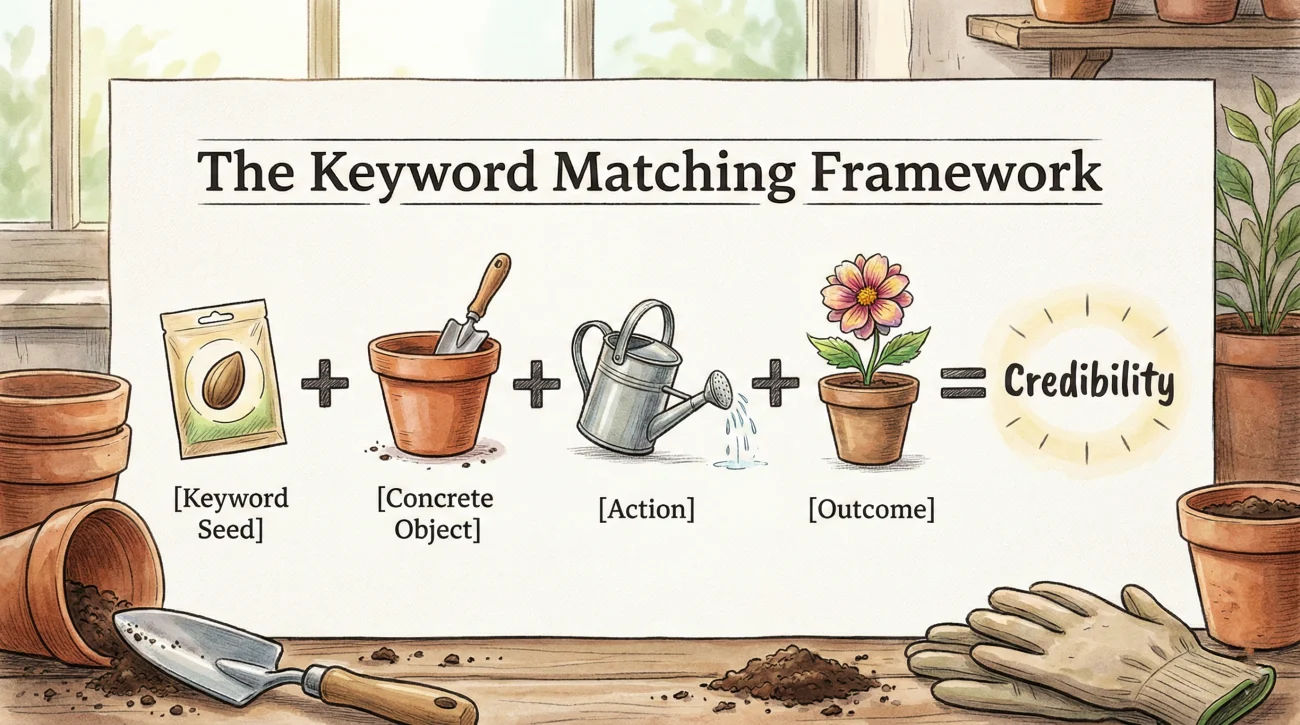
Whenever someone asks me, “How do I do this fast?” I give them a framework, not a trick.
[Keyword] + [Concrete Object] + [Action] + [Outcome]
This is the safest way to implement ATS keywords resume strategy because it forces you into proof. If you cannot fill in the object or outcome, you probably should not use that keyword.
Step 1: Pull only repeat terms (not every noun)
Circle the terms that appear multiple times or appear in the must-have requirements. Ignore the fluff words that appear once and never again.
Step 2: Decide the “exact match” terms
Exact match terms are usually: job title variants, tool names, certifications, and regulated standards. These are the terms recruiters actually search for, and ATS parsers often recognize clearly.
Step 3: Decide the “behavior match” terms
Behavior match terms are the soft phrases: collaboration, communication, ownership, ambiguity. Convert them into actions: cadence, documentation, decision-making, escalation paths, handoffs.
Step 4: Place keywords where they make sense
For most candidates, the best placement is: title line, skills, and bullets. The worst placement is: a random keyword dump at the bottom.
❌ Note: Avoid gimmicks. If a tactic would embarrass you if a recruiter screenshares your resume in a hiring meeting, it is not a strategy, it is a liability.
The “Looks Real” Checklist Recruiters Use (Even If They Don’t Call It That)
I want to share a quick internal lens many hiring teams use. They may not say it out loud, but they are scanning for these signals:
- ✅ Does the candidate use role language naturally, without repeating it like a slogan?
- ✅ Do the keywords show up next to concrete work: tools, deliverables, decisions, metrics?
- ✅ Does the resume show progression and ownership, not just a list of nouns?
- ✅ If the resume claims a tool, can I see what they used it for?
- ✅ If the resume claims a domain, can I see the domain context in the bullets?
Elynn, a senior analyst I worked with, had the opposite problem: She avoided keywords because she hated sounding corporate. Her resume was honest but too generic, so recruiters could not quickly map her to the role. We fixed it by adding a small set of exact match terms in the right spots, then upgrading two bullets with clearer objects and outcomes. She did not become someone else. She just became easier to recognize.
“I didn’t need a new story. I needed the right labels on the work I already did.”
Final: A Resume That Matches Without Performing
The goal is not to “beat” a system. The goal is to be accurately understood. When you treat keywords like labels for proof, you stop chasing scores and start building clarity.
Use the 10 mirror points as your guardrails. Match exact terms where facts matter, translate soft phrases into behaviors, and cap your density with a human read. That is how you build ATS resume keywords alignment that feels real, because it is real.
❓ FAQ
🎯 How many keywords should I include for ATS?
There is no universal number that works across roles. A better rule is: Include the repeated must-have terms, then prove them in bullets. If your resume reads like a job post, you included too many.
🧠 Do ATS systems require exact keyword matches?
Exact matches matter most for tool names, certifications, and job title variants. For softer role language, matching behavior and context is what convinces the human, and often still helps the system.
🛠️ Where should I place ATS keywords on my resume?
Use a clean distribution: a few in the headline or summary, a tight skills list, and the strongest placement inside bullets where the keyword is attached to an action and outcome.
🚫 What is the biggest sign I’ve crossed into keyword stuffing?
Repetition without new meaning. If the same phrase appears in multiple bullets but the bullets do not get more specific, you have moved from matching to stuffing.
📌 If I have experience but different terminology, what do I do?
Use both terms once: The job-post term plus your familiar term in parentheses, then prove it in the bullet. This keeps you searchable while staying honest.
⚠️ Disclaimer: ResumeSolving provides resume, cover letter, and job search communication guidance for informational purposes only. It is not legal, medical, financial, or professional counseling advice. Hiring decisions vary by company, role, location, and individual circumstances, so we do not guarantee interviews, offers, or outcomes. Always use your own judgment, verify requirements directly with the employer, and follow local laws and workplace policies. When a situation is sensitive, we prioritize privacy-safe, recruiter-appropriate wording, and you never need to share personal details you are not comfortable disclosing.