- If they ask why you want full time now, your job is to remove one fear: You will leave when the next client appears.
- A strong answer has three beats: What freelancing gave you, what full time gives you that you actually want, and one concrete commitment signal.
- Never lead with “stability” as your main point. Lead with ownership, depth, and long-term outcomes, then confirm commitment cleanly.
Why This Question Feels Loaded for Freelancers
When an interviewer asks, “Why do you want full time now?” they are usually not testing your personality. They are testing your probability.
They are trying to predict whether you will treat the role like a “bridge job,” whether you will keep juggling clients, and whether you will struggle with structure after years of running your own day.
Here is the trap: Many freelancers answer with the most human truth (“I want stability,” “I want benefits,” “I am tired”). Those can be true, but they can also sound like you are being pushed into employment rather than pulled toward the role.
If you want a simple target, aim for this: Your answer should make full time sound like a deliberate choice that matches the job, not a retreat from freelancing.
Why do you want full time after freelancing interview answer is not a speech. It is a short structure that keeps you out of the awkward middle.
What Hiring Managers Actually Worry About
I have sat in debriefs where the feedback was basically: “They seem talented, but will they stick?” Nobody said it with drama. It was always said like a risk note, the same way people talk about commute distance or a short tenure.
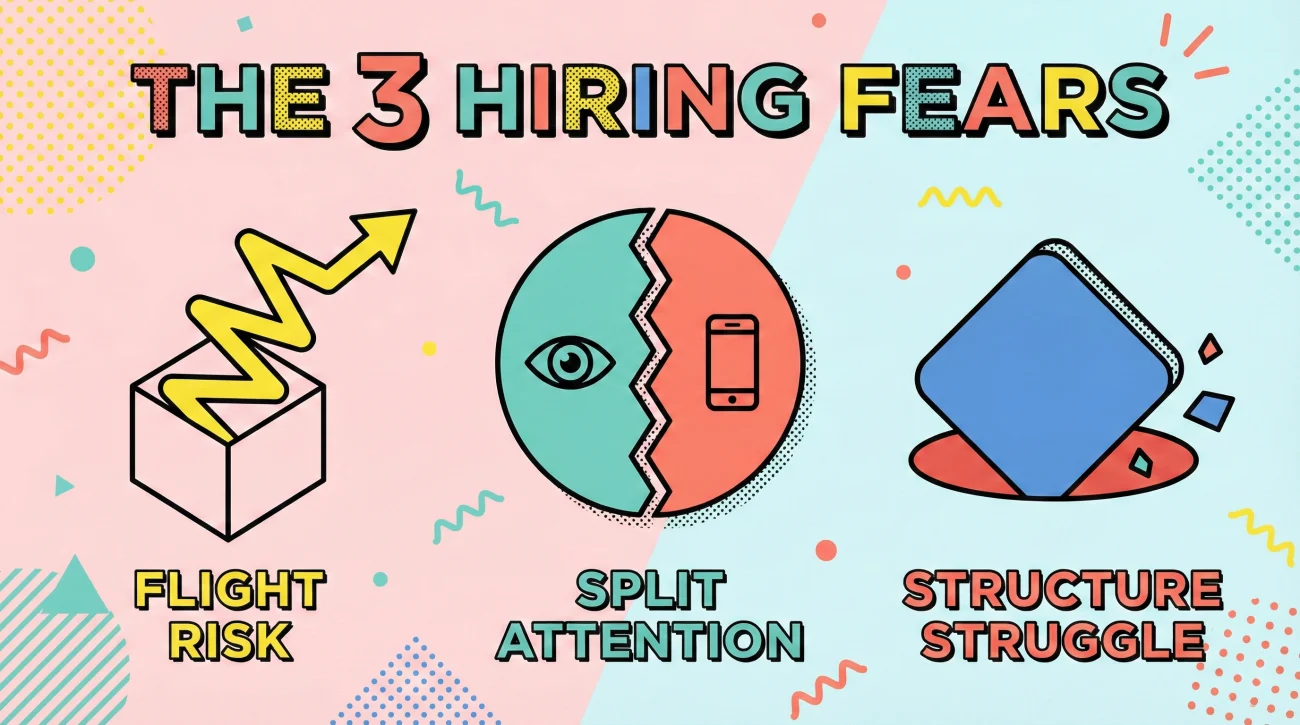
Fear 1: You will leave the moment freelancing looks good again
This is the big one. If your answer sounds like “I need a break,” the interviewer may hear: “I will be gone in six months.”
The fix is not to overpromise loyalty. The fix is to show that the role gives you something you cannot reliably get from freelancing: Depth of ownership, longer time horizon, and shared goals.
Fear 2: You will keep clients and split your attention
Some companies are fine with side work. Some are not. What they want, either way, is clarity.
You do not need to be defensive. You do need to signal that your time boundaries will not be a mystery.
Fear 3: You will struggle with structure, priorities, and feedback loops
A freelancer can decide what “done” means. A team cannot. Hiring managers want to know you can ship inside shared definitions, not just personal standards.
💡 Pro Tip: The easiest way to prove you can work inside structure is to talk about a long-term client relationship like a mini employment story: Onboarding, recurring priorities, stakeholder alignment, and measurable outcomes.
The 20-Second Structure That Sounds Calm and Intentional
When someone says they want “scripts,” I usually push back. Scripts can sound robotic. But a structure is different. A structure keeps your answer from drifting into apology.

Use this three-part answer: Gain, Pull, Proof
[Gain from freelancing] + [Pull toward this role] + [Proof of commitment]
That is it. Three beats. One breath. No overexplaining.
Pull: I am looking for deeper ownership on longer cycles, where I can build, iterate, and improve the same product or process over time.
Proof: I am intentionally closing out remaining client work, and I am excited to commit my full capacity to one team.
Notice what this does: It respects freelancing, it makes full time about the job (not about your personal crisis), and it lands one clean commitment signal without sounding like a promise you cannot guarantee.
Choose one proof signal, not five
Most people panic and add extra explanations: “I will not freelance anymore,” “I love structure,” “I am ready to commit,” “I want stability,” “I want benefits.” Stack enough of those and it starts to sound like damage control.
Pick one proof signal that is true, specific, and calm. Here are options you can use without getting weird:
- I have already planned a clean wrap-up timeline for current client work.
- I am targeting a role where I can grow inside one team and one set of priorities for the next stage of my career.
- I am most motivated by long-term outcomes, not short project wins.
- I miss the rhythm of building with the same partners over time, and I am choosing that intentionally.
Six Answer Variations That Fit Real Situations
Below are six variations you can adapt. Each one still uses Gain, Pull, Proof. The difference is the “pull” line, because your pull should match the job you are applying for.
Variation 1: You want deeper ownership (product, process, or outcomes)
“Freelancing taught me how to deliver fast and own the full scope, but I am looking for deeper ownership on longer cycles. This role is exactly the kind of work where I can build, iterate, and improve outcomes over time. I am wrapping up remaining client commitments so I can focus fully on one team.”
If you are applying to product, ops, marketing, analytics, or anything with a long runway, this version lands well because it frames employment as an upgrade in depth, not a downgrade in freedom.
Variation 2: You miss teamwork, mentorship, and shared standards
“I loved the independence of freelancing, and it made me stronger at stakeholder management. What I miss is building with a team: Shared standards, sharper feedback loops, and mentorship in both directions. I am choosing full time because I want that collaboration every day, and I am prepared to commit my full capacity to one role.”
This works best when the job description is heavy on cross-functional work, reviews, and iterative delivery.
Variation 3: You want bigger scope and resources than clients can give you
“Freelancing gave me range: Different industries, different problems, fast delivery. But I am at the point where I want bigger scope and better infrastructure: The kind you only get inside a dedicated team. That is why I am pursuing full time now, and I am ready to focus on one mission instead of splitting attention across projects.”
This is a strong fit for engineering, data, and design roles where scale and systems matter.
Variation 4: You want a clearer growth track and leadership path
“Freelancing pushed me to run my own work like a business, which I am proud of. Now I want a clearer growth path: Coaching, leading projects, and eventually leading people in a structured way. A full-time role gives me that runway, and I am making the transition intentionally, not reactively.”
Use this when the role includes mentoring, project leadership, or people leadership as a near-term expectation.
Variation 5: You are pivoting into a specific industry, not just chasing a paycheck
If your freelance work was broad, an interviewer might wonder if you are “trying everything.” This version makes you sound focused.
“Freelancing helped me explore what I am best at and what type of work energizes me. Over time I kept gravitating toward this industry and this kind of role, and I want to go deeper rather than staying wide. Full time is the best way for me to build expertise here, and I am ready to commit to one team and one direction.”
freelancer to employee interview answer works best when you can name the pattern: Same problem type, same audience, same outcomes, across multiple clients.
Variation 6: You do want stability and benefits, but you want to say it like an adult
Sometimes the honest reason is: You want predictability. You can say that, but do it as the third beat, not the first.
“Freelancing was a great chapter and it strengthened my delivery skills. What I want now is a longer time horizon: Deeper ownership, consistent collaboration, and sustainable focus on one set of priorities. A full-time role supports that, and I am ready to build in one place instead of constantly resetting context between projects.”
This version signals stability without sounding like you are running from freelancing. It also quietly answers why leave freelancing without turning your answer into a personal story dump.
Common Follow-Ups and the Calm One-Liners That Handle Them
Interviewers often ask a second question right after your answer. If you are ready for it, you look confident. If you scramble, you look unsure.
| Follow-up | What they are testing | One-line response |
|---|---|---|
| Will you keep freelancing on the side? | Focus and boundaries | I am prioritizing this role and keeping my schedule fully aligned with team expectations. |
| Why not continue freelancing if it paid well? | Pull vs push | I want deeper ownership and long-term outcomes that are hard to get in short project cycles. |
| What changed recently? | Stability and decision quality | I realized I am most energized by building inside one team over time, and I am acting on that intentionally. |
| Do you miss autonomy? | Culture fit | I like autonomy with alignment: Clear goals, then room to execute with accountability. |
| How do we know you will stay? | Commitment risk | I am making a deliberate shift toward a long-term role where I can grow and deliver outcomes over time. |
⚠️ Warning: If you mention money, keep it simple. “I want stable income” can sound like your pipeline collapsed. Lead with the work, then confirm that the full-time setup matches how you want to deliver.
Mistakes That Make You Sound Like You Failed Freelancing
I have heard good candidates talk themselves into a corner here. Not because they were dishonest, but because they chose the wrong emphasis.
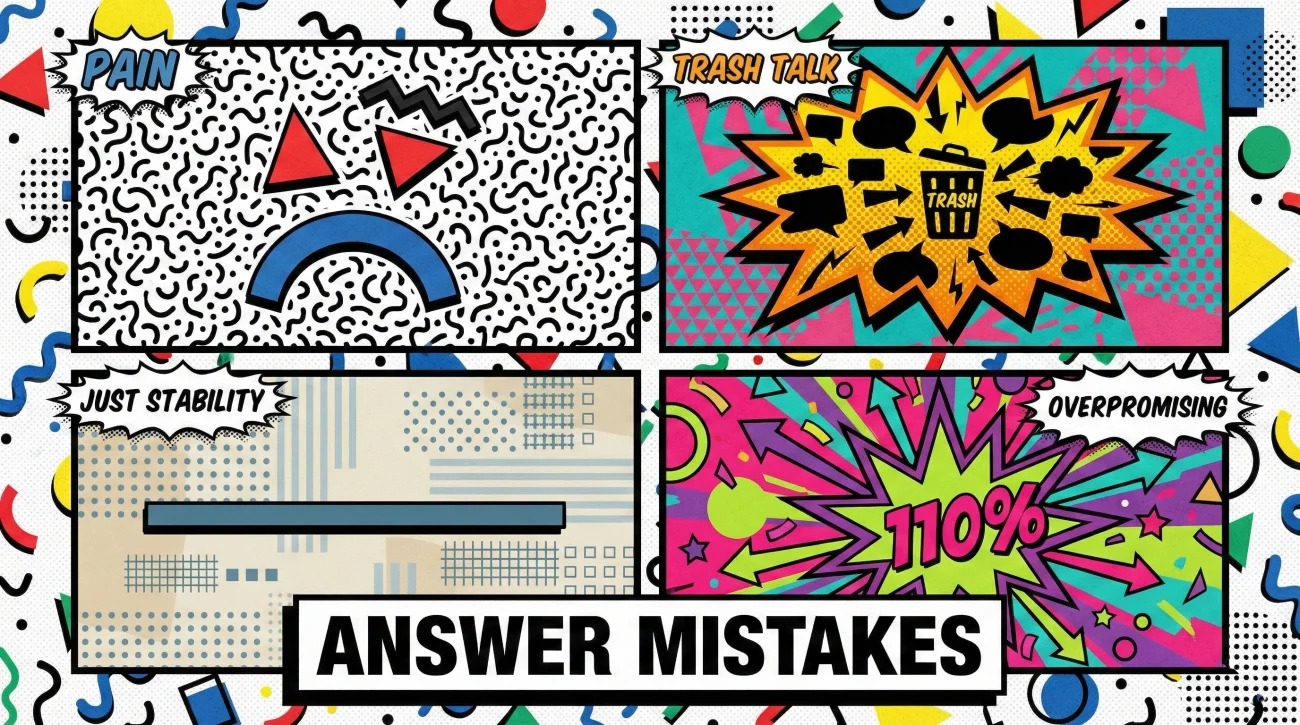
Mistake 1: Leading with pain (burnout, stress, desperation)
You can be tired. You can want a change. But if you open with pain, the interviewer may hear instability.
Better: Start with what you gained, then talk about what you want to build next.
Mistake 2: Trash-talking clients or saying every client was “a nightmare”
Even if it was true, it frames you as someone who blames the environment. Keep it neutral and professional.
If you need to explain a mismatch, use language like: “I learned I do my best work with longer timelines and clearer shared goals.”
Mistake 3: Making “stability” your entire story
Stability is a valid reason. It is just not a differentiator.
Hiring managers want to hear why this specific role is the best container for your best work.
Mistake 4: Overpromising loyalty
Do not say “I would never freelance again” unless you are certain and the company policy supports it.
Instead, talk about priorities and capacity: One role, one team, one set of outcomes.
Final: A Good Answer Sounds Like a Choice, Not a Confession
The goal is not to prove you are “done” with freelancing. The goal is to make your decision feel intentional, aligned with the role, and easy to believe.
If you keep your answer to Gain, Pull, Proof, you avoid sounding defensive. You also avoid the messy middle where you overshare and accidentally create new concerns.
And if you want a clean line to remember, it is this: Freelancing made you stronger. Full time is where you want to apply that strength with deeper ownership and a longer runway.
That is the heart of a strong why do you want full time after freelancing interview answer.
❓ FAQ
🎯 Should I mention benefits as a reason?
You can, but do not lead with it. Start with the work: Ownership, depth, long-term outcomes. If it comes up, frame benefits as part of building a sustainable work setup, not as a rescue plan.
🧠 What if freelancing ended because clients dried up?
Keep it short and neutral. Focus on what you learned and what you want next. Then add one commitment cue that you are choosing a long-term role because it fits how you want to deliver, not because you are panicking.
✅ What is the best proof signal that I am serious about full time?
The best proof signal is specific and calm: A wrap-up plan, a clear priority statement, or a reason tied to longer time horizons. Avoid dramatic promises.
🕒 If they ask whether I will freelance on the side, what do I say?
Answer with priorities and boundaries. Make it clear the role gets your full working capacity and that any outside work will not conflict with expectations. If the company policy forbids it, match the policy.
💬 How long should my answer be?
Twenty seconds is a good target, then pause. If they want more, they will ask. A short, structured answer sounds confident. A long answer sounds like you are negotiating with yourself.
⚠️ Disclaimer: ResumeSolving provides resume, cover letter, job search communication, and career transition guidance for informational purposes only. Hiring practices vary by employer, role, location, industry, and individual circumstances. We do not guarantee interviews, job offers, ATS results, or other outcomes. Verify employer requirements directly and follow applicable laws and workplace policies. For sensitive situations, use only information you are comfortable disclosing and keep all statements accurate.