- Most freelance downtime is normal. The real risk is when your resume makes it look unplanned, ongoing, or hard to explain.
- Use a simple 3-part fix: Date your freelance work clearly, add one calm bridge line only when needed, then prove stability with outcomes and repeatable work.
- If you try to “explain every week,” you often create more questions than you close. Route your explanation based on how long the gap is and what role you want next.
Freelance Downtime Is Not the Problem, Ambiguity Is
I have reviewed a lot of resumes where the candidate was genuinely good, the portfolio was strong, and the references were clean. Still, one small pattern triggered extra questions: freelance gaps between clients on resume that looked like “something happened” instead of “normal pacing.”
Here’s the truth from the hiring side: I do not expect a freelancer to be booked 52 weeks a year. What I look for is whether you can explain your rhythm without sounding defensive, and whether your work history shows repeatable delivery.
A designer named Lynzie once told me, “I’m embarrassed by the quiet months.” She had a two month lull after a big client paused spend. Nothing dramatic happened, but her resume made it feel mysterious because the dates were inconsistent and the story was missing one calm sentence. We changed almost nothing about her accomplishments. We changed the framing. The questions stopped.
What Gaps Between Clients Signal to Recruiters
When someone is hiring you into a full time role, they are not only buying skill. They are buying reliability, predictability, and how you behave when work is not landing instantly.
In practice, most recruiters read a gaps between clients resume pattern through a few common lenses. Some are fair. Some are just shortcuts.
| What they might assume | What you want them to conclude instead | How your resume can nudge it |
|---|---|---|
| Your pipeline is unstable | You work in cycles, and you plan for it | Consistent umbrella dates + a calm bridge line only if gap is long |
| A client relationship ended badly | Projects end. You close cleanly | Outcome bullets and repeatable work types, not emotional wording |
| You are “between things” right now | You are available and intentional | Resume summary sets direction, not a timeline apology |
| You were not working at all | You kept momentum through development or product work | One line that names training, product build, or structured prospecting |
💡 Pro Tip: Your goal is not to prove you were busy every day. Your goal is to remove the “mystery gap” feeling that triggers follow up questions.
A recruiter I worked with years ago used a blunt filter: “If the resume makes me guess, I assume the worst.” It is not fair, but it is real. The fix is giving them one clean, boring explanation when the downtime is long enough to be noticed.
Routing Rules: When You Should Explain the Downtime
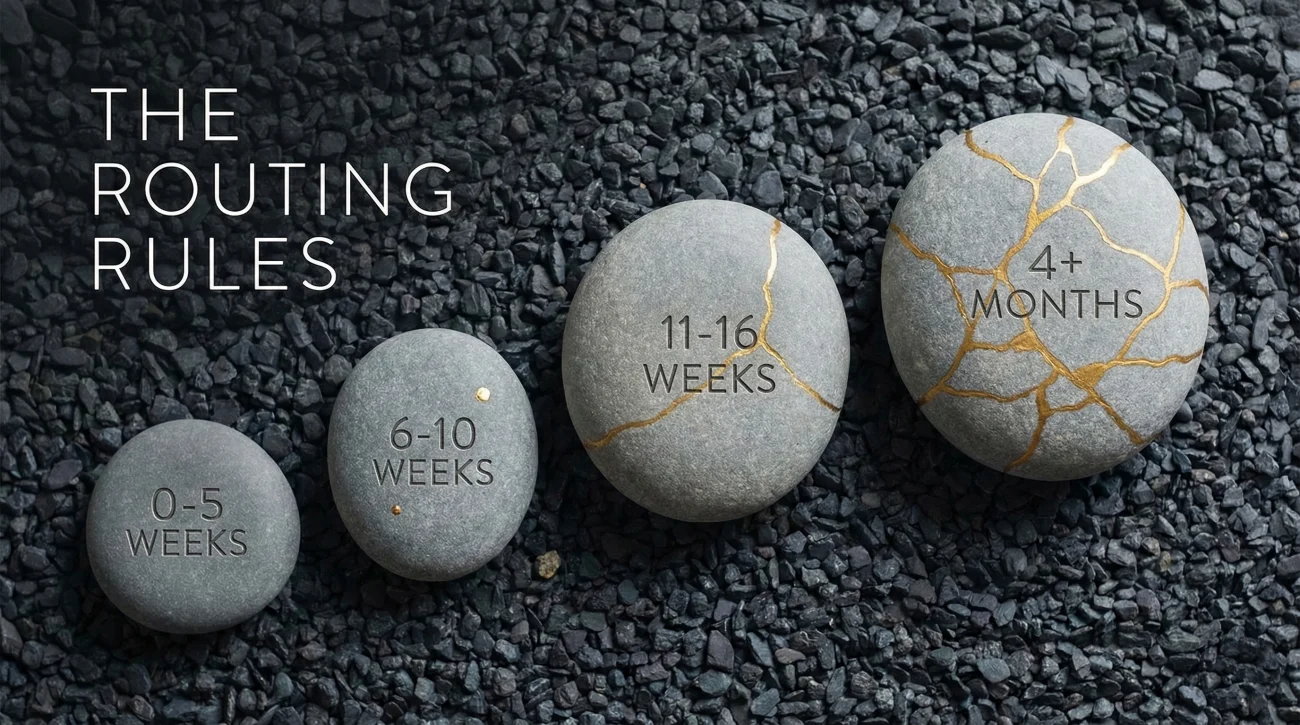
Freelancers often overcorrect. They try to narrate every pause. That usually backfires, because it highlights the gaps and turns a normal rhythm into a storyline.
Use routing rules instead. Think of downtime like weather. A light drizzle does not need a press release. A full storm does.
A Simple Four-Level System
These ranges are not law. They are a practical way to decide whether your resume needs a bridge line.
- 0 to 5 weeks: Usually do nothing. Keep your freelance umbrella entry clean and focus on outcomes.
- 6 to 10 weeks: Consider a bridge line only if your last project ended abruptly or your industry is conservative.
- 11 to 16 weeks: Add one calm bridge line. Keep it factual and closed-ended.
- 4+ months: Add a bridge line plus one proof signal (training, product build, volunteer delivery, or structured prospecting).
Do I need to list every gap between engagements?
No. If you try to explain every quiet week, you often create a “pattern of instability” that was not visible before. Use your resume to show stability through consistent positioning and repeatable delivery.
⚠️ Warning: If you work in regulated roles (finance, healthcare, government contracting), longer unaccounted gaps can trigger verification questions. The answer is still not oversharing. It is one clean line that closes the timeline.
Date Strategy: Make Freelance Look Continuous Without Feeling Fake

Before you write any explanation line, fix the dates. Most “gap anxiety” comes from inconsistent date presentation rather than the gap itself.
If you have a freelance umbrella entry, keep the umbrella dates consistent and highlight your strongest engagements inside the bullets. This is where many people solve freelancing gaps between contracts without writing a single “gap sentence.”
Three Clean Date Options That Recruiters Read Correctly
Option 1: Umbrella role with selected engagements in bullets. This is best when you have many clients and the downtime is short and normal.
Option 2: Umbrella role plus a small “Selected Projects” subline. This is best when you want to show variety without turning your resume into a list of mini jobs.
Option 3: Two freelance eras with a clear break. This is best when you truly paused freelancing, moved locations, changed work authorization, or did a reset.
– Led GTM messaging for 9 B2B launches across SaaS and fintech; improved activation by 18% on average
– Built repeatable onboarding email frameworks for 4 clients; reduced time-to-value from 14 days to 7 days
– Selected engagements: 3-month contract (Q2 2024), 10-week sprint (Q3 2025), retention rebuild (Q4 2025)
Notice what this does: It shows continuity without pretending you were booked every day. It also keeps your resume readable for ATS, because the core entry is stable.
The One-Line Bridge: A Calm Way to Explain Downtime

When downtime is long enough to be noticed, the best move is a single closed-ended line. Not a confession. Not a life story. Just enough to remove ambiguity.
This is where people often mess up. They write emotional detail, mention burnout, or explain a conflict. Even if it is true, it changes the reader’s focus from your work to your personal stability.
That “after” version works because it is factual and closed. It does not invite a debate. It also quietly signals agency.
Where to Place the Bridge Line
Place it inside your freelance umbrella entry as the final bullet, or add a short “Professional Development” line if it is clearly a development period. Do not create a separate “Gap” job unless the break is extremely long and needs explicit dating.
If you are targeting roles where timelines are heavily scrutinized, you can add a bridge line that reads like project management, not personal justification. This keeps resume gaps between projects from looking like a loose end.
“So, what happened after that contract ended?”
“Nothing dramatic. I wrapped the engagement, took six weeks to update my portfolio and rebuild my pipeline, then booked the next sprint in March.”
That tone is what your resume should hint at: steady, boring, professional.
Six Copy-Paste Lines You Can Use on Your Resume
Think of these as bridge sentences that remove ambiguity without turning your resume into a diary. They are short on purpose, but they should still sound like a professional timeline, not a confession or a plea.
How to Use These Lines Without Making the Gap Bigger
Pick one line that matches reality, then stop. The common mistake is stacking two or three explanations in a row, which makes the downtime feel bigger than it was. A single clean sentence is usually enough to close the loop and let your outcomes do the selling.
Every strong bridge line has three elements: A time box, a concrete action, and a closed ending. That last part matters because it prevents the reader from wondering if the situation is still ongoing.
Pick the Line That Matches Your Situation
The goal is not to prove you were busy every day. The goal is to remove the “mystery gap” feeling that triggers follow-up questions. These options help you explain gap between freelance jobs with a calm, recruiter-friendly tone.
Choose the closest match below and keep the rest of your freelance entry focused on outcomes, scope, and repeatable delivery.
If You Stayed in Business Mode During the Lull
This works well when the gap was not dramatic but visible. It signals you stayed in “business mode” and did the unglamorous work that keeps freelancing stable. For full time hiring teams, it reads like disciplined upkeep rather than drifting.
If You Shipped a Concrete Deliverable While Between Contracts
Use this when you want the bridge line to feel like output, not “learning.” The word shipped is doing real work here because it implies something tangible that could be reviewed in an interview, even if the work was self-directed.
This is especially useful when your next target role values execution and proof over narrative.
If the Downtime Was Planned and Clearly Temporary
This line is for intentional breathing room that you can show was time-boxed. The “returned with” clause closes the story and prevents the reader from assuming you are still in an open-ended break.
If you remove that ending, “planned time off” can accidentally read like uncertainty, which is the opposite of what you want.
If You Built Something That Supports Your Next Role
This fits people who used a quiet period to build a real asset. The second half is the anchor: it ties the build back to business value, so it does not sound like a random side project.
If you can connect the work to retention, onboarding, conversion, or operational improvements, the line reads as relevant experience rather than a detour.
If You Need an External Proof Signal for Conservative Roles
Choose this when you want credibility from an outside stakeholder. It keeps the timeline clean and signals accountability, which matters more in roles that prize reliability and verification.
The phrase measurable deliverable is intentional. It implies the work can be discussed objectively, not framed as goodwill.
If the Break Was Logistical and You Want It to Feel Closed
This is the cleanest way to explain a logistical break without sounding scattered. Relocation is understandable, but you still want a closed ending that proves momentum returned.
The final clause does that job. Without it, a reader can wonder whether the pause is still ongoing or whether you are still “settling in.”
Language to Avoid in a Resume Bridge Line
❌ Note: Avoid language that sounds ongoing or emotionally loaded. Examples include “still dealing with,” “trying to recover,” or “had a difficult time.” Keep the bridge line factual, time-boxed, and closed so it does not steal attention from your results.
Three Real Situations I Have Seen and What Worked
To make this practical, here are three situations that came across my desk, plus what actually reduced recruiter friction. Names are changed, details are simplified, and the patterns are real.
The “Quiet Quarter” After a Big Client Paused Spend
Luis was a freelance performance marketer. A major client paused budgets, and his Q3 went quiet. He was not failing. He was caught in the reality of marketing spend cycles.
His first resume draft tried to explain it emotionally. It sounded like apology. We replaced it with one bridge line and moved the spotlight to measurable outcomes from his strongest engagements. The key was that the line had a time box and a deliverable.
The Freelancer Who Looked “Always Available” and Triggered Doubt
Mei listed “Freelance Designer (2021 – Present)” with no hints of cadence. Some hiring managers read that as stable. Others read it as “she is still freelancing and will keep prioritizing clients.”
We kept the umbrella dates but adjusted her summary to sound ready for full time, and added one line about repeatable cross-functional work with product and engineering. That removed the “split focus” fear without her saying anything dramatic.
The Long Gap That Needed One Extra Proof Signal
Andre had a four month break between contracts due to relocation. He added a simple bridge line, but it still felt thin for a conservative operations role.
What worked was adding one proof signal: a short volunteer delivery with a measurable outcome. Not because he “needed to justify himself,” but because the role valued reliability. His resume stopped looking like a blank stretch and started looking like a planned transition.
Final: A Stable Story Is Built With Dates, One Line, and Proof
Most hiring teams do not punish freelancers for normal downtime. They hesitate when the resume forces them to guess. If your dates are clean, your bridge line is short and closed-ended, and your bullets show repeatable delivery, the gap stops being a story.
When you handle freelance gaps between clients on resume this way, you do not sound like you are defending your past. You sound like someone who understands how work actually flows, and who can bring that calm into a full time environment.
❓ FAQ
🧩 Should I write “Between engagements” even for a 2-week gap?
Usually no. Two weeks is normal operational noise in freelance life. Adding a line can accidentally spotlight something the reader would not have noticed.
🗓️ Is it okay to list freelance as “2022 – Present” even if I had downtime?
It can be okay if freelancing was your primary mode of work and the downtime was part of normal cycles. The key is that your bullets show substantial engagements and clear outcomes, so the entry reads as real work, not a placeholder.
🔍 What if a recruiter asks me to explain the exact months with no projects?
Answer calmly and briefly with a time box and one concrete activity. Keep it factual and closed-ended. You are not being interrogated, they are simply reducing uncertainty.
🧠 Should I mention burnout or mental health as the reason for downtime?
On a resume, it is usually safer to keep the explanation work-focused and time-boxed. You can tell the truth without giving personal detail that changes the conversation away from your skills.
📌 Where is the best place to add the bridge line?
Most of the time, place it as the final bullet under your freelance umbrella entry. If the downtime was clearly development-focused, a short “Professional Development” line can also work, as long as it stays concise.
✅ What’s the fastest way to make freelance look stable for full time roles?
Lead with consistent umbrella dating, choose a few strong engagements to prove repeatable delivery, and only add one bridge line when the downtime is long enough to be noticed.
⚠️ Disclaimer: ResumeSolving provides resume, cover letter, job search communication, and career transition guidance for informational purposes only. Hiring practices vary by employer, role, location, industry, and individual circumstances. We do not guarantee interviews, job offers, ATS results, or other outcomes. Verify employer requirements directly and follow applicable laws and workplace policies. For sensitive situations, use only information you are comfortable disclosing and keep all statements accurate.