- If you led founder-led sales, your resume must show a repeatable pipeline story, not “scrappy hustle”.
- Translate founder work into Sales Manager signals: Process, forecasting, coaching, deal strategy, and CRM discipline.
- Use a simple Pipeline Map to turn “I sold” into stages, conversion rates, and revenue hygiene.
- Build a Proof Pack: A tight set of evidence that makes your numbers believable without oversharing.
- Your goal is stability: A hiring manager should feel you can run a team inside someone else’s system.
Founder to Sales Manager: When “Scrappy Selling” Sounds Like a Risk
I have seen a pattern when founders apply for sales leadership roles: They describe selling like a movie montage. “Closed deals, built partnerships, grew revenue.” It is not wrong. It is just not legible.
Hiring managers do not reject founders because they dislike founders. They reject founder resumes because the selling story feels unrepeatable, un-coachable, or too dependent on founder energy. If you want a Sales Manager title, your resume needs to communicate: Pipeline thinking, team leverage, and predictable execution.
That is exactly what a founder to sales manager resume must do. It has to translate founder-led chaos into sales leadership signals, without pretending you had a 20-person SDR org when you did not.
One candidate I worked with, Christina, had run a tiny B2B SaaS startup. She had real wins, but her resume read like a founder diary: product, funding, hiring, “sales”. When she rewrote her selling work into stages, ratios, and coaching behaviors, she stopped getting “interesting background” replies and started getting real recruiter screens for Sales Manager and BD Manager roles.
What Hiring Managers Fear When a Founder Applies for Sales Manager

Sales leaders hire for predictability. A founder background can feel like the opposite, even when your outcomes were strong. These are the common doubts you need to address through wording and structure, not through defensive explanations.
Fear 1: “They don’t run a process, they run on adrenaline”
If your bullets sound like “I hustled and it worked,” the reader assumes there is no repeatable motion. They want to see stages, handoffs, cadence, and how you defined what “qualified” means.
Fear 2: “They sold because they were the founder, not because they can sell”
Founders sometimes win early deals through vision, personal network, or sheer novelty. A Sales Manager is expected to build a pipeline that keeps working after novelty wears off.
Fear 3: “They won’t coach, they’ll just take over”
Sales leadership is not about being the best closer in the room. It is about enabling others. If your resume reads like “I did everything,” it signals you will struggle with delegation and coaching.
⚠️ Warning: The fastest way to trigger these fears is to overuse vague founder language like “drove growth,” “owned sales,” or “built relationships” with no operational detail.
Sales Manager Signal Map: The Translation You Need to Do
Here is the pivot move: Stop describing your startup. Describe the sales system you built inside it. Even a tiny company has a system, whether you called it that or not.
| Founder-Led Sales Activity | Sales Manager Signal It Should Become |
|---|---|
| “Found initial customers” | Defined ICP, qualification rules, and lead-to-opportunity criteria |
| “Did partnerships” | Built channel motion, partner onboarding, and revenue attribution |
| “Closed deals myself” | Deal strategy, pipeline reviews, objection handling playbook, multi-threading |
| “Tracked sales in spreadsheets” | CRM discipline, stage definitions, forecasting hygiene, reporting cadence |
| “Hired a rep once” | Recruiting, onboarding, ramp plan, coaching routine, performance expectations |
Angelo, a founder I know through a former colleague, told me something useful: “I thought I was applying for sales roles, but I was actually describing entrepreneurship.” Once he reframed his work as a repeatable system, his resume finally matched what sales leaders screen for.
Build a Simple Pipeline Map (Even If You Never Had One on Paper)
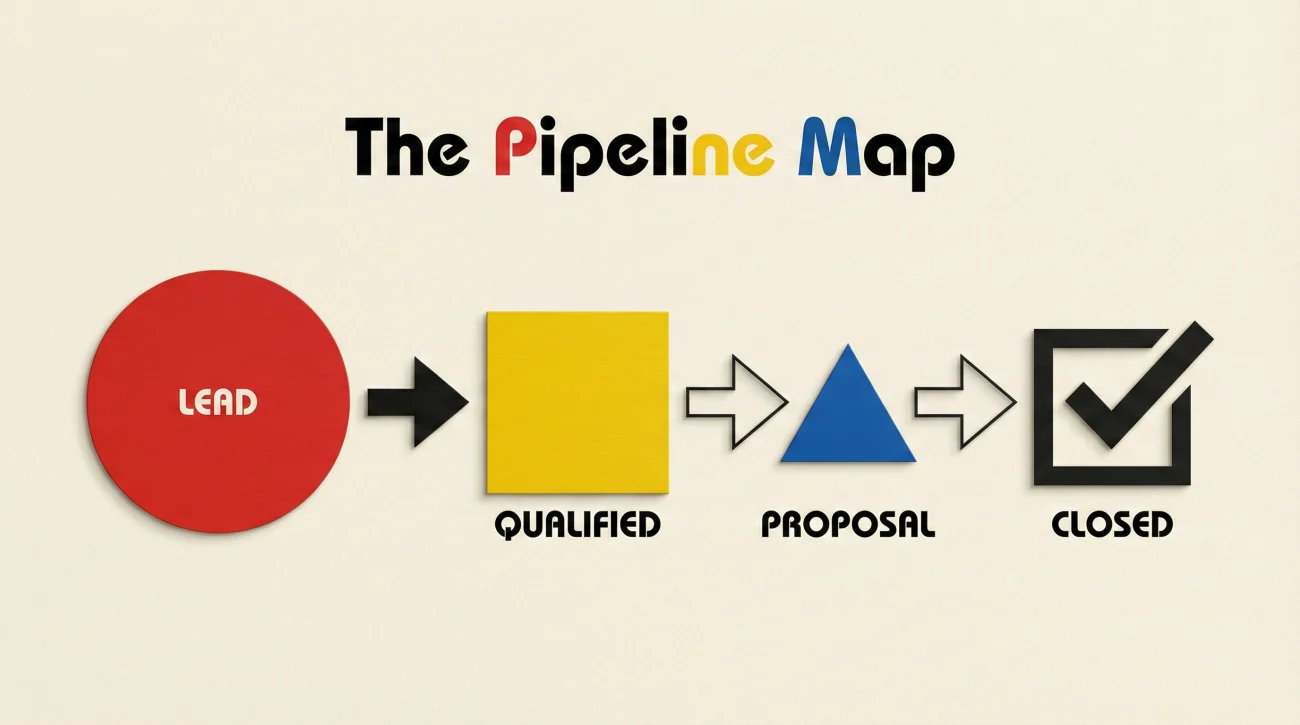
This section is the missing piece in most founder resumes. A Sales Manager resume needs a pipeline story. Not a list of wins. A pipeline story.
Step 1: Name your stages like a sales org would
You do not need enterprise complexity. You need clarity. Pick 4 to 6 stages that reflect how deals actually moved.
Lead Sourced → Qualified → Discovery Completed → Proposal Sent → Negotiation → Closed Won/Lost
Step 2: Add one “quality rule” per stage
Quality rules make you sound like a manager, not a gambler. Example: “Qualified = budget range confirmed + problem statement + next meeting scheduled.”
Step 3: Show one conversion ratio (or time-to-stage)
You do not need to publish your entire funnel. One believable ratio proves you think like sales leadership. For instance: Lead-to-qualified rate, discovery-to-proposal rate, or average sales cycle by segment.
Stages: Qualified → Discovery → Proposal → Closed
Typical Cycle: 21-35 days (SMB), 45-60 days (Mid-market)
Key Ratio: 38% Discovery-to-Proposal after tightening qualification criteria
💡 Pro Tip: If you cannot compute a ratio, use “time-to-stage” instead. Sales managers care about velocity and bottlenecks.
The Wording Swap: From Founder Energy to Sales Leadership Language
A resume is not a documentary. It is a translation layer. Your job is to keep the truth while changing the reader’s mental model.
Here is another swap that matters if you are using the founder to sales resume angle: Do not hide the founder title, but do not let it be the only identity you project.
“I’m not trying to convince you I’m still in founder mode. I’m showing you how I built a sales motion, then trained other people to run it without me.”
That line works because it addresses the real worry: “Will you stay?” It also signals coachability without begging for trust.
12 Resume Bullets That Sound Like a Sales Manager (Not a Founder Pitch)
These are templates, not copy-paste lines. The structure is what matters: Process + metric + leadership behavior. If you were a startup founder sales manager in practice, your bullets should prove it.
Pipeline and forecasting
- Defined pipeline stages and qualification criteria, improving deal hygiene and reducing “stalled” opportunities in the active pipeline.
- Built a weekly pipeline review cadence: Risk flags, next steps, and close-date discipline across active deals.
- Introduced simple forecasting logic by segment, improving predictability and making revenue planning usable for budgeting decisions.
- Tracked cycle time by stage to identify bottlenecks; adjusted discovery structure to increase proposal readiness.
Go-to-market clarity
- Refined ICP and disqualification rules, shifting effort toward higher-conversion segments and reducing time spent on low-fit leads.
- Built a messaging and objection library from real calls and lost deals, improving consistency across outreach and discovery.
- Created a light-weight handoff process between inbound interest, discovery, and proposal follow-up to prevent lead leakage.
- Established a deal desk checklist: Pricing rationale, stakeholder map, risks, and mutual close plan.
Coaching and team leverage
- Onboarded and coached a junior seller: Call reviews, talk-track feedback, and weekly skill focus to accelerate ramp.
- Implemented a simple activity-to-outcome dashboard so performance conversations stayed grounded in data, not vibes.
- Designed role clarity between selling, account management, and customer success to reduce churn driven by mismatched expectations.
- Built a repeatable follow-up workflow using CRM tasks and stage exit criteria, making sales execution less dependent on memory.
❌ Note: Avoid bullets that read like investor updates. “Raised funding,” “grew brand,” and “built vision” can belong, but not where your sales leadership evidence should be.
Your Proof Pack: Make Founder Numbers Believable Without Oversharing

Founders often have numbers, but the reader does not trust the context. A proof pack is a small set of signals that makes your story feel real and repeatable.
Proof type 1: System artifacts (process evidence)
Mention artifacts, not secret documents. Examples: “Created stage definitions,” “built a pipeline review template,” “implemented CRM fields for qualification.” This reads as operational maturity.
Proof type 2: Sales hygiene evidence (discipline)
Sales managers are judged on hygiene. Show you care about close-date accuracy, next steps, and risk flags. Even a single line about stage exit criteria signals a lot.
Proof type 3: Team leverage (you are not the hero)
If you can credibly show other people sold with your system, do it. It can be one rep, one partner channel, or one CS teammate handling renewals. The point is leverage.
One friend of mine, Jacqueline, had a tiny services business and wanted a corporate Sales Manager role. She was terrified because her revenue was “small” compared to big company numbers. We did not inflate anything. We rewrote her proof pack around process, conversion improvements, and coaching behavior. Her interviews changed. The questions became “How would you implement this here?” instead of “Is this real sales?”
How to Structure the Experience Section So It Reads Like a Role, Not a Detour
The easiest structure is: Title that matches the target, then founder context in the company line or a short descriptor. You are not lying. You are choosing the most relevant truth.
Option A: Role-first title (best when you want Sales Manager roles)
– Built pipeline stages, qualification rules, and weekly review cadence to improve forecast discipline
– Coached junior seller through call reviews and deal strategy feedback; improved proposal readiness
Option B: Founder title with sales leadership subtitle (best when founder identity is a strong signal)
Sales Leadership Focus: Pipeline process, coaching, forecasting, and deal strategy
💡 Pro Tip: If you are coming from a business owner background, this is where business owner sales resume positioning can work, as long as the bullets stay sales-operational, not general-CEO.
Final: The Resume Should Prove You Can Run Sales Without Needing the Founder Myth
If your resume makes the reader imagine you as “the founder who can sell,” you will get curiosity but not confidence. If your resume makes them imagine you as “the sales leader who built a repeatable system,” you get serious interviews.
The cleanest test is simple: Could someone else run your process? Could you coach a team inside a company that already has rules? If your bullets and structure answer “yes,” you are doing this pivot correctly.
When you write a founder to sales manager resume, you are not minimizing your founder story. You are translating it into the language sales leaders trust: Pipeline clarity, forecasting hygiene, coaching behaviors, and repeatable execution.
❓ FAQ
💼 Should I keep “Founder” as my title if I want Sales Manager roles?
Yes, if it helps credibility. But your bullets must read like sales leadership. If “Founder” becomes the entire identity, the reader worries about coachability and fit.
📊 What if I do not have clean metrics from my startup sales work?
Use process metrics: Time-to-stage, stage exit criteria, conversion improvements, or forecast accuracy habits. One credible ratio or velocity metric can be enough.
🧠 How do I show coaching if I never managed a big sales team?
Show leverage: Onboarding one rep, enabling a partner channel, or training a teammate to run parts of the funnel. The point is that results did not depend only on you closing.
🧩 Should I list CRM tools if I used spreadsheets most of the time?
List what you truly used, but emphasize the discipline: Stage definitions, next-step tracking, pipeline reviews, and reporting cadence. Tools matter less than hygiene.
🎯 What is the biggest wording mistake founders make on sales resumes?
They describe “selling” as a personality trait instead of a system. Replace vague wins with pipeline structure, qualification rules, and repeatable execution signals.
⚠️ Disclaimer: ResumeSolving provides resume, cover letter, job search communication, and career transition guidance for informational purposes only. Hiring practices vary by employer, role, location, industry, and individual circumstances. We do not guarantee interviews, job offers, ATS results, or other outcomes. Verify employer requirements directly and follow applicable laws and workplace policies. For sensitive situations, use only information you are comfortable disclosing and keep all statements accurate.