- If your resume looks like “too many jobs,” the real problem is usually readability and risk signals, not your character.
- Use a triage approach: Keep the roles that prove fit, merge the roles that repeat, hide the roles that add noise (but keep them for forms).
- Your goal is one clean story on the resume and one consistent record across applications, interviews, and background checks.
The Real Issue Is Not “Too Many Jobs,” It Is What The Reader Assumes
I have watched smart candidates lose momentum for a painfully simple reason: Their resume makes a recruiter do math. Count the number of companies. Count the months. Guess the pattern. When the page forces that kind of mental work, the brain fills the silence with risk.
And yes, sometimes the pattern is messy. But just as often, it is a normal life story: contracts ended, a startup ran out of runway, a department got reorganized, a caregiver situation changed, a move happened, a manager left and the role evaporated. The problem is that your resume is not built to explain all that. It is built to be scanned fast.
So when someone searches too many jobs on resume, they are rarely asking, “How do I hide my past?” They are asking, “How do I make my past readable, credible, and not alarming?”
Key Point: You are not trying to prove you never changed jobs. You are trying to prove you can be a safe, stable bet in the role you want next.
Below is the framework I use with candidates who have long lists of short stints, frequent role changes, or a mix of contracts and full time jobs. It is practical, it is honest, and it avoids the weird “keyword stuffing” tone that makes resumes feel fake.
How Recruiters Translate “Many Jobs” Into “Risk”
Recruiters do not sit there thinking, “Wow, this person is bad.” They think in shortcuts because they have to. A resume with many entries triggers a few predictable questions, and those questions show up even when your reasons were completely reasonable.
| What They See | What They Worry About | What Calms That Worry |
|---|---|---|
| Many employers in a short time | Will they leave quickly? | Clear fit, repeatable outcomes, and one stability signal |
| Several roles that look similar | Is this just “same job everywhere”? | Achievements, scope changes, and fewer duplicated bullets |
| Short stints around layoffs or startups | Were they pushed out? | Neutral framing, project completion language, references to deliverables |
| Contract and freelance mixed in | Is this unstable work? | Umbrella structure, “selected projects,” and consistent titles |
| Older jobs taking up space | Is their best work behind them? | Recent relevance first, older roles compressed |
⚠️ Warning: The “risk” is not created by your job history. It is created by your formatting choices: Too many lines, too many repeated bullets, and no signal of what matters most.
That is why “just keep 10 years” advice feels incomplete. A timeframe is only one lever. The stronger lever is what I call role density: How much value you squeeze into each entry without turning the page into a diary.
The Triage Framework: Keep, Merge, Hide
When someone has 9, 12, or 15 entries, the fix is not “delete until it looks normal.” The fix is to make decisions with a purpose. Here is the triage model I use.
[KEEP] roles that prove fit + [MERGE] roles that repeat + [HIDE] roles that add noise (but keep them for forms)
| Triage Bucket | What Goes Here | The “Why” | What It Looks Like On The Page |
|---|---|---|---|
| Keep | Your strongest, most relevant roles | These are your proof points | Full bullets with outcomes and scope |
| Merge | Similar roles or related stints | Reduce repetition and role count | One parent entry, fewer bullets, clearer story |
| Hide | Low relevance, very short, noisy roles | They distract more than they help | Removed from resume, tracked privately for applications |
Notice that “hide” is not “lie.” It is simply acknowledging that a resume is a marketing document, not a legal form. You can trim for clarity while still staying consistent when an application requires full history.
💡 Pro Tip: If you struggle to decide, ask one question: “If I remove this entry, do I lose a proof point that supports the job I want next?” If the answer is no, it probably belongs in Merge or Hide.
What To Keep: The Roles That Carry Your Story

“Keep” roles are the ones that do at least one of these jobs:
- They match the target role closely (title, function, or scope).
- They contain measurable outcomes that are hard to ignore.
- They show a stability signal (longer tenure, promotion, expanded scope, or repeat trust).
- They include a brand or domain credibility you do not want to lose.
One candidate I worked with, Arianna, had 11 entries in 6 years. On paper it looked chaotic. In reality, she was a product designer bouncing between early stage startups, and three of those startups shut down within months of her joining. The resume was not wrong. It was just unreadable.
We kept only the roles where she shipped something visible: A redesign that improved activation, a pricing experiment that reduced churn, and a design system rollout. The rest did not vanish from her life. They vanished from the page because they were not doing any work for her candidacy.
“If I only keep three roles, will recruiters think I am hiding something?”
They usually do not, as long as the page looks intentional. The resume should feel like a curated highlight reel, not an accident. The next sections show how to make the curation look clean, not suspicious.
What To Merge: Repetition Is What Makes You Look “Job Hoppy”

Merging is where most generic advice gets you in trouble. People either merge too aggressively and it looks like a cover up, or they refuse to merge at all and the resume becomes a wall of duplicated responsibilities.
Here are safe merge patterns that do not require weird wording.
Merge Pattern 1: Same employer, multiple titles
If you had several roles inside one company, you can show one parent company line and list the titles underneath. This reduces role count while still being accurate.
Senior Operations Analyst | 2022 – 2024
Operations Analyst | 2020 – 2022
Operations Coordinator | 2019 – 2020
– Cut reporting cycle time from 10 days to 4 by rebuilding dashboards and handoffs
– Standardized vendor onboarding, reducing compliance exceptions by 27%
– Partnered with Finance to reduce recurring spend by $180K annually
This keeps your promotions visible and prevents the “three separate jobs” feeling.
Merge Pattern 2: Similar roles across different employers
If you did the same job in multiple places, your bullets should not repeat. The merge is not literal (you do not pretend it was one job), but your writing treats it like one capability story: fewer bullets per role, more outcomes, less task copy.
❌ Note: If you copy and paste “Responsible for” bullets across five roles, the resume screams “short stints” even if the dates are fine.
Instead, make each role carry a different proof point: One role shows growth, one shows scale, one shows stakeholder management, one shows a hard metric.
Merge Pattern 3: Contract roles under an umbrella
If you worked through an agency, staffing firm, or umbrella company, you can list the umbrella as the employer and add selected projects underneath. This is both readable and normal in many industries.
Selected Projects:
– Fintech onboarding rebuild (12-week contract): Reduced drop-off by 18% after flow redesign and copy testing
– B2B billing migration (16-week contract): Delivered phased rollout plan, avoiding revenue interruption during cutover
– Internal tooling refresh (10-week contract): Cut support tickets by 22% through workflow automation
This structure is especially useful when you have many short engagements that are real work but not all worth full space.
What To Hide: When A Job Adds Noise Instead Of Proof

“Hide” is the emotionally hard one because it feels like erasing part of your life. I get it. But in hiring, the resume is a tool. Tools are allowed to be selective.
Roles that often belong in Hide:
- Very short jobs that are not relevant and contain no unique achievement.
- Stopgap roles that were purely income during a transition.
- Roles with identical scope to a stronger role you are already keeping.
- Older roles that crowd out your most recent, most relevant work.
One of my colleagues, Joseph, coached a candidate who had three “month long” stints after a layoff. They were real jobs, but they were chaotic: poor onboarding, shifting expectations, and a quick exit each time. We removed them from the resume, kept a stronger “consulting” entry that covered the same window, and built a simple private timeline for application forms.
⚠️ Warning: Do not hide jobs on an application form if the form explicitly asks for full employment history. The resume can be selective. The form is a record. Your strategy should handle both without creating contradictions.
The Consistency Layer: Resume, LinkedIn, And Application Forms
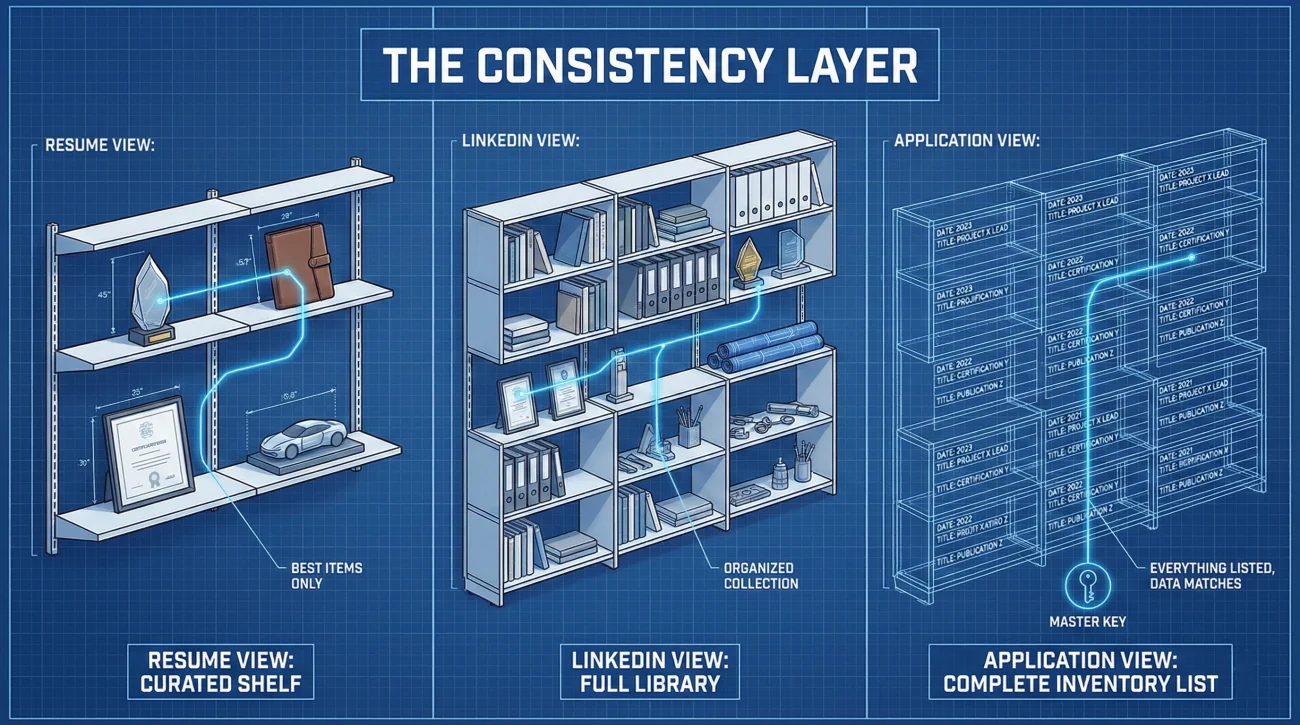
This is the missing piece in most “too many jobs” articles: The resume is not the only document. Recruiters will compare your resume to LinkedIn. Many employers use third party verification or ask for employment history directly in their systems. If your story shifts, it creates friction you did not need.
Here is the approach that keeps you calm:
- Resume: Curated, triage based, focused on fit and outcomes.
- LinkedIn: Slightly fuller than the resume, but still readable. If you list every micro role, keep descriptions short.
- Application form: Complete, accurate, consistent dates. Use a prepared timeline so you never guess.
When a candidate does not prepare this, you see accidental inconsistencies: a month off here, a title variation there, a contract listed as full time somewhere else. Those are the little things that can trigger extra questions.
– Employer / Umbrella Company:
– Client or Project (if contract):
– Title Used On Resume:
– Title Used On Application Form (if different):
– Start Date / End Date (Month, Year):
– Reason For Leaving (Neutral, 6 to 10 words):
– One Proof Marker (Result, Project Delivered, Scope):
If you keep that timeline in a note on your phone, you stop making “date math” mistakes under pressure.
A Practical Editing Pass That Shrinks The Page Without Looking Like You Shrunk It
When someone says “I have too many jobs,” the resume usually has three hidden space leaks: duplicated bullets, overly detailed older roles, and inconsistent job density (some roles have five bullets, some have one, some have a paragraph).
Here is the editing pass I recommend. It is boring, and it works.
- Step 1: Cap most roles at 2 to 3 bullets. Keep 4 bullets only for your top 1 to 2 “Keep” roles.
- Step 2: Replace task bullets with outcome bullets. If two roles have the same task, only one role should say it.
- Step 3: Compress older roles into one line each or an “Additional Experience” block if you truly need them.
- Step 4: Add one stability signal near the top. It can be tenure, promotion, repeat contracts, or scope growth.
💡 Pro Tip: If you are worried that fewer roles makes you look less experienced, remember this: Recruiters value clarity more than completeness. A clean page gets read. A cluttered page gets skimmed and judged.
Final: A Shorter Resume Is Not A Smaller Career
When a resume looks like “too many jobs,” the fix is rarely to defend yourself. The fix is to curate. Keep the roles that prove fit, merge the roles that repeat, and hide the roles that add noise while staying consistent on forms and timelines.
If you do that, your history stops looking like instability and starts looking like a professional who can deliver across environments, which is exactly what most hiring teams want during uncertainty. That is the heart of too many jobs on resume: A calm presentation of a complicated path.
❓ FAQ
🧭 How many jobs should I list if I have changed roles often?
There is no magic number. Your resume should list enough roles to prove fit for the job you want next, then stop. If additional roles do not add a new proof point, merge or hide them and keep a private timeline for application forms.
🧩 Should you remove short term jobs from resume if they were legitimate?
Yes, sometimes. Legitimate does not always mean useful. If the role is short, not relevant, and contains no unique achievement, it often creates more noise than value on the resume. Just make sure you can still list it accurately on forms if asked.
🛠️ How do I merge multiple roles on resume without looking like I am hiding something?
Use transparent structure. If roles were within one employer, list the company once and show titles underneath with dates. If roles were contracts, list the umbrella employer and add “Selected Projects.” Avoid merging across different employers into one entry.
📎 What if my LinkedIn has more jobs than my resume?
That is normal. LinkedIn can be a fuller record, while the resume is a curated pitch. The key is consistency in dates, titles (or explainable variations), and the overall timeline. A prepared private timeline keeps you from guessing.
🔍 Will a background check expose jobs I left off my resume?
Potentially, depending on the employer and what they verify. The safe approach is to treat the resume as curated, but keep your full employment record accurate in applications and be ready to explain any trimmed roles calmly if asked.
⚠️ Disclaimer: ResumeSolving provides resume, cover letter, job search communication, and career transition guidance for informational purposes only. Hiring practices vary by employer, role, location, industry, and individual circumstances. We do not guarantee interviews, job offers, ATS results, or other outcomes. Verify employer requirements directly and follow applicable laws and workplace policies. For sensitive situations, use only information you are comfortable disclosing and keep all statements accurate.