- If your internal moves read like “three jobs in two years,” recruiters will assume instability even when you never left the company.
- Use one of two display formats: Nested Roles (best for clear progression) or Consolidated Timeline (best for messy org changes).
- Avoid the three killers: Breaking the employer line, duplicate date ranges, and vague titles that hide what actually changed.
Why Internal Moves Get Misread In The First Place
I have watched this happen in real hiring rooms: A candidate has a solid five year run at one company, moved teams twice, and got promoted once. They should look stable. Instead, their resume looks like three separate jobs and a recruiter quietly files them into the “might leave again” pile.
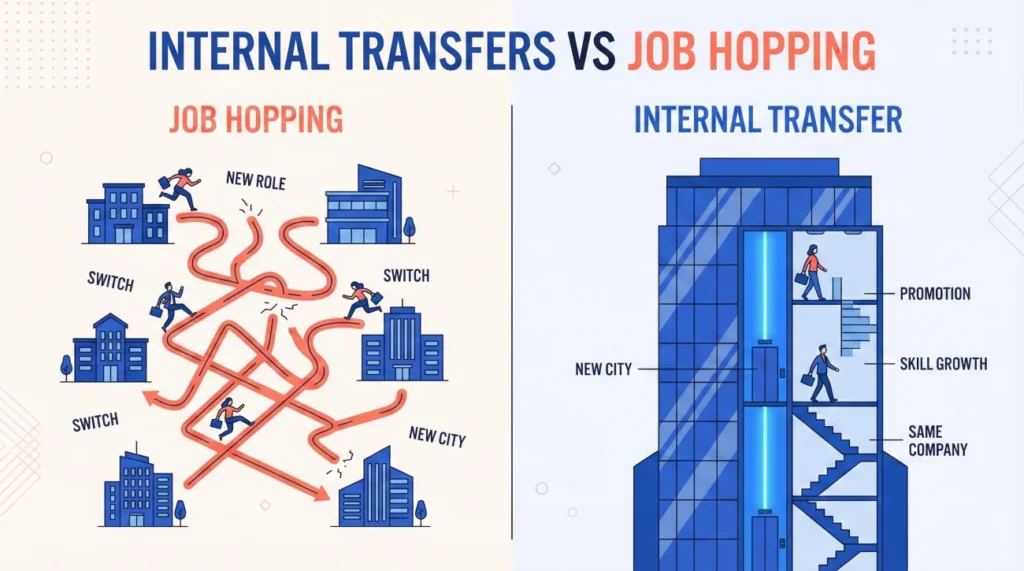
The problem is not the moves. It is the display. When the timeline is hard to parse, the brain uses the simplest shortcut: “Many changes equals job hopping.” That is exactly where internal transfers vs job hopping becomes a formatting problem, not a career problem.
Key Point: Recruiters do not penalize internal mobility. They penalize ambiguity. Your job is to make the timeline effortless to decode.
One of my colleagues, Yoshie, told me she can usually spot this in seconds. If she has to re-read the dates twice, she starts wondering what else is hidden. That is not “fair,” but it is real. And the fix is practical.
What Recruiters Are Actually Scanning For When They See Multiple Roles

Most recruiters scan Experience the same way: Company names first, then titles, then date continuity, then bullets. They are trying to answer four silent questions:
- Is this one employer or many employers?
- Is the timeline continuous, or does it look choppy?
- Do the changes signal growth, or do they look like constant resets?
- Is there a simple story, or do I need to do math?
When internal moves look like job hopping, it is usually because the resume forces the reader to do math. Here are the common triggers I see:
- ⚠️ The company name repeats three times in a row, with no visual cue that it is the same employer.
- ⚠️ Titles are listed, but dates are inconsistent or duplicated, so the timeline feels unreliable.
- ⚠️ A lateral move looks like a reset because the bullets do not show progression.
- ⚠️ A reorg changes the org chart, but the resume does not clarify scope, so it reads like role churn.
💡 Pro Tip: Your goal is “one employer, one storyline.” You can have multiple roles, but you cannot have multiple interpretations.
The Two Resume Display Formats That Prevent Confusion
For most candidates, you only need one of two formats. Pick the one that matches how clean your internal story is.
| Format | Best When | Risk It Reduces |
|---|---|---|
| Nested Roles Under One Employer | Clear promotions, clear role changes, clean dates | Mistaken “multiple employers” impression |
| Consolidated Timeline With Highlighted Promotions | Reorgs, lateral moves, title changes that do not map neatly | Date confusion and “role churn” impression |
Most generic advice online stops here. What it does not give you is the decision rule. Here is mine from screening thousands of resumes with internal mobility:
[If The Story Is Clean] Use Nested Roles. [If The Story Is Messy] Use Consolidated Timeline.
“Messy” is not an insult. Messy means: reorgs, matrix reporting changes, lateral transfers, title changes that lag behind responsibilities, or multiple moves in a short window that were normal inside the company but look suspicious outside it.
Format 1: Nested Roles Under One Employer
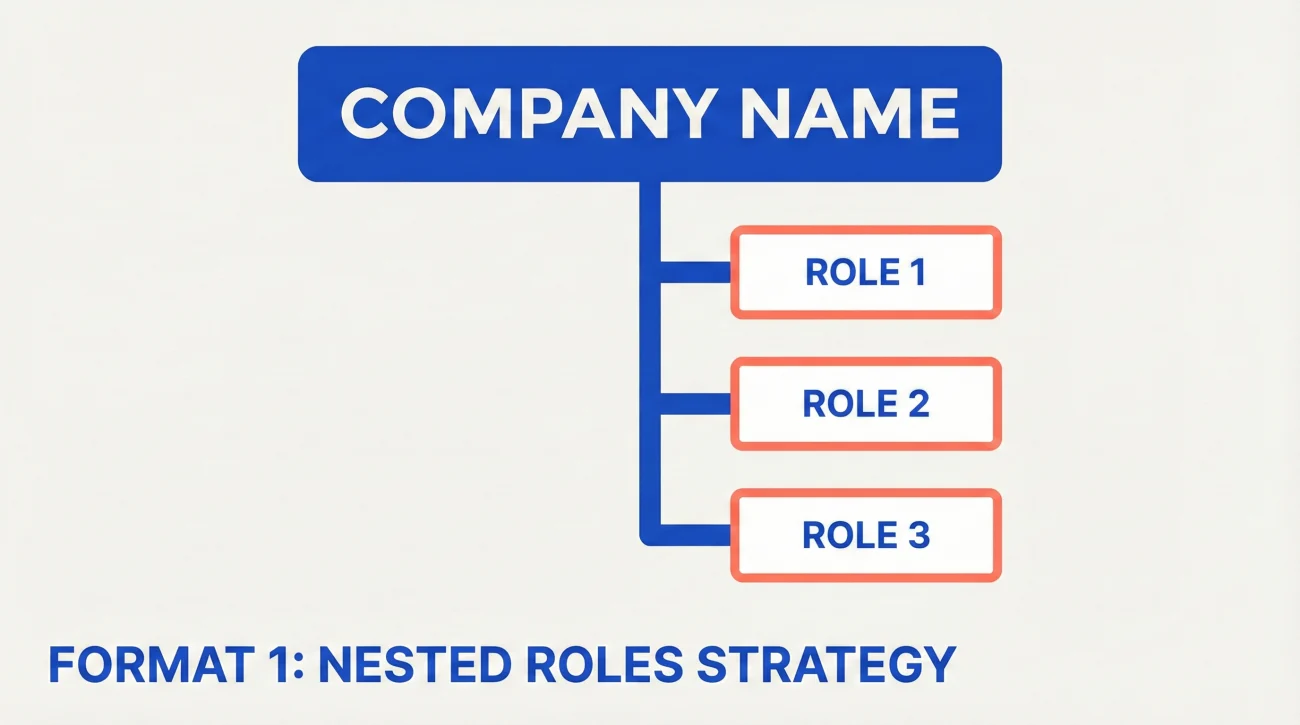
This is the cleanest visual for internal growth. You show the company once, then list titles beneath it with their dates. This tells the reader, instantly: “Same employer, evolving scope.”
When I coached Ken, a data analyst who moved from Analytics to RevOps, his first resume repeated the company line twice. It looked like he left and came back. We nested the roles and the confusion disappeared.
Senior Revenue Operations Analyst | Mar 2023 – Present
– Built forecasting model that reduced variance by 18% across three quarters
– Partnered with Sales Ops and Finance to align pipeline definitions across teamsRevenue Operations Analyst | Jun 2021 – Feb 2023
– Standardized CRM hygiene workflow, improving lead-to-opportunity conversion by 9%
– Created weekly KPI dashboard used by VP Sales and regional managers
Two details make this work:
- The company appears once. That alone kills the “three employers” misread.
- The bullets show increasing scope, not just different tasks.
⚠️ Warning: If you have three moves in 18 months and they were all lateral transfers, nested roles can still look like churn. That is when format 2 usually wins.
Format 2: Consolidated Timeline With Promotion Signals
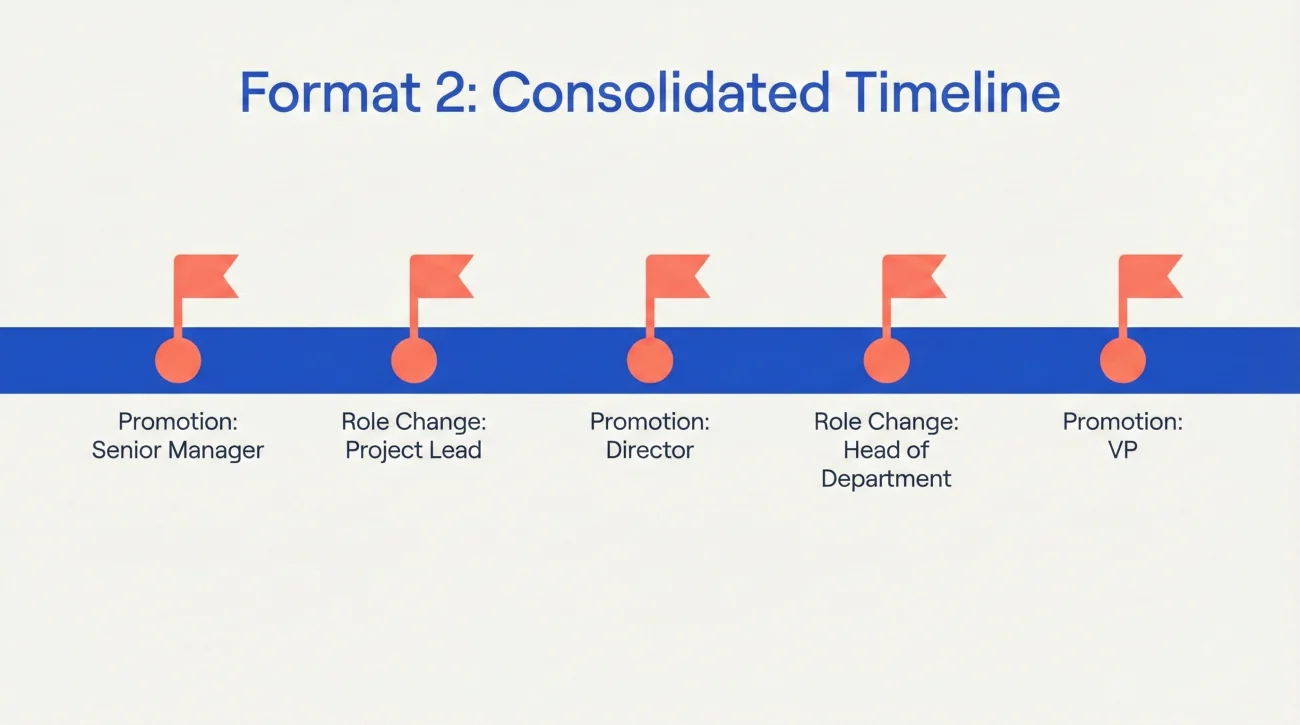
This format is underrated, especially for candidates whose internal mobility was driven by reorgs or business shifts. Instead of making the reader follow multiple date ranges, you show one continuous tenure and highlight the key changes inside it.
A friend of mine, Elise, lived through two reorganizations in one year. Her title stayed the same, but her team, stakeholders, and KPIs changed completely. Listing “the same title” three times would have looked absurd. Consolidating let her show continuity and still prove growth.
Product Operations Lead | Jan 2021 – Present
– Expanded scope after internal transfer into Product org; became primary ops partner for two product lines
– Took on launch readiness ownership after reorg, reducing release delays from 6 weeks to 2 weeks
– Promoted into lead role in 2023; managed roadmap intake process across Product and Support
Notice what this does: It removes date math. The reader gets one story: “Stayed, adapted, grew.”
When candidates ask me whether this harms ATS, my answer is: The ATS does not need your org chart. The recruiter needs your clarity. If you are worried, you can add a short “promotion note” line, but keep it human.
Here is where to naturally use promotion resume format without turning your resume into a timeline spreadsheet: One continuous tenure, then one line that marks the step up, then bullets that prove it.
How To Make An Internal Transfer Read Like Growth, Not Escape
Recruiters do not mind internal transfers. What they mind is a pattern that looks like you keep moving away from problems.
When an internal transfer is healthy, it usually has at least one of these signals:
- ✅ The move matches a business need: New org, new product line, new region.
- ✅ The move expands scope: Bigger budget, bigger stakeholders, higher impact.
- ✅ The move is framed as alignment: Skills to business priority, not personality conflict.
When it gets misread as job hopping, the resume often accidentally signals the opposite:
- ❌ Vague titles: “Specialist” becomes “Specialist,” with no visible change in scope.
- ❌ Bullets reset to basics: Each role starts over with generic duties.
- ❌ No reason clue: The reader cannot tell why you moved, so they invent a reason.
💡 Pro Tip: You do not need to explain the transfer. You need to show the consequence of the transfer: New scope, new impact, new trust.
That is the practical meaning of internal transfers resume done well: The resume makes the transfer feel inevitable, not reactive.
The Do Not Do List That Creates “Job Hopper” Vibes By Accident
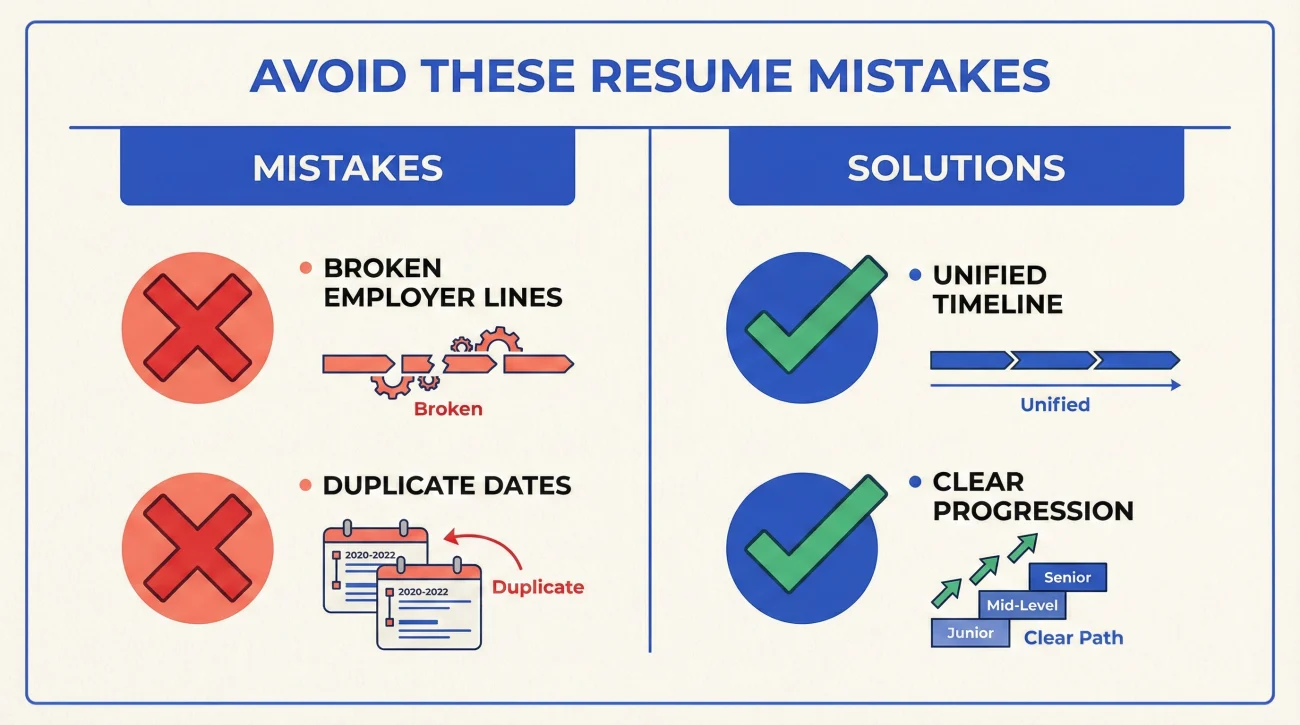
I want to be blunt here because these mistakes are common and expensive.
- 🚫 Break the employer line into multiple “companies” just to highlight moves.
- 🚫 Duplicate date ranges in a way that forces the reader to guess what overlapped.
- 🚫 Use internal-only titles that mean nothing outside your org without a clarifying cue.
- 🚫 Write three roles with identical bullets. It makes the moves look political, not professional.
- 🚫 Turn every internal change into a new “job block” if the work is basically the same.
One candidate I screened, Maxwell, did the duplicate date thing. He had “Jan 2022 – Present” on two roles at the same company, and the bullets did not clarify a transition. The hiring manager’s immediate question was not about his skills. It was: “Is he exaggerating?”
❌ Note: A confusing timeline can trigger integrity doubts even when you did nothing wrong.
How Many Roles Should You Show When You Have A Long Tenure
This is the part most templates get wrong. They encourage you to show everything. In reality, you should show what supports the role you want next.
As a rule of thumb I use in resume reviews:
- 📌 Show the most recent role in full detail.
- 📌 Show the previous role if it demonstrates progression or a key skill you still use.
- 📌 Collapse earlier roles into one line if they are no longer relevant.
This keeps the resume readable, and it reduces the “endless internal movement” impression.
If you are specifically worried about how a recruiter reads many titles at one employer, remember this: The recruiter is not counting titles. They are judging stability. A clean display plus a clear progression story looks stable.
That is also why multiple roles same company resume needs a filter, not just a format.
A Real Hiring Room Moment: How This Gets Interpreted
Here is the kind of conversation that happens when your resume is unclear. This is not an exaggeration, it is a pattern I have heard.
“I like her background, but I cannot tell if she has been in three different companies or just moved internally.”
“She says it is the same company, but the dates look weird.”
“If we have to decode it, we will probably skip it and move to the next.”
That last line is the quiet killer. Recruiters are not trying to be cruel. They are trying to process volume. Clarity is kindness to the reader.
A Quick Self Check Before You Hit Submit
Before you submit, do a ten second scan like a recruiter:
- 🔎 Can I see “one employer” instantly?
- 🔎 Do the dates read as one continuous timeline?
- 🔎 Do the bullets show growth, not just movement?
- 🔎 Would a stranger understand my titles without my org context?
💡 Pro Tip: If you need to explain the formatting in an interview, the formatting is doing too much work.
Final: Make The Timeline So Clear That Nobody Argues With It
If you have internal mobility, you do not need to defend it. You need to display it in a way that reads as stable and intentional. Pick a format that matches your story, remove date math, and let your bullets prove increasing trust and scope.
When you handle internal transfers vs job hopping this way, the resume stops looking like a series of exits and starts looking like a single relationship that evolved.
❓ FAQ
🎯 Should I list every internal move if I changed teams often?
No. List the moves that support your next role. Too many internal changes can look like churn even when they were normal. Use a consolidated timeline if the org story is complex.
🧭 What if my title never changed but my responsibilities did?
Use the consolidated timeline and let your bullets show the scope shift. You can add one short line that signals the internal transfer or reorg, but keep it factual.
🧩 Is it okay to show overlapping dates for an internal transition?
Only if the overlap is real and brief, and your formatting makes it obvious what overlapped. If the overlap creates confusion, remove the overlap and show the clean transition month to month.
🚀 How do I prove growth if a move was lateral?
Do not force a “promotion” story. Prove growth through bigger stakeholders, bigger outcomes, and increased ownership. Lateral moves can still be growth when the impact expands.
🧾 Will ATS misread multiple titles under one company?
Most ATS systems can parse nested titles, but the bigger risk is recruiter confusion. Choose the clearest format for humans first, then keep the structure consistent and easy to scan.
⚠️ Disclaimer: ResumeSolving provides resume, cover letter, job search communication, and career transition guidance for informational purposes only. Hiring practices vary by employer, role, location, industry, and individual circumstances. We do not guarantee interviews, job offers, ATS results, or other outcomes. Verify employer requirements directly and follow applicable laws and workplace policies. For sensitive situations, use only information you are comfortable disclosing and keep all statements accurate.