- You do not need to explain every short stint: You need a clean pattern and one stability signal.
- Pick the listing method that matches your situation: Repeated role, mixed roles, contract umbrella, or a pivot phase.
- Use these six examples as your base: Then swap the labels, not your dignity.
Why Multiple Short Stints Look Worse On Paper Than They Often Are
If you are searching for a multiple short jobs resume example, you are usually not trying to “hide” anything. You are trying to stop your work history from reading like a random walk.
I have worked with candidates whose short stints were completely rational: A startup ran out of runway, a team was reorganized twice in one year, an agency moved them between clients, a manager left and the role quietly collapsed. The problem is that recruiters do not live inside your story. They see a pattern, and patterns are how risk is assessed in the first pass.
One recruiter I trust phrased it bluntly in a call: “I am not judging your character. I am scanning for how predictable your next six months will be.” That is the real game.
Key Point: Your goal is not to defend short stints. Your goal is to make them read like a coherent sequence with clear scope and a closed chapter.
This article gives you six clean patterns you can copy, then tailor. Each one includes a short note on why it works, so you are not guessing what a reader is reacting to.
What Recruiters Actually Worry About When They See Many Short Jobs
Most resumes with short stints trigger the same three questions, even when the candidate did nothing wrong:
- 🧩 Is this a “role ended naturally” pattern, or a “could not stick” pattern?
- 🧭 Are the moves directional, or scattered?
- 🧱 Does the resume show any “closure” signal, or does it read like you are still in flux?
Here is the mistake I see all the time: People try to answer those questions with emotional context. They add explanations that sound like a conversation, not a document. It often backfires because it introduces new uncertainty.
⚠️ Warning: If your short-stint explanations sound like ongoing instability, they can create more doubt than the short stints themselves.
| What You Did | What A Recruiter Might Infer | What To Show Instead |
|---|---|---|
| Listed six jobs with wildly different titles | Scatter, no direction | A consistent headline and aligned bullets |
| Added a long explanation under each role | Defensive, complicated | One neutral label, once per pattern |
| Used inconsistent date formats | Messy, hard to parse | Same format everywhere, month + year |
| Left short stints with zero outcomes | Low impact | One measurable result per stint |
This is why examples matter. When you see a clean structure, you can feel the difference immediately.
Make One Decision Before You Rewrite Anything: What Pattern Are You In
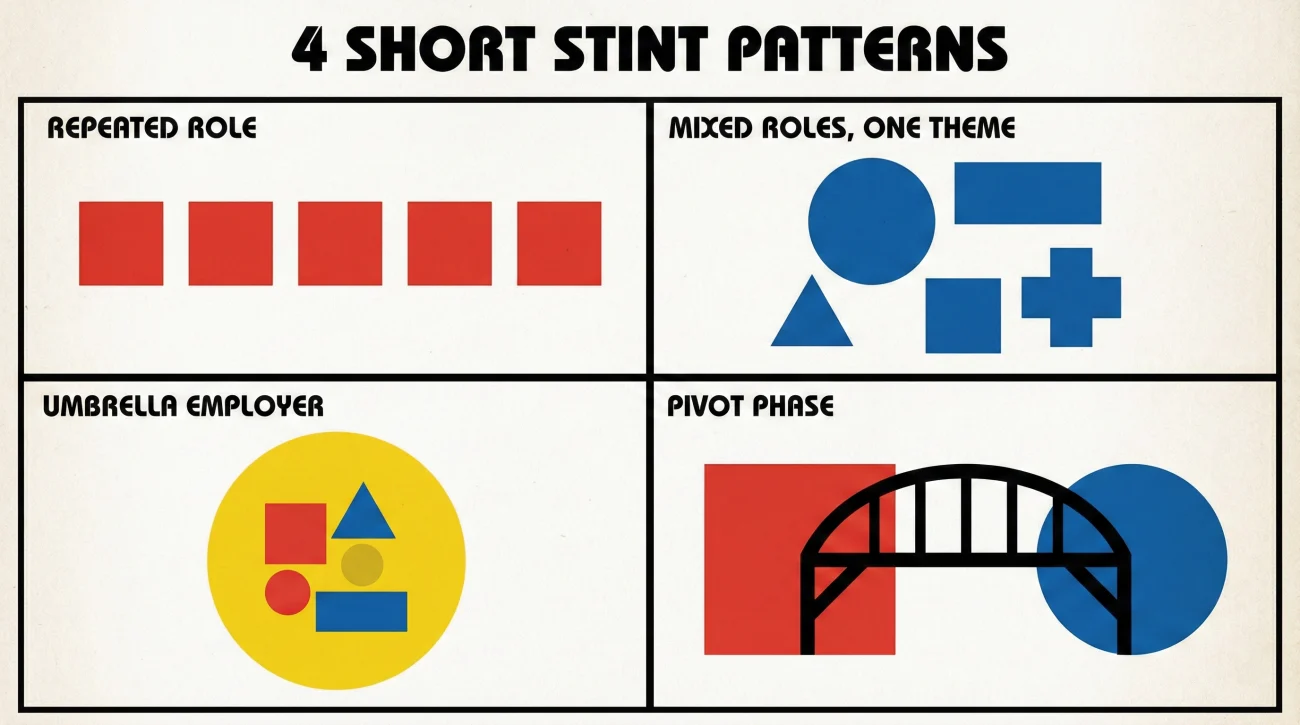
Most advice online skips the step that actually reduces stress: Decide your pattern first, then write the entries to match it. This is where a good resume example multiple short jobs helps, because it gives your brain a template for “normal.”
In my notes, I use four buckets. You only need one of them:
- Repeated role, different companies: Same job, multiple short stops.
- Mixed roles, one theme: Titles differ, but the work has a consistent core.
- Umbrella employer: Agency or consulting firm with multiple client assignments.
- Pivot phase: A short experimental period during a transition.
Pick the bucket that fits best, even if it is not perfect. Recruiters do the same thing, except they do it fast and without your context.
[Role Theme] + [Context Label] + [Outcome Proof]
This formula is the backbone of every example below. It is also the easiest way to produce clean short tenure resume wording without sounding defensive.
Six Clean Examples You Can Copy and Adjust
Choose the pattern that matches your situation, then keep the structure consistent across the page. The goal is to make the timeline easy to scan and the outcome easy to trust.
Example 1: Same Role Repeated, Make It Look Intentional
I see this most with Customer Success, SDR, Design, and Ops roles in volatile companies. A candidate named Zoe had three “same job, new logo” stints in 18 months. Her resume looked like churn until we made the pattern obvious: She was doing the same work in similar environments.
• Managed renewals and expansion for SMB portfolios ($450K – $700K ARR)
• Standardized onboarding playbooks, reducing time-to-value by 18%
• Short-term tenures driven by restructuring and org changes (team-level)
Why this works: The phrase “Various SaaS Companies” is not a trick. It is a clarity move. It signals that the pattern is the point, not the logos. The stability signal is “team-level,” which keeps blame out of it while still explaining the churn.
💡 Pro Tip: If you use a grouped headline like this, your bullets must be role-specific and measurable, or it will look like you are hiding something.
Example 2: Different Titles, One Theme, Lead With The Theme
Not every short stint is “job hopping.” Sometimes it is a string of adjacent roles around one skill. I helped a colleague’s friend, Mohamed, who had: Analyst, Ops Coordinator, Project Specialist. The titles looked scattered. The actual work was process cleanup and stakeholder wrangling.
Project Specialist | Northbridge Retail | Feb 2024 – Sep 2024
• Owned weekly KPI reporting and backlog triage for 3 internal teams
• Built intake workflow that cut request turnaround time by 22%
Operations Coordinator | Lumen Logistics | May 2023 – Jan 2024
• Streamlined vendor onboarding checklist and reduced errors by 30%
Analyst | Orchard Services | Aug 2022 – Apr 2023
• Maintained dashboards and flagged variance patterns for leadership reviews
Why this works: The top line gives your reader a map. Without it, the reader creates their own map, and it is rarely generous. This is a strong resume with short-term jobs example when your titles are “close enough” but not identical.
Notice what is missing: No apology. No drama. Just an organizing frame and outcomes.
Example 3: The Umbrella Employer, Stop Making Client Moves Look Like Quitting
If you were staffed through an agency or consulting firm, listing every client as if you “left” each one is the fastest way to look like a job hopper.
Client: Blue Moon Bank | Jun 2024 – Nov 2024
• Supported requirements gathering for digital onboarding refresh
• Coordinated UAT documentation and issue triage across 4 squads
Client: Finwell Insurance | Mar 2023 – May 2024
• Built weekly reporting cadence and reduced rework in handoffs
Why this works: The employer story stays stable even if the client story changes. You are not hopping employers. You are being assigned work. This is a clean answer to how to list short-term jobs on resume when the “jobs” were actually assignments.
“I did not quit three times. My staffing firm moved me as projects ended.”
💡 Pro Tip: Keep client bullets tight and outcome-based. If you over-explain the project context, it starts to read like padding.
Example 4: Senior Roles, Short Stints Need One Extra Stability Cue
Senior roles are judged differently. A short stint as a Director can read like a political blowup, even when it was simply a mismatch or a re-org. I worked with a VP-level candidate, Morgan, who had two sub-10-month roles. The fix was not a long story. The fix was a neutral cue that the role had a bounded scope.
• Brought in to rebuild paid acquisition after leadership change
• Reset channel mix and lowered CAC by 14% over two quarters
• Role ended after restructuring consolidated growth under product org
Why this works: “Brought in to rebuild” implies a mission. “Role ended after restructuring” is a closure signal. Together, they turn a short stint into a contained project, not a personal failure.
⚠️ Warning: At senior levels, vague bullets like “Led strategy” will not save you. You need one concrete outcome per short stint.
Example 5: Early Career, Show Growth Instead Of Just Movement
Early career short stints are common, but they still need structure. A candidate named Elisa had internships and short roles that were all real, but the resume felt like a collage. We used a simple principle: Every entry should answer “What did you learn to do reliably?”
• Built weekly content calendar and maintained publishing cadence
• Produced 18 short-form assets and improved click-through by 9%
Social Media Intern | Lark Apparel | Jan 2024 – May 2024
• Supported community management and tracked engagement trends
Campus Marketing Rep (Part-Time) | Sep 2023 – Dec 2023
• Coordinated 3 events and grew newsletter signups by 320 students
Why this works: It reads like progression in responsibility, even if the time windows are small. This is the kind of job hopper resume example that still feels safe because it shows steady capability building.
💡 Pro Tip: For early career, consistency in formatting matters more than you think. Keep the same bullet structure everywhere.
Example 6: Pivot Phase, Make The Experiment Explicit Without Sounding Lost
Career switches often create short stints because you are testing fit. The danger is sounding like you are still undecided. I saw this with a friend of mine, Andrea, who moved from admin roles into data. She had a short contract, a short internship, and a short analyst role. The resume needed one sentence that made the pivot feel deliberate.
Junior Analyst (Contract) | Ridgeway Health | Apr 2024 – Sep 2024
• Cleaned operational datasets and built recurring weekly reporting
• Reduced manual reporting time by 6 hours per week
Analytics Intern | CityWorks Lab | Jan 2024 – Mar 2024
• Supported survey analysis and summarized findings for stakeholders
Certificate Projects | 2023
• Built portfolio dashboards and documented methods and assumptions
Why this works: The heading “Data Analytics Transition” makes the short stints feel like steps, not flailing. It also prevents a reader from trying to force a single linear narrative that does not exist.
💡 Pro Tip: If you use a transition heading, keep it factual. Do not use emotional labels like “Finding my passion.”
The Do Not Do List: What Turns Short Stints Into A Red Flag
This is the part most articles bury under generic advice. These are the lines that make recruiters uneasy because they introduce more uncertainty than the dates do.
- ❌ “Left due to toxic culture”: It sounds like conflict, even if true.
- ❌ “It was not a good fit”: It feels subjective and unresolved.
- ❌ “Personal reasons”: It is vague and invites assumptions.
- ❌ “Company was chaotic”: It reads like blame and drama.
- ❌ “Exploring options”: It implies you are still exploring.
What to do instead is boring on purpose: Use neutral labels like “restructuring,” “project ended,” “role consolidated,” or “contract completed.” Then anchor it with one measurable outcome so the reader has something solid to hold on to.
Final: Make The Pattern Easy To Read, Then Let Your Results Do The Talking
Multiple short stints do not automatically mean risk. They mean your resume has to do one extra job: It has to make the sequence feel coherent. Pick the pattern that best fits, keep your labels neutral, and show one outcome per stint so the reader has proof you deliver.
When you write it this way, a multiple short jobs resume example stops being a damage-control trick and becomes a clean, predictable story a recruiter can follow in a quick scan.
❓FAQ
🧠 Should I hide months and only show years if I have many short jobs?
Usually no. If your timeline is already tight, removing months often makes it look like you are trying to blur the story. A cleaner move is consistent month + year everywhere, plus one neutral stability label for the pattern.
🧩 Do I need to explain every short stint on the resume?
No. You typically need one explanation once per pattern, not a mini explanation under every role. If you explain each one, the resume starts to read like a defense statement.
📌 What if one short job was genuinely a bad fit?
Keep it neutral. Use a closure label that does not invite debate, and move the reader toward what you delivered. If asked later, you can give a calm interview answer, but the resume itself should stay factual.
🧾 Should I group multiple companies under one headline like “Various Companies”?
Only when the roles are truly the same and your bullets stay specific. If your responsibilities varied a lot, use a theme heading instead, then list each role underneath so the reader can still follow the timeline.
🚀 How many short stints is “too many” before it becomes a problem?
There is no magic number. The tipping point is readability and predictability. If the reader can see a clear pattern and you show outcomes, even multiple short stints can read as stable.
⚠️ Disclaimer: ResumeSolving provides resume, cover letter, job search communication, and career transition guidance for informational purposes only. Hiring practices vary by employer, role, location, industry, and individual circumstances. We do not guarantee interviews, job offers, ATS results, or other outcomes. Verify employer requirements directly and follow applicable laws and workplace policies. For sensitive situations, use only information you are comfortable disclosing and keep all statements accurate.