- If your verbs feel “bigger” than your job title, the bullet reads like a performance, not proof.
- Pick verbs by scope: Support, Own, Lead, and Change. Then match the verb to a concrete object.
- Use the Credibility Test: Could you explain “How, With what, And with which constraints” in 20 seconds?
Why Action Verbs Backfire More Often Than People Admit
I once reviewed a resume from a candidate named Verity who had done solid work as a marketing coordinator. Her bullets looked “powerful” on paper, but something felt off. Almost every line started with a verb like “Spearheaded,” “Orchestrated,” or “Drove.” The problem was not her effort. The problem was the implied scope.
When the hiring manager asked follow-ups, Verity could explain the work clearly, but the verbs had promised a bigger seat at the table than she actually had. That mismatch is how resume bullet point action verbs turn into a credibility issue instead of a strength.
In this guide, I am not giving you a 300-word list to copy. I am giving you a way to choose verbs that sound true for your level, your role, and your real proof.
The Real Problem Is Not Weak Verbs, It Is Unmatched Scope
Most people think their resume is “not strong enough,” so they upgrade verbs. But verbs do not live alone. A verb is a promise about scope, ownership, and decision power.
Here is what makes recruiters squint:
- The verb implies authority you did not have (example: “Directed” when you were executing a plan).
- The verb implies impact you did not show (example: “Transformed” with no before and after).
- The verb implies strategic work but the object is small (example: “Spearheaded weekly report updates”).
Key Point: The fastest way to sound credible is not to “power up” the verb. It is to match the verb to your scope and then anchor it to a real object.
My colleague Marcus (an engineering manager) calls this the “verb to chair ratio.” If your verb sounds like it belongs to a bigger chair than you sat in, the reader notices even if they cannot explain why.
The Credibility Test: A 20-Second Check Before You Keep Any Verb
Before you choose from a action verbs list for resume, run each bullet through three quick checks. If you fail one, downgrade the verb or rewrite the object.
| Test | Question to Ask Yourself | If You Hesitate, Do This |
|---|---|---|
| Ownership Test | Could I say “I owned this” without clarifying who decided what? | Switch to a support or execution verb and name your role in the process. |
| Mechanism Test | Can I explain how I did it in one breath (tools, steps, constraints)? | Add the mechanism: the system, method, workflow, or audience you worked through. |
| Scope Test | Does this verb match my level (IC vs lead vs manager) in this specific org? | Use a verb ladder: Support, Own, Lead, Change. Pick the rung you actually did. |
💡 Pro Tip: If you are worried your verbs sound “too small,” keep the verb honest and upgrade the object. “Built monthly churn report in Looker and briefed GTM leads” reads stronger than “Spearheaded reporting.”
The Verb Ladder: Support, Own, Lead, Change
This is the missing piece in most lists of resume action verbs. A verb is not “strong” by default. It is strong when it accurately signals your rung on the ladder.

Rung 1: Support (You helped move it forward)
Use these when you contributed to a deliverable, improved a workflow, or enabled someone else’s decision.
- Supported, Assisted, Coordinated, Prepared, Maintained, Updated, Scheduled, Resolved, Documented, Triaged
Rung 2: Own (You were accountable for the output)
Use these when the result depended on you and you can explain your decisions, not just tasks.
- Owned, Built, Delivered, Implemented, Produced, Managed (small scope), Administered, Executed (with specifics), Monitored
Rung 3: Lead (You guided people or cross-functional execution)
Use these when you coordinated multiple stakeholders, set direction for a workstream, or unblocked others.
- Led, Guided, Drove (with constraints), Aligned, Facilitated (with specifics), Mentored, Delegated, Negotiated
Rung 4: Change (You shifted a system, process, or outcomes)
Use these when you can point to a before and after, even if you do not include numbers.
- Redesigned, Rebuilt, Reduced, Accelerated, Standardized, Automated, Consolidated, Simplified, Recovered, Stabilized
⚠️ Warning: “Spearheaded,” “Orchestrated,” and “Transformed” are not forbidden. They are just expensive verbs. If you use them, your object and mechanism must be specific enough that a recruiter can picture the work.
What Sounds Inflated: Common Verbs and Better Replacements
Below are swaps I use a lot when a resume reads like it was written by a thesaurus instead of a person. These are not “weaker” verbs. They are more believable, which is the point.
| If You Wrote | It Often Implies | Try Instead |
|---|---|---|
| Spearheaded | Executive-level ownership | Led, Owned, Launched, Coordinated (choose the true rung) |
| Orchestrated | Complex multi-team control | Coordinated, Aligned, Ran, Delivered |
| Leveraged | Vague “buzzword energy” | Used, Applied, Built with, Implemented using |
| Optimized | Implied measurable improvement | Reduced, Streamlined, Simplified, Improved (name what changed) |
| Drove | Ownership without proof | Led, Advanced, Increased, Delivered (attach mechanism) |
| Executed | Sounds generic without object | Delivered, Implemented, Ran, Completed (name the deliverable) |
Notice the pattern: the replacement is not just a different verb. It forces you to choose scope. That is why it reads more human.
A Simple Workflow: Write It Plain, Then Choose the Verb
A candidate named Merrison once told me, “My bullet points sound fake the moment I start with verbs.” We fixed it by writing the sentence like a text message first, then converting it into a bullet.
“Can I write what I did like I’m explaining it to a friend, then we turn it into a resume line?”
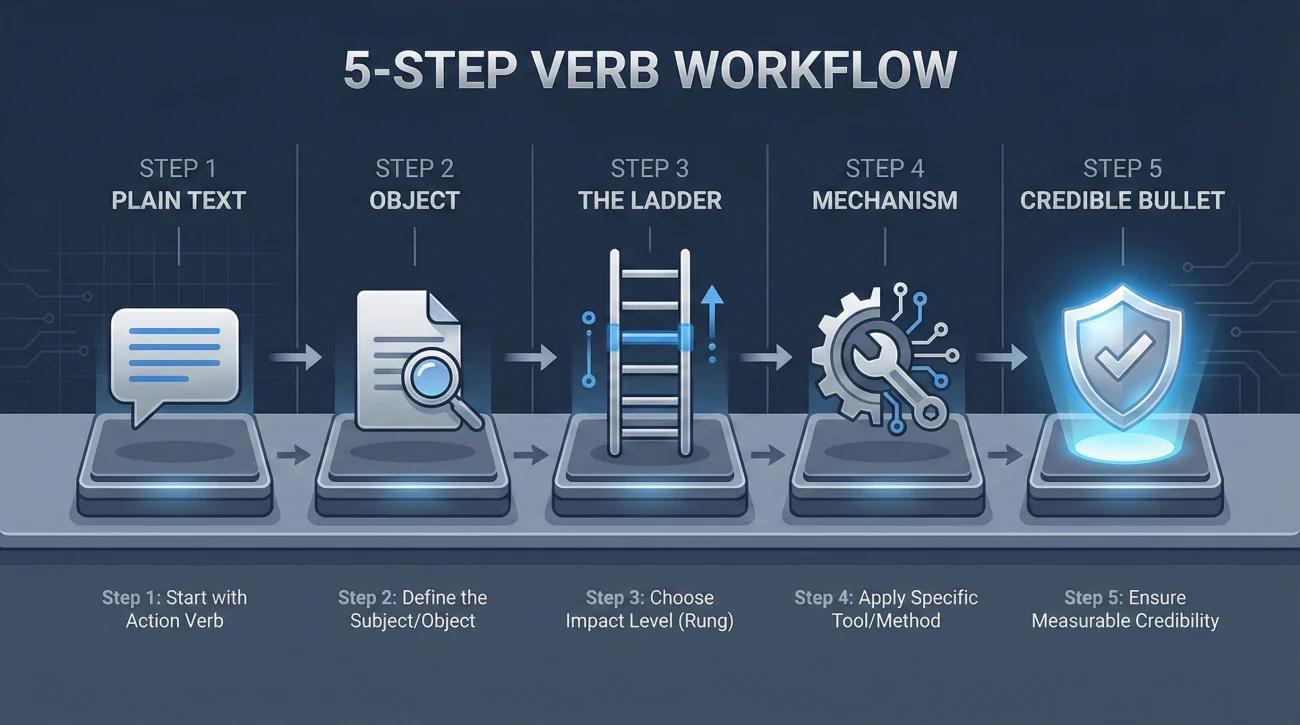
Here is the workflow I use:
- Step 1: Write the plain sentence (no fancy verbs).
- Step 2: Identify the real object (report, process, system, customers, pipeline, queue).
- Step 3: Choose the rung (Support, Own, Lead, Change).
- Step 4: Add mechanism (tool, method, cadence, stakeholder group).
- Step 5: If you cannot explain it fast, downgrade the verb or tighten the object.
❌ Note: Do not pick verbs by vibe. Pick verbs by what you could defend in an interview without backpedaling.
Examples: Credible Bullets Using Strong Verbs Without Sounding Inflated
Below are examples using action verbs for resume bullets in a way that stays believable. I included a mix of roles because verb credibility depends on scope more than industry.
| Before | After |
|---|---|
| Spearheaded the creation of weekly performance dashboards | Built weekly performance dashboards in Looker, standardized definitions, and shared a 5-minute readout with sales leads |
| Drove customer satisfaction improvements | Reduced ticket handoff time by updating macros, triage rules, and escalation steps for the support queue |
| Orchestrated stakeholder alignment across teams | Coordinated weekly handoffs between product and ops, captured blockers, and tracked decisions in a shared doc |
| Optimized email performance | Improved onboarding email CTR by revising subject lines, segment rules, and send timing based on A/B tests |
| Executed marketing campaigns | Delivered two lifecycle campaigns end to end: Brief, build, QA, launch, and post-launch reporting |
| Leveraged data to inform strategy | Used SQL extracts to identify churn drivers and summarized patterns for the retention plan review |
These bullets feel “strong” because the objects are real and the mechanisms are visible. The verb is just the handle.
A Small Do Not Use List (When You Cannot Back It Up)
I am not anti-verb. I am anti-verb-without-receipts. If you cannot explain the mechanism, avoid these because they invite skepticism:
- Transformed (unless you can describe the before and after clearly)
- Revolutionized (almost always reads like marketing copy)
- Orchestrated (use only when you truly controlled complex coordination)
- Spearheaded (use only when you initiated and owned the workstream)
- Leveraged (replace with “Used” plus the tool or method)
If you love one of these words, keep it. Just make sure your bullet can survive one follow-up question without shrinking.
Final
The best bullets do not sound like a poster. They sound like a competent person describing real work with clear objects and believable scope. When you pick verbs by rung, add mechanism, and avoid “expensive verbs” you cannot defend, your resume stops feeling performative and starts feeling trustworthy.
If you want one rule to remember: Choose the verb that matches your chair, then write the object so clearly that the reader can picture it. That is how resume bullet point action verbs become proof, not perfume.
❓ FAQ
🎯 How many different action verbs should I use on one resume?
Aim for variety, but not at the cost of clarity. Repeating a believable verb is better than forcing a fancy synonym that changes your implied scope.
🧩 Is “managed” always a strong verb?
It is strong when it matches your scope. “Managed vendor invoices” is fine for operations. “Managed company strategy” reads inflated unless you can anchor the object and decision power.
🛠️ What if I did not lead anything, only supported?
Support verbs can be excellent if the object is meaningful. “Supported” becomes strong when you add mechanism, constraints, and what your support enabled.
📌 Are “spearheaded” and “orchestrated” ever okay?
Yes, but treat them as high-stakes words. If you use them, make the object specific and be ready to explain how you initiated, owned, and coordinated the work.
🧠 Do I need numbers for action verbs to work?
No. Numbers help, but specificity works too. A bullet can feel real with clear objects, tools, and outcomes even without metrics.
🧾 How do I know if a verb sounds fake?
Run the Mechanism Test: If you cannot explain “how” in 20 seconds, the verb is probably too big or your object is too vague.
⚠️ Disclaimer: ResumeSolving provides resume, cover letter, job search communication, and career transition guidance for informational purposes only. Hiring practices vary by employer, role, location, industry, and individual circumstances. We do not guarantee interviews, job offers, ATS results, or other outcomes. Verify employer requirements directly and follow applicable laws and workplace policies. For sensitive situations, use only information you are comfortable disclosing and keep all statements accurate.