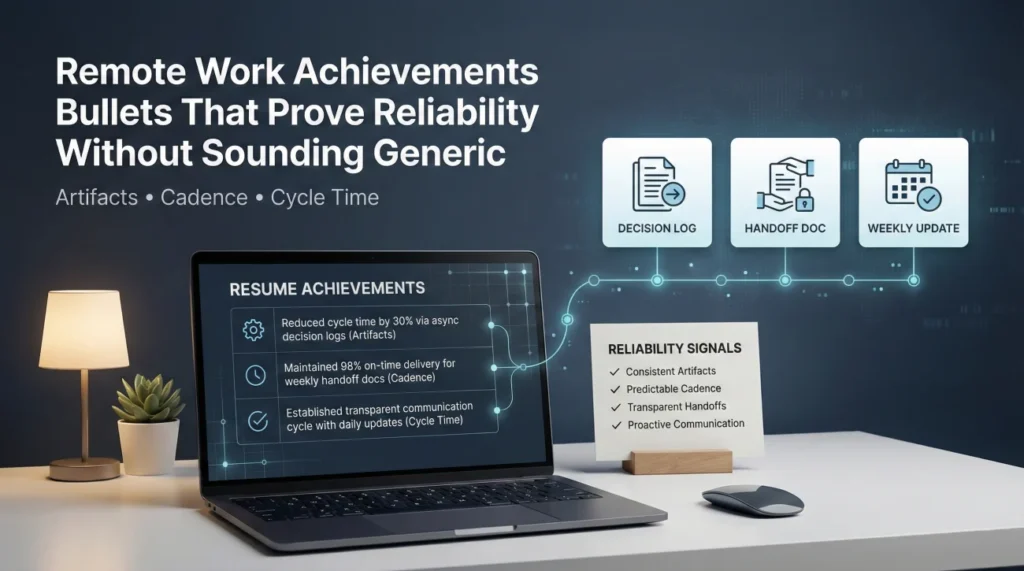
- If your bullets only say “collaborated” and “communicated,” remote recruiters will read you as a risk.
- The strongest remote achievements prove reliability through artifacts, cadence, and cycle time, not hype or buzzwords.
- Use the 6 patterns and 18 examples below to write results that feel real without inventing metrics.
Why Remote Achievements Get Judged Differently
I’ve reviewed a lot of resumes where the candidate was genuinely strong, but their bullets read like they needed constant supervision. In remote hiring, that is the silent dealbreaker. The funny part is: Most of them were reliable in real life. They just never learned how to prove it on paper.
When you write remote work achievements on resume, you are not only describing outcomes. You are answering a remote manager’s private question: “Will I regret hiring this person when nobody is watching?”
A candidate named Judith taught me this the hard way. She led cross functional launches for two years fully remote. Her resume looked polished, but every bullet sounded like a job description. The hiring manager’s feedback was blunt: “I can’t tell what she owned, and I can’t tell how she worked.” We rewrote her bullets around proof artifacts and cycle time. Two weeks later, she got interviews from teams that had ignored her before.
💡 Pro Tip: In remote roles, “reliability” is not a personality trait. It is a set of visible signals you leave behind: updates, handoffs, decision records, and fewer surprises.
The 5 Remote Signals Your Bullets Should Prove
Most articles tell you to “quantify achievements” and “show impact.” True, but remote hiring is picky about what kind of impact. The strongest bullets prove outcomes plus working style signals that reduce risk for a distributed team.
| Remote signal | What it means in plain English | Proof nouns that make it believable |
|---|---|---|
| Clarity | People do not have to chase you for context | weekly update, decision log, PRD, recap, stakeholder brief |
| Cycle time | Work moves without constant meetings | SLA, lead time, turnaround, handoff doc, checklist |
| Quality | Less rework, fewer surprises, fewer urgent escalations | QA plan, test cases, incident review, runbook, acceptance criteria |
| Stakeholder trust | You keep alignment across time zones and functions | stakeholder map, launch notes, comms plan, RACI, approvals |
| Autonomy | You unblock yourself and surface risks early | risk register, mitigation plan, escalation note, dependency tracker |
Notice what is missing: A random list of remote tools. Tools can help, but they are not proof. Proof is the trail of decisions and outputs you leave behind.
What if I genuinely do not have clean metrics?
You can still quantify without inventing numbers. Use counts (stakeholders, regions, requests), cadence (weekly, daily), scope (time zones, channels), and time saved (fewer meetings, faster approvals) as honest proxies.
Six Bullet Patterns That Sound Real in Remote Hiring
Below are six patterns I use when coaching candidates for remote roles. They work because they connect achievement with reliability signals. They also help you avoid generic verbs like “collaborated” that say nothing.
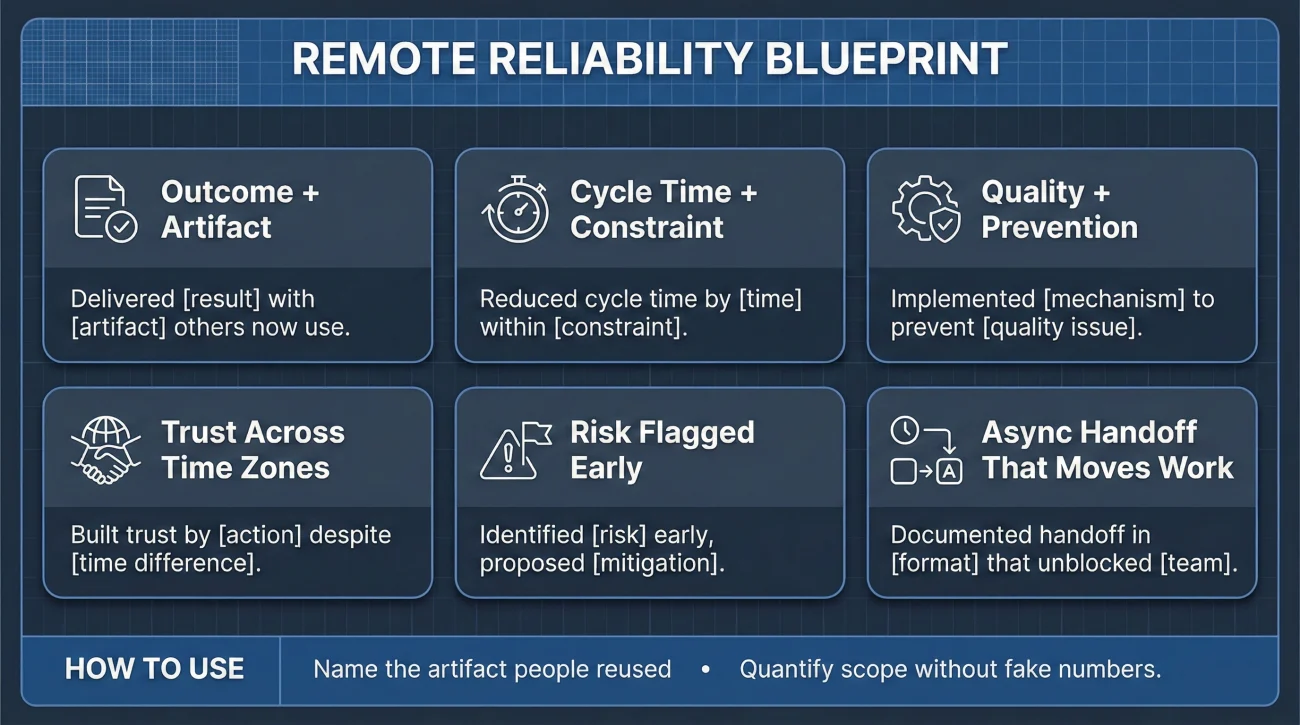
Pattern 1: Outcome plus the artifact that made it repeatable
Remote teams trust what they can reuse. If your bullet includes an artifact, it reads like you built something that survives beyond one heroic week.
[Outcome] + by creating [artifact] that [reduced confusion or rework]
Before: Improved communication across teams.
After: Improved launch alignment by publishing a weekly stakeholder recap and decision log, reducing last minute scope churn.
Pattern 2: Cycle time with a constraint (the part people forget)
Anyone can claim “faster delivery.” A remote manager wants to know: faster under what constraint? Across time zones? With fewer meetings? With fewer handoffs?
[Delivered X] + within [constraint] + by changing [process]
Pattern 3: Quality signal plus the prevention mechanism
Quality bullets are remote gold because they imply fewer interruptions. The key is naming what you put in place, not just saying “high quality.”
[Reduced defects or rework] + by implementing [mechanism] + tied to [standard or criteria]
Pattern 4: Stakeholder trust across time zones
This is where you can quantify without “revenue grew 900%.” Mention how many groups you aligned, how many regions you supported, or how you handled approvals without meeting spam.
[Aligned stakeholders] + across [time zones/functions] + using [cadence and format]
Pattern 5: Autonomy shown through early risk surfacing
In office, you can save yourself with hallway chats. Remote teams do not get that luxury. Showing you surface risk early is a strong reliability marker.
[Prevented issue] + by flagging [risk] early + and driving [mitigation]
Pattern 6: Async handoff that kept work moving
One of my colleagues, Mark, worked on a distributed engineering team where “handoff quality” decided whether your week was calm or miserable. The people who got promoted were not the loudest. They were the ones whose handoffs were usable.
[Kept delivery moving] + by writing [handoff] + that enabled [next person] to act without meetings
⚠️ Warning: Do not force these patterns with fake metrics. If you cannot support a number, replace it with a concrete scope detail: time zones covered, workflow steps removed, number of stakeholders aligned, or cadence maintained.
A Quick List of Proof Nouns That Make Bullets Credible
If you are stuck, do not start with verbs. Start with artifacts. Ask yourself: “What did I leave behind that other people actually used?” Those nouns do half the persuasion for you.
- 🧾 Decision log, trade off notes, project brief, PRD, launch notes
- 🗓 Weekly update, async status recap, stakeholder digest, escalation note
- 🧩 Handoff doc, runbook, onboarding guide, checklist, SOP
- 🧪 QA plan, test cases, acceptance criteria, review rubric
- 🧯 Incident review, postmortem, mitigation plan, dependency tracker
- 📦 Comms plan, enablement pack, FAQ doc, templates
One candidate, Perry, told me she felt “boring” because she did not have flashy wins. But she had a clean trail of artifacts. We turned her bullets into “boring in a good way,” the kind hiring managers love for remote teams. She got hired into a role with a manager who literally said: “I trust anyone who writes handoffs like this.”
Eighteen Remote Achievement Bullets You Can Adapt
Use these as structure, not copy paste. The goal is to map your real work into a proof shaped sentence. Also, each example avoids “I am a self starter” energy. It shows the evidence instead.
Product and Program Management
• Unblocked delivery by flagging dependency risks early and publishing mitigation options before handoff deadlines
• Improved approval speed by switching status updates to async briefs with clear acceptance criteria and open questions
• Kept a cross time zone launch on track by documenting trade offs in launch notes so teams could execute without live meetings
Engineering and Data
• Increased reliability by creating a runbook and escalation notes that enabled faster incident response without paging the whole team
• Improved handoff quality by writing implementation notes and PR summaries that let reviewers approve with fewer back and forth threads
• Stabilized delivery cadence by introducing a lightweight dependency tracker visible to distributed stakeholders
Marketing and Content
• Increased output consistency by creating an editorial checklist and review rubric that reduced revision loops
• Accelerated collaboration by shifting approvals to async review packets with clear context, assets, and decision requests
• Strengthened remote enablement by packaging launch FAQs and messaging notes for Sales and Customer Success
Customer Success and Support
• Improved resolution flow by creating handoff notes that allowed teammates in other time zones to continue cases smoothly
• Increased customer trust by sending concise async recaps with next steps, owners, and timelines after complex interactions
• Stabilized support quality by introducing a QA checklist for distributed agents and coaching based on repeat patterns
Operations and People Roles
• Improved cross functional execution by setting a weekly update cadence and capturing decisions in a shared log
• Prevented last minute surprises by tracking risks and dependencies early and publishing mitigation steps asynchronously
• Increased consistency by standardizing SOPs so teams could execute without relying on one person’s memory
Remote achievements resume usually become stronger when you replace “helped” with “made it easier for others to act.” Remote teams reward that mindset.
Common Mistakes That Make You Sound Generic
Mistake 1: Stuffing remote buzzwords instead of proof
Words like “self motivated” and “excellent communicator” are cheap. Remote recruiters have seen them too many times. Replace adjectives with artifacts and cadence.
Mistake 2: Listing tools as if tools equal performance
It is fine to mention tools when relevant, but the achievement should still be the headline. “Used Jira and Slack” is not an achievement. Show what changed because you used them.
Mistake 3: Inventing numbers you cannot defend
This is the fastest way to lose trust. If you cannot prove a metric, do not use it. Use scope based quantification instead: time zones supported, number of stakeholders aligned, volume handled, cadence maintained, or steps removed from a workflow.
Note: Remote hiring managers are unusually sensitive to “resume theater.” Generic claims read like theater. Concrete artifacts read like real work.
Mistake 4: Writing bullets that look like a job description
If your bullets could be pasted into a role posting, they are not achievements. Add the trigger, the change you introduced, and the proof trail you left behind.
Remote work accomplishments do not need to be flashy. They need to be trustworthy.
Final
Remote work rewards the people who make progress visible. Not louder. Not busier. Visible.
If you want your resume to land well, treat each bullet like a small reliability story: what improved, what constraint you handled, and what artifact proves you did it in a distributed environment. That is how you write remote work achievements on resume in a way that feels human and credible, not copied from a template.
Once you do that, your remote performance resume stops sounding like “I worked from home,” and starts sounding like “I made remote work easier for everyone around me.”
❓ FAQ
🎯 Do I need numbers for remote achievement bullets?
No. If you do not have clean metrics, quantify honestly with scope details: cadence (weekly updates), constraints (time zones), volume ranges (requests handled), or steps removed from a workflow.
🧾 What counts as a “proof noun” for remote work?
Anything that leaves a reusable trail: decision logs, handoff docs, runbooks, incident reviews, QA checklists, stakeholder recaps, and templates other people actually use.
🧠 How do I avoid sounding generic when I did routine work?
Routine work becomes non generic when you show the mechanism: what you changed in process, what artifact you created, and how it reduced confusion, rework, or delays.
🛠 Should I list remote tools like Slack and Zoom in my bullets?
Only when the tool is tied to an outcome. If the bullet’s main point is the tool, it will read weak. Make the achievement the headline, and the tool a supporting detail if needed.
📌 Where should remote achievements appear on a resume?
Put the strongest remote proof in your most recent role bullets. Recruiters spend the most attention there, and that is where reliability signals carry the most weight.
⚠️ Disclaimer: ResumeSolving provides resume, cover letter, job search communication, and career transition guidance for informational purposes only. Hiring practices vary by employer, role, location, industry, and individual circumstances. We do not guarantee interviews, job offers, ATS results, or other outcomes. Verify employer requirements directly and follow applicable laws and workplace policies. For sensitive situations, use only information you are comfortable disclosing and keep all statements accurate.