- Your summary is not a founder bio: It is a role-mapped hiring pitch with proof.
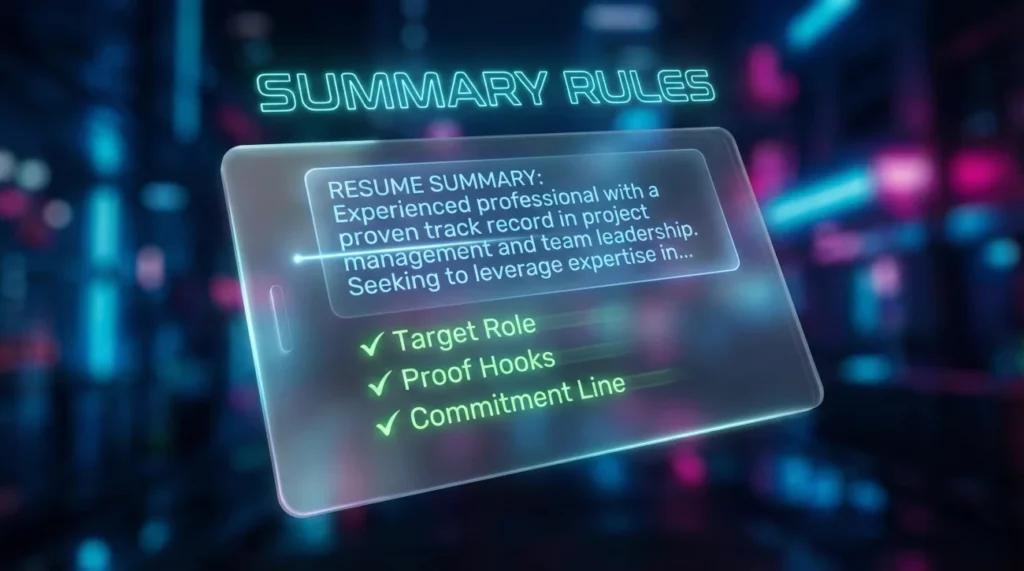
- Use a simple 3-part structure: Target role first, outcomes second, commitment line last.
- Pick one opening below, then swap in two proof hooks that match the job you want.
Founder Summaries Fail When They Sound Like You Are Still Pitching
I once coached a founder named Kyle who kept getting polite rejections for operations roles. His resume was strong, his numbers were real, and his references loved him. The problem was the first three lines.
He opened with something that sounded impressive but vague: “Visionary founder with a passion for building innovative solutions.” That line told a hiring manager exactly nothing about whether Kyle could run an operating cadence on Monday morning, take direction on Tuesday, and close out a messy workflow by Friday.
Here is the uncomfortable truth: A founder summary is judged like a risk memo. Recruiters are quietly scanning for three questions: “What role are you actually applying for?”, “Do you have employee-shaped proof?”, and “Are you committed or just passing through?”
This guide gives you founder resume summary examples that answer those questions fast, without pretending you were not a founder.
⚠️ Warning: If your summary sounds like a pitch deck, the reader assumes you still want to run a company, even if your business is already closed.
The Three Rules That Make a Founder Summary Feel Hireable
Most advice about summaries is fine for traditional careers. Founders are different because you are fighting a specific perception: “Impressive, but unpredictable.” So your summary needs structure that removes ambiguity.
Rule 1: Lead With the Role You Want, Not the Identity You Had
If the first words are “Founder” or “CEO,” you force the reader to do mental translation before they even know where to place you. Instead, open with the role you are targeting and let your founder experience support it.
This is where a lot of people get stuck because it feels like hiding. It is not hiding. It is positioning. You are telling the truth in the order that helps the reader understand you.
Rule 2: Add Two Proof Hooks That Sound Like Employee Outcomes
“Built a company” is not a proof hook. It is a headline. Proof hooks are short, measurable results that a hiring manager can map to the job they are hiring for.
Think: Revenue, retention, cycle time, operational accuracy, adoption, customer outcomes, shipping milestones, cost reduction, team output, risk reduction.
Rule 3: Close the Commitment Gap With One Calm Sentence
Founders lose roles because the reader worries you will leave as soon as something shiny appears. You can address that without oversharing.
One sentence is enough, especially if it is concrete: You are seeking an employee role, you want to build inside a team, and your venture is not an active distraction.
What does a founder summary need that other summaries do not?
It needs a commitment line. Not a dramatic story, not an apology. Just a clear signal that you are choosing this role and this structure on purpose.
Six Proof Hooks You Can Borrow to Translate Founder Work
If you have ever tried to write a founder resume summary and ended up staring at your own screen thinking “I did a thousand things, but which ones count,” you are not alone.
These hooks are not industry-specific. They are “translation units” you can adapt quickly.
| Proof hook type | What it signals to the reader | Example phrasing |
|---|---|---|
| Shipping milestone | You execute, not just ideate | Shipped v1 in 10 weeks and launched to 3 paid pilots |
| Revenue or pipeline | You can sell and forecast | Built a $420K pipeline and closed $180K in annual contracts |
| Retention or support | You care about customers after the sale | Cut churn from 7.2% to 3.9% by rebuilding onboarding |
| Operations improvement | You run a system, not a sprint | Standardized SOPs and reduced fulfillment errors by 31% |
| Team leadership | You create output through others | Led a team of 6 across product, growth, and support |
| Constraint management | You prioritize under pressure | Delivered roadmap with a lean budget by tightening scope and cycle time |
Notice what is missing: No “visionary,” no “disrupting,” no identity words. Just proof that matches how teams are evaluated.
A Quick Before and After That Fixes 80% of Founder Summaries

This is the pattern I see most. The “before” is not evil. It is just written for the wrong audience.
See the difference: The “after” names the function, includes implied proof, and quietly answers the commitment concern.
So are you planning to go back to your startup if the market improves?
No. That chapter is closed in the way that matters for this role. I am choosing a team environment because I want to build inside a larger system and go deeper on execution.
You did not overshare. You did not sound defensive. You simply removed uncertainty.
Founder Resume Summary: 7 Openings You Can Copy and Customize
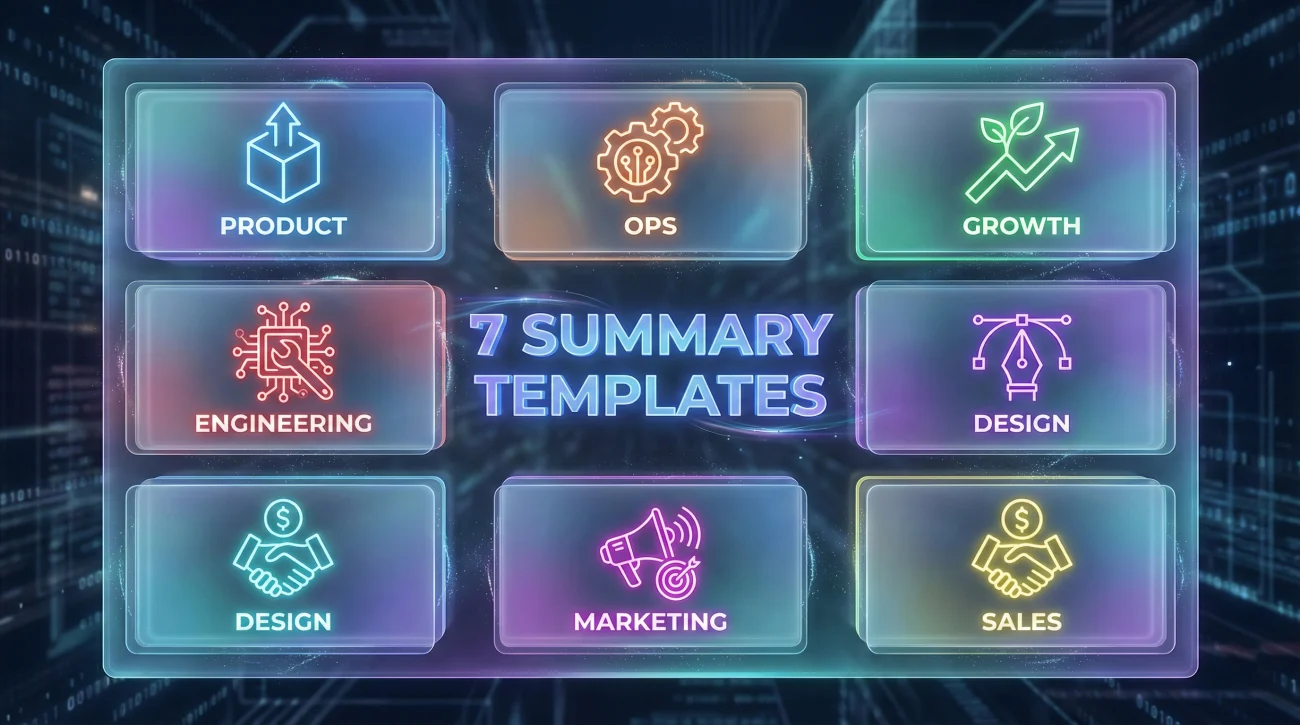
Each opening below follows the same spine: Role, proof, commitment. Your job is to swap in proof hooks that match the job description.
If you are applying broadly, do not reuse one generic summary. Create two versions. One for “product and growth” roles, one for “operations and execution” roles. That split alone usually improves response rate.
1) Product Manager or Product Lead Pivot
This is for founders who built the product themselves or led the roadmap. Keep it grounded: shipping, adoption, and trade-offs. Avoid “vision” language because PM hiring already assumes you can talk big.
💡 Pro Tip: If your product was small, that is fine. Add one proof hook about speed or learning loops, not scale you do not have.
2) Operations Manager or BizOps Pivot
This is for founders who ran fulfillment, finance, vendor ops, or internal systems. Your strongest signal is repeatability: SOPs, metrics, cycle time, error reduction, predictable outputs.
When this works well, the reader thinks: “This person will make our mess less messy.” That is a hireable feeling.
3) Growth or Marketing Lead Pivot
This one needs proof fast because “marketing” summaries are often fluffy. Anchor it in pipeline, CAC, conversion, lifecycle, or clear channel wins. Keep the commitment line calm and short.
If your best results were content or partnerships, name that clearly. Do not pretend you ran paid at scale if you did not.
4) Engineering Manager or Technical Lead Pivot
This is for technical founders who want to be evaluated as builders, not as “CEO.” Your strongest angle is delivery: shipped product, improved reliability, created tooling, and coached others.
Keep it humble and specific. Technical hiring managers can smell inflated claims in two seconds.
5) Customer Success or Account Management Pivot
Founders often do customer success naturally, but they describe it poorly. Use outcomes: retention, expansion, onboarding improvements, support time reduction, and relationship management.
This is also a strong route if your venture was small but your customer relationships were deep and measurable.
6) Finance, Strategy, or Analytics Pivot
This one works when you can talk about forecasting, pricing, unit economics, and decision-making under constraints. It is especially good for founders who did not love the “front-of-house” part of being a CEO.
If you want to sound even more employee-shaped, add one line about collaboration with stakeholders or leadership teams.
7) People Ops or HR-adjacent Pivot
I have seen founders pivot into people roles when they were actually strongest at hiring, coaching, and team design. If that is you, do not sell it as “I like people.” Sell it as systems: recruiting process, onboarding, performance habits, and clarity.
And yes, this can still be credible even if your team was small. Small teams are where good habits matter most.
If you want an even more direct label for certain employers, you can also frame it as a business owner resume summary with employee-style outcomes. The content stays the same. The label just matches what that employer expects to see.
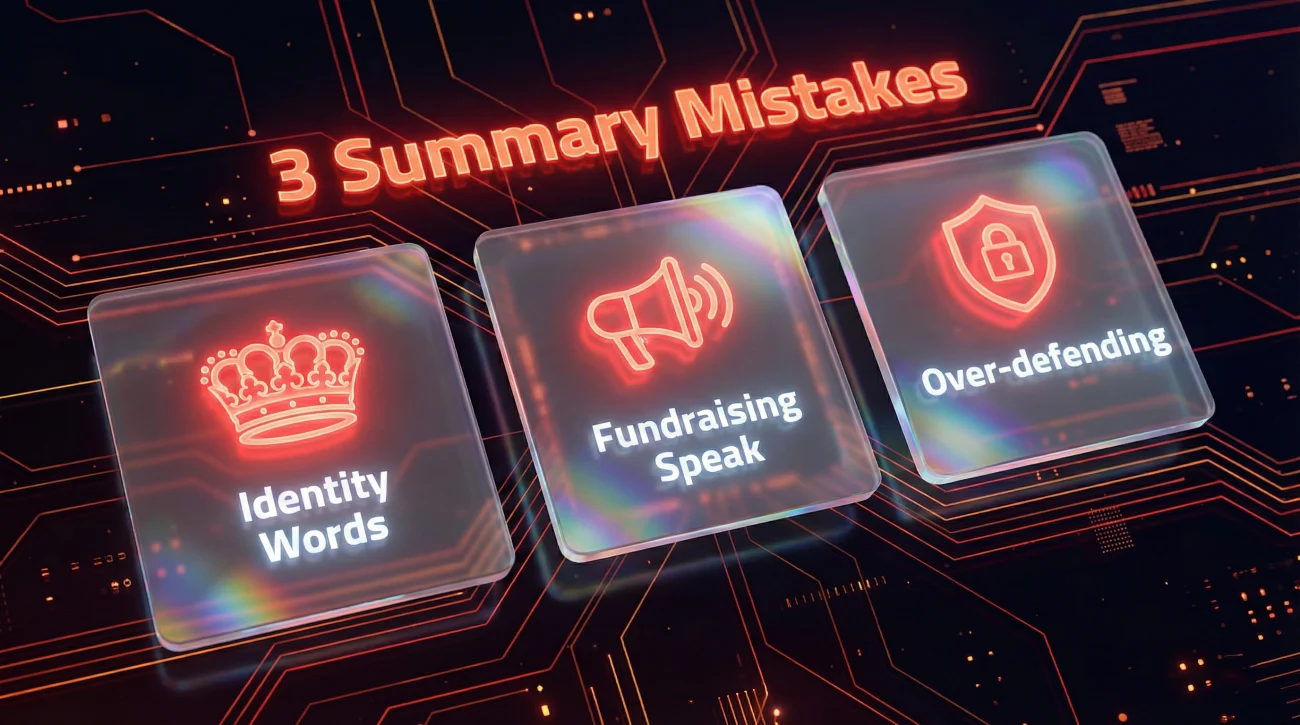
Three Mistakes That Quietly Trigger the “Flight Risk” Reaction
These show up constantly in founder summaries. They do not feel like mistakes while you are writing them, which is why they keep surviving drafts.
- Starting with identity words: Founder, CEO, visionary. Lead with function and let the context come later.
- Sounding like you are still fundraising: “Mission-driven,” “disrupting,” “seeking new opportunities.” Hiring managers read this as “not settled.”
- Over-defending the pivot: Too much explanation creates suspicion. One calm commitment line is stronger.
See how the second version stops talking about “opportunities” and starts talking about “work.” That shift matters.
A Quick Edit Pass to Make Any Founder Summary Stronger
If you are not sure which opening to choose, run this checklist. It is simple, but it catches the exact things recruiters trip over.
- Role clarity: Does the first sentence name the function you want?
- Proof density: Do you have two proof hooks that a hiring manager can map to the job?
- Language tone: Did you remove pitch words and replace them with delivery words?
- Commitment: Is there one calm sentence that signals you want an employee role?
- Length: Keep it to 3 lines on screen. Save the rest for bullets.
If you want to test it fast, read your summary out loud and ask: Would this sound normal if a senior employee said it about their work? If it sounds like a keynote, it is too founder-ish.
Also, if you are using an entrepreneur resume summary template from a generator, do not trust the adjectives. Keep the structure, replace the adjectives with proof.
Final A Founder Summary Should Read Like a Calm Commitment, Backed by Proof
The best summaries for founders do not beg to be understood. They make the reader’s job easy: Role first, outcomes second, commitment last.
If you only change one thing, change the opening line. Stop announcing “founder energy” and start showing employee-shaped results. Most hiring managers are not anti-founder. They are anti-uncertainty.
When your summary does that, founder resume summary examples stop being “templates” and start being a translation tool you can adapt for each role you want.
❓ FAQ
🎯 Should I say “Founder” in my summary at all?
You can, but it usually should not be the first word. Lead with the function you want, then reference founder experience as context with proof.
🧠 How long should a founder summary be?
Aim for 2 to 3 sentences that fit in about three lines on screen. The rest of your proof should live in your bullets.
🧩 What if my startup did not “scale” or raise money?
Scale is not required. Use proof hooks about delivery: Shipping milestones, customer outcomes, system building, and measurable improvements.
🔍 How do I handle the “Are you still working on it?” question?
Answer calmly and briefly. State that the chapter is closed in the way that matters for the role, then redirect to why you want an employee environment and what you deliver.
📌 Can I reuse the same summary for every job?
Try not to. Create at least two versions based on role family, then swap in proof hooks that match each job description.
⚠️ Disclaimer: ResumeSolving provides resume, cover letter, job search communication, and career transition guidance for informational purposes only. Hiring practices vary by employer, role, location, industry, and individual circumstances. We do not guarantee interviews, job offers, ATS results, or other outcomes. Verify employer requirements directly and follow applicable laws and workplace policies. For sensitive situations, use only information you are comfortable disclosing and keep all statements accurate.