- Your founder title is not a trophy. It is a translation layer that helps a recruiter map you to a role in 6 seconds.
- Use three rules: Truth anchor, target role mapping, and seniority calibration. If one rule breaks, the title backfires.
- Skip “CEO” unless you can defend real scope. Most founders win more interviews with a functional title plus “Founder” as context.
Founder Titles Are Where Good Candidates Accidentally Trigger Doubt
I still remember a candidate named Riya who ran a tiny SaaS with two contractors and one part-time designer. She was sharp, measurable, and exactly the kind of operator a scale-up needed. But her resume opened with “CEO” and nothing else. The recruiter told me, “I can’t tell if she built product, sold it, or just named herself a title.” That one line pulled attention away from her results.
If you are Googling what job title to use as a founder on a resume, you are not asking for permission to look important. You are trying to avoid the silent filter: eye-roll, confusion, and the assumption you will not adapt to being an employee.
Here is the uncomfortable truth from the hiring side: people do not reject founders because they were founders. They reject founders when the title makes the story harder to trust.
Why “CEO” Can Backfire Even When It Is Technically True
On paper, “CEO” can be accurate. In reality, recruiters read it as a set of risks unless the scope is obvious.
| What you meant | What a recruiter may hear | What fixes it |
|---|---|---|
| I owned accountability | Title inflation or ego | Add a functional title that matches the role you want |
| I led a business | Unclear day-to-day skills | Make your function readable: Product, Growth, Ops, Engineering, Sales |
| I made final decisions | May struggle with reporting lines | Show collaboration signals in bullets: cross-functional, stakeholder, roadmap |
| I ran a small team | Scope mismatch to “CEO” expectation | Calibrate seniority: Lead or Head can be stronger than CEO here |
⚠️ Warning: In communities where people discuss titles openly, “CEO of a tiny business” is often described as eye-rolling, even by other business owners. That social reaction is what you are protecting yourself from.
One of my colleagues used to joke, “If the title forces me to do math, the resume loses.” That is not cruelty. It is workload. Most recruiters are skimming fast.
Three Rules That Keep Your Founder Title Credible

Rule 1: Pick a truth anchor that would survive a background check.
Your title must be defensible if someone verifies your company registration, references, or public footprint. You do not need to undersell yourself, but you do need consistency.
Truth anchors that usually hold up well: Founder, Co-Founder, Owner, Principal. Then you add the functional layer that explains what you actually did.
💡 Pro Tip: If your LinkedIn is public and your resume is private, consistency matters more than perfection. A mismatch is what invites questions.
Rule 2: Your title must map to the employee job you want next.
Recruiters are not hiring “a founder”. They are hiring a Product Lead, a Growth Manager, an Operations Manager, an Engineering Manager, or a Sales Lead. Your job title should do that mapping for them.
Think of it like translation. If you built product, shipped releases, wrote specs, and owned roadmap, your resume should not start with a title that hides that.
[Founder] + [Functional Title That Matches Target Role]
Rule 3: Calibrate seniority so you do not look mismatched to the role.
This is where founders accidentally sabotage themselves. A “CEO” label can make you look too senior for a manager role, or too vague for an individual contributor role.
Senior titles are not always better. Often, a calibrated title wins because it reduces friction. “Head of Growth” can feel more believable than “CEO” if you are applying for Growth Lead roles.
❌ Note: Do not force yourself into a seniority level you cannot back up with scope. Hiring managers can smell it in the first two bullets.
Ten Title Options That Usually Work (Choose One and Commit)
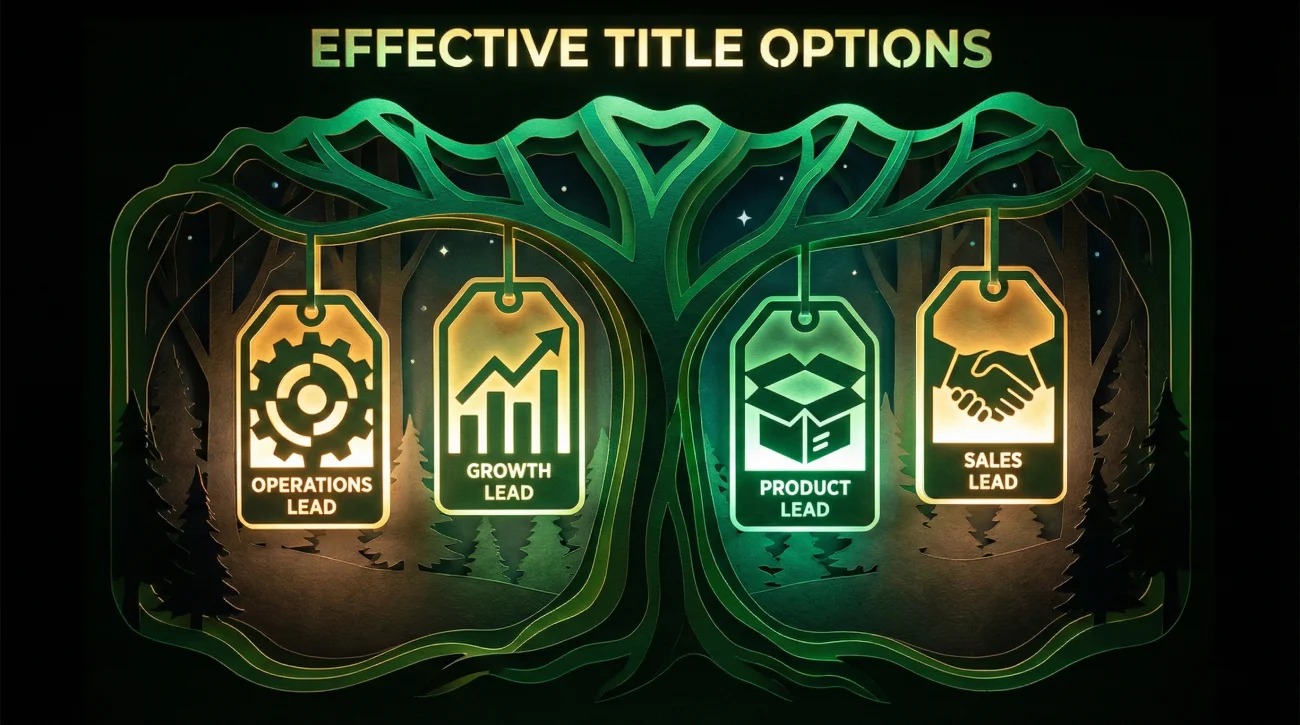
Below are options that keep “Founder” as the truth anchor, while making your function obvious. You do not need all of them. Pick the one that matches the role you are applying for and your actual day-to-day work.
- Founder, Product Lead (built product strategy, roadmap, specs, launches)
- Founder, Head of Product (product plus leadership, hiring, cross-functional priorities)
- Founder, Growth Lead (acquisition, funnel, experimentation, CAC, retention)
- Founder, Marketing Lead (positioning, content, lifecycle, partnerships)
- Founder, Sales Lead (pipeline, outbound, demos, closing, expansion)
- Founder, Operations Lead (process, vendors, finance ops, delivery, execution)
- Founder, Customer Success Lead (onboarding, retention, support systems, churn reduction)
- Founder, Engineering Lead (technical ownership, architecture, delivery, team coordination)
- Founder, Technical Product Manager (if you truly did PM work and bridged engineering)
- Owner, General Manager (often strongest for local business or ecommerce operations)
Notice what is missing: fancy labels that force the reader to guess. Your goal is to reduce guessing.
Six Titles That Commonly Backfire (And Better Swaps)
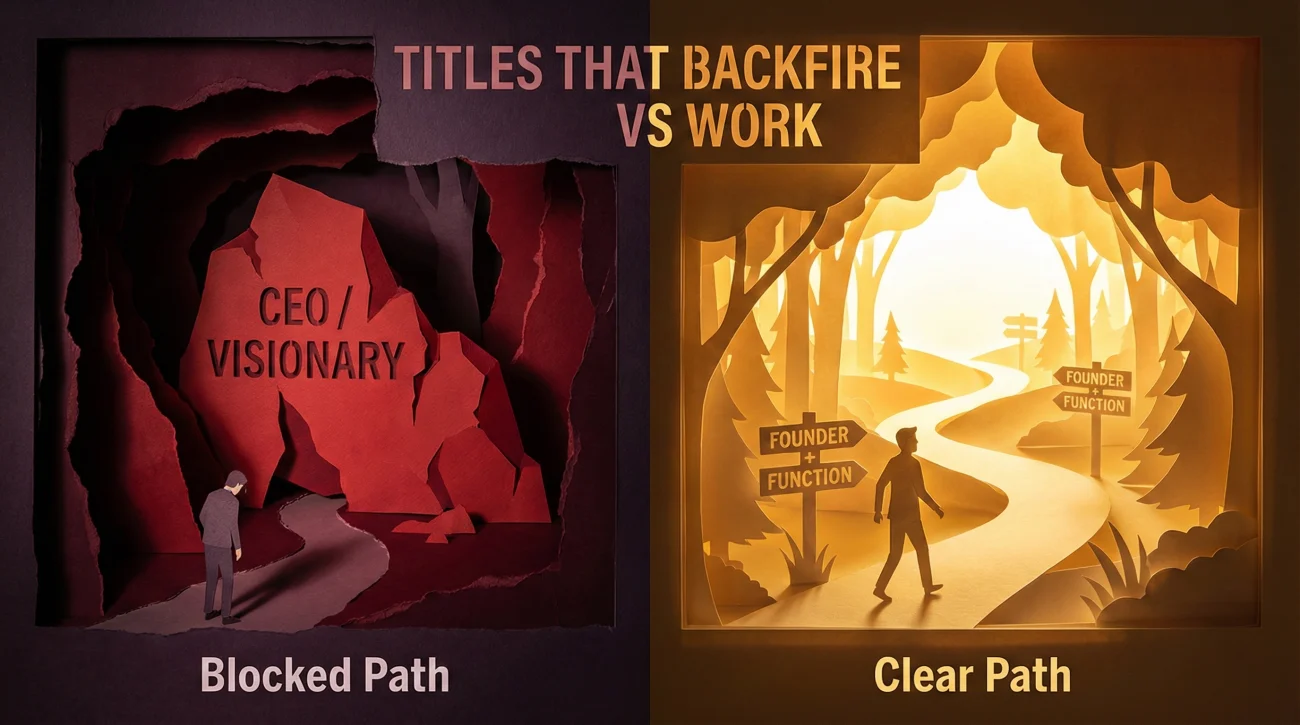
I am not here to police anyone’s ego. I am here to protect your conversion rate. These titles tend to create friction unless the scope is obvious on sight.
1) CEO (when the company was tiny or the scope is unclear).
If the business is small, “CEO” often reads as self-appointed. Better swap: Founder, [Functional Title] or Owner, General Manager.
2) Visionary, Evangelist, Chief Happiness Anything.
Unusual titles can be fun internally, but they are a tax in hiring. Better swap: a standard functional title that matches the job posting.
3) Serial Entrepreneur (as a job title).
This reads like a biography line, not a role. Better swap: Founder, then list the company, then show outcomes.
4) President (when you are applying for manager level roles).
President can sound too senior and trigger “overqualified” assumptions. Better swap: Head of Operations, Operations Lead, or General Manager.
5) Co-Founder and Everything.
When your title tries to do too much, it tells the reader nothing. Better swap: pick the one function you want to be hired for next.
6) Owner (when you want startup credibility, not local-business framing).
Owner is great for ecommerce or a service business. For venture-style startup roles, Founder or Co-Founder often frames you better. Choose the label that matches the market you are entering.
💡 Pro Tip: When in doubt, choose the title that makes your bullets easier to believe.
How to Write the Title Line So It Feels Like a Real Job, Not a Self-Assigned Label
Your title line should answer three silent questions: What was the entity, what function did you own, and what was the scale.
– Shipped MVP in 10 weeks, launched to 40 paying teams, and built a roadmap tied to retention and expansion
– Led user research, wrote specs, coordinated a small dev team, and owned release cadence
That reads like a hireable function. The founder label is there, but it is not the whole story.
– Built supply chain and fulfillment process that reduced returns and improved on-time delivery
– Ran marketing, pricing, and customer support systems with a focus on repeat purchase rate
If you truly did executive work at meaningful scale, you can still use CEO. You just need to make scale obvious immediately.
– Built and led a 14-person team across product, engineering, and compliance
– Owned fundraising, partnerships, and regulatory delivery through launch milestones
If Someone Challenges Your Title, Use This Calm Translation Answer
This comes up more than people admit. A recruiter sees “CEO” and wonders if you will take direction, or if you are inflating scope. The goal is not to argue. The goal is to translate.
Your resume says “Founder, Product Lead” but your LinkedIn says “CEO”. Which one is accurate?
Both are accurate in different contexts. Legally, I was the company’s CEO. Functionally, my day-to-day was product leadership: roadmap, specs, launches, and customer discovery. For this search, I’m using the functional title because it maps directly to the role you’re hiring for.
So you are comfortable reporting into a Head of Product?
Yes. I’m intentionally moving into a team environment where product decisions are shared and the learning loop is faster. I’m not attached to hierarchy. I’m attached to building good product with clear ownership.
⚠️ Warning: Do not say “I changed my title because CEO looks bad.” That can sound manipulative. Frame it as translation and relevance.
Final: The Title That Gets You Interviews Is the One That Makes Your Work Obvious
When you pick a founder title, you are not describing your identity. You are making it easy for a stranger to place you in a hiring manager’s world.
The simplest win is this: keep “Founder” as the truth anchor, add a functional title that matches the role, and calibrate seniority to the level you are applying for. That combination answers the real question behind what job title to use as a founder on a resume without drama.
And if you are torn between two options, choose the one that makes your first two bullets feel believable. Your outcomes are the proof. Your title is just the label that helps people read them correctly.
❓ FAQ
🧭 Should I ever use “CEO” on my resume as a founder?
Use it when the scope is instantly defensible: real team size, clear executive responsibilities, or public credibility that makes “CEO” unsurprising. If the scope is small or unclear, a functional title plus Founder is usually safer and more readable.
🧩 Is “Owner” better than “Founder”?
Owner often works best for ecommerce and local businesses because it signals operations. Founder often works best for startup-style roles because it signals building and product creation. Choose the anchor that matches the market you want to enter.
🔍 Can I use “Head of Product” if I was the founder?
Yes, if you truly did product leadership work and can back it with outcomes. Many founders are functionally Head of Product, Growth Lead, or Ops Lead. The key is to keep a truth anchor like Founder so it does not look like you are hiding your ownership.
🧠 What if I did everything and cannot pick one functional title?
Pick the function you want to be hired for next. Your resume is not a documentary. It is a hiring tool. You can show breadth in bullets, but your title should tell the reader where to place you.
🪪 Do my resume and LinkedIn titles have to match exactly?
They do not have to be identical word-for-word, but they must be consistent in meaning. If they look contradictory, expect the mismatch question. The safest approach is to keep the same truth anchor everywhere and vary only the functional layer based on relevance.
⚠️ Disclaimer: ResumeSolving provides resume, cover letter, job search communication, and career transition guidance for informational purposes only. Hiring practices vary by employer, role, location, industry, and individual circumstances. We do not guarantee interviews, job offers, ATS results, or other outcomes. Verify employer requirements directly and follow applicable laws and workplace policies. For sensitive situations, use only information you are comfortable disclosing and keep all statements accurate.