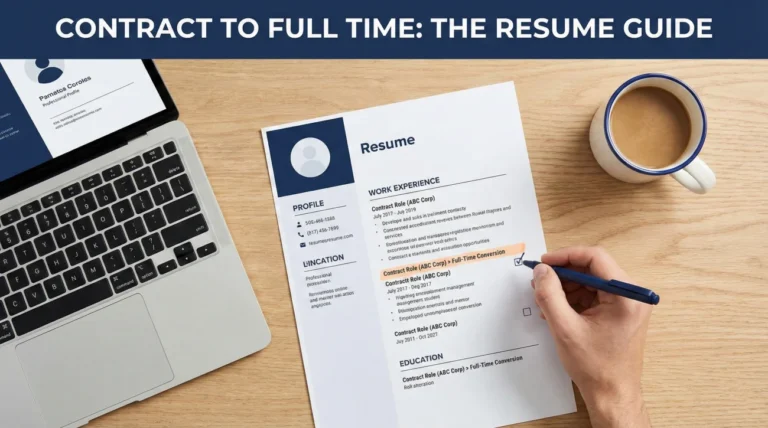
- If you have long-term clients, your real job is not “listing clients.” It is proving continuity with dates, cadence, and renewals in a way that reads like stable work.
- Use one anchor entry for your freelance practice, then show continuity through 6 patterns: Retainers, renewals, rolling statements of work, repeat cycles, fractional cadence, and umbrella accounts.
- You do not need client names to look credible. You need credibility signals: Stakeholder level, scope boundaries, measurable renewals, delivery cadence, and reference-ready phrasing.
- Write bullets that feel steady: Same systems, repeated deliverables, recurring reporting, and multi-quarter outcomes. One great long-term client can carry more trust than ten tiny gigs.
Long-Term Clients Are a Hidden Advantage, If Your Resume Shows Continuity
Most freelancers who come to me do not have a “lack of experience” problem. They have a translation problem. The resume reads like scattered gigs even when the work was steady for years.
In this guide, I’m going to show you exactly how to show long term freelance clients on resume without turning your Experience section into a client list, and without violating confidentiality.
I’m writing this as someone who’s hired across full-time and contract teams. When I see “Freelance” on a resume, I’m not judging the label. I’m scanning for two things: Continuity and availability. If your resume answers both in a calm, adult way, the “freelance bias” fades fast.
Quick story: Megan, a product marketer, told me she had “only two clients” in three years and felt embarrassed. In reality, that was the strongest signal on her profile. Her resume just did not make it obvious. We rewrote the entry to show renewal cycles and a monthly cadence. The interviews followed because it finally read like stable work.
Why Recruiters Miss Your Stability Even When You Had It

Recruiters are pattern readers. They are also tired. If your freelance section forces them to do mental math, they will default to the simplest interpretation: short gigs, unclear scope, unclear commitment.
The three “unstable” patterns that are usually just formatting mistakes
Pattern 1: You list every client as a separate job. It looks like job hopping even when it was one ongoing practice.
Pattern 2: You write “Freelance Projects” with no dates per project. It looks vague, even if your work was continuous.
Pattern 3: You use impressive client hints but skip the cadence. Without “how often” and “for how long,” big names do not equal trust.
Key Point: Continuity is not a vibe. It is a readable structure: Duration, cadence, renewals, and repeatable deliverables.
Another real example: Devon, a developer, worked under NDA for a regulated industry client for 26 months. His resume said “Contract Projects, 2022 to 2024” with three vague bullets. Hiring managers assumed he was between gigs. The truth was the opposite. We rewrote it to show a rolling statement of work, quarterly release cadence, and stakeholder type. Nothing confidential, but suddenly it read like stable delivery.
The Continuity-First Framework: Make One Entry Carry the Weight
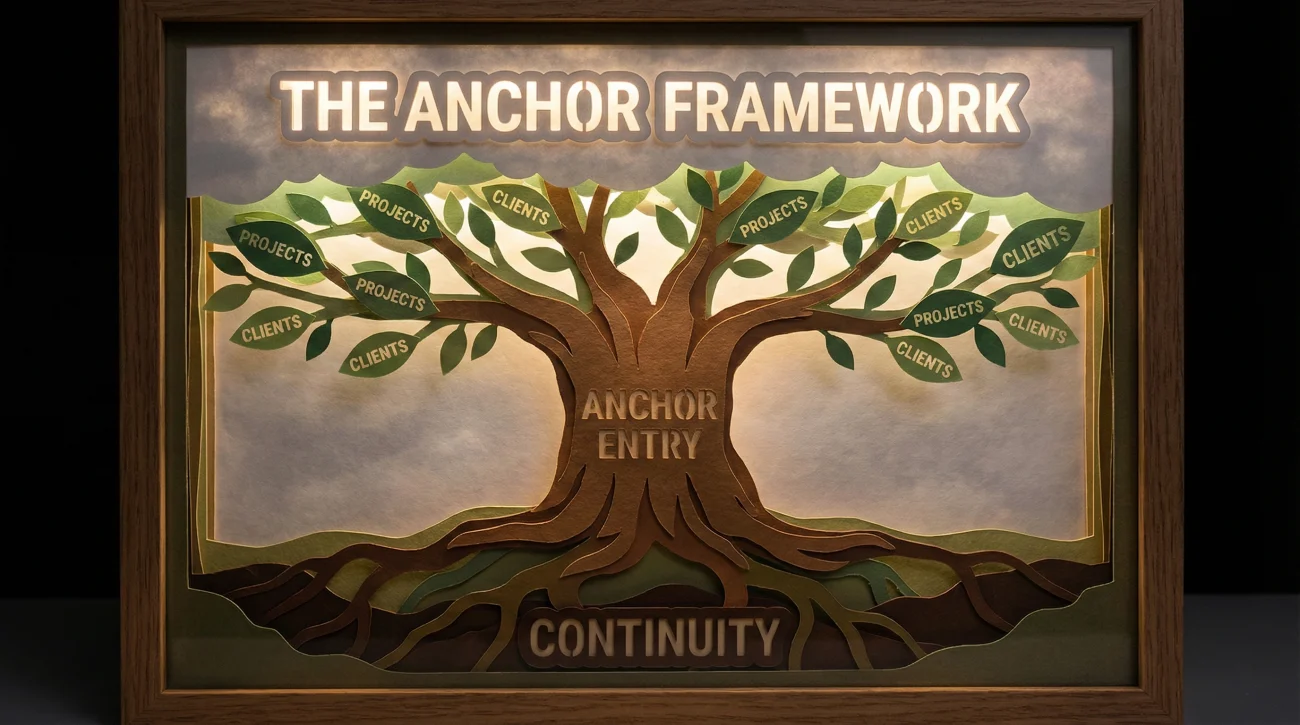
Before we get into patterns, here is the simplest structure that works for most people moving from freelance to full time:
[Independent Practice Title] | Self-Employed or Consulting | [Start] - Present
Then: 2 to 4 bullets that prove continuity, followed by 2 to 3 bullets that prove role fit.
💡 Pro Tip: If you want your freelance resume continuity to feel real, add at least one bullet that includes cadence (weekly, monthly, quarterly) and one bullet that includes duration or renewal.
Where long-term clients belong in this structure
Long-term clients do not need to become separate “jobs.” They become evidence inside the same role:
- Evidence of renewal: Retainers, extensions, re-signs, repeat cycles.
- Evidence of steady output: Monthly reporting, quarterly roadmaps, recurring deliverables.
- Evidence of trust: Stakeholder level, cross-functional partners, compliance constraints, measurable outcomes.
– Maintained a 24-month retainer supporting lifecycle and email performance across two growth stages (Seed to Series B).
– Delivered monthly reporting, quarterly experimentation plans, and copy systems reused across product launches.
– Renewed client agreements through measurable lifts in activation and retention (tracked monthly).
– Partnered with Product and Sales to align messaging, handoffs, and campaign timelines.
6 Continuity Patterns That Make Long-Term Clients Obvious
Pick the pattern that matches your reality. The goal is not to sound fancy. The goal is to make stability effortless to see.
| Continuity pattern | What you write | Why it works |
|---|---|---|
| Retainer | “12 to 24-month retainer” + cadence | Signals ongoing trust and predictable delivery |
| Renewals | “Renewed 3x” or “extended across phases” | Shows the client chose you again |
| Rolling SOW | “Rolling statements of work” + deliverable rhythm | Communicates structured, contract-based continuity |
| Repeat cycles | “Each quarter” or “each product release” | Creates a steady, employment-like narrative |
| Fractional cadence | “Fractional, 1 to 2 days per week” + duration | Explains how you can do multiple clients without chaos |
| Umbrella account | “Primary account covering multiple brands” | Shows scale without listing ten separate client entries |
How to write each pattern without client names
Retainer: Use time + scope + cadence. Example: “18-month retainer supporting content ops and SEO updates, with biweekly deliverables and monthly performance reporting.” This directly supports a retainer client on resume without naming anyone.
Renewals: Use renew language carefully. Example: “Renewed across three 6-month cycles based on lead quality improvements and stakeholder satisfaction.”
Rolling SOW: This works well for product, dev, design, analytics. Example: “Operated under rolling SOWs, delivering quarterly roadmap items and release notes in a regulated environment.”
Repeat cycles: Great for marketing, finance, ops. Example: “Ran a monthly close support cycle and quarterly forecast refresh for an international services firm.”
Fractional cadence: The magic here is honesty. Example: “Fractional PM support (8 to 12 hrs/week) for 14 months, coordinating vendors and release timelines.”
Umbrella account: If one client had multiple brands or teams, show that scale. Example: “Supported two product lines and three internal stakeholders under one primary account.”
⚠️ Warning: Avoid vague prestige fillers like “Top global company.” If you cannot name the client, describe the environment instead: Industry, scale range, stakeholder type, compliance constraints.
6 Credibility Signals That Replace Big Client Names
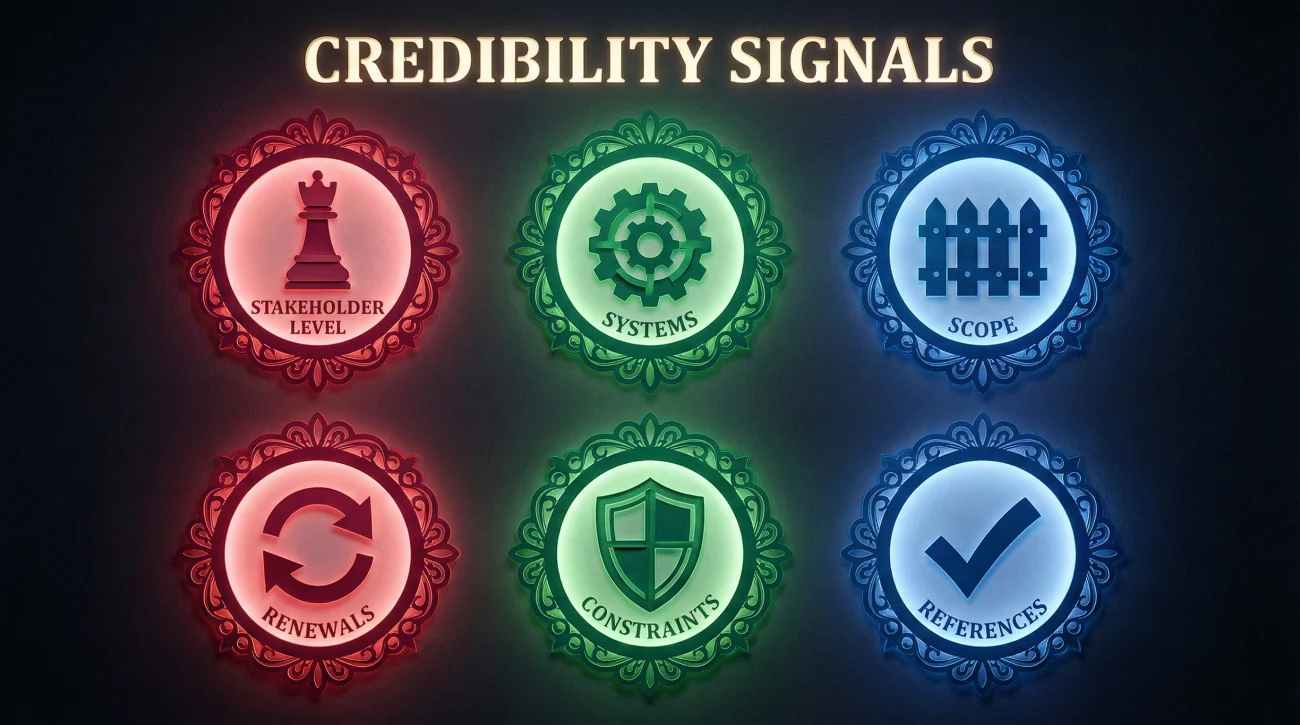
If you cannot list client names because of NDAs, or you simply prefer not to, you can still make your work feel legitimate. You just need proof points that a recruiter trusts.
Use these signals, not hype
- Stakeholder level: “Partnered with VP of Sales and RevOps lead” is often more credible than a logo.
- Cadence and systems: “Monthly reporting pack” or “quarterly roadmap review” reads like a real operating rhythm.
- Scope boundaries: “Owned lifecycle email, landing page testing, and reporting” shows you were not doing random tasks.
- Renewal evidence: “Extended across phases” or “renewed for additional cycles” signals satisfaction.
- Constraint language: “Regulated environment,” “SOC 2 workflows,” “privacy constraints,” when true, adds realism without secrets.
- Reference-ready phrasing: “References available upon request” can be useful if you genuinely have them.
Story from a colleague: Mira, a UX researcher, did long-term work for a healthcare platform and could not name it. Her old resume looked like three short gigs. Her revised version described stakeholder level, research cadence, and the repeat cycle: “monthly discovery,” “quarterly usability benchmarks,” and “renewed scope based on adoption outcomes.” She stopped getting “so were you working consistently?” questions in interviews.
10 Bullet Examples That Read Like Stable Work, Not Random Gigs
These are written to feel steady. Notice the rhythm: duration, cadence, repeatable deliverables, then outcomes. Use them as templates and swap in your truth.
❌ Note: Do not stack ten metrics in one bullet to look impressive. One or two meaningful metrics plus continuity reads stronger than a spreadsheet bullet.
Bullet bank
- Maintained a 20-month retainer delivering biweekly deliverables and a monthly performance summary for a B2B subscription business.
- Renewed scope across three cycles by improving time-to-delivery and reducing rework through reusable templates and QA checks.
- Ran a monthly reporting cadence and quarterly planning cycle, aligning deliverables with stakeholder priorities and launch dates.
- Provided fractional support (10 hrs/week) for 14 months, coordinating cross-functional timelines and vendor handoffs.
- Delivered repeat engagement work for seasonal launches, refining the same core system across multiple release cycles.
- Standardized intake, SLAs, and documentation to keep delivery predictable across ongoing requests.
- Managed recurring deliverables across two product lines under one primary account, maintaining consistent quality and turnaround.
- Built and maintained a reusable content or design system, reducing cycle time and improving consistency across months.
- Produced monthly stakeholder updates that tracked progress, risks, and next steps, reducing last-minute changes.
- Supported long-term client relationships by documenting decisions and keeping continuity across changing stakeholders.
If you want a phrase that signals stability without sounding defensive, this one works in many contexts: ongoing client freelance resume work “delivered on a recurring cadence with defined deliverables.” It is calm, factual, and readable.
Three Mini Layouts You Can Copy Depending on Your Situation
Choose the layout that matches your reality. The best choice is the one that reduces questions.
Layout A: One primary long-term client plus a few smaller projects
Write one anchor role with continuity bullets, then add a short “Selected Projects” subsection inside the same job entry using 2 bullets max. Do not create five separate “jobs.”
– Supported a long-term engagement (18+ months) with recurring monthly reporting and quarterly forecasting refresh.
– Delivered dashboard updates on a predictable cadence, improving stakeholder visibility and decision speed.
– Selected projects: Built a churn model prototype and documented handoff steps for internal teams.
Layout B: Multiple long-term fractional clients at once
This is where you must explain cadence. Otherwise recruiters assume overload.
– Provided fractional operations support (8 to 12 hrs/week) across two retained clients for 12 to 16 months each.
– Ran recurring weekly check-ins and monthly reporting packs to keep delivery steady and transparent.
– Improved process clarity and reduced cycle time through documented SOPs and reusable templates.
Layout C: One long engagement under NDA
Describe the environment and outputs. Skip the secrecy tone. Just be professional.
– Delivered roadmap items under rolling SOWs with a recurring release cadence and documented QA workflow.
– Partnered with cross-functional stakeholders to align requirements, timelines, and acceptance criteria.
– Improved reliability through monitoring updates and incident-response documentation.
Common Mistakes That Accidentally Undermine Your Long-Term Story
Mistake 1: Turning your resume into a client directory
If you list 12 clients as 12 separate roles, the resume reads like constant switching. Even if the dates overlap, the visual impression is chaos.
Fix: One anchor entry, continuity bullets, then “selected engagements” only when truly needed.
Mistake 2: Hiding behind vague prestige
“Fortune 500” can help when true, but it can also backfire if it feels like bragging or like you are dodging NDA details.
Fix: Replace prestige with operating reality: stakeholder level, cadence, scope, constraints.
Mistake 3: No closure signal while applying for full-time
Hiring managers do not need a dramatic explanation. They need clarity. If you are still freelancing, say what that means in practical terms without oversharing.
Fix: Add one calm line in a bullet if needed, such as “Projects scheduled outside standard hours while interviewing” only if it is true and relevant. Keep it short.
Key Point: You are not “convincing” anyone with confidence. You are removing ambiguity with structure.
Final: Continuity Reads Like Employment When You Write It Like Operations
Long-term clients are not a detail to sprinkle in. They are the spine of your story. When your resume shows duration, cadence, and renewals, the reader stops wondering whether you were “between gigs” and starts focusing on whether your skills match the role.
That is the whole point of learning how to show long term freelance clients on resume the right way. It is not about name-dropping. It is about making stability easy to see, even when your path did not look like a traditional payroll job.
If you do the continuity work once, your freelance chapter stops looking like a question mark. It just looks like a normal professional who delivered, renewed, and kept showing up.
❓ FAQ
🧩 Should I list the client name if it’s well-known?
Only if you are allowed to, and you are confident it does not violate any agreement. When in doubt, skip the name and describe the industry, scope, and cadence. Most hiring managers care more about what you delivered and how consistently you delivered it.
🕒 How many long-term clients should I mention?
Usually one or two is enough, as long as the entry proves continuity. More names rarely add more trust. Strong cadence and renewal signals add more trust than a long list.
🔁 How do I show renewals if I don’t want to share contract details?
You can write “renewed across multiple cycles” or “extended based on performance outcomes” without listing dollar amounts or contract terms. Keep it factual and simple.
🧠 What if my long-term client was only part-time, will that look weak?
Not if you write cadence clearly. “Fractional, 8 to 12 hrs/week for 14 months” reads stable and believable. The problem is not part-time. The problem is ambiguity.
🧾 Should I add a “Selected Clients” line under my freelance role?
Only if you can name them and it strengthens your match for the role. If you cannot name them, a “Selected Industries” line is usually safer and still useful.
📌 Will ATS struggle if I do not list client names?
ATS typically parses titles, dates, skills, and keywords more than it rewards brand names. You will get more value from role-relevant keywords and clear outcomes than from client logos.
⚠️ Disclaimer: ResumeSolving provides resume, cover letter, job search communication, and career transition guidance for informational purposes only. Hiring practices vary by employer, role, location, industry, and individual circumstances. We do not guarantee interviews, job offers, ATS results, or other outcomes. Verify employer requirements directly and follow applicable laws and workplace policies. For sensitive situations, use only information you are comfortable disclosing and keep all statements accurate.