- If you are switching fields, a projects section is your credibility bridge, but only if it reads like accountable work.
- Use a simple structure: Clear label, tight scope, real constraints, measurable outcome, and a hint of proof.
- Below you get a section plan, 8 plug and play project writeups, and 8 bullet patterns that feel like real experience.
Why a projects section can save a career change resume
When someone is changing careers, the resume problem is rarely “lack of talent”. It is “lack of proof”. Hiring teams are scanning for evidence that you can do the new work in a real environment, with real constraints, and still land a result.
That is where a projects section for career change resume becomes useful. Not as a dumping ground for anything you have tried, but as a controlled space where you show: “I have already done the work, and I can talk about it like a professional”.
I have seen this go well, and I have seen it backfire. A candidate named Tessa moved from recruiting into HR analytics. She had a strong certificate and solid curiosity. Her first resume version listed three “data projects” with vague bullets like “Built dashboards” and “Used SQL”. The recruiter response was silence. When we rewrote those projects with scope, constraints, stakeholder, and outcome, the same projects suddenly looked credible. Her interviews started within two weeks.
This article is built for that exact pivot moment. Not theory, not motivational lines, just practical writing that makes your projects read like real experience.
What recruiters are quietly checking when they see “Projects”
Recruiters are not allergic to projects. They are allergic to projects that feel like homework, self taught fluff, or unverifiable claims. In a career change, that skepticism is even stronger because the projects are often your main evidence.
Here is the split I keep in mind when reviewing career switch resumes. If your project hits the left column, it reads like experience. If it hits the right column, it reads like padding.
| Signals it feels like real work | Signals it feels like “career change homework” |
|---|---|
| Clear scope and deliverable (what you shipped) | Vague goal (“learned X”, “explored Y”) |
| Constraint or tradeoff (time, data quality, budget, compliance) | Only tools listed, no real-world friction |
| Stakeholder or user (who needed this, who approved it) | No audience, no decision-maker, no customer |
| Outcome with baseline (before vs after, volume, speed, error rate) | Outcome-free bullets (“created”, “built”, “designed”) |
| Ownership level (your role, your decisions) | “We” everywhere with no personal contribution |
| Light proof signal (internal rollout, pilot, adoption, published result) | Portfolio vibe with no hint of use in the real world |
Notice what is missing from the “real work” side: Fancy wording. The credibility comes from specifics that are hard to fake.
🗝️ Key Point: A project becomes “experience-like” when it shows accountability. Not just what you did, but what you were responsible for changing.
One of my colleagues, Devon, used to hire entry-level analysts. He told me he did not care if the project was personal or volunteer. He cared whether the candidate could answer one question: “What changed because you did this?” That is the test you should write for.
Pick projects that survive skepticism

The fastest way to weaken your resume is to include projects you cannot defend under pressure. In a career change interview, the project will be poked. Not in a hostile way, but in a “Tell me more” way. If you freeze, it reads like the project was a surface-level exercise.
Use this filter before you write anything. I recommend choosing 2 to 4 projects total. More than that usually turns into thin bullets and diluted credibility.
- Real audience: Someone needed this, used this, or benefited from it.
- Real constraint: Deadline, messy inputs, limited access, or competing priorities.
- Real decision: You had to choose between options, not just follow a tutorial.
- Real outcome: Speed improved, errors dropped, engagement increased, time saved.
Now, the subtle career change twist. Your project also needs to “map” to the target job. That does not mean the project must match the new job perfectly. It means the project must demonstrate the same thinking pattern.
For example, a candidate named Dolores moved from operations into product management. She did not have PM job titles yet, but she had two projects that proved PM behaviors: Clarifying requirements, prioritizing tradeoffs, aligning stakeholders, and shipping an improvement that changed a metric. That mapping is what made her a believable switcher.
⚠️ Warning: If your project exists only to “learn a tool” with no user, no constraint, and no outcome, it usually belongs in Skills or Training, not in Projects.
When you are unsure, ask this: “If I remove this project, does my resume lose credibility or just lose volume?” If it is only volume, cut it.
The section plan that works for most career switchers
This is the practical part people rarely give you. Where do you put projects, what do you call the section, and how do you keep it ATS-friendly without making it look like a student resume.
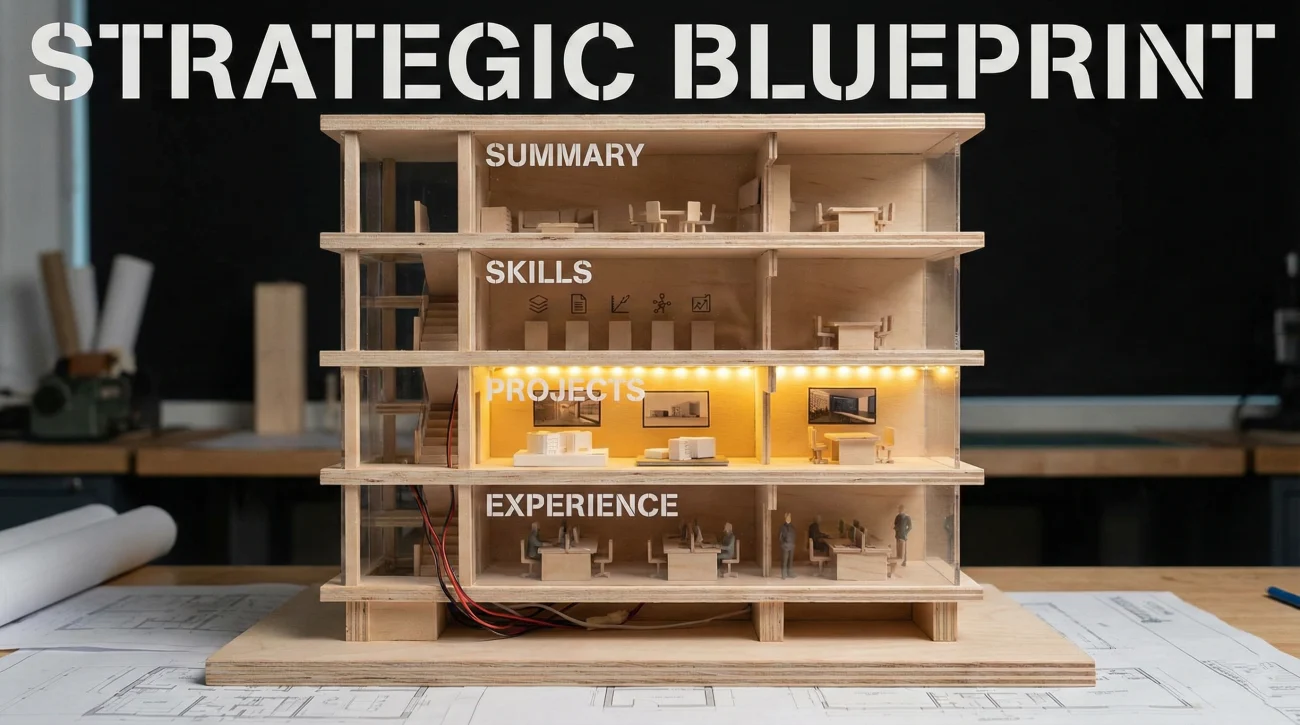
Recommended placement
For most career change resumes, I like this order:
- ✅ Summary (career change positioning)
- ✅ Skills (target job keywords)
- ✅ Projects (bridge credibility)
- ✅ Experience (your prior field, trimmed to transferable impact)
- ✅ Education and Certifications
Why Projects before Experience: It reduces “title bias”. If the hiring manager sees your old titles first, they may anchor on the past. If they see relevant work first, they anchor on capability.
Section naming options
Pick one that matches your reality:
- Selected Projects: Clean and neutral.
- Relevant Projects: Works when you have a tight link to the target role.
- Project Highlights: Good when the projects are within your current job but you want to spotlight them.
- Analyst Projects / UX Projects / Product Projects: Strong when the target role is clear and you want ATS alignment.
Notice what I did not list: Cute labels. In a career switch, you want clarity more than personality.
How many bullets per project
Use 2 to 3 bullets per project. If you need more, you probably picked a project that is too broad or you are mixing multiple projects into one.
💡 Pro Tip: Keep the Projects section tighter than Experience. The goal is to prove relevance, not to re-live the entire build process.
Write projects like mini jobs, not mini essays

Here is the writing framework I use when turning “project work” into “experience-like” resume content. It is simple, but it forces the missing pieces into the open.
[Deliverable] + [Constraint] + [Your Decision] + [Outcome] + [Proof Signal]
You do not have to hit every bracket in every bullet, but the overall project should cover them. The moment you add constraint and outcome, the project starts feeling real.
What makes a project credible in one line
If your project header line is vague, the bullets will struggle. Use a header that communicates job-like context:
Inventory Forecasting Dashboard | Operations Analyst (Career Pivot Project) | Apr 2025 – Jun 2025
Tools: Excel, SQL, Power BI
That header already answers: What it was, what role you played, when it happened, and what tools were involved. Now the bullets can focus on decisions and outcomes.
Proof signals you can use without turning it into a portfolio
Some career switchers avoid proof entirely because they fear it looks like a portfolio guide. You do not need links everywhere. You just need a hint that the work lived outside your laptop.
- Pilot rolled out to a team
- Used in a volunteer org or community group
- Presented to stakeholders
- Adopted as a repeatable process
This is especially important for projects section career change resumes, because the reader is already asking “Is this real?”. A proof signal answers without overexplaining.
8 project writeups that feel like real experience
Below are eight examples you can copy and adapt. They are written to sound accountable, not flashy. Swap the tools, metrics, and domain details to match your situation. Do not keep numbers if they are not yours.
These are also designed for career switchers who need resume projects for career change that map to a target job without pretending they held that job title already.

Example 1: Operations to Data Analyst
Demand Variance Dashboard | Analyst (Career Pivot Project) | Feb 2025 – Apr 2025
Tools: SQL, Power BI
– Cleaned 12 months of order data and built a variance model to flag demand spikes vs baseline by SKU and region
– Partnered with supply lead to define “action thresholds” and reduce weekly firefighting time by 4 hours per week
– Deployed a refresh schedule and documentation so the dashboard could run without manual updates
This one works because it shows baseline thinking, stakeholder alignment, and an operational outcome.
Example 2: Customer Support to Product Management
Self-Serve Help Flow Redesign | Product Project Lead (Internal) | May 2025 – Jul 2025
Tools: Jira, GA4, Zendesk Insights
– Audited top 20 ticket drivers and mapped customer intent to the help center flow, prioritizing fixes by volume and effort
– Wrote requirements and coordinated engineering, support, and content to ship 6 improvements in 8 weeks
– Reduced “how do I” ticket volume by 18% and improved first-contact resolution on the remaining category
Notice the language: Requirements, prioritizing, cross-functional coordination. That is the PM bridge.
Example 3: Teacher to Learning and Development
New Hire Training Sprint | L&D Project (Volunteer) | Jan 2025 – Mar 2025
Tools: Google Workspace, Loom, LMS (TalentLMS)
– Designed a 2-week onboarding curriculum for a nonprofit team of 25, based on role tasks and common mistakes
– Built micro-lessons and quick checks to reduce repeated “how do I” questions from managers
– Cut ramp-up time from 4 weeks to 2.5 weeks based on manager feedback and task completion rates
Career changers often underuse “feedback metrics”. Even simple tracking can boost credibility.
Example 4: Marketing to UX Research
Checkout Drop-Off Study | UX Research Project | Aug 2025 – Sep 2025
Tools: Maze, Hotjar, Google Sheets
– Ran 10 moderated sessions and 32 unmoderated tasks to identify friction points in checkout for first-time buyers
– Synthesized findings into 4 themes with severity ratings, linking each issue to conversion impact and effort to fix
– Presented recommendations to design team; 2 changes shipped in the next sprint and reduced drop-off at payment step
One candidate I coached, Lindsay, did something similar. Her first version sounded academic. Once she added “what shipped” and “what changed”, the project stopped feeling like a class assignment.
Example 5: Admin to HR (People Ops)
Interview Process Cleanup | People Ops Project (Internal) | Oct 2024 – Dec 2024
Tools: ATS, Excel
– Audited 40 recent interview packets and identified inconsistencies in scoring and feedback timing across teams
– Created a structured scorecard and a 24-hour feedback rule, then trained 12 interviewers on usage
– Reduced “missing feedback” cases from weekly to rare and improved time-to-decision by 3 days
This reads like HR work because it focuses on process, governance, and cycle time.
Example 6: Finance to Business Analyst
Pricing Scenario Model | Business Analysis Project | Mar 2025 – May 2025
Tools: Excel, SQL
– Built a scenario model to compare 3 pricing strategies using margin, churn risk, and customer segment mix
– Worked with sales lead to define assumptions and stress-test edge cases before leadership review
– Delivered a recommendation deck and model; leadership used it to set a pilot plan for Q3
Even if the pilot result is not finished, the decision framework and stakeholder alignment still counts.
Example 7: Sales to RevOps
Pipeline Hygiene Fix | RevOps Project (Internal) | Jun 2025 – Jul 2025
Tools: Salesforce, Google Sheets
– Analyzed 6 months of CRM data to find stage slippage patterns and “stale deal” drivers by rep and segment
– Defined a weekly hygiene workflow with clear ownership and automated reminders to reduce manual chasing
– Improved forecast accuracy and reduced end-of-month surprises by tightening stage definitions and exit criteria
This works because it feels operational, not motivational.
Example 8: Hospitality to Project Coordinator
Vendor Onboarding Playbook | Project Coordination (Career Pivot Project) | Apr 2025 – May 2025
Tools: Notion, Google Workspace
– Mapped the end-to-end onboarding process, identifying 9 handoffs that caused delays and rework
– Created a checklist, timeline, and escalation rules so each vendor moved through the same steps
– Reduced onboarding time by standardizing tasks and clarifying who owns each decision point
Some of the strongest career switch projects are not “tech”. They are coordination, clarity, and repeatability.
Quick reminder: You are not trying to look perfect. You are trying to look believable. That is what makes a relevant projects resume career switch strategy work.
8 bullet patterns that make projects sound accountable
If your bullets keep starting with “Built” and “Created”, your projects will feel generic. Use patterns that force scope, decision, and outcome.
Patterns you can reuse
- Pattern 1: “Diagnosed X by analyzing Y, then changed Z to improve outcome.”
- Pattern 2: “Reduced risk or rework by adding a rule, checklist, or constraint.”
- Pattern 3: “Aligned stakeholders by defining success criteria and tradeoffs.”
- Pattern 4: “Built a repeatable process so results did not depend on you.”
Eight plug and play bullet examples
- Turned messy inputs into a clean dataset by defining validation rules, reducing manual cleanup time each week
- Chose a simpler model after testing edge cases, prioritizing stability and explainability over complexity
- Defined success metrics with a stakeholder before building, so the final deliverable answered the real question
- Created a workflow with ownership and escalation rules, preventing handoff delays and “not my job” gaps
- Shipped a minimum version in two weeks, then iterated based on usage signals instead of guessing
- Built documentation and handoff notes so the work could be maintained without you
- Measured baseline performance, then tracked improvement after changes to show impact, not effort
- Standardized templates and checklists to reduce variation and make outcomes predictable
These bullets are intentionally “work-like”. They signal responsibility, tradeoffs, and results. That is what hiring teams trust.
Mistakes that make projects hurt you in a career change
Projects are powerful, but they are also easy to get wrong. Here are the most common issues I see when reviewing career switch resumes.
Listing tools as if tools are the job
Tools help ATS, but they do not create credibility by themselves. If the project reads like a shopping list of software, it will be treated like a tutorial outcome.
No constraint, no stakeholder, no outcome
This is the “floating project” problem. If nothing in the project anchors it to reality, the reader has nothing to trust.
Note: Avoid bullets that only say “learned”, “explored”, “studied”, “practiced”. Those belong in Training, not Projects.
Trying to force projects into the Experience section
If your project was not a job, do not disguise it as one. You can still make it credible without crossing into misrepresentation. Use clear labels like “Career Pivot Project”, “Volunteer”, or “Internal”.
Adding too many projects and making each one thin
Two strong projects beat six weak ones. Thin bullets scream “padding”, especially for switchers.
“I only have projects, so I listed eight of them. Now my resume feels busy, but still not convincing.”
I heard a version of that line from a candidate named Jorge who was moving from sales into data. We cut his list down to three projects, doubled the specificity, and his resume suddenly looked calmer and more professional.
Final: Make projects do one job, not five
A good Projects section is not there to impress. It is there to remove doubt. Your reader should walk away thinking: “This person has already done the work in a way that looks accountable”.
Keep it tight, keep it specific, and keep it mapped to the target role. If you do that, a projects section for career change resume stops being a “career change accessory” and becomes the credibility bridge that earns interviews.
That is the whole goal: Not to look like you tried, but to look like you can deliver.
❓ FAQ
🎯 How many projects should I include when changing careers?
Most career switchers do best with 2 to 4 projects. You want enough proof to feel credible, but not so many that each project becomes thin and generic.
🧩 Should projects go before or after work experience?
If your past titles are in a different field, placing Projects before Experience often helps. It lets the reader anchor on relevant work first, then interpret your past experience through that lens.
✅ Can I include a personal project, or does it have to be paid work?
You can include personal projects if they have a real deliverable, a real constraint, and a clear outcome. Add one proof signal, such as user adoption, a pilot, or a presentation to stakeholders.
🧠 What if I do not have metrics for my project?
Use “before vs after” proxies: Time saved, steps reduced, error rate lowered, cycle time improved, or even a simple baseline comparison. If you truly cannot quantify, focus on decision-making, constraints, and stakeholder impact.
🔎 Will ATS understand a Projects section?
Yes, as long as you use clear headers, consistent formatting, and include target keywords naturally. Avoid graphics, columns, and overly stylized layouts that can break parsing.
🚫 What is the biggest red flag in a projects section for career switchers?
The biggest red flag is vagueness. If your projects lack scope, constraints, and outcomes, they read like homework. One strong, specific project beats several vague ones every time.
⚠️ Disclaimer: ResumeSolving provides resume, cover letter, job search communication, and career transition guidance for informational purposes only. Hiring practices vary by employer, role, location, industry, and individual circumstances. We do not guarantee interviews, job offers, ATS results, or other outcomes. Verify employer requirements directly and follow applicable laws and workplace policies. For sensitive situations, use only information you are comfortable disclosing and keep all statements accurate.