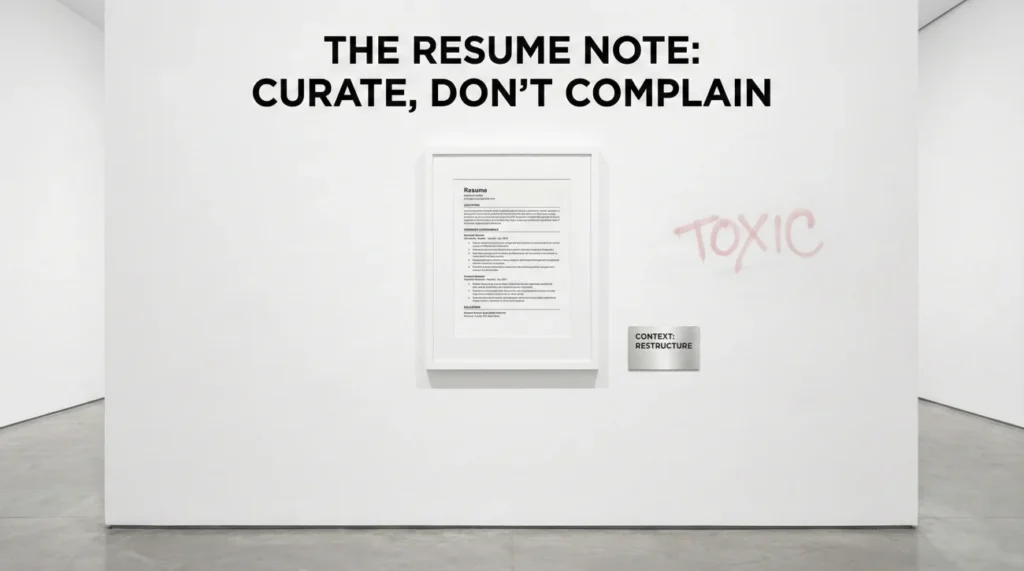
- If your resume already reads clean, you usually do not need a “toxic workplace” note.
- Add a note only when it prevents a predictable misunderstanding: Timeline confusion, ultra-short tenure, or a name change that triggers reference questions.
- The best note is neutral, closed, and boring. It signals: “This chapter ended. I am available.”
The Resume Problem: “Toxic” Is a Feeling, Recruiters Screen for Risk
I have reviewed a lot of resumes where someone clearly wanted to warn future employers about what happened. The intention is human. The effect is often the opposite: The resume starts to sound like an unresolved situation.
Most of the time, you do not need to explain anything on the resume. But there are a few moments where a single line can stop the wrong story from forming in a recruiter’s head. That is what this is about: A toxic workplace resume explanation line that protects clarity without turning your resume into a complaint letter.
⚠️ Warning: If you write “toxic,” “hostile,” “abusive,” or “unsafe,” many readers will immediately wonder: “Is there a conflict, a legal issue, or a pattern?” That may be unfair, but it is a common screening reflex.
What Recruiters Are Actually Trying to Solve When They See a “Bad Exit”
Recruiters do not need your emotional truth on page one. They need a stable narrative they can defend internally. When a resume includes a messy exit, they quietly test a few risk questions:
- Is this candidate still tied up in conflict, investigations, or references?
- Will the same friction show up again in our environment?
- Is the candidate fully available and emotionally steady right now?
- Is the timeline clean, or is something being hidden?
If your resume already answers those questions through structure and dates, you can usually skip a note. If your resume accidentally creates one of those doubts, a minimal line can help.
| Scenario | Do You Add a Note? | Why It Helps (Or Why It Hurts) |
|---|---|---|
| Normal tenure (1+ year), clean dates, clear next step | No | A note adds drama where none is needed. |
| Very short tenure (under 3 to 6 months) | Sometimes | One neutral clause can prevent “performance issue” assumptions. |
| Company rebrand, acquisition, or name change | Sometimes | A note can prevent reference confusion and duplicate employer checks. |
| Role ended quickly after restructure or leadership change | Sometimes | A neutral structural reason is easier to accept than silence. |
| You resigned after conflict, bullying, or a hostile environment | Rarely | Resume is not the place. Handle it in interview with a controlled script. |
Key Point: A resume note should solve confusion. If it does not solve confusion, it is just a signal that invites follow up.
A Quick Decision Checklist: Should You Add One Line Or Leave It Alone?

I use a simple test when coaching candidates through high-friction exits. If you answer “yes” to two or more of the questions below, consider a one-line note. If not, keep the resume clean.
- Will the reader likely assume you were fired because the job ended unusually fast?
- Does your timeline look confusing without context (overlap, gap, abrupt stop)?
- Will a background or reference check raise questions about the employer name or status?
- Does your next step depend on explaining why you left quickly (industry switch, geography, contract)?
- Can you write a reason that is structural, neutral, and closed in under 12 words?
- Can you describe it without implying a dispute, blame, or ongoing conflict?
- Can you say it with the same calm tone in an interview later?
💡 Pro Tip: The best resume note reads like an admin label. If it feels like a message to your old employer, it is too much.
Five Neutral Resume Notes That Do the Job Without Saying “Toxic”
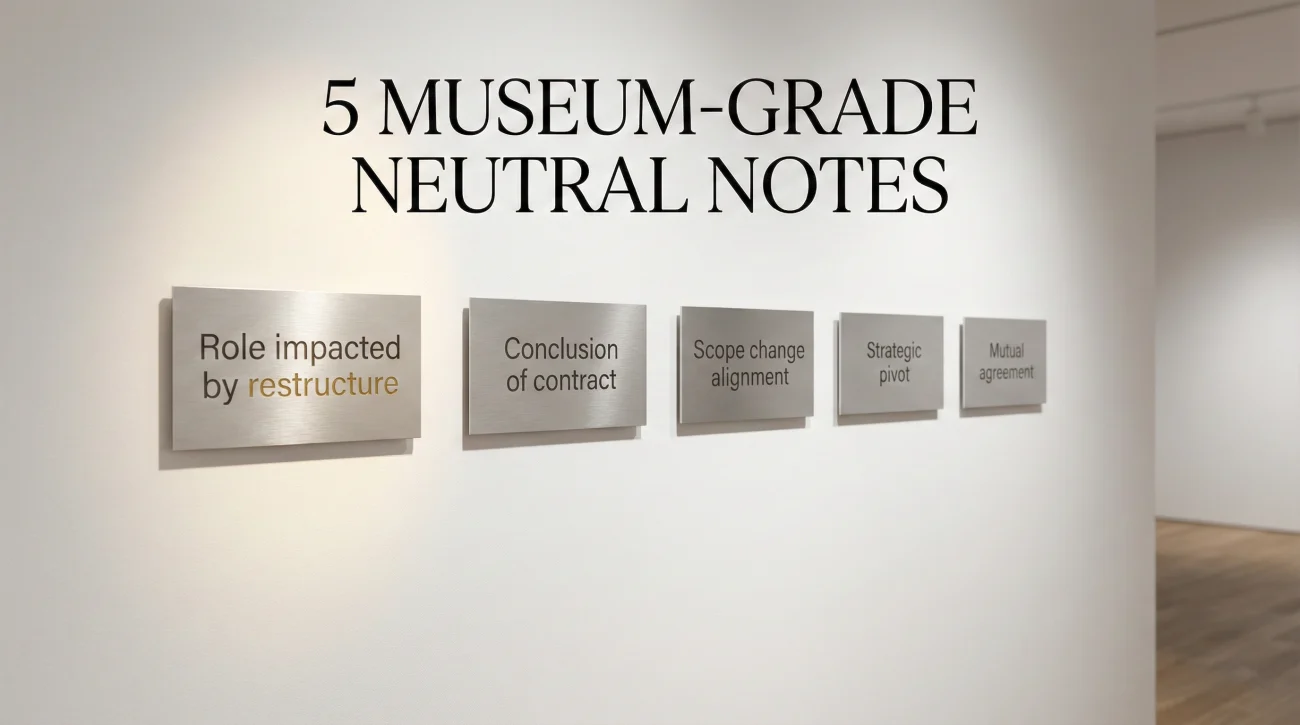
These are not magic phrases. They are templates that protect clarity. Your goal is to create a boring explanation that sounds finished.
First, one important reminder: A resume line for toxic workplace should never describe the workplace. It should describe the exit in a neutral, closed way.
1) When the tenure is short and you need a clean reason
This is the most common case where a tiny note can help. Without a note, a three-month role often gets interpreted as “did not work out.” You are not proving anything. You are preventing a predictable guess.
Role concluded after a team restructure and scope change.
2) When you resigned quickly because expectations changed
If the job you accepted was not the job you were assigned, you can describe the mismatch without blaming anyone. This is a good way to explain leaving toxic job on resume without turning it into an accusation.
Exited after role responsibilities shifted outside the agreed scope.
3) When you need to signal closure after a high-friction culture mismatch
Culture mismatch is often the safest umbrella, but it needs a closure signal so it does not sound like “I cannot work with people.” Keep it factual and short.
Left following a working-style mismatch; available for full-time roles.
4) When the company name triggers reference confusion
Sometimes the “toxic” part is not the story. The story is that the company dissolved, rebranded, or changed ownership, and you want to prevent awkward verification issues.
Employer renamed after acquisition; references available on request.
5) When you want a neutral line that does not invite follow-up
If you only want one sentence of toxic job resume wording, use a structural reason plus a calm availability signal. Do not add emotion. Do not add details.
Role ended due to a change in leadership priorities.
⚠️ Warning: “Leadership priorities” is safe when it is true and you can calmly repeat it in interviews. If you sound bitter when you say it out loud, pick a different line.
Five Notes That Backfire, Even If They Are True
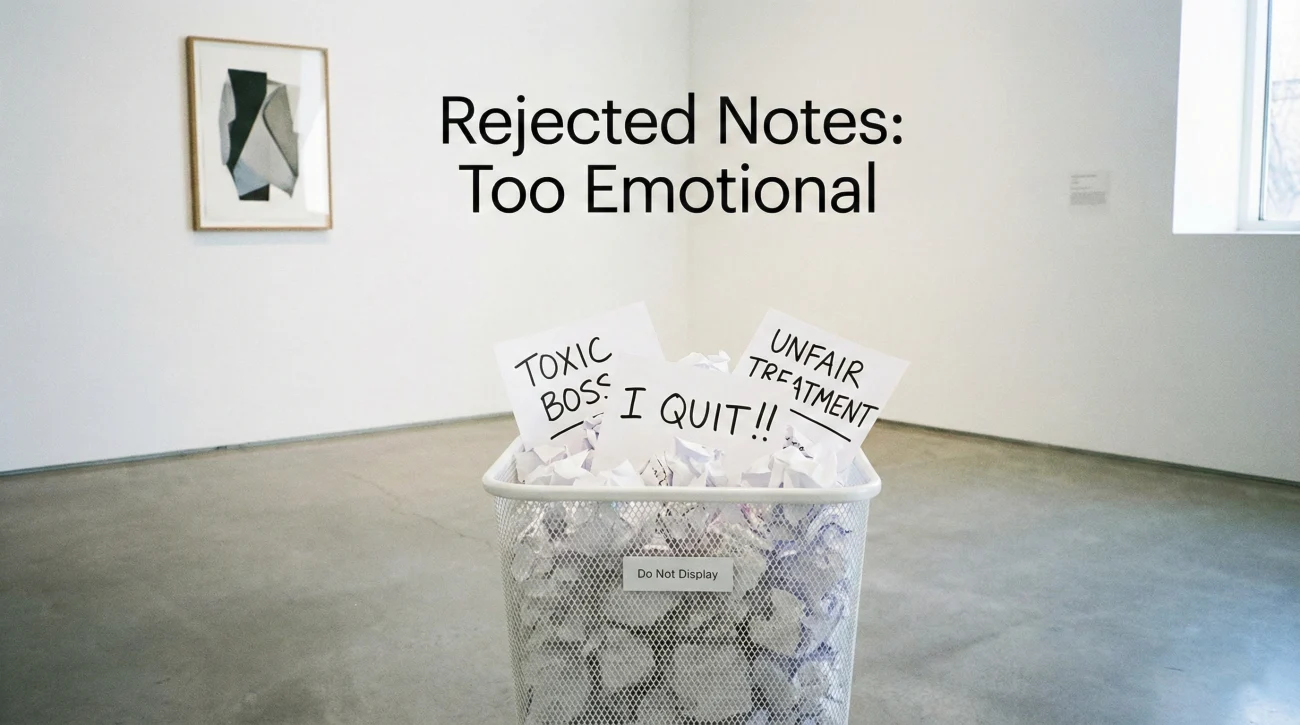
These lines create more questions than they solve. They also feel like you are recruiting the reader to take your side.
⚠️ Keep off the resume: If your “reason” sounds like a claim, a verdict, or an ongoing dispute, it creates risk questions before your skills get read.
1) Anything that sounds like a legal claim
Even when the situation was serious, the resume is not the place to name it. The reader cannot verify it, so it turns into follow-up.
❌ Example: “Left due to harassment” or “hostile environment.”
Save that wording for the correct formal process, not a one-line resume label.
2) Anything that sounds like a character verdict
Once you label the employer, the reader wonders whether you will label them next. It feels like conflict, not fit.
❌ Example: “Toxic culture,” “abusive boss,” “unethical leadership.”
If you need a neutral umbrella, use “role scope” or “working style,” then pivot to what you are choosing now.
3) Anything that implies you could not cope
Even good managers read this as a capacity question. The resume does not give you room to explain it responsibly.
❌ Example: “High stress,” “burnout,” “could not handle pressure.”
If health is relevant, you handle it with more control than a single line under a job title.
4) Anything that invites the reader to ask: “What happened?”
Vague reasons next to short tenure often increase suspicion. They make the reader fill in the blanks.
❌ Example: “Left for personal reasons.”
If you must add context, choose a structural reason that sounds closed, not mysterious.
5) Anything that describes people problems in detail
People drama on a resume usually reads like unresolved conflict, even if you were the reasonable one.
❌ Example: “Conflict with manager,” “team bullying,” “political environment.”
Save the nuance for the interview, where you can steer the story with calm tone and tight wording.
One more thing: If you are tempted to write a hostile work environment resume line, that is usually a sign you need a tight interview script, not a resume note.
Where the Note Goes (So It Looks Normal, Not Like a Warning Label)

A resume note should sit quietly. It should not be a headline. It should not be a paragraph. It should be a clause that reads like admin context.
Option A: A short clause under the role (best for short tenure)
Keep it to one line directly under the job entry, as shown in the examples above.
Option B: A micro-clarifier inside the date line (best for name changes)
Use the employer name field for rebrands or acquisitions. Do not turn it into a story.
A simple formula that keeps you honest:
[Neutral structural reason] + [Closure or availability signal]
💡 Pro Tip: The phrase “available for full-time roles” is powerful because it answers the unspoken concern: “Is this resolved?” Use it only if it is true.
If your note implies a dispute, remove it. If your note implies immaturity, remove it. The note should feel like a small label, not a warning sign.
Three Real-World Patterns I See Over and Over (And What Worked)
To make this practical, here are three situations that come up constantly when someone leaves a high-friction environment.
Hannah: The three-month role that looked like a performance problem
Hannah came to me with a resume she was proud of, except for one painful line: A role that lasted just under three months. She wanted to write a paragraph explaining why she left. That paragraph would have become the main thing anyone remembered.
We replaced it with a single neutral line about scope change. The interviews stopped focusing on “what happened,” and started focusing on her work again. The story did not disappear. It simply moved to the right place, where she could control it.
Douglas: A culture mismatch that turned into a “pattern” in screening
Douglas had two shorter tenures in a row. Not because he was unstable, but because he kept landing in chaotic teams that promised structure and delivered confusion. Recruiters were starting to treat it as a pattern.
He did not need to defend himself on the resume. He needed to show a consistent selection logic. We tightened the resume, removed emotional language, and used one calm line that signaled the exit was clean. The rest of the narrative went into his interview answer.
Karina: The workplace was bad, but the resume did not have to say it
Karina worked in a place where the manager created constant conflict. She wanted the resume to “warn” future employers. I understood why. I also knew what would happen: The resume would become about the manager, not about Karina.
We kept the resume clean. Then we built one interview bridge that sounded calm and closed.
“I realized the role was not the right long-term environment for how I do my best work. I left professionally, and I am looking for a team with clearer priorities and healthier collaboration.”
That answer did not ask the interviewer to pick a side. It simply described what she is moving toward.
If They Ask “Why Did You Leave?” Use a Two-Sentence Bridge
A resume note is only step one. If the exit was short or messy, someone may still ask about it. When that happens, you want a short bridge that avoids blame and signals stability.
Key Point: Your goal is not to prove the old place was wrong. Your goal is to prove you are steady, selective, and ready.
Here is a simple structure that works in most roles:
- Sentence 1: Neutral reason that sounds structural, not personal.
- Sentence 2: What you learned about fit, and what you are choosing now.
💡 Pro Tip: The calmer you sound, the less they dig. If your tone feels heated, practice it until it sounds like it happened a year ago.
If you keep the resume note neutral, the interview answer becomes easier. If you make the resume emotional, the interview starts from a defensive place.
One last phrase to avoid in both places is anything that sounds like a diagnosis of the organization. You are not an investigator. You are a candidate making a professional choice.
That is the real difference between a clean explanation and a story that follows you.
Final: A Resume Note Should Reduce Suspicion, Not Increase Curiosity
Leaving a bad environment is not a flaw. The risk is letting the resume carry the emotional weight of it. If your timeline is clean, say nothing and let your work speak. If your timeline invites the wrong assumption, add one neutral line that signals closure and availability.
The point of a toxic workplace resume explanation line is not to tell the story. It is to keep the story from hijacking your candidacy before you even get a conversation.
❓ FAQ
🧩 Should I write “toxic workplace” anywhere on my resume?
In most cases, no. The resume is a screening document, not a testimony. If you need context, use a neutral structural reason and a closure signal, not a label that implies conflict.
🕒 What if I was there only a few weeks?
If it is extremely short, you may choose to omit it if it does not create a suspicious gap and if it is not required for verification in your context. If you include it, keep the note boring and factual, and avoid anything that sounds like blame.
📌 Do I need a reason-for-leaving line for every job?
No. Adding reasons everywhere often makes the resume feel unstable. Use a note only when it prevents a predictable misunderstanding, such as short tenure or employer name confusion.
🧠 What is the safest “culture” wording if I get asked?
Use “working style,” “role scope,” or “team priorities” language, then quickly pivot to what you are looking for now. Keep it calm and closed, and do not describe personal conflict.
📄 Where should the note go so it does not look like a warning label?
Put it as a single line directly under the role entry, or as a micro-clarifier in the employer name if the issue is a rebrand or acquisition. Avoid bolding it, and avoid turning it into a paragraph.
⚠️ Disclaimer: ResumeSolving provides resume, cover letter, job search communication, and career transition guidance for informational purposes only. Hiring practices vary by employer, role, location, industry, and individual circumstances. We do not guarantee interviews, job offers, ATS results, or other outcomes. Verify employer requirements directly and follow applicable laws and workplace policies. For sensitive situations, use only information you are comfortable disclosing and keep all statements accurate.