- Application forms are classification tools, not confession boxes: You are being sorted into a bucket.
- Use one neutral reason everywhere, then add a closure signal so it reads like a finished chapter.
- Pick a short template that fits your situation, and avoid loaded phrases that trigger follow-up questions.
Why The “Reason For Leaving” Field Feels Like A Trap
If you are staring at an application form and freezing, you are not being dramatic. That little box is one of the few places where a hiring team can accidentally turn a normal job change into a “risk story” before they even meet you.
I have watched strong candidates talk themselves into extra scrutiny by writing a paragraph that belongs in a private journal, not in an ATS. The job application is not asking for the full truth. It is asking for a stable label that fits their internal categories.
In other words: The safest approach to the reason for leaving toxic workplace application question is to write like the form is a filing system, because it is.
Key Point: The goal is not to prove your workplace was toxic. The goal is to show you can exit professionally and arrive ready to work.
What The Form Is Really Classifying

Most application systems are trying to sort your last role into a small set of outcomes. Recruiters do not always love those categories, but the software forces them to use them. When your free-text answer fights the dropdown, the system flags you for follow-ups.
| Common form bucket | What it can imply to a reader | Safer free-text phrasing |
|---|---|---|
| Resigned | Voluntary exit, they will check maturity and professionalism | “Resigned after role expectations and operating style changed.” |
| Left for another opportunity | Normal move, but they want coherence with your career direction | “Moved on to find a team with clearer scope and stronger support.” |
| End of contract | Time-bound role, usually low drama if consistent | “Contract concluded, and I targeted a more stable long-term role.” |
| Termination | Performance or conduct concern, often triggers verification | Only use if accurate, then keep it neutral and short. |
| Other | Unclear, invites questions | Use only when dropdown forces it, then choose a clean label. |
⚠️ Warning: Writing “toxic workplace”, “hostile environment”, or “abusive manager” often reads like unresolved conflict. Even if true, it can trigger “Tell me more” loops you do not want on an application.
Three Consistency Rules That Prevent Extra Probing

Rule 1: Match the dropdown, then write one sentence that supports it
If the dropdown says “Resigned”, your text should not sound like you were fired. If the dropdown says “Other”, your text should not read like a legal complaint. The quickest way to get questions is to create a mismatch.
Rule 2: Use the same label across application, resume, and references
I have seen candidates lose momentum because their resume said “Resigned” while the application said “Management issues”, and then their reference said “Team conflict”. None of those are automatically disqualifying. The inconsistency is what creates doubt.
A colleague of mine helped a candidate named Brooklyn fix this after three rejections in a row. We replaced three different explanations with one stable line. The next two applications moved straight to recruiter screens, no extra forms, no awkward follow-ups.
Rule 3: Add a closure signal so it sounds finished
Even neutral reasons can sound ongoing if you forget closure. A closure signal is a small phrase that tells the reader this is resolved: “after a reorg”, “following a leadership change”, “once scope shifted”, “at the end of the project cycle”.
💡 Pro Tip: Think of your line as: [Neutral reason] + [Operational change] + [Forward focus]. It is short, boring, and that is exactly why it works.
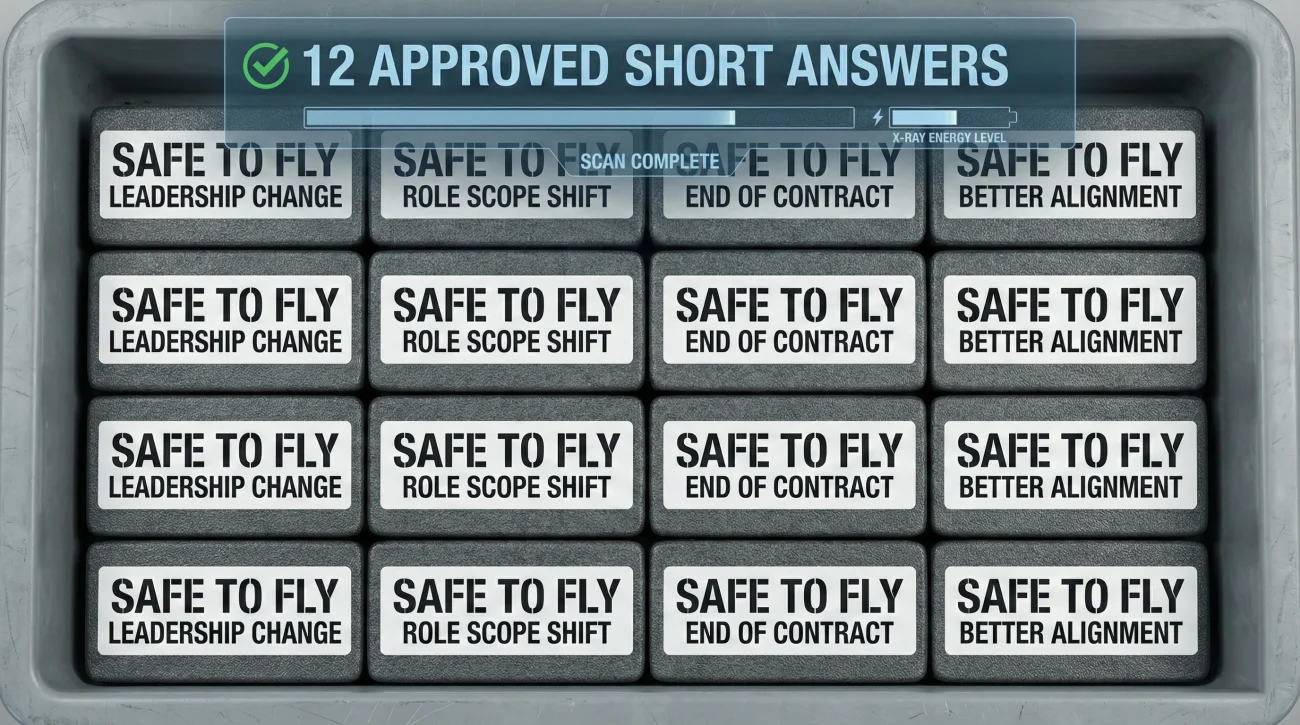
12 Short Answers You Can Use On Applications
These are built for small text boxes. Pick the one that matches your situation, then keep it consistent everywhere. Each template avoids blaming language, but still signals you left for a legitimate reason.
Scenario A: The environment changed, and your role stopped being workable
This fits when the job became chaotic, unsupported, or unpredictable. You are not claiming wrongdoing. You are describing operational reality.
“Resigned after a leadership change significantly altered expectations and support.”
“Resigned when role scope expanded without the resources needed to deliver.”
“Left after repeated workflow changes made the position unsustainable long-term.”
Scenario B: You needed clearer boundaries and healthier ways of working
This is the safer version of “toxic”. It frames the issue as fit and operating style, not personal conflict.
“Left to find a team with clearer boundaries and consistent communication norms.”
“Resigned to move into a workplace with stronger structure and decision clarity.”
“Left to pursue an environment with stable priorities and realistic timelines.”
Scenario C: Conflict existed, but you exited professionally
Sometimes there was real conflict. The key is to show you handled it like an adult and did not stay stuck in it.
“Resigned after it became clear the role was no longer a fit for the team’s direction.”
“Left after repeated misalignment on responsibilities and escalation paths.”
“Resigned once it was clear the working model did not match how I deliver best work.”
Scenario D: You left without another job, and you want to avoid panic signals
This is common after a tough environment. You do not need to explain your bank balance. You need to show control and readiness.
“Resigned to reset and pursue roles aligned with my strengths and working style.”
“Left to focus on a targeted search for a more stable and well-scoped position.”
“Resigned after role conditions changed, and I prioritized a structured next step.”
⚠️ Warning: If the form has a strict character limit, remove adjectives first, not meaning. Keep the “change” and “closure” pieces, then cut the rest.
Five Optional Add-Ons If The Form Allows One More Line
Only use these if the form gives you room. If it is a tight box, do not force it. The point is stability, not storytelling.
- Shift it forward: “Now targeting roles with stronger planning and clearer stakeholder alignment.”
- Signal professionalism: “Provided notice and completed transition documentation.”
- Make it operational: “The role changed materially after restructuring.”
- Show fit logic: “Seeking an environment that matches my delivery style and pace.”
- Close the chapter: “Situation resolved, ready for a stable long-term role.”
One candidate I worked with, Lina, used the “Provided notice and completed transition documentation” add-on after leaving a manager who was frankly chaotic. It did not magically erase the story. It did remove the interviewer’s fear that she leaves in flames.
What Not To Write, Even If It Is True

Some phrases are emotionally satisfying and strategically expensive. They tend to trigger probing, defensiveness, and “Tell me exactly what happened” follow-ups.
❌ Note: Avoid lines like “toxic workplace”, “hostile environment”, “abusive boss”, “bullying”, or “HR did nothing” in application forms. They read like unresolved conflict and can pull your application into a different review lane.
Instead, translate the core truth into something the form can handle: misalignment, operating style change, unclear expectations, unstable priorities, or lack of support structure. That is still honest, just written in the language that gets processed quickly.
If A Recruiter Asks For More Detail Later
Application forms should stay short. If you get to a human conversation, you can offer a little more context without sounding bitter. The trick is to keep it factual, brief, and future-facing.
“The role changed after a leadership shift, and the working style stopped being a fit for how I do my best work. I resigned professionally, completed a clean handover, and I am looking for a team with clearer scope and steady priorities.”
Notice what is missing: No name-calling, no courtroom language, no long timeline. Just a controlled explanation plus a clear picture of what you want next.
Final: Keep It Boring, Consistent, And Closed
The fastest way to stop the application form from turning into an interrogation is to treat it like a classification tool. Choose one neutral label, add a small closure signal, and keep the same wording across every step of the process.
Most of the time, the simplest version wins: reason for leaving toxic workplace application is not a place to prove you were right. It is a place to show you can leave a bad situation with control, and show up to the next role with stability.
❓ FAQ
🧩 Can I write “toxic workplace” if the company really was toxic?
You can, but it often increases follow-ups and pushes the reader toward a conflict narrative. A safer approach is to describe the operational issue: Unclear expectations, unstable priorities, or working style misalignment.
🛡️ What if the dropdown forces “Other”?
Use “Other”, then give a short neutral label that reads like a standard category: “Resigned after leadership change” or “Left due to role scope shift”. Avoid anything that sounds like an accusation.
🧠 How do I avoid sounding like I cannot handle pressure?
Do not talk about emotions in the form. Talk about structure: Resources, scope, decision clarity, priorities. That frames your exit as judgment, not fragility.
🎯 Should I use “career growth” even if the real reason was the environment?
Only if it is true and coherent with the role you are applying for. If it feels like a dodge, use a fit-based line instead: “Seeking clearer scope and steadier priorities”.
🧾 Do I need the same wording on my resume too?
You do not need a long explanation on your resume, but you do want consistency in the label. The risk is not the exit itself, it is three different stories across documents.
⚠️ Disclaimer: ResumeSolving provides resume, cover letter, job search communication, and career transition guidance for informational purposes only. Hiring practices vary by employer, role, location, industry, and individual circumstances. We do not guarantee interviews, job offers, ATS results, or other outcomes. Verify employer requirements directly and follow applicable laws and workplace policies. For sensitive situations, use only information you are comfortable disclosing and keep all statements accurate.