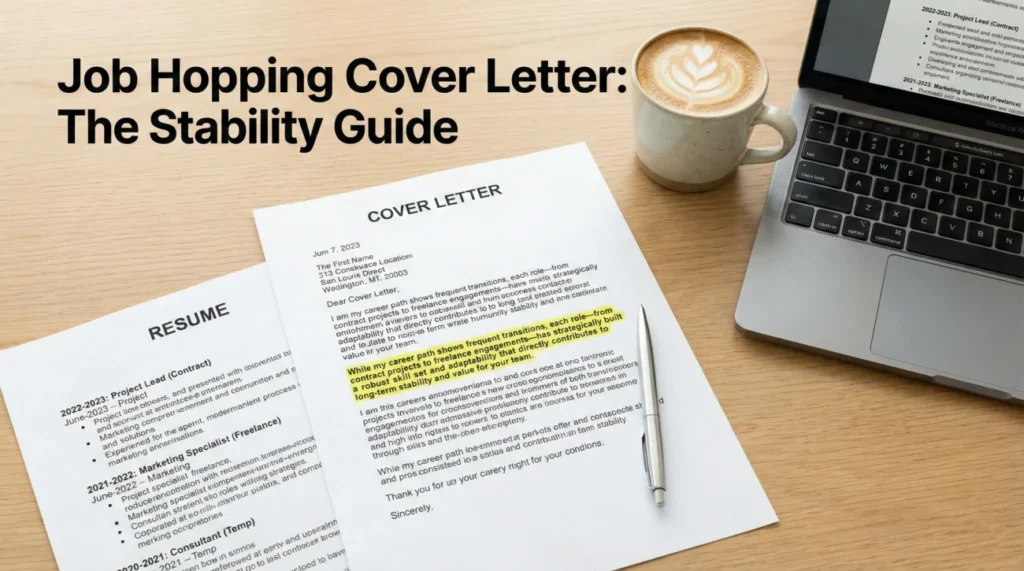
- Only address job hopping in a cover letter when the pattern is obvious or the posting explicitly asks for stability.
- A good paragraph has three parts: Neutral pattern label, Stability signal, Role-fit proof.
- Use one tight paragraph, not a story. The goal is to reduce risk, not to win sympathy.
The Moment A Recruiter Mentally Labels You “Short-Stint”: What Your Paragraph Must Fix
I have sat on hiring loops where we loved a candidate’s skills, then someone pointed at the dates and said, “They do not stay.” The room got quieter. Not because anyone thought the person was bad, but because short tenure creates a planning problem.
That is the real issue your cover letter is solving. Not morality. Not loyalty speeches. Planning. If your resume already reads like a sequence of quick exits, a job hopping cover letter paragraph can remove the biggest fear: “This will happen again here.”
One important caveat: Most candidates write far too much. A long explanation makes the pattern feel bigger. You want one tight paragraph that reads like a closed case file, not an open investigation.
Key Point: Your paragraph is not there to justify every move. It is there to signal stability, clarity, and fit in under 6 seconds.
When A Job Hopping Paragraph Helps, And When It Backfires
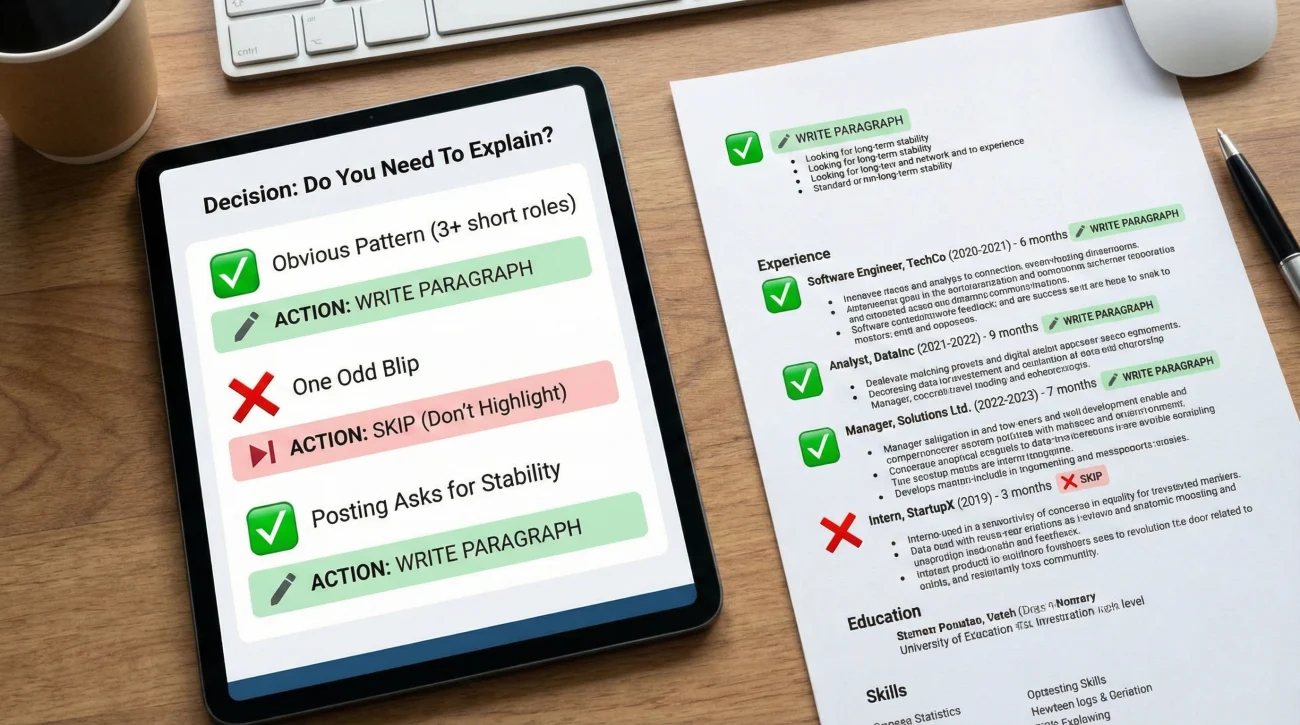
Use it when the pattern is the first thing a stranger sees
If your last three roles are under a year, or if you have repeated 6 to 10 month stints, a recruiter does not need to “dig” to notice. The pattern is already doing damage. This is when a paragraph can be a net positive.
- Three or more short stints in a row.
- Repeated exits right before 12 months.
- Roles that look voluntary, but were actually structural changes (reorg, acquisition, budget freeze) and your resume does not show that.
- A posting that explicitly asks for “commitment,” “long-term,” or “stability” and you know they will scrutinize tenure.
Skip it when you only have one odd blip
If you have one short role and everything else is stable, explaining it in the cover letter can accidentally spotlight it. In that case, be ready to answer in an interview, but do not pre-announce it.
⚠️ Warning: If your paragraph reads like you are trying to convince them you will not leave, you are already confirming the fear.
Do not use the cover letter as a timeline defense document
I watched a candidate turn a manageable situation into a red flag by listing every employer and giving a mini-excuse for each. The hiring manager’s reaction was blunt: “If it takes this much explaining, what else is messy?”
The Three-Part Framework That Keeps Your Paragraph Calm
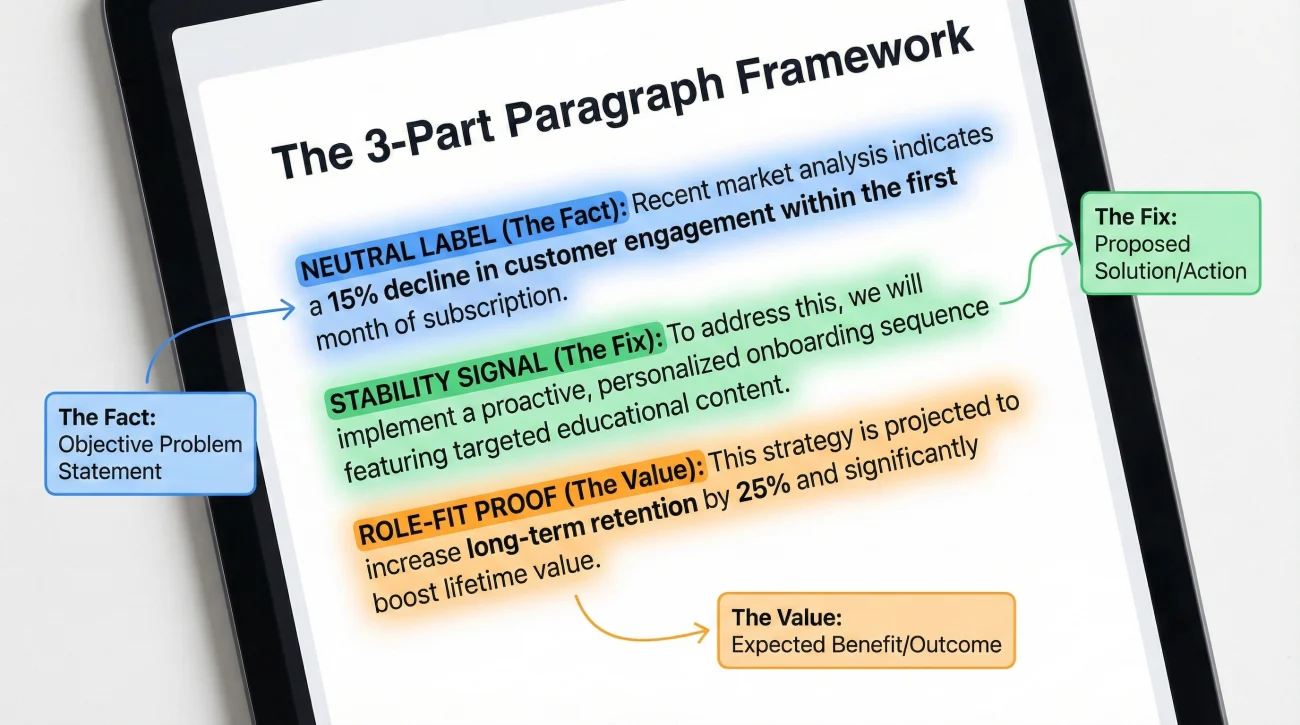
When people say “keep it short,” they rarely tell you what to include. Here is what I use when coaching candidates who have real pattern risk and cannot ignore it.
[Neutral Pattern Label] + [Stability Signal] + [Role-Fit Proof]
Part 1: Neutral pattern label
Name the pattern without drama. No apologies. No self-criticism. You are simply preventing a wrong story from forming.
- Good: “My recent roles were a mix of short, project-based engagements and fast-moving environments.”
- Bad: “I know I look like a job hopper and I feel terrible about it.”
Part 2: Stability signal
This is the line most articles miss. Recruiters need one concrete reason the next role will last. Not a promise. A structural change.
Examples of stability signals that do not sound needy:
- A clear reason your search criteria is different now (team type, scope, industry, company stage).
- A commitment anchor you can prove (location settled, role level aligned, contract cycle completed).
- A selection filter that reduces repeat mismatch (mission fit, manager style, core responsibilities).
Part 3: Role-fit proof
Finish with competence. One strong sentence that makes the reader think, “Even if the timeline was messy, this person can do the work here.”
💡 Pro Tip: If you include numbers, include only one. Over-metricizing a paragraph can feel like you are trying too hard.
Template 1: The “Pattern Clarification” Paragraph (Most Candidates Need This One)
This is the safest template when the pattern is real, but the explanation is boring and structural. It is also the best fit for people who need a cover letter explain job hopping line without sounding defensive.
How to customize without overexplaining:
- Replace “short, high-intensity environments” with your true category: early-stage startup, contract cycle, reorg-heavy company.
- Pick one stability signal that is not emotional.
- Pick one proof that aligns with the job posting.
Template 2: The “This Time Is Different” Paragraph (Use Only If You Have A Clean Pivot)
Use this version when your next step is structurally different from the last few moves, and you can explain that difference in one sentence. This is especially useful for a short stints cover letter paragraph when your short tenures came from mismatch, not performance.
⚠️ Warning: Do not claim “long-term” if you cannot say what makes it long-term. The structure is your evidence.
Sentence Bank: Swap In One Line Without Sounding Like You Are Begging
These are plug-and-play lines I have seen work because they sound like a decision, not a plea. Pick one from each category.
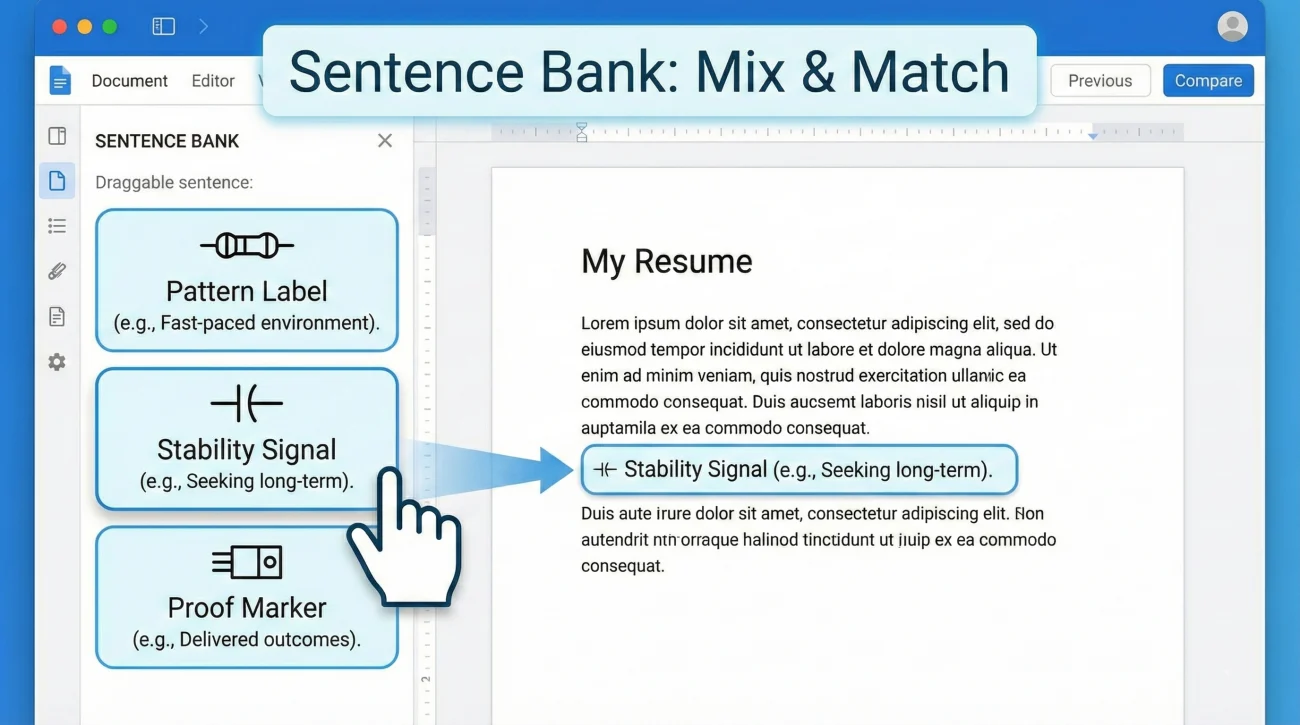
Neutral pattern labels
- “My recent roles were in fast-changing environments, so the timelines look tighter than a traditional path.”
- “Several of my recent positions were time-bound or scope-specific, which compresses tenure on paper.”
- “The last few years included a period of intentional exploration across [industry or function], which clarified my target.”
Stability signals
- “I am now prioritizing a stable roadmap and a clearly owned scope, because that is where my work compounds.”
- “My search is intentionally narrower: [team type] with [scope], rather than generalist roles.”
- “I am looking for a role where I can own outcomes over multiple cycles, not just deliver quick fixes.”
Role-fit proof lines
- “Most recently, I improved [metric or process] by [result], and I am excited to do the same in this role.”
- “I am strongest when I can drive [responsibility], and your posting highlights exactly that need.”
- “I have delivered [proof] in messy conditions, and I am motivated by the scale of the work your team is doing.”
What Not To Say: The Phrases That Make Recruiters Think You Will Leave Again
A lot of cover letter advice accidentally creates more doubt. Here are the lines I routinely cut, and what they signal.
| Do not write this | What it accidentally signals | Safer swap |
|---|---|---|
| “I promise this is my last move.” | You are making a promise because you do not have a reason. | “I am targeting a stable scope and long-range roadmap, which is why this role fits.” |
| “I had bad luck with companies.” | You blame external factors and sound unpredictable. | “Several roles were in fast-changing environments, and I am now prioritizing stability.” |
| “I left because my manager was toxic.” | Even if true, it reads like conflict risk. | “I am looking for a team with clear priorities and strong operating rhythm.” |
| “I am desperate for a stable job.” | Neediness can feel like low selectivity. | “I am intentionally narrowing my search to roles like this where scope and impact match.” |
❌ Note: If your paragraph includes more than one negative adjective about past employers, rewrite it. One neutral sentence is enough.
Real Scenarios: How I’ve Seen Candidates Use One Paragraph Without Over-Explaining
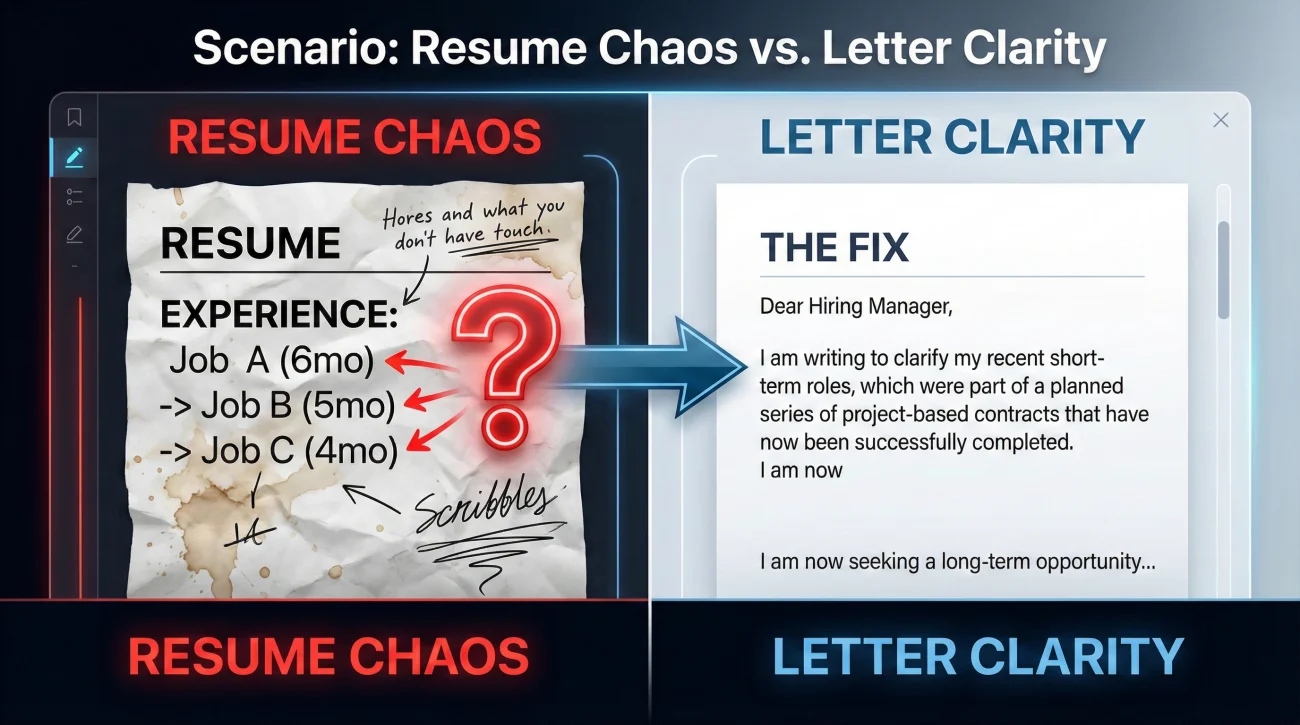
Scenario 1: Contract and project cycles that look like quitting
A candidate named Damiel worked in analytics. His resume looked like he “couldn’t stick” because several roles ended around 9 to 10 months. The missing context was simple: contract cycles and renewals.
We used a neutral label plus a stability signal: “I am now targeting a permanent role.” The result was fewer screening objections because recruiters stopped guessing.
Scenario 2: Early-stage startup churn
My colleague Rafael recruits for product roles. He told me the fastest way to lose him is to write a long excuse about startups. He does not need the story. He needs to know what you are choosing now.
In this case, “I am now prioritizing a stable roadmap and clear ownership” does more work than any detailed narrative.
Scenario 3: Repeated scope mismatch (the “wrong job” problem)
Mina moved twice in two years because her roles kept shifting from strategy to execution-heavy support. Her paragraph did not mention any conflict. It focused on what she learned about scope, and why the current posting matched her selection filter.
This is the cleanest way to handle a many job changes cover letter situation when the truth is: you were still calibrating.
Scenario 4: One short stint that happened to sit next to another short stint
Sometimes the pattern is not your behavior. It is the timeline optics. Two short tenures in a row can happen from a layoff followed by a mismatch. In those cases, one line that separates the causes is enough, and then you move on.
💡 Pro Tip: If one move was involuntary, label it neutrally: restructure, reduction, role ended. Do not litigate it.
How To Keep It One Paragraph Without Losing Credibility
This is the rule I give candidates: If it cannot be read in one breath, it is not a paragraph, it is a confession.
- Target 55 to 85 words.
- One cause category only. Do not list three reasons.
- One stability signal only. Pick the strongest.
- One proof marker only. Make it relevant.
⚠️ Warning: Avoid listing employer names in the paragraph. The cover letter is not a second resume.
Final: A Good Paragraph Makes Your Timeline Boring Again
If you have a visible pattern of short stints, your goal is not to convince someone you are loyal. Your goal is to remove uncertainty. Name the pattern neutrally, give one concrete reason the next move is structurally different, then land on proof.
When you do it right, the reader stops imagining drama and starts assessing fit. That is the point of a job hopping cover letter paragraph: It closes the risk story so your skills can finally be the main story.
❓FAQ
🧭 Should I address job hopping if no one asked?
Only if the pattern is obvious at a glance or the role emphasizes stability. If it is one odd blip, a cover letter explanation can magnify it.
🧩 Can I mention a toxic manager as the reason I left?
I would not. Even when true, it reads like conflict risk. Convert it into a forward-looking preference: Clear scope, stable roadmap, healthy operating rhythm.
🧪 How long should the paragraph be?
Keep it to one tight paragraph, ideally under 85 words. If you need more, your resume structure or interview story should carry the extra detail instead.
🛠️ What if my short stints were contracts?
Say so, neutrally. “Time-bound engagements” or “project-based work” is usually enough, then add a stability signal like targeting a permanent scope.
📌 Should I promise I will stay for years?
No. Promises without structure sound insecure. Instead, explain what is different about the role you are pursuing now and why it matches how you work best.
⚠️ Disclaimer: ResumeSolving provides resume, cover letter, job search communication, and career transition guidance for informational purposes only. Hiring practices vary by employer, role, location, industry, and individual circumstances. We do not guarantee interviews, job offers, ATS results, or other outcomes. Verify employer requirements directly and follow applicable laws and workplace policies. For sensitive situations, use only information you are comfortable disclosing and keep all statements accurate.