- This question is not about perfection. It is a test of ownership, judgment, and whether you build repeatable fixes.
- Pick a mistake that is real but containable, then anchor it to a change in process, not a dramatic personality confession.
- Answer once, cleanly. Then be ready for follow-up questions that try to push you into oversharing.
Why “What Did You Do Wrong?” Feels Like a Trap
If you have ever frozen on this question, you are not alone. I have watched strong candidates stumble here, not because they lacked competence, but because they answered the wrong question. The interviewer is rarely asking for a dramatic confession. They are asking whether you can see your own role, describe it calmly, and show that you can prevent a repeat.
This guide is about how to answer what did you do wrong interview without sounding defensive, reckless, or strangely proud of your own mistake. You will get five accountability patterns, ten safe phrases, and a follow-up playbook for the second question that usually comes next.
One quick story. A candidate I will call Tréasa (mid-level operations) once answered this with a long explanation about a difficult stakeholder and a broken process. She was not lying. The environment really was messy. But the room went cold because the answer did not include a single sentence about what she controlled. We rewrote it into three lines. Same truth, less heat. Two rounds later, she got the offer.
What Interviewers Are Actually Testing
In hiring debriefs, this question is often shorthand for three separate checks. If you answer like it is only about “learning,” you miss the other two.
| What they are listening for | What it sounds like in a good answer |
|---|---|
| Ownership | You name your part clearly, without blaming the team or the company. |
| Judgment | You chose a mistake that is real, containable, and relevant to the role you want now. |
| Change loop | You describe a fix that has a mechanism: A checklist, a review step, a trigger, a metric. |
Here is the part most content skips. Your mistake is not the headline. Your decision-making is the headline. The mistake is just the evidence.
Key Point: The safest answer names a specific misstep, then shifts quickly into how you corrected the system that allowed it.
A colleague of mine in finance recruiting once told me she can forgive a mistake faster than she can forgive vagueness. “I was stretched thin” is vague. “I did not confirm the approval threshold before sending the quote” is clear. Clear is coachable, and coachable reads as safe.
Mistake Sizing: Pick a Real Mistake That Will Not End Your Candidacy
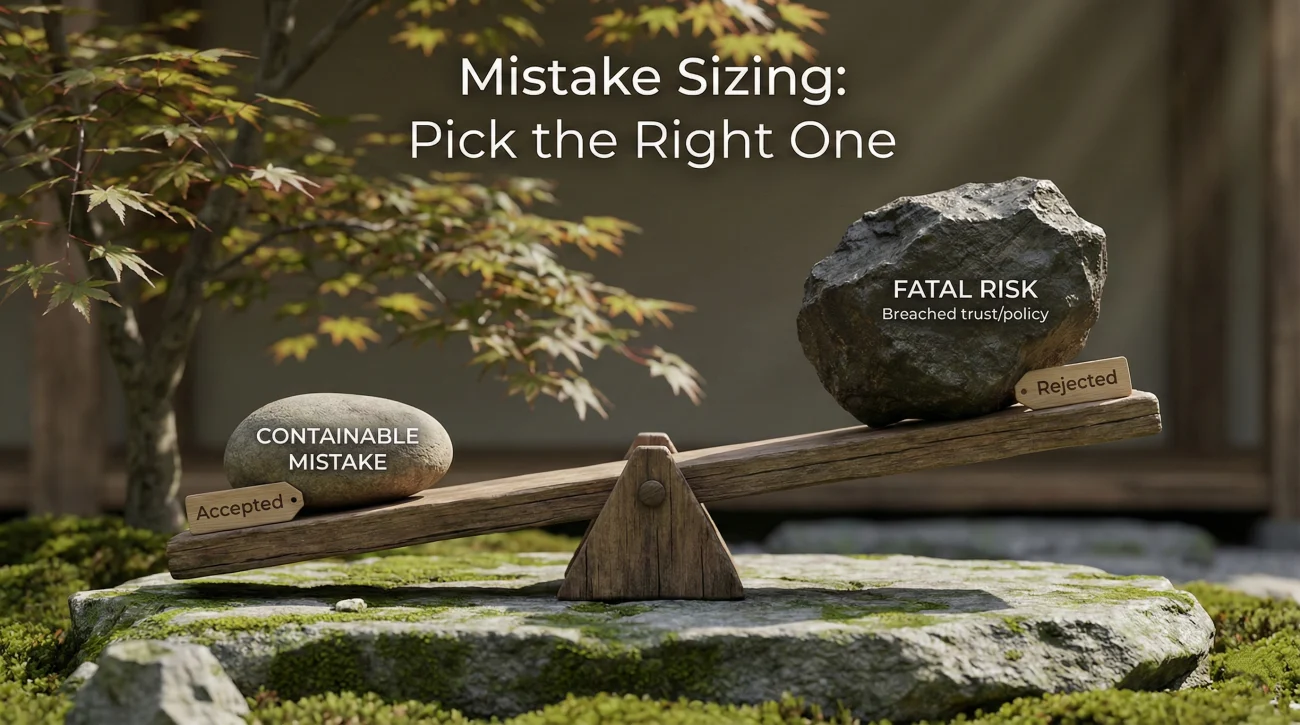
The most common failure mode is picking the wrong size mistake. Too big and you trigger risk alarms. Too small and you look performative. This is why generic advice like “pick something light” can backfire.
A Sizing Rule That Works Across Roles
Choose a mistake with three properties. First, it was reversible or containable once you noticed it. Second, it taught a skill that matters to the role you want now. Third, it has a prevention mechanism you can explain in one sentence.
Containable does not mean trivial. It means the impact was limited and you handled it quickly. A clean example is “I sent a proposal without confirming the latest scope,” not “I missed an email.” The first shows judgment and repair. The second can sound like you are trying to dodge the question.
- It was reversible or containable once you noticed it.
- It taught a skill that matters to the role you want now.
- It has a specific prevention mechanism you can explain in one sentence.
⚠️ Warning: Avoid anything that implies you broke trust, violated policy, or mishandled sensitive data. Even if you fixed it, the interviewer cannot “unhear” the risk.
Mistakes That Usually Create Unhelpful Risk Signals
These are not “never say this” in every universe. But in real hiring loops, they often create more questions than they answer, especially when the role involves client trust, money, compliance, or access.
If you describe a mistake that touches confidentiality, security shortcuts, or questionable approvals, you might be telling the truth and still lose the offer. Hiring teams often cannot separate “one-time slip” from “this could happen here.” That is why sizing matters.
- Anything that sounds like financial impropriety, even accidental.
- Anything involving confidential information, security, or compliance shortcuts.
- Anything that frames you as careless with clients, deadlines, or quality controls.
When candidates get stuck, I ask a reframing question: What did you misjudge? That usually leads to a safer story than “What did you mess up?” because it keeps the answer professional and decision-focused.
The 5 Accountability Patterns You Can Reuse
Think of these as five “shapes” your answer can take. You are not memorizing lines. You are choosing a shape that matches what actually happened, then keeping it tight.

Pattern 1: The Assumption Check
This is the cleanest option when your mistake was moving forward on a belief that should have been verified. It is common in project work, stakeholder-heavy roles, and any environment where priorities move.
“I assumed the stakeholder priorities were unchanged and moved forward with the original plan.
The part I got wrong was not re-confirming priorities before committing resources.
I corrected it by adding a short alignment check before kickoff and documenting sign-off points.”
Pattern 2: The Communication Gap (Owned, Not Blamed)
This one is about the moment you chose silence over clarity. People often say “miscommunication” like it fell from the sky. A stronger answer names the exact decision: You did not clarify early enough, and it created avoidable risk.
What if the interviewer pushes: “So why did it happen at all?”
You keep it simple. You waited too long to confirm expectations. Then you mention the new trigger you follow now, like a written recap after a meeting, a checkpoint at a milestone, or an escalation rule when timelines shift.
Pattern 3: The Process Upgrade
This is the pattern that makes hiring managers relax. It turns the story from “I messed up” into “I improved the mechanism so it does not rely on memory.”
“I should have caught that earlier. I did not have a second review step, and I owned that gap. I added a peer check for high-impact items so the process does not rely on one person’s memory.”
The key is tone. Calm, specific, and boring in the best way. No self-insults, no moral drama, just ownership and a fix.
Pattern 4: The Calibration Lesson
This works when you pushed too hard in one direction, speed, urgency, or independence, and you learned to adjust. It is not a personality confession. It is a judgment story.
A clean version sounds like: You optimized for speed when the situation required clarity. Then you name the behavior you changed, such as aligning on success criteria before pushing deadlines or checking impact before escalating urgency.
Pattern 5: The Boundary and Escalation Call
Sometimes the environment is messy and that is real. This pattern keeps the truth while still owning the part that was yours: You did not escalate early enough, you accepted unclear requirements, or you tried to absorb risk alone.
One candidate I coached, Paolo, worked at a startup where priorities changed daily. His mistake was not the chaos. His mistake was pretending he could absorb it alone. His fix was creating a weekly risk log and escalating conflicts early. The hiring manager liked it because it sounded like leadership, not complaining.
10 Safe Phrases That Answer the Question Without Triggering Red Flags
Most people lose points here because of tone. They either minimize the mistake, or they over-confess. These options keep you in the “calm ownership” zone. They also help you explain how to talk about a work mistake without blaming others.
| Phrase | How to use it in a sentence that feels real |
|---|---|
| “The part I got wrong was…” | Follow it with one controllable behavior, then one prevention mechanism. Keep it factual. |
| “I made an assumption that should have been verified.” | Great for stakeholder work. Immediately name what you now verify and when. |
| “I should have escalated earlier, and I did not.” | Pair it with a trigger: What now tells you it is time to escalate. |
| “I validated too late instead of validating upfront.” | Works in product, ops, marketing. Shows you moved validation earlier. |
| “I optimized for speed when I should have optimized for clarity.” | Use when you rushed alignment. Then say how you define “done” now. |
| “I did not define ‘done’ early enough.” | Turn ambiguity into professionalism. Add how you confirm success criteria now. |
| “I relied on memory instead of a checklist.” | Simple and credible. Mention the checklist, not the whole checklist content. |
| “I over-indexed on my own perspective.” | Keep it concrete: What input do you now collect earlier. |
| “I did not reconfirm priorities after the scope changed.” | Excellent for messy environments. Names a decision point you own. |
| “I fixed it by changing the mechanism, not just working harder.” | Use as a closer line. It signals repeatable improvement, not burnout heroics. |
💡 Pro Tip: If you are unsure which phrase fits, pick the one that leads naturally into your prevention mechanism. The prevention mechanism is what makes the answer feel safe.
The Follow-Up Playbook: What They Ask Next, and How to Stay Steady
This question rarely lives alone. Interviewers often use it to open a tunnel of follow-up questions. If you prepare only the first answer, you will still feel ambushed.
Think of follow-ups as a pressure test. They are not always trying to be harsh. Sometimes they just want to see if your story stays consistent when they poke at it. Consistency is a hiring signal.

Follow-Up 1: “What would you do differently today?”
Answer with one decision and one mechanism. Do not list five improvements. One is enough, if it is real. A clean structure is: “I would do X earlier, and I now do it by Y.”
If you ramble here, it can sound like you are reverse-engineering an answer in real time. Keep it simple and repeatable, as if you are describing a habit you already have.
Follow-Up 2: “How do I know it will not happen again?”
This is where you mention a trigger, a checklist, or a review step. Keep it short. This is not a process lecture. You want the interviewer thinking: “That sounds reliable.”
Examples of reliable mechanisms are: A required sign-off point, a recurring check-in, a peer review for high-impact work, or a metric you now monitor. Pick one that matches your story.
Follow-Up 3: “Was anyone else involved?”
Be careful. You can acknowledge context without distributing blame. A clean line is: “Others were involved, but my part was X, and that is what I changed.”
That sentence does two things. It answers the question directly, and it tells the interviewer you do not default to blaming when things get messy. That matters more than people realize.
Two Complete Sample Answers You Can Adapt
I am giving two versions because candidates get hired with different tones. Pick the one that matches your style and your level. Both are short on purpose, because short answers are easier to keep consistent under follow-up pressure.
Sample 1: Mid-Level Candidate, Project Coordination Mistake
“The part I got wrong was assuming the priorities were the same as the prior quarter.
I moved forward without reconfirming, and that created rework when the stakeholder focus shifted.
I corrected it by adding a short alignment check before kickoff and documenting sign-off points so changes surface early.
This version answers the question, then shows you build systems. It is also safe because it avoids trust, compliance, and confidentiality landmines.”
Sample 2: Senior Candidate, Leadership Calibration Mistake
“I pushed urgency too hard in a cross-functional project and did not pause to confirm what “success” looked like for each team.
The result was speed without alignment, and I owned that because it was my job to set the tempo and define “done.”
Since then, I start major work with a short success-metrics check and a risk log so teams stay aligned when scope changes.”
Notice what is missing. No self-insults, no dramatic guilt, no vague “I learned a lot.” The answer is calm, specific, and future-safe.
Final: A Calm Answer Beats a Perfect Story
Here is what I want you to remember the next time someone asks “What did you do wrong?” and you feel your stomach drop. You are not being graded on having a pretty story. You are being graded on whether you are safe to trust with work.
Safe sounds like this: You name your part without wobbling. You describe the impact without dramatizing it. Then you show the mechanism that prevents a repeat. When candidates do that, interviewers stop chasing for more and start moving on.
If the room gets blunt, treat it like a small crisis moment. Stay factual, stay steady, and keep your answer tight. That is the heart of how to answer what did you do wrong interview when you want confidence, not over-explaining.
❓FAQ
🎯 What if I truly believe I did not do anything wrong?
Do not say “Nothing.” Instead, name a judgment call you would refine. For example: You could say you would clarify expectations earlier, confirm priorities sooner, or escalate a risk earlier. You are showing self-awareness without inventing a disaster.
🧠 Should I pick a small mistake to be safe?
Small is fine if it still shows judgment and a prevention mechanism. If the mistake is so tiny it sounds fake, it can read as avoidance. Aim for containable, not trivial.
🧯 What if the situation was mostly someone else’s fault?
Own your decision point. You can acknowledge context in one line, then anchor the answer to what you controlled. The phrase “My part was…” keeps you out of blame language.
🧾 How long should the answer be?
Usually 20 to 40 seconds for the first answer. If they ask follow-ups, add one mechanism per follow-up. Long answers tend to create new risks.
🔎 Can I use a mistake that happened years ago?
Yes, if it still maps to a relevant skill and your fix is still how you work today. If it is too old and no longer connected to the role, it can feel like you are reaching.
⚠️ Disclaimer: ResumeSolving provides resume, cover letter, job search communication, and career transition guidance for informational purposes only. Hiring practices vary by employer, role, location, industry, and individual circumstances. We do not guarantee interviews, job offers, ATS results, or other outcomes. Verify employer requirements directly and follow applicable laws and workplace policies. For sensitive situations, use only information you are comfortable disclosing and keep all statements accurate.