- Toxic workplace stories trigger three recruiter fears: drama magnet, blame tendency, conflict problems. Your answer must counter all three.
- The goal is not lying. It is translating toxic reality into professional language that stays factual without sounding bitter.
- Never use the word “toxic.” Describe conditions and mismatches, not character judgments.
The Negativity Trap
You left a genuinely terrible job. The manager was abusive. The culture was dysfunctional. The expectations were impossible. Anyone who worked there would have left too. Now you are in an interview, and they ask why you left your last job.
Here is the trap: telling the truth sounds like complaining. Interviewers hear “my manager was terrible” and think “this person blames others.” They hear “the culture was toxic” and think “this person might be the problem.” They hear detailed accounts of dysfunction and think “this person will badmouth us too someday.”
A project manager named Diana left a job where her director publicly berated team members in meetings, changed priorities weekly, and took credit for her work. Everything she said was true. But in interviews, her detailed explanations of these problems made her sound bitter and difficult. She was rejected from six opportunities before realizing the issue was not her experience – it was how she was describing it.
We rebuilt her answer using neutral language that described conditions without accusations. Same facts, different framing. “The leadership style created an unpredictable environment that made it difficult to deliver consistent results. I’m looking for a team with clearer priorities and more collaborative decision-making.” She received an offer within three weeks.
Understanding toxic workplace interview answer challenges means understanding that interviewers cannot verify your story. They only know how you tell it. Your tone and word choice become the evidence they use to predict how you will behave as their employee. Fair or not, the way you discuss past problems reveals more about you than the problems themselves.
What Recruiters Fear When You Mention Workplace Problems
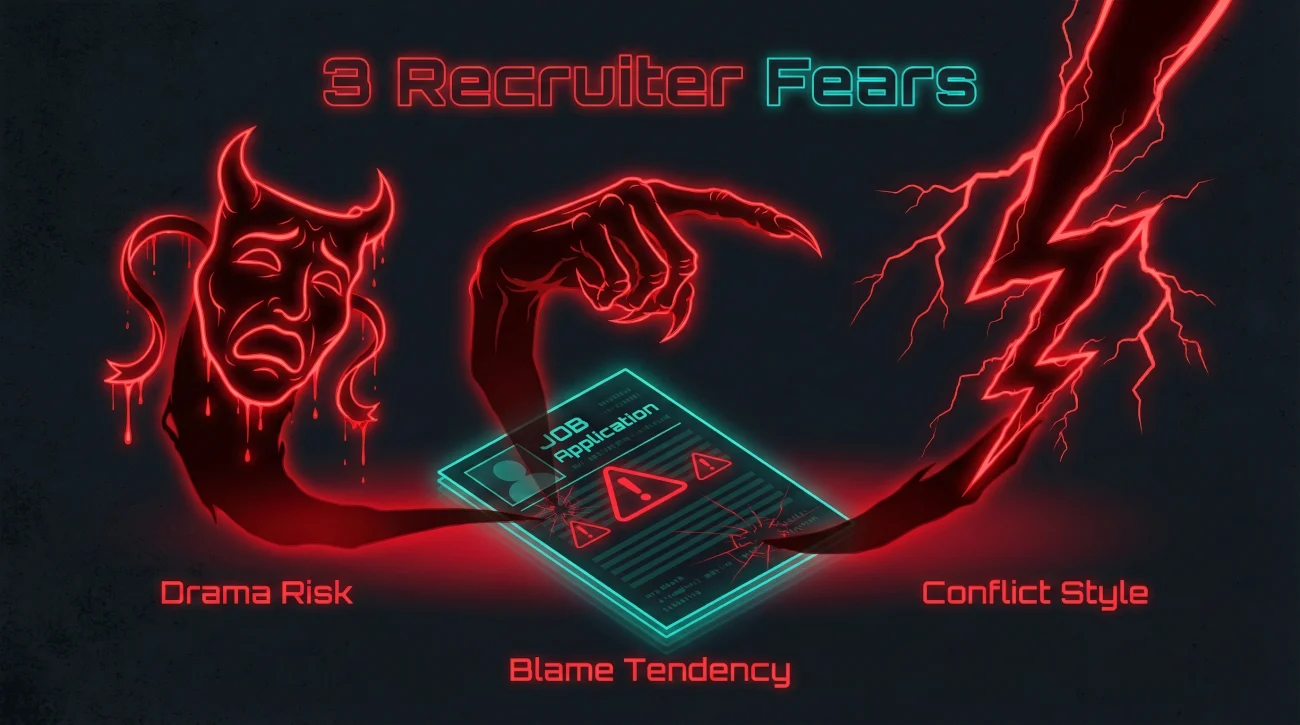
Three specific concerns activate when candidates discuss negative workplace experiences. Understanding these fears helps you craft answers that address them implicitly:
🎭 Drama Risk. Will this person bring conflict into our team? Detailed stories about workplace dysfunction, especially those involving interpersonal conflict, suggest someone who gets involved in drama. Even if you were the victim, extensive focus on negative experiences makes recruiters wonder if you attract or escalate problems.
👆 Blame Tendency. Does this person take ownership or point fingers? When everything that went wrong was someone else’s fault – the manager, the culture, the leadership – recruiters question whether you will ever take accountability for your own performance issues. Even legitimate blame sounds like a pattern when it dominates your narrative.
⚔️ Conflict Style. How will this person handle disagreements here? Your description of past conflicts reveals how you process and discuss interpersonal problems. Bitter, detailed accounts suggest you might handle future conflicts the same way – by venting to others and holding grudges.
Your answer must implicitly address all three concerns: you are not dramatic, you take appropriate ownership, and you handle conflict professionally.
Tone-Risk Checklist
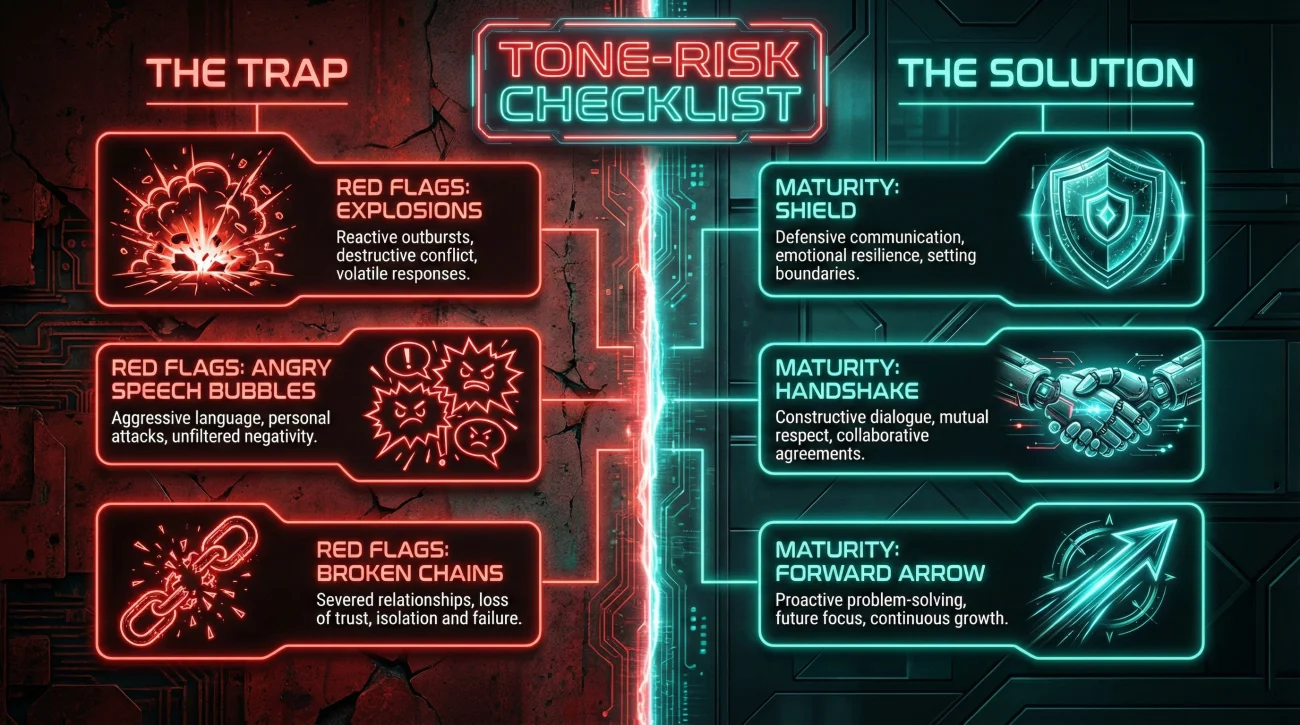
Before any interview, audit your prepared answer against these signals:
🚩 Red Flags That Signal Problem Employee
- 🚩 Using the word “toxic” or “hostile”
- 🚩 Naming specific people as villains
- 🚩 Detailed stories of specific incidents
- 🚩 Emotional language: “unbearable,” “nightmare,” “abusive”
- 🚩 More than 30 seconds on the negative situation
- 🚩 No acknowledgment of any positives or learnings
- 🚩 Suggesting you were the only one who saw the problem
- 🚩 Implying legal or HR issues without being asked
✅ Signals That Suggest Professional Maturity
- ✅ Neutral, factual descriptions of conditions
- ✅ Focus on mismatch rather than wrongdoing
- ✅ Brief acknowledgment, then pivot to what you want
- ✅ Taking some ownership: “I learned I need…”
- ✅ Forward-looking language about your target environment
- ✅ Calm, matter-of-fact tone throughout
💡 The 30-Second Rule: Your explanation of why you left should take no more than 30 seconds. Everything after that is you processing your feelings, not answering their question.
Translation Table: Toxic Reality to Professional Language
You are not lying. You are selecting words that describe the same facts without triggering defensive reactions. The goal is accuracy without accusation. Here is how to translate common toxic experiences into interview-safe language:
| Toxic Reality | Professional Translation |
|---|---|
| “My manager was abusive and yelled at people” | “The management style wasn’t a fit for how I work best” |
| “The culture was toxic and backstabbing” | “The team dynamics made collaboration difficult” |
| “Leadership was incompetent and chaotic” | “The organization was going through significant changes that created uncertainty” |
| “I was given impossible deadlines constantly” | “The workload expectations weren’t sustainable long-term” |
| “My boss took credit for all my work” | “I was looking for more visibility and ownership of my contributions” |
| “They lied to me about the role” | “The role evolved differently than initially discussed” |
| “HR was useless and protected bad managers” | “The support systems weren’t set up for the kind of feedback I needed” |
| “Everyone was miserable and leaving” | “There was significant turnover during my time there” |
Notice the pattern: professional translations describe conditions and outcomes, not people and motives. “The management style” instead of “my manager.” “Team dynamics” instead of “my coworkers.” “The organization” instead of “leadership.” This depersonalization is not dishonest – it is strategic restraint.
Common Mistakes That Backfire
Even well-intentioned candidates make these errors when discussing toxic workplace exits:
🚫 Over-preparing the negative story. Some candidates rehearse detailed explanations of everything that went wrong. This backfires because the more detailed your negative story, the more it sounds like an obsession. Brief and neutral beats thorough and bitter.
🚫 Seeking validation from the interviewer. Phrases like “I’m sure you understand” or “Anyone would have left” try to get the interviewer on your side. This reads as needy and suggests you are still processing the experience emotionally rather than professionally.
🚫 Using therapy language. Terms like “boundaries,” “gaslighting,” “narcissistic,” or “trauma” may be accurate but sound clinical in interviews. Stick to workplace vocabulary: “expectations,” “communication style,” “working environment.”
🚫 Mentioning legal considerations. Even hinting at lawsuits, HR complaints, or documentation makes you seem litigious. Employers avoid candidates who might sue them. Keep legal matters entirely separate from job interviews.
🚫 Badmouthing while claiming you won’t badmouth. “I don’t want to speak negatively, but…” followed by negative details is worse than just being direct. Either keep it brief and neutral, or own your perspective without the disclaimer.
Four Scripts for Toxic Exit Situations
These scripts provide templates for different levels of explanation. Start with the shortest version and only elaborate if specifically asked. Each script maintains neutrality while addressing the underlying concerns about drama, blame, and conflict style.
Script 1: Neutral Reason (15 seconds)
“The role evolved in a direction that wasn’t aligned with my strengths, and the team dynamics made it difficult to do my best work. I’m looking for an environment with clearer expectations and more collaborative decision-making.”
Use as your default answer. Brief, neutral, forward-looking.
Script 2: Values Mismatch Framing (20 seconds)
“I realized there was a mismatch between my working style and the company’s operating approach. I thrive with clear priorities and consistent feedback, and that wasn’t the environment there. I learned a lot about what I need to do my best work, which is why I’m particularly interested in how your team operates.”
Use when you need slightly more explanation. Frames it as fit, not fault.
Script 3: Boundary Line (For Probing Questions)
“I’d prefer to focus on what I’m looking for going forward rather than dwelling on that situation. What I can tell you is that I left professionally, I learned what kind of environment brings out my best work, and I’m confident this role is a better match. What questions can I answer about my qualifications?”
Use when questions become too detailed or personal. Politely redirects.
Script 4: Pivot to Role Fit
“That experience clarified what I’m looking for: a team that values collaboration, clear communication, and sustainable pace. From what I’ve learned about this role, it seems like those elements are present here. Can you tell me more about how your team handles competing priorities?”
Use to turn the question into an opportunity to learn about them.
Handling Follow-up Questions
Interviewers sometimes probe deeper. Here is how to handle common follow-ups without getting pulled into negativity:
Can you be more specific about what wasn’t working?
Stay at the level of conditions, not incidents. “The priorities shifted frequently, which made it hard to complete projects to the standard I wanted. I work best when I can see something through from start to finish.” Do not give specific examples of chaos – that invites more questions.
Was there conflict with your manager?
Acknowledge without details. “We had different approaches to communication and feedback. I’ve learned I do best with managers who provide direct, regular input. It wasn’t a personality conflict – just different working styles.” Never say your manager was wrong, even if they were.
Did you try to address the issues before leaving?
Show you made effort without going into failed attempts. “I did raise concerns and tried to adapt my approach. Ultimately, I concluded the fundamental mismatch wasn’t going to change, and it was better to find an environment that was a natural fit.” This shows maturity without suggesting you gave up easily or created drama.
Would you go back if things changed?
Redirect to your current focus. “I’m focused on moving forward rather than looking back. What excites me about this opportunity is [specific aspect]. I’m looking for a long-term fit, not a temporary solution.” Do not trash the old employer even when invited to.
When to Walk Away
Sometimes interview questions cross lines into territory that should concern you. Recognize these warning signs:
Persistent probing about specific incidents or people suggests the interviewer may have problematic tendencies themselves. A healthy company does not need to know exactly who mistreated you and how. Excessive interest in workplace drama can signal a culture that tolerates or even creates similar dynamics.
Questions that imply you were the problem – “Are you sure you didn’t contribute to the situation?” – can be addressed once with grace. “I’m sure there are things I could have done differently. I’ve reflected on that and learned from it.” If they continue pushing, consider whether this company has the same dynamics you just left.
You can always decline to continue a line of questioning: “I’ve shared what I’m comfortable sharing about that situation. I’d rather focus on whether I’m the right fit for this role. What else would help you evaluate that?”
Detailed Guides
| Article | Focus |
|---|---|
| How to Explain Toxic Workplace Without Sounding Negative | Core framing framework with 8 safe phrases and 8 to avoid |
| Why Did You Leave: Answer When It Was Toxic | 5 short and 5 longer scripts with pivots |
| Conflict With Manager Interview Answer | 4 patterns for describing manager problems professionally |
| Hostile Work Environment Interview Answer | Script for serious situations without legal language |
| Left Due to Bad Manager Interview Answer | 6 scripts with neutral phrasing and pivots |
| Quit Toxic Job Without Another Offer | Credibility script for voluntary exit with no backup |
| Left Toxic Workplace After 3 Months | Short tenure plus toxic exit dual-risk framework |
| Reason for Leaving: Application Form Answers | 12 neutral short answers for forms |
| Should You Tell Recruiter It Was Toxic | Timing rules for disclosure with scripts |
| Recruiter Asked Why You Left: 3 Replies That Stay Neutral | 3 calm reply options with a built-in pivot so the conversation moves forward |
| Culture Fit After a Toxic Job: How to Describe What You Want Without Complaining | How to define culture needs as positives, not a complaint about the past |
| Toxic Workplace on a Resume: When to Add a Note and When to Keep It Neutral | Decision rules for resume wording: when to label, when to stay generic, and what to avoid |
| Still Employed in a Toxic Job: How to Answer Why You Are Leaving | Current-exit scripts that signal stability and discretion while protecting references |
Tell the Story That Serves You
Your toxic workplace interview answer is not about justice or validation. It is not about making the interviewer understand how bad it was. It is about getting hired. Translate your experience into neutral language that describes conditions without accusations. Keep it under 30 seconds. Pivot quickly to what you want in your next role. The interviewer does not need to understand your suffering. They need to believe you will be a professional, positive, low-drama addition to their team. Give them that evidence through how you handle difficulty in conversation, not through the graphic details of what you endured.
❓ FAQ
🎯 What if they directly ask if the workplace was toxic?
Do not confirm with that word. “I wouldn’t use that label, but it wasn’t the right environment for me” keeps you neutral. The word “toxic” has become loaded and triggers assumptions even when accurate.
📝 Can I ever share specific incidents?
Rarely and briefly. One short example can add credibility if delivered without emotion: “There were situations where direction changed significantly mid-project.” But details invite more questions. Keep it high-level.
💼 What if I have evidence like emails or documentation?
Do not offer it. Bringing documentation to an interview suggests you are preparing for conflict. Save evidence for legal situations if applicable. Interviews are about fit, not prosecution.
🔍 What if the interviewer seems sympathetic and wants to hear more?
Resist the invitation. Sympathetic interviewers sometimes draw out stories that later count against you in evaluation. Stick to your brief, neutral answer regardless of how understanding they seem. Thank them for understanding and pivot forward.
⚠️ Disclaimer: ResumeSolving provides resume, cover letter, and job search communication guidance for informational purposes only. It is not legal, medical, financial, or professional counseling advice. Hiring decisions vary by company, role, location, and individual circumstances, so we do not guarantee interviews, offers, or outcomes. Always use your own judgment, verify requirements directly with the employer, and follow local laws and workplace policies. When a situation is sensitive, we prioritize privacy-safe, recruiter-appropriate wording, and you never need to share personal details you are not comfortable disclosing.