- Your “position eliminated” line should close the question fast: Structural reason, bounded timing, then readiness.
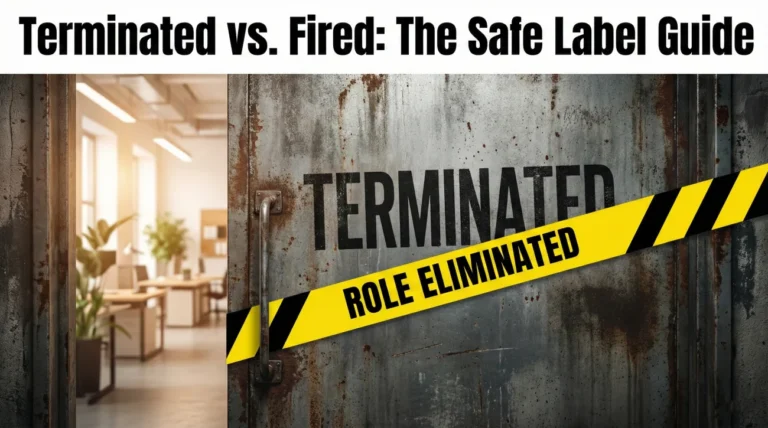
- Use one stable label per scenario (RIF, reorg, site closure) and avoid emotional add-ons that invite performance doubt.
- Follow the exit line with a pivot that pulls attention back to impact, not the exit.
Why “Position Eliminated” Still Triggers Performance Doubts
I have watched strong candidates lose momentum in screening for one frustrating reason: Their resume exit line felt like a conversation starter instead of a closed chapter. That is exactly why position eliminated resume wording matters more than people think.
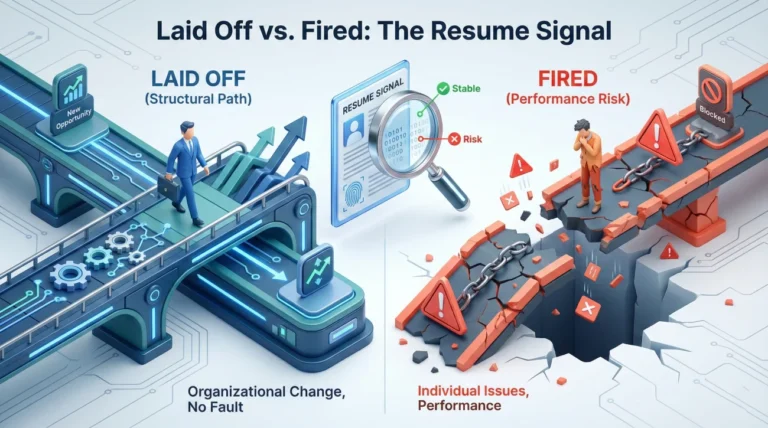
Recruiters skim fast. When they see “position eliminated,” their brain tries to sort it into one of two buckets: Structural change (neutral), or performance problem (risk). Your job is to make the first bucket obvious in one sentence, without sounding bitter or defensive.
One of my former colleagues, Olena, calls this “the silent accusation problem.” Nobody accuses you of anything. They just quietly choose the next resume if your line feels fuzzy.
Key Point: The goal is not to prove you were treated unfairly. The goal is to remove ambiguity so your impact bullets do the selling.
The Signals Recruiters Actually Read in One Line
Most guidance online says: “Keep it brief.” True, but incomplete. Brief can still be risky if it leaves a blank.
When I train junior recruiters, I tell them to look for four cues in an exit line: What happened, how broad it was, whether it is clearly finished, and whether the candidate is available now. If one cue is missing, people fill the gap with assumptions.
| What the line includes | What it signals | What it prevents |
|---|---|---|
| Structural label (reorg, RIF, site closure) | Not personal, not performance | “Was this a firing?” |
| Scope cue (company-wide, department-wide) | You were one of many | “Were you singled out?” |
| Bounded timing (date or time window) | Closed chapter | “Is this still ongoing?” |
| Readiness signal (available, actively interviewing) | Low friction hire | “Are they paused or uncertain?” |
Here is the part many templates skip: Readiness. Not because candidates are not ready, but because the sentence never closes the loop.
If your line ends on “position eliminated” and nothing else, the reader’s brain keeps working. That extra work is where performance doubt quietly shows up.
This is the tone that closes the loop without sounding defensive.
So you were laid off?
Yes. The team was reduced during a reorg, and I am actively interviewing for roles where I can apply the same growth work again.
⚠️ Notice what it does: It labels the cause as structural, it sounds finished, and it points forward. No apology, no blame, no extra story.
The One Sentence Formula That Sounds Stable

A safe line is not a story. It is a label plus a closure signal.
[Structural Label] + [Scope Cue] + [Time Bound] + [Readiness Signal]
If you feel tempted to add emotion, blame, or “they did me wrong” context: Don’t. On a resume it reads like you are still inside the argument, and that is what triggers doubt.
For ATS reality, keep the language plain. If you need a straightforward phrasing like RIF resume wording, keep it readable in one breath.
You do not need this line on every job. It helps most when the eliminated role is your most recent role, or when the dates create a visible gap you want to neutralize.
Eight Position Eliminated Lines You Can Copy Without Sounding Bitter
Each option below is built to do the same job: Make the exit structural, bounded, and calm. Pick the one that matches reality. Do not blend two scenarios in one line.
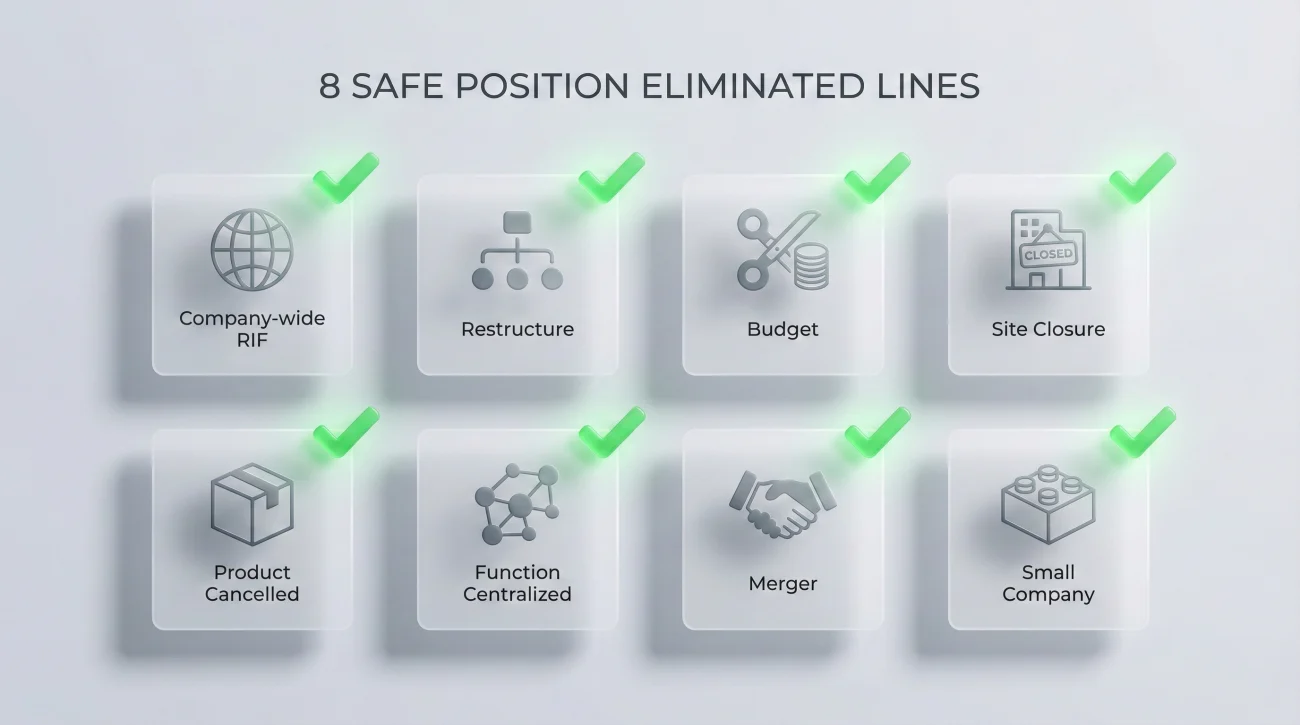
Company-wide RIF: Broad scope, low ambiguity
Use this when the reduction was widespread or formally communicated and you want the recruiter to stop guessing fast.
Keep the wording clean. Do not add a headcount number unless it was public and easy to verify. “Company-wide” usually does the job without inviting questions.
Why it works: “Company-wide” reduces the singled-out fear, and “available” closes the loop.
Department restructure: Clean, common, believable
This is the most flexible version. It fits cases where teams were merged, re-scoped, or rebalanced, and it also works for position eliminated on resume situations where you want neutral clarity.
One small upgrade: Name the role you are targeting, not the role you lost. That keeps the line from feeling backward-looking.
Tip: Replace [Target Role] with the role you are applying to, not your old title.
Budget reduction: Factual, no commentary
Use this when the company cut spend and multiple roles disappeared. This is not the place to explain whether you agree with the decision.
If you feel annoyed reading it, that is normal. Still, keep the resume tone calm so the recruiter does not read “ongoing conflict” into your profile.
Keep it factual. Do not add opinions about leadership or fairness.
Site closure: High credibility scenario
This one tends to be instantly understood because “site closure” is clearly structural. You only need a closure signal and the forward-looking piece.
If you are open to multiple work modes, mention it briefly. Do not turn the line into a relocation story.
Site closure is already structural. The more you add, the more you dilute it.
Product line cancelled: Common in tech
Use this when your team existed for a product that was discontinued. It signals strategy change, not personal failure.
Avoid writing a post-mortem. Recruiters do not need the why, they need the label and the fact that you are ready to move.
Keep it a label, not a post-mortem.
Function centralized: Shared services, consolidation
This fits cases where work moved into a centralized model, a regional hub, or a shared services org. The key is to avoid political framing.
If your function is specialized, you can keep the second half slightly broader so it does not sound like you only do one narrow job.
Avoid political framing. Recruiters read politics as mess.
Post-merger consolidation: Duplicate roles removed
When a merger creates overlap, recruiters already understand what happened. Your goal is to show it was consolidation, then move on.
If you were retained through part of the integration, you can reflect that in your bullets, not in the exit line.
This pattern is familiar. Label it and move on to achievements.
Small company restructure: Plain language
Use this when “RIF” feels too formal, or when the employer is small enough that corporate terms sound weird. This also fits role eliminated resume situations where you want to avoid jargon.
The most common mistake here is listing too many skill areas. Keep it tight so it reads like direction, not panic.
Replace [Core Skill Area] with something tight, not a list.
If you are tempted to add a headcount number, only do it if it was public or formally communicated. Otherwise, “company-wide” is safer than a number that can be questioned.
Six Pivot Lines That Pull Attention Back to Your Impact

The exit line closes the question. The pivot line tells the reader what to look at next: Your value. Keep pivots short and measurable when possible.
- Measurable growth: Known for delivering [Metric] growth through [Lever], and ready to replicate that in my next role.
- Critical systems or operations: Most proud of stabilizing and scaling [System/Process], and looking for a team that needs that same reliability.
- Hired into change: Originally hired to build [Thing] during a transition, and eager to bring that build mindset to a stable roadmap.
- Recognition and feedback: Consistently recognized for [Strength], and actively pursuing roles where that strength is central to the job.
- Industry change, same function: Focusing my search on [Function] roles where my track record in [Core Skill] transfers cleanly.
- Teams cut while results were strong: The work delivered strong outcomes even as priorities shifted, and I am targeting teams investing in [Priority Area].
If you want these to feel less templated, swap in one concrete proof marker. A colleague once changed “delivering growth” into “lifting onboarding conversion by 18%,” and that one detail did more than any explanation.
Mistakes That Quietly Reopen Performance Doubts
Most bad exit lines are not “wrong.” They are emotionally understandable. The issue is that resumes are not therapy. A resume is a risk document.
- Blame language that sounds like a complaint.
- Victim framing like “unfairly let go” with no proof.
- Over-explaining in multiple sentences.
- Wording that feels ongoing or unsettled.
- Defensive phrasing like “not performance-related,” which can create the exact question you want to avoid.
Here is the edit rule I use: If a line makes you feel validated, it might also make a recruiter feel uncertain.
| Risky version | Stable swap |
|---|---|
| Let go due to management issues and politics | Position eliminated during organizational restructure; available and interviewing |
| Company downsized and I was removed despite strong performance | Role impacted by company-wide workforce reduction; actively pursuing [Target Role] |
| They cut the product even though we were succeeding | Role eliminated after product line cancellation during strategic pivot; available for immediate start |
If an application explicitly asks why you left, answer it honestly and consistently. On the resume itself, keep the label neutral and let your achievements carry the story.
Where This Line Belongs So It Does Not Steal Attention

Keep this line small and close to your most recent role, not as a headline. If you put it in the summary, it becomes your brand, which is not what you want.
Two practical placements that work:
- As a short parenthetical at the end of the most recent role dates.
- As a one-line note immediately under the role title, before bullets.
If you choose the second option, your first bullet should be an impact bullet. The sequence should feel like: Exit label, then value.
Final: Close the Gap in One Line, Then Let Your Work Speak
A layoff does not have to be defended. It has to be labeled in a way that feels structural, time-bounded, and settled. When you do that, the reader stops hunting for hidden meaning and starts reading your achievements like a normal candidate.
If you want the broader crisis framing for layoffs, restructures, and other exits, keep your resume line neutral and consistent with the bigger story in position eliminated resume wording.
❓FAQ
🎯 Should I write “position eliminated” or “laid off” on my resume?
Use the phrase that reduces ambiguity. “Position eliminated” is often cleaner because it points to structural change. If “laid off” is the common language in your industry, keep it brief and add a scope cue like “company-wide.”
🧩 Do I need to include this line at all?
Not always. It helps most when the exit is recent, the gap is visible, or your industry is sensitive to performance risk signals. If the role ended years ago and your career has been stable since, you can usually skip it.
📌 Can I mention severance or unemployment benefits?
No. Those details do not help screening decisions and can distract from impact. Keep the resume focused on work, scope, and readiness.
🧠 What if the layoff was really performance-related but they called it a restructure?
Do not overshare. Use a neutral structural label that matches official communication, then focus on what you delivered and what you are targeting next. Consistency matters more than perfect storytelling.
🛠️ Should I put the reason for leaving inside each job entry?
Usually no. One clean line for the most recent exit is enough. If you add reasons for multiple exits, the resume can start reading like a defense document instead of a value document.
⚠️ Disclaimer: ResumeSolving provides resume, cover letter, and job search communication guidance for informational purposes only. It is not legal, medical, financial, or professional counseling advice. Hiring decisions vary by company, role, location, and individual circumstances, so we do not guarantee interviews, offers, or outcomes. Always use your own judgment, verify requirements directly with the employer, and follow local laws and workplace policies. When a situation is sensitive, we prioritize privacy-safe, recruiter-appropriate wording, and you never need to share personal details you are not comfortable disclosing.