- Recruiters estimate your age within 6 seconds. The signals are not just graduation year – they are email format, tools listed, jargon used, and resume length.
- The goal is not hiding experience. It is presenting experience in modern packaging that signals current relevance.
- Remove what dates you. Keep what proves you can do the job today.
The 6-Second Age Test
Before a recruiter reads a single word of your experience, they have already estimated your age. The email address. The resume length. The font choice. The way you list your phone number. All of it communicates something, and for older workers, much of it communicates the wrong thing.
A operations director named Richard had 25 years of genuinely impressive experience. His resume was four pages, listed a Hotmail address, included every job since 1994, mentioned proficiency in Lotus Notes, and opened with an objective statement. He could not get interviews for roles he was clearly qualified for.
The problem was not his experience. The problem was that his resume looked like it was written in 2005. Recruiters screening hundreds of applications made instant assumptions: outdated skills, resistant to change, expensive, close to retirement. None of that was true, but his materials told that story before he could tell his own.
We modernized the presentation without hiding his experience. Two pages. Gmail address. Recent 15 years emphasized. Current tools highlighted. Modern summary format. Same person, same qualifications. Interview requests started within two weeks.
Understanding older worker resume challenges means understanding that age bias operates through signals, not statements. Nobody writes “too old” on a rejection form. They just move to the next candidate whose resume looks more current. Your job is to remove the signals that trigger assumptions while keeping the substance that proves you can do the job. This is not about deception. It is about presentation.
What Triggers Age Assumptions
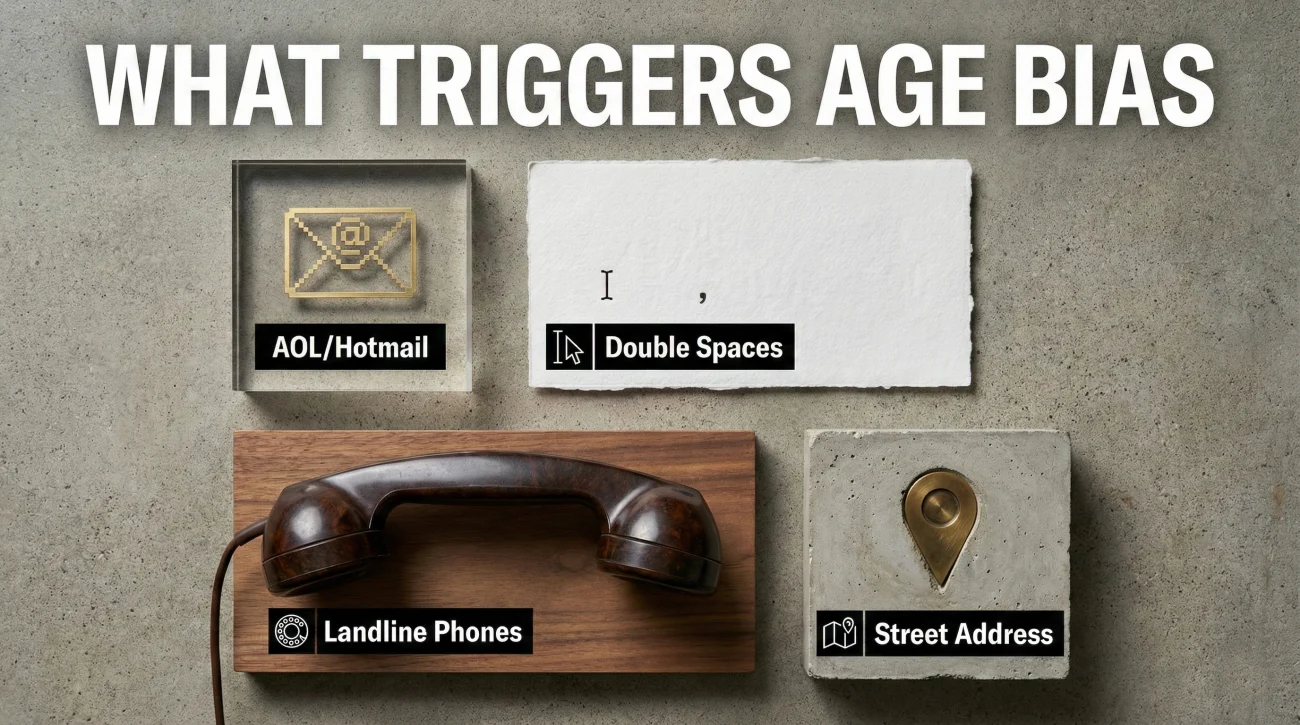
Age signals cluster into six categories. Each one independently suggests “older candidate” to recruiters scanning hundreds of applications. Multiple signals together create a cumulative effect that can sink otherwise strong candidates.
📧 Contact Details. AOL, Hotmail, or Yahoo email addresses read as dated. So does listing a full mailing address, a fax number, or multiple phone numbers. Including “References available upon request” at the bottom is another signal from an earlier era. Modern resumes: professional Gmail or custom domain email, city and state only (no street address), single phone number, LinkedIn URL.
📏 Resume Length. Three or four page resumes suggest someone who cannot edit or who thinks every job since college matters equally. They also signal a very long career. Modern standard is two pages maximum for most roles, with ruthless editing of older positions. If you have 30 years of experience, the first 15 get minimal space.
🖥️ Technology References. Listing outdated tools like Lotus Notes, WordPerfect, Windows XP, or early software versions immediately dates you. Even mentioning “Microsoft Office” without specifics reads as outdated – everyone uses Office. Modern resumes list current, specific tools relevant to the target role. If you know Salesforce, Tableau, Slack, Asana, mention those. Drop the tools nobody uses anymore.
📝 Language and Jargon. Certain phrases signal era: “objective statement” instead of summary, “references available upon request,” “responsible for” as a bullet starter, “utilized” instead of “used,” overly formal language throughout. The phrase “seasoned professional” is an age signal. So is “extensive experience” as your lead claim. Modern resume language is direct, specific, and outcome-focused.
🎓 Education Dates. A graduation year of 1992 immediately establishes age range. Unless the graduation date is within the last 10-15 years, remove it entirely. The degree still counts. The year does not add value and subtracts opportunity.
📜 Early Career Overload. Listing every position for 30 years with equal detail suggests you cannot prioritize. Jobs from 20+ years ago should be condensed to title, company, and dates – or removed entirely if irrelevant. The last 10-15 years deserve detail. Earlier career is context, not showcase.
Age-Signal Audit
Review your resume for these specific signals. Each checked item is costing you interviews:
Contact Section
- 🚩 AOL, Hotmail, or Yahoo email address
- 🚩 Full street address included
- 🚩 Multiple phone numbers listed
- 🚩 Fax number anywhere
- 🚩 “References available upon request”
Format and Length
- 🚩 More than two pages
- 🚩 Objective statement instead of summary
- 🚩 Times New Roman font
- 🚩 Dense paragraphs instead of bullets
- 🚩 Inconsistent or outdated formatting
Content Signals
- 🚩 Graduation years older than 15 years
- 🚩 Jobs listed from 25+ years ago with full detail
- 🚩 Outdated technology or software names
- 🚩 “Seasoned professional” or “extensive experience”
- 🚩 Phrases like “over 30 years of experience”
- 🚩 Listing “Microsoft Office” as a skill
💡 Quick Test: Show your resume to someone under 35 in your field. Ask them to guess your age. If they guess within 5 years, your signals are leaking.
Four Mini Edits That Remove Years
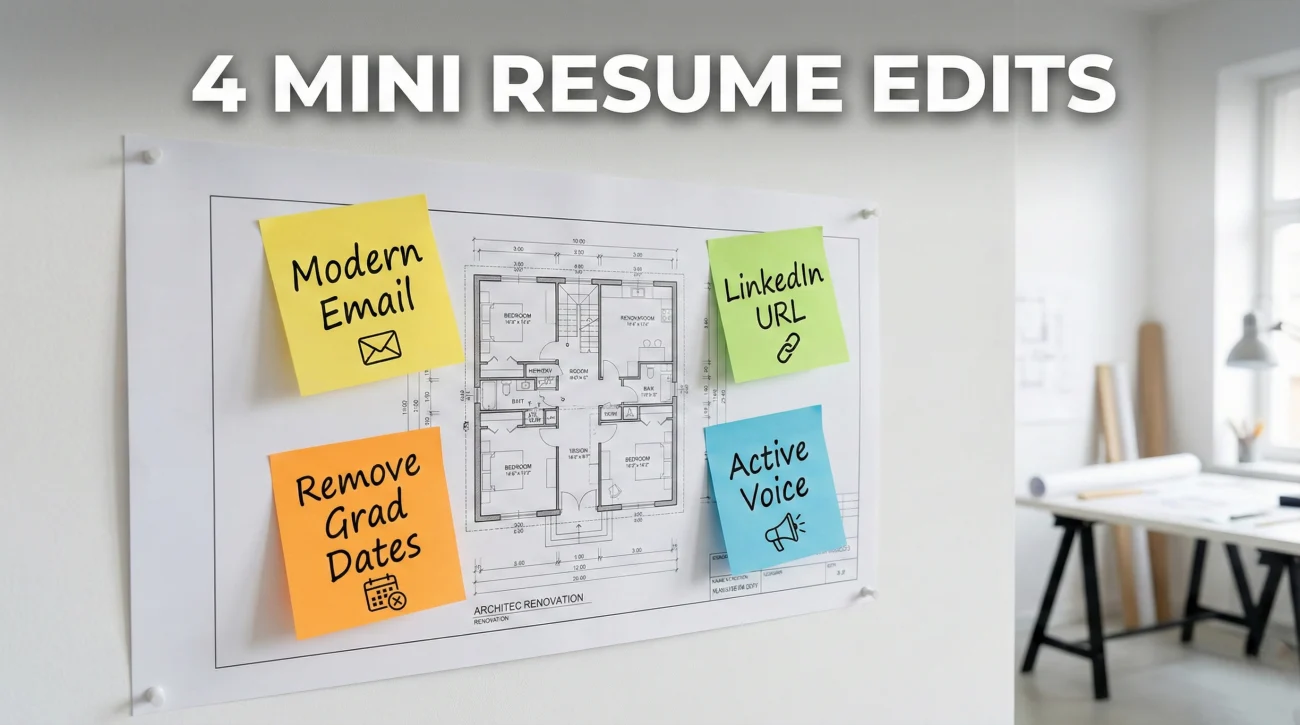
These specific changes have the highest impact for the least effort. Each one targets a different age signal category and can be completed quickly. Start with these before moving to larger resume restructuring.
Edit 1: Email Modernization
[email protected]
This takes five minutes to set up and removes one of the most obvious age signals. A custom domain (yourname.com) reads as particularly professional and tech-comfortable.
Edit 2: Experience Timeline Compression
Full details for all positions 1994-2024, four pages total
Full details for 2010-2024, one-line entries for 2000-2009, “Earlier career in operations management” single line for pre-2000
This reduces length while keeping career continuity visible. Recruiters care about recent relevance. Distant history is context, not qualification.
Edit 3: Summary Reframe
“Seasoned operations executive with over 25 years of experience in supply chain management and process improvement across multiple industries.”
“Operations director focused on supply chain optimization and cost reduction. Led distribution network redesign saving $2.4M annually. Currently implementing predictive analytics for inventory management.”
The after version leads with current focus and recent proof, not years accumulated. It demonstrates modern skills (predictive analytics) and specific outcomes.
Edit 4: Skills Modernization
The after version names specific, current tools and demonstrates actual capability level in Excel rather than just claiming proficiency. Drop anything nobody uses anymore.
What Not To Do

Some anti-ageism advice backfires. Avoid these approaches:
🚫 Removing all dates. A resume with no dates anywhere looks evasive. Recruiters will assume you are hiding something worse than age. Keep dates for recent roles. Remove or compress dates for distant history.
🚫 Using functional format. Purely functional resumes (skills-first, no chronology) are often recommended for older workers. In practice, they raise red flags. Recruiters assume you are hiding job hopping, gaps, or age. A hybrid format with strong recent experience works better.
🚫 Lying about dates. Falsifying employment dates is discoverable in background checks. Do not do it. You can omit early career positions entirely. You cannot invent fake dates for positions you include.
🚫 Over-explaining in cover letters. Writing paragraphs about your age, energy level, or willingness to work for less money draws attention to exactly what you want to minimize. Let your qualifications speak. Do not preemptively defend against bias.
🚫 Trying to sound young. Adopting slang, excessive enthusiasm, or trendy language that does not match your voice sounds forced. The goal is modern and professional, not youthful. Authenticity reads better than performance.
Beyond the Resume
Your resume gets you to the interview. What happens next requires additional preparation.
LinkedIn alignment:
Your LinkedIn profile must match your resume’s modernized presentation. Same timeframe emphasis, same current tools mentioned, professional photo that looks current (not a headshot from 2008). Recruiters will check. Inconsistency between resume and LinkedIn raises questions.
Energy and currency signals:
In interviews, demonstrate current knowledge. Reference recent industry developments. Mention recent learning – a certification, a course, a conference. Show that you are actively engaged with your field, not coasting on past knowledge.
Technology comfort:
Be visibly comfortable with whatever technology the interview uses. Video calls, screen sharing, digital documents. Fumbling with basic tech confirms age-related assumptions. Practice if needed.
Salary expectations:
Age bias partly stems from cost assumptions. Be prepared to discuss compensation in terms of market rate for the role, not your historical salary. “I’m focused on the right opportunity and expect compensation aligned with this role’s scope” is neutral positioning.
Reference selection:
Choose references who will speak to your current capabilities, not just historical achievements. A reference who says “We worked together in 2005 and she was great” is less powerful than one who can speak to recent collaboration.
The Experience Paradox
Here is the core tension older workers face: your experience is genuinely valuable, but emphasizing its length triggers age bias. Companies want experienced professionals. But they also unconsciously discount candidates who seem too far from the “default” worker they imagine. The solution is not hiding experience. It is reframing what you emphasize and how you present it.
Instead of leading with duration (“25 years in operations”), lead with current capability (“Operations director specializing in distribution optimization”). Instead of listing every role, curate the roles most relevant to your target. Instead of citing old achievements, cite recent ones that prove you are still delivering.
The question to ask for each resume element: does this prove I can do the job today, or does it only prove I did similar work decades ago? Proof of current capability stays. Historical documentation gets compressed or removed.
Seniority itself is not the problem. Companies want experienced professionals. The problem is when the presentation suggests the experience stopped accumulating fifteen years ago. A 55-year-old who presents like a current professional gets interviewed. A 55-year-old whose resume reads like a 2005 artifact does not.
Your goal is demonstrating that your experience includes recent learning, current tools, and ongoing relevance. The years of experience support that story – they do not replace it.
Summary Writing for Older Workers
The summary is where age signals concentrate most heavily. It is also where you have the most control over first impressions. A summary that leads with “25 years of experience” immediately triggers age calculations. Here is how to write one that demonstrates seniority through scope and proof without revealing a number:
Lead with target role, not years. “Operations Director” not “Executive with 25 years of experience.” The role tells them your level. The years tell them your age.
Include one current proof point. Something from the last 2-3 years that shows ongoing delivery. This counters the assumption that your best work is behind you.
Mention a current or recent tool/method. Reference something that signals you are keeping current: a recent methodology, a modern platform, a current approach. “Currently implementing” is powerful language.
State what you want, not what you have been. End with forward-looking language about your target, not backward-looking summary of your history.
This summary could describe someone with 10 years or 30 years of experience. The seniority is clear from the scope. The age is not.
Detailed Guides
| Article | Focus |
|---|---|
| How Far Back Should a Resume Go | Timeline rules by seniority with compression strategies |
| Resume Length for Senior Professionals | When 2 pages is fine, when 3 looks unedited, trimming checklist |
| Outdated Skills on a Resume: Remove, Reframe, or Keep | Skill modernization rules with reframe table |
| Modernize Your Resume Wording: 20 Dated Phrases Replaced | Language refresh with before/after examples |
| High School on a Resume: When to Remove It | Education detail decisions by career stage |
| Email and Contact Details That Signal Age | Contact line modernization with clean format rules |
| Resume Summary That Avoids Age Signals | Summary patterns emphasizing current value |
| Age Signals on a Resume: 18 Things to Remove or Rewrite | Comprehensive red flag list with fixes |
Modern Presentation, Full Credibility
An older worker resume that gets interviews is not a document that hides experience. It is a document that presents experience in current packaging. Remove the signals that trigger age assumptions. Keep the substance that proves qualification. Lead with what you can do today, not what you accomplished decades ago. Your experience is an asset when it is framed as current capability rather than historical documentation. Present it accordingly, and let the interviews prove what your resume promises.
❓ FAQ
🎯 Is removing graduation year dishonest?
No. Graduation year is optional information. You are not claiming a different year – you are simply not volunteering a data point that triggers bias without adding relevant qualification information. The degree itself is what matters.
📝 Should I hide that I have 30 years of experience?
You are not hiding experience – you are curating presentation. Show the experience most relevant to your target role with full detail. Compress or remove distant history that adds length without adding qualification proof.
💼 What if they ask my age in an interview?
Direct age questions are illegal in most US jurisdictions. If asked indirectly (“when did you graduate?”), you can redirect: “I completed my degree at State University. More relevant to this role is my recent work on…” Pivot to current qualifications.
🔍 Will employers figure out my age anyway?
Possibly, once you reach the interview. But the goal is reaching the interview. Age-neutral materials get you past the initial screen where bias operates most strongly. Once you are in the room, your energy, relevance, and preparation matter more than a number.
⚠️ Disclaimer: ResumeSolving provides resume, cover letter, and job search communication guidance for informational purposes only. It is not legal, medical, financial, or professional counseling advice. Hiring decisions vary by company, role, location, and individual circumstances, so we do not guarantee interviews, offers, or outcomes. Always use your own judgment, verify requirements directly with the employer, and follow local laws and workplace policies. When a situation is sensitive, we prioritize privacy-safe, recruiter-appropriate wording, and you never need to share personal details you are not comfortable disclosing.