- If you label the exit wrong, recruiters stop reading your achievements and start reading your risk.
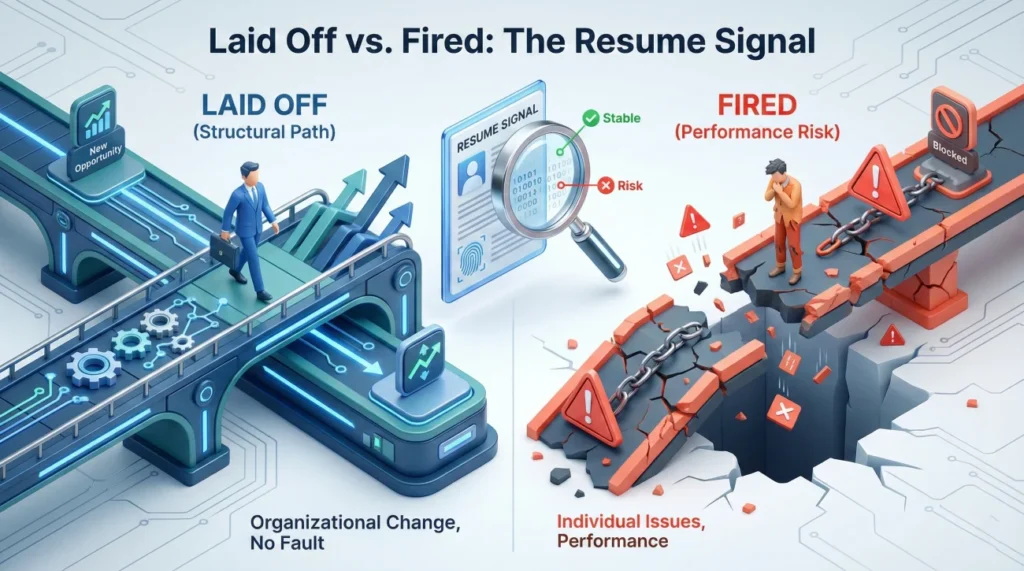
- Laid off vs fired is not a grammar issue. It is a trust issue, and trust is faster than skill in early screening.
- Use the decision rules and the safe labels below so your resume closes the story instead of reopening it.
The label is not the story. The signal is.
One of the most awkward moments I see in resume reviews is when someone has a perfectly strong track record, but one line on the timeline quietly sabotages it. The line is not even “bad”. It is just vague enough that a recruiter fills in the blank with the worst interpretation.
I have watched it happen in real time. A product manager I will call Stephanie sent me her resume after a restructure. Her experience was solid. Metrics were solid. But her final line said “Terminated, 2025.” That single word moved the conversation from “What can she do?” to “What happened?” before she ever got a screen.
This guide is about laid off vs fired as a resume signal. Not a legal definition. Not a morality story. Just what the label implies in a six second scan, and how to keep the scan focused on your work.
Key Point: Recruiters rarely have enough context to interpret your intent. If your wording suggests a hidden reason, they assume there is one.
What recruiters actually hear when you say “laid off” or “fired”
Most online articles define these words like a dictionary. The resume problem is different. On a resume, your wording is not a definition. It is a clue.
The fast mental shortcut in screening
In early screening, the recruiter is trying to answer one question: “Is this candidate likely to create extra work or extra risk?” If your exit label feels messy, they assume your reference checks will be messy too.
That is why the phrase difference between laid off and fired matters in practice. One phrase typically signals structural change. The other typically signals a performance or behavior story, even when that story is more complicated in real life.
| Label you use | What it usually implies | Common recruiter worry | Safer replacement |
|---|---|---|---|
| Laid off | Role removed due to business conditions | “Was it part of a broader reduction?” | Role eliminated (restructuring) |
| Fired | Performance or conduct decision | “What went wrong, and is it repeating?” | Role ended (mutual separation) |
| Terminated | Could mean anything, often read as negative | “Is this ‘for cause’ and hidden?” | Employment ended (restructure) |
| Position eliminated | Structural, usually neutral | “Was it a full team cut or just you?” | Position eliminated (team reduction) |
⚠️ Warning: Your goal is not to “spin”. Your goal is to prevent ambiguous words from creating unnecessary suspicion.
A simple decision rule to choose the safest label
If you were part of a workforce reduction, your safest move is to stay inside structural language. If you were separated for performance or conduct, your safest move is to avoid words that sound like you are hiding the reason.

The quick test: Would a stranger assume “fault”?
Read your exit wording and ask: If someone had no context, would they assume I did something wrong? If the answer is yes, that wording is expensive.
This is where laid off vs terminated meaning becomes a real problem. “Terminated” is technically neutral in many workplaces, but it often lands as “something happened.” If you do not clarify structural context, you are asking a recruiter to guess.
Use this formula when you need one line
[Structural Event] + [Scope] + [Closure Signal]
Structural event can be “restructuring” or “reduction in force.” Scope can be “team-wide” or “company-wide.” Closure signal is a calm phrase that tells the reader the chapter is closed, like “role eliminated” rather than “terminated.”
💡 Pro Tip: If you are tempted to write “laid off” to avoid stigma, stop and check the facts. If your situation was not a layoff, choose neutral truth, not a false label.
Eight safe labels that stay factual without oversharing
Below are labels I have helped candidates use when they wanted clarity, but did not want to overshare. Each one is designed to signal closure and reduce assumptions.
| Safe label | When it fits | What it signals |
|---|---|---|
| ✅ Role eliminated (company restructuring) | When the change is real and easy to explain in one phrase | Structural event, low drama, closed chapter |
| ✅ Position eliminated (team reduction) | When the cut is scoped and you want a formal tone | Not personal, not behavioral, not a hidden story |
| ✅ Role ended due to budget changes | When budget constraints were clearly communicated | Business decision, not candidate risk |
| ✅ Role ended due to organizational changes | When priorities shifted or teams merged | Neutral restructure without extra explanation |
| ✅ Reduction in force (RIF), role eliminated | When the organization used RIF language internally or publicly | Scale and structure, not a personal exit |
| ✅ Project concluded, role ended | When your work was tied to a defined initiative that ended | Natural endpoint, predictable story |
| ✅ Contract ended (non-renewal) | When the arrangement was time-bound and simply did not renew | Normal end date, clean closure |
| ✅ Company-wide layoff (team impacted) | When the layoff was widely known or verifiable | Transparent context without oversharing |
Quick Check: If a label makes a stranger wonder “What did you do?”, it is not a safe resume label, even if it is technically accurate in an HR system.
Six labels that create new questions you do not want
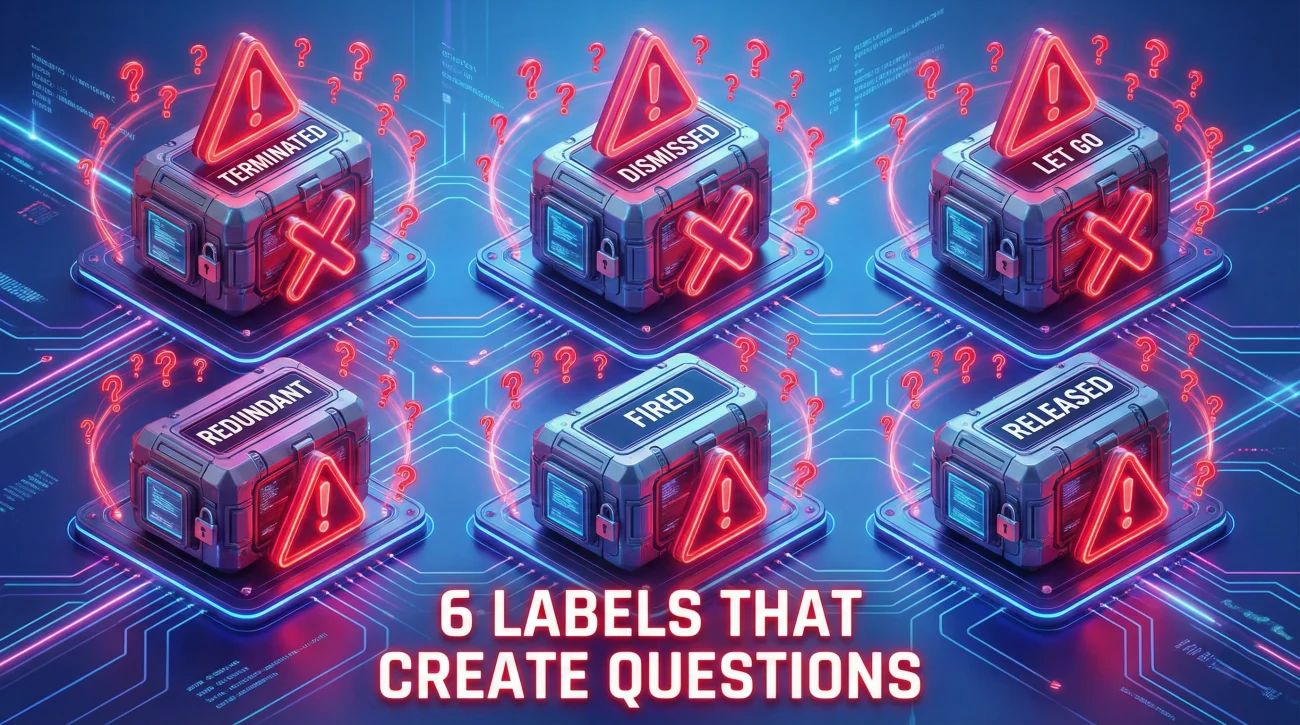
In resume reviews, these are the words that quietly turn a normal exit into a “dig deeper” moment. Even when you mean them neutrally, they rarely land that way.
- Terminated: Often read as “for cause” and triggers suspicion.
👉 Use structural closure language if that is the real context. - Let go: Sounds informal and often implies performance issues.
👉 Use “role ended” or “position eliminated.” - Dismissed: Reads punitive and escalates the story.
👉 Keep it factual, then move back to achievements. - Separated for performance: Too much detail for a resume timeline.
👉 Save the narrative for the interview and keep the resume outcome-led. - Management conflict: Signals ongoing drama and risky references.
👉 Use a neutral end label and prepare a calm interview pivot. - Wrong fit: Vague, suspicious, and invites worst-case guessing.
👉 Use a clear closure line, then proof markers.
❌ Note: If you are trying to “sound honest” by choosing harsh language, you may be paying a penalty that honesty does not require.
Interview scripts that keep the conversation stable
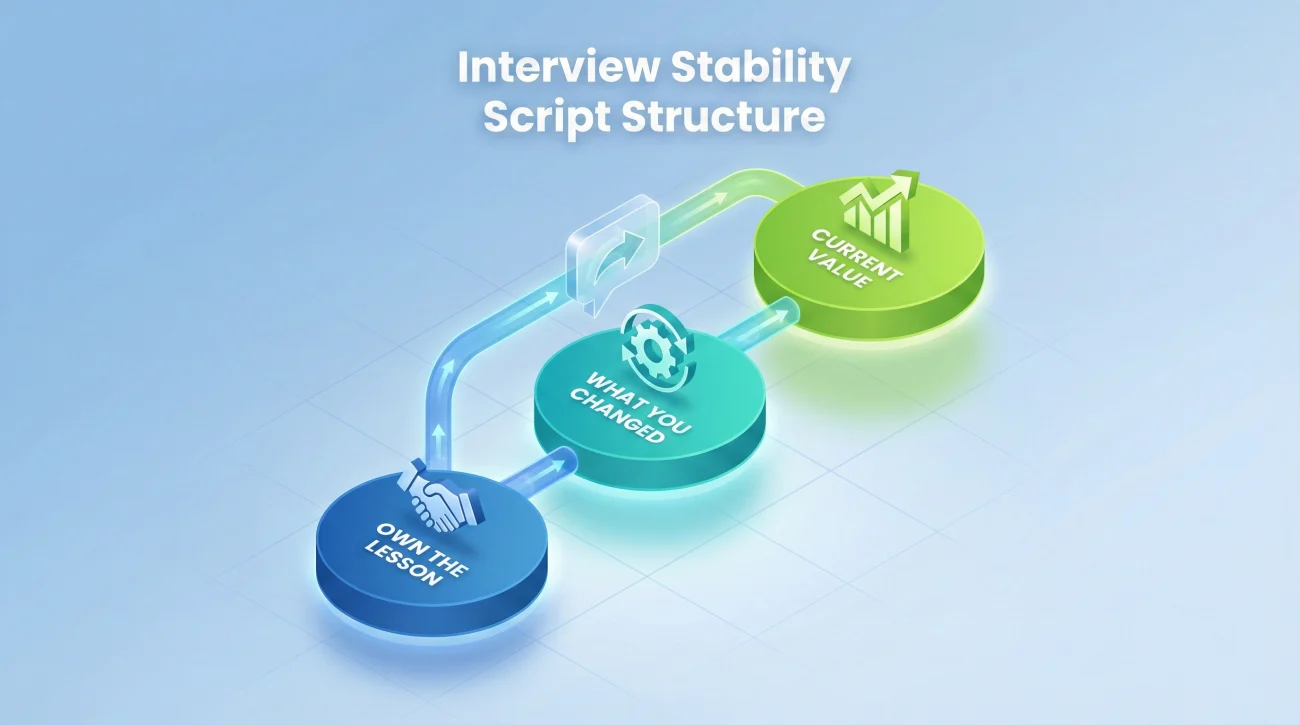
A resume label sets the starting point. But some recruiters will still test your narrative, especially if they have seen mixed exits lately. Your job is to stay calm, stay factual, then pivot back to value.
If you were laid off, keep the structure and close the door
When candidates ramble, it makes a structural event sound personal. Your line should be short, then you return to achievements.
“It was a company-wide reduction, and my role was eliminated during the restructure. I wrapped up handoffs cleanly, and I am focused on roles where I can apply the same product execution strengths at a stable team.”
If the exit was performance-related, own the lesson without self-flagellation
This is where candidates either overshare or try to hide. Neither works. Aim for “closure plus proof.”
Use one sentence to define what changed, one sentence to show what you did, and one sentence to show what is different now.
“That role exposed a gap in how I was prioritizing stakeholders, and I took it seriously. Since then I have rebuilt my process with weekly alignment checkpoints and clearer decision logs, and my last project delivery was ahead of schedule with higher partner satisfaction.”
That second script is especially useful when the recruiter is implicitly testing what to say if you were fired without turning the interview into an interrogation.
The gray-zone exits that confuse people: How to stay truthful without self-sabotage

Not every separation fits neatly into “laid off” or “fired.” Sometimes a team downsizes and you were the only one removed. Sometimes the company says “termination” as a default HR term. Sometimes you leave under a performance plan and the story is both structural and personal.
If only one person was cut, avoid the “mass layoff” claim
Here is the rule I give candidates: If you cannot confidently defend the scale, do not use scale language. Instead, use structural language without numbers.
💡 Pro Tip: “Position eliminated” is often safer than “laid off” when the event was real but not widely visible.
If HR used “terminated” but it was not “for cause”
This is common. HR systems use standardized terms. Recruiters, however, interpret “terminated” emotionally. If you use it on a resume, you are volunteering ambiguity.
If you want a cleaner signal, choose a structural label that matches reality, and reserve system terms for official forms only. This is also where termination for cause vs layoff confusion can damage you, even if you did nothing wrong.
If your role was eliminated and performance was also mixed, lead with closure and proof
A colleague of mine in HR once coached a candidate named Martin who had been on a PIP when the company restructured. Martin wanted to say “laid off” because it felt easier. We did not do that. We wrote a neutral structural label, and we prepared an interview answer that addressed performance growth cleanly, without panic.
The surprising part: once the resume stopped sounding defensive, recruiters asked fewer questions. They moved on to his portfolio and his outcomes.
In these situations, your resume line should not try to resolve every detail. It should prevent your exit label from becoming the headline. If you want an extra layer of clarity, use a phrase like fired for performance vs laid off internally as your prep category, but do not put that framing on the resume itself.
One more wording nuance that matters: position eliminated vs fired is often the difference between “structural change” and “candidate risk” in the reader’s mind. Choose the label that matches the event you can defend, then move on.
Final: Use the label that closes the story instead of reopening it
Most candidates do not lose interviews because they were separated. They lose interviews because the resume makes the separation feel like an unresolved problem.
Your achievements deserve to be the main story. Keep your exit label factual, calm, and closed. If you were laid off, let it read structural. If you were fired, let it read resolved and learned, without turning the resume into a confession.
When you handle laid off vs fired this way, your resume line does what it should do: reduce uncertainty, protect trust, and move the reader back to your work.
❓ FAQ
🎯 Do I need to say I was laid off on my resume?
Usually no. Your resume can simply show dates and achievements. Add a short label only if the gap or the timing is likely to raise questions, or if your industry expects clarity.
🧭 Is “terminated” ever a good word to use on a resume?
Almost never. Even when it is technically neutral, it is commonly interpreted as “for cause.” If you need a neutral truth, use structural labels like “role eliminated” or “employment ended due to restructuring.”
🧩 What if I was the only one laid off on my team?
Avoid scale language you cannot defend. Use structural wording without numbers, such as “position eliminated” or “role ended due to organizational changes.”
🛡️ What if the recruiter asks directly, “Were you fired?”
Answer truthfully, then keep it short. One sentence of facts, one sentence of what changed, then pivot to value. Long explanations make the issue feel bigger than it is.
📌 Should I put the reason for leaving next to every job?
No. Reasons for leaving are not standard resume content. Use them only when they prevent a likely misunderstanding, and keep them to a single calm line.
⚠️ Disclaimer: ResumeSolving provides resume, cover letter, and job search communication guidance for informational purposes only. It is not legal, medical, financial, or professional counseling advice. Hiring decisions vary by company, role, location, and individual circumstances, so we do not guarantee interviews, offers, or outcomes. Always use your own judgment, verify requirements directly with the employer, and follow local laws and workplace policies. When a situation is sensitive, we prioritize privacy-safe, recruiter-appropriate wording, and you never need to share personal details you are not comfortable disclosing.