- If you are taking a lower level role after a health break, hiring teams are testing risk, retention, and readiness more than ambition.
- A strong explanation has three parts: the break is closed (without medical detail), the level is intentional, and your runway is stable.
- Pick one story framework and stick to it: Skill Anchor, Scope Reset, or Capacity Match.
When “Lower Level” Is a Smart Move, But Recruiters Misread It
I have coached candidates through the same frustrating moment: the role they want is not “less,” it is simply more sustainable after a health break. The problem is that hiring teams sometimes translate that decision into fears that have nothing to do with your actual ability: “They will leave as soon as they feel better,” “They are hiding capacity limits,” or “They will resent the scope.”
This is why the long tail question how to explain taking a lower level job after health break matters. Your resume does not need a personal story. It needs a clean, calm signal that the decision is deliberate and stable.
Also, I am not pretending one HR person knows everything. Some of the clearest language in this article comes from colleagues and hiring partners I have worked with, plus what I have heard in debriefs. Different teams react differently, so the goal is to give you frameworks that adapt, not one “perfect” script.
What Hiring Managers Are Really Checking When You Downlevel
Most advice treats downleveling like a confidence problem. In real hiring conversations, it is usually a risk problem. People are trying to predict what happens after you get hired, especially in the first 90 days.
In one debrief I sat in years ago, a hiring manager said something blunt after rejecting a candidate: “I can’t tell if she wants this role, or if she wants any role that will take her.” That is the core issue you have to remove.
| What they worry about | What you need to signal |
|---|---|
| Short stay and quick exit | Clear reasons this scope fits your near term runway and goals |
| Capacity mismatch | A closed chapter and stable availability, without medical detail |
| Hidden performance risk | Recent proof of consistency, even if informal (volunteer, project, coursework) |
| Scope resentment | Specific elements of the role you genuinely want, not “open to anything” language |
If you do not address these silently, the interviewer will address them out loud. They will ask “Why this level now?” and they will keep asking it in different shapes until they feel safe.
The Gap Itself Is Not the Story, The Downshift Is
After a health break, many candidates over-focus on explaining the time off. They assume the gap is the red flag. Sometimes it is, but often the bigger red flag is the mismatch between past seniority and current target scope.
A recruiter can accept a gap if the next move looks coherent. What spooks them is a storyline that feels unresolved: Was the break forced. Is the person still in it. Are they applying below level because they are desperate.
⚠️ Warning: Any explanation that requires emotional context to sound “fair” usually reads as unstable in a hiring funnel. Keep it factual, brief, and forward facing.
When I help candidates tighten the story, I use a simple formula that keeps them out of the weeds:
[Closed Time Frame] + [Intentional Level Choice] + [Role Fit Proof]
Notice what is missing: symptoms, diagnoses, personal drama, or a timeline of recovery. The point is not secrecy. The point is relevance.
Three Story Frameworks That Make Downleveling Look Intentional
Pick one framework and use it consistently across your resume summary, LinkedIn headline, and interview opener. Mixing frameworks makes your intent feel fuzzy. The right framework depends on why you are downshifting, not on what sounds most impressive.

Framework 1: Skill Anchor
Use this when the lower level role sits closer to the craft you actually want to do. You are not stepping down, you are stepping toward the work that fits you now. This is common when people move from manager to individual contributor, or from broad leadership scope into a focused specialty.
A colleague of mine, Marcus, shared a debrief story from his own team. They hired a former manager into a senior analyst role after a health-related break. The candidate did not talk about health details. Instead, he explained that he wanted to spend most of his week on analytics delivery again, and he could point to recent work outputs. Marcus told me the line that made the panel relax was simple: “I am choosing scope where I can be excellent fast.”
Former [Manager Title] returning to full-time work and intentionally targeting an IC scope to maximize impact in [Skill], [Skill], and [Skill]. Focused on consistent delivery, clear stakeholder communication, and measurable outcomes.
The key is that you name the work you want, not the title you used to have. Hiring teams can accept a downshift when the intent is specific and the proof feels current.
Framework 2: Scope Reset
Use this when the previous level came with unpredictable demands: on-call rotations, constant travel, nonstop escalations, or a broad leadership span that made the days chaotic. After a health break, you might want a role with a narrower blast radius. That is not weakness. It is risk management.
I have seen this work well when candidates frame it as protecting reliability for the team, not protecting themselves from discomfort. One hiring manager I worked with described it as “a candidate who knows how to build a stable runway,” and that is exactly the signal you want.
“After time away for health priorities, I am returning with a preference for predictable scope. I am targeting this level because it matches the rhythm I can commit to consistently, and it keeps me close to the work I enjoy, especially [responsibility].”
This framework is strongest when you also name one thing you are excited to own at this scope, so it does not sound like you are only running away from pressure.
Framework 3: Capacity Match
Use this when you can work full time, but you want a role that is easier to ramp into and easier to sustain without constant spikes. Hiring teams will worry about performance. Your job is to show that the role is sized correctly for quick, reliable output, and that you chose it for that reason.
In practice, this framework works best when you pair it with one recent proof of consistency. It does not need to be a big job. It can be a contract sprint, a volunteer deliverable, a portfolio project, or a certification that produced something real. The proof line tells the employer you can start finishing things again.
Returning to full-time work after a health-related career break. Targeting a scope where I can deliver consistent output immediately, build momentum through measurable wins, and grow through steady ownership.
If you do not have a proof line yet, build one before you apply. This is one of those moments where small real work beats perfect wording.
Where to Place the Explanation on Your Resume Without Making It Weird
Most candidates either hide the downleveling, which makes it look suspicious, or over-explain it, which makes it look unstable. The clean middle is to place your intent in one of these locations:
- Resume Summary if your last title is much more senior than the target role.
- Headline if you want the recruiter to understand your target scope in three seconds.
- Experience section only if you need to clarify a role change inside the same company.
The gap itself can be one neutral line if you choose to include it, but your bigger win is making the target level feel logical. If your resume makes the level choice obvious, the gap becomes background noise.
❌ Note: Do not add a “Health Break” block that becomes the most visually prominent part of the page. It invites the reader to center your private life instead of your fit.
Ten Headline Options That Answer “Why This Level” Without Saying Too Much
These are copy-ready starting points. Pick one that matches the framework you chose, then customize the role title and the proof point. Each option includes an intent signal and a stability signal without medical detail.
| Headline option | Best when |
|---|---|
| Senior [Role] | Returning to Full-Time Work | Focused on Consistent Delivery | Capacity Match and re-entry clarity |
| [Role] (IC Focus) | Former [Manager Title] | Choosing Hands-On Scope | Skill Anchor, manager to IC shift |
| [Role] | Process and Quality | Preference for Predictable Scope | Scope Reset, calmer environments |
| [Role] | Back to Full-Time Work | Ready for Stable Team Rhythm | Neutral readiness signal |
| [Role] | Execution-First | Stronger Fit at This Scope Right Now | When seniority mismatch is obvious |
| [Role] | Delivering Measurable Wins | Sustainable Pace, Long-Term Intent | Retention concern, want “I am staying” signal |
| [Role] | Returning After a Career Break | Clear Focus on [Skill] | When you need to name the break briefly |
| [Role] | Former [Senior Title] | Choosing a Craft-Focused Path | Skill Anchor with identity shift |
| [Role] | Ready for Consistent Work | Building Momentum Through Results | Capacity Match with proof emphasis |
| [Role] | Calm Operator | Strong Fit for This Level and Scope | Scope Reset, operations style roles |
Notice the pattern: you are not asking them to trust you. You are giving them enough structure that trust feels reasonable.
Six Interview Redirects That Keep the Conversation Professional
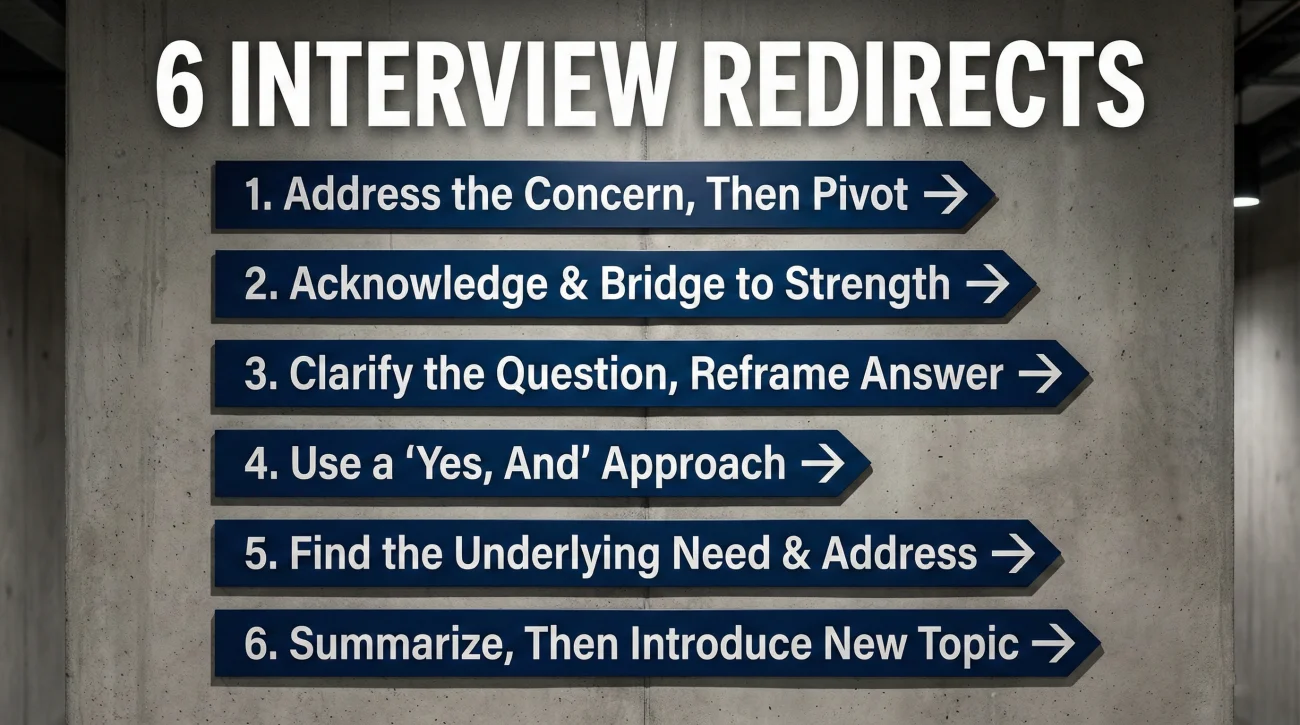
When the interviewer asks “Why this level now?”, answer once, then steer back to the work. If you keep looping on the explanation, they will keep looping on the doubt.
- ✅ “I chose this scope because it matches the rhythm I can commit to long term, and the day-to-day work is genuinely what I want to own, especially [responsibility].”
- ✅ “This level lets me deliver quickly and consistently. I would rather be excellent at this scope than stretched in a scope that adds risk for the team.”
- ✅ “I am optimizing for the craft part of the work again. I want to spend most of my week on [skill], and this role is designed for that.”
- ✅ “I am not treating this as a temporary step. I am targeting roles like this because the scope aligns with what I want next, and I can commit to it.”
- ✅ “I understand the overqualification concern. The reason I am applying is that the responsibilities are exactly what I want to execute, and I can show recent proof of follow-through.”
- ✅ “I keep the break private, but I can share what matters for the job. I am fully available for consistent work, and here is one recent example of my reliability: [proof].”
Key Point: If your answer ends with readiness plus proof, the interviewer stops trying to solve your personal story and starts evaluating your fit.
Common Mistakes That Make Downleveling Look Risky

People do not make these mistakes because they are careless. They make them because they are trying to be understood. Unfortunately, hiring funnels reward clarity more than full context.
Mistake 1: Making the health story the centerpiece. If you spend more time explaining the break than explaining the role fit, you teach the interviewer what to focus on. Keep the break factual and closed, then put your energy into why the scope fits and how you will perform consistently.
Mistake 2: Using “open to anything” language. Lines like “I am open to lower roles” can read like urgency, not intent. Replace that with specificity: what parts of the job do you want, what scope do you prefer, and what outcomes can you deliver.
Mistake 3: Ignoring pay band and growth assumptions. Hiring managers often assume you will be unhappy with the compensation range or promotion timeline. You do not need to negotiate in the first interview, but you do need to signal you understand the level and you are choosing it deliberately.
💡 Pro Tip: A simple line helps: “I understand the scope and range for this level, and I am comfortable with it because the fit is strong for what I want next.”
A One-Paragraph Script You Can Adapt
This is a script I have seen work because it stays calm, stays bounded, and ends with proof. You can adjust the proof line to match your reality without changing the structure.
If it feels too simple, that is usually good. The goal is a professional answer that reduces guesswork, not a complete autobiography.
Final Checklist Before You Hit Apply
Before submitting any application, review your resume with a cold eye to ensure a stranger can grasp your professional intent within ten seconds. If the narrative feels vague, tighten the summary or headline to make your target scope appear deliberate rather than accidental.
- Does your story show the break is closed without offering unnecessary medical detail?
- Does it explain the level choice as a strategic intention rather than an act of desperation?
- Does it include a tangible proof point that demonstrates your current consistency?
- Does your interview opener conclude with readiness instead of explanation?
Validating these points helps you build a cohesive narrative where the step down serves as a purposeful reset. This approach aligns with the broader Career Recovery framework and effectively solves how to explain taking a lower level job after health break by prioritizing your future contribution over your recovery history.
❓ FAQ
🎯 Should I mention the health break if nobody asks?
Usually no. If the timeline is visible, a brief neutral line is enough. Your stronger move is to explain the level choice and show a readiness signal. If the break is not obvious, keep the focus on fit.
🧠 Will recruiters assume I am overqualified and bored?
Some will, which is why you need a specific “I want this work” statement. Overqualification fear drops when you can name the responsibilities you genuinely want and explain why the scope is a deliberate match.
💬 What if the interviewer pushes for medical details?
Bring it back to readiness and role fit. Keep your tone calm, confirm you can meet the job demands consistently, and offer proof of recent follow-through. You do not need to justify private health details to earn a fair evaluation.
📌 Should I change past titles to look less senior?
No. Keep titles accurate. Use your summary or headline to clarify the scope you are targeting now. Accuracy builds trust. Clarity removes confusion.
🛠️ What proof is strongest if I have not worked recently?
Choose proof that shows follow-through: a small project with a clear output, a certification with applied work, volunteer work with deliverables, or a structured course where you built something real. One strong proof point is better than vague activity.
⚠️ Disclaimer: ResumeSolving provides resume, cover letter, and job search communication guidance for informational purposes only. It is not legal, medical, financial, or professional counseling advice. Hiring decisions vary by company, role, location, and individual circumstances, so we do not guarantee interviews, offers, or outcomes. Always use your own judgment, verify requirements directly with the employer, and follow local laws and workplace policies. When a situation is sensitive, we prioritize privacy-safe, recruiter-appropriate wording, and you never need to share personal details you are not comfortable disclosing.