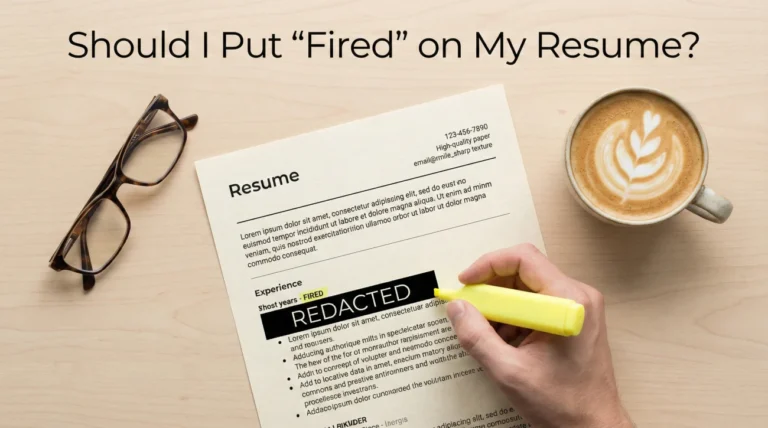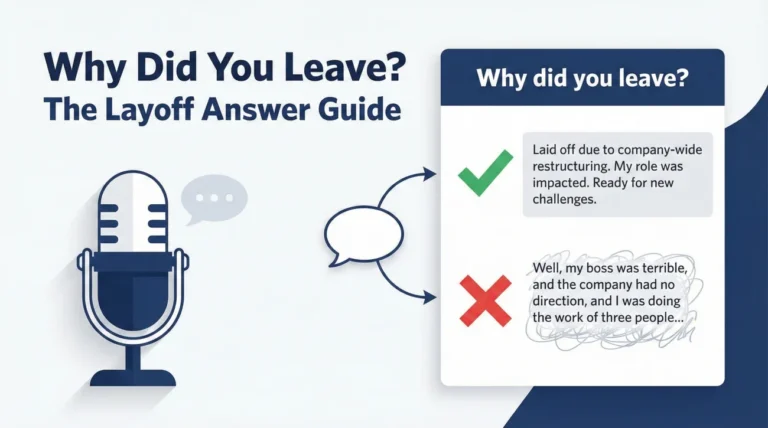
- Layoffs fall into clear categories: RIF, restructuring, site closure, budget cuts, product cancellation. Name yours so recruiters stop guessing.
- The recruiter fear is performance suspicion. Your job is to prove the layoff was structural, not personal.
- Use 4 mini scripts: a 15-second answer, a 40-second answer, a performance suspicion response, and a recruiter message template.
- Keep your story consistent across resume, applications, LinkedIn, and interviews. Mismatches get flagged.
The Real Problem With Layoff Explanations
Getting laid off is not the problem. Explaining it badly is.
When a recruiter sees a layoff on your resume or hears about it in an interview, one question dominates their thinking: Was this really a company decision, or were you selected because of performance issues?
That suspicion is your enemy. Everything in this guide is designed to neutralize it.
Last spring, I worked with a senior engineer named Henry who had been part of a 200-person RIF at a tech company. His skills were strong, his track record was solid, but he kept getting screened out. The problem? When interviewers asked about the layoff, he would pause, look uncomfortable, and say something vague like “they had to make cuts.” That hesitation made him look like he was hiding something.
We rebuilt his answer using the framework in this guide. Within three weeks, he had two offers.
The facts of his layoff did not change. His delivery did.
Name Your Layoff Category
Vague explanations invite suspicion. Specific categories shut down speculation. Here are the main types of layoffs and how to name them.
| Category | What Happened | How to Say It |
|---|---|---|
| RIF (Reduction in Force) | Company cut headcount across the board | “Part of a company-wide reduction in force” |
| Restructuring | Department or team was reorganized | “Position eliminated during restructuring” |
| Site Closure | Office or location shut down | “Office closed; role did not relocate” |
| Budget Cuts | Funding reduced, team downsized | “Team reduced due to budget reallocation” |
| Product Cancellation | Product line or project ended | “Product line discontinued; team dissolved” |
| Acquisition | Company bought, roles consolidated | “Role eliminated post-acquisition” |
Pick the category that fits your situation. Use those exact words. When you name a structural category, you shift the frame from “what did you do wrong” to “what happened to the company.”
Key Point: Recruiters hear vague layoff explanations constantly. Specific categories stand out because they sound factual, not defensive.
The Layoff Risk Checklist
Some layoff situations raise more red flags than others. Check which risks apply to you so you can address them proactively.
Which of these apply to your situation?
- ⚠️ Performance suspicion: The company kept others in similar roles but let you go
- ⚠️ Short tenure: You were there less than a year before the layoff
- ⚠️ Pattern risk: This is your second or third layoff in recent years
- ⚠️ Leadership role: You were in management, raising questions about judgment
- ⚠️ No public news: The layoff was not covered in press, so it is hard to verify
- ⚠️ Company still exists: Unlike a shutdown, they chose who to cut
If none of these apply, your layoff explanation can be brief and straightforward. If several apply, you need stronger proof points and more deliberate framing.
Angela, a marketing manager, had three risk factors: short tenure (8 months), no press coverage, and the company kept other marketers. Her initial explanation was just “I was laid off.” That invited all the wrong questions. We rebuilt her answer to lead with the structural context (budget cuts after a failed product launch), mention her specific accomplishments during those 8 months, and include a reference who could verify her performance. The risk factors did not go away, but she addressed them before interviewers could speculate.
Decision Map: Where and How to Explain
Different touchpoints require different approaches. Here is when and how to address your layoff at each stage.
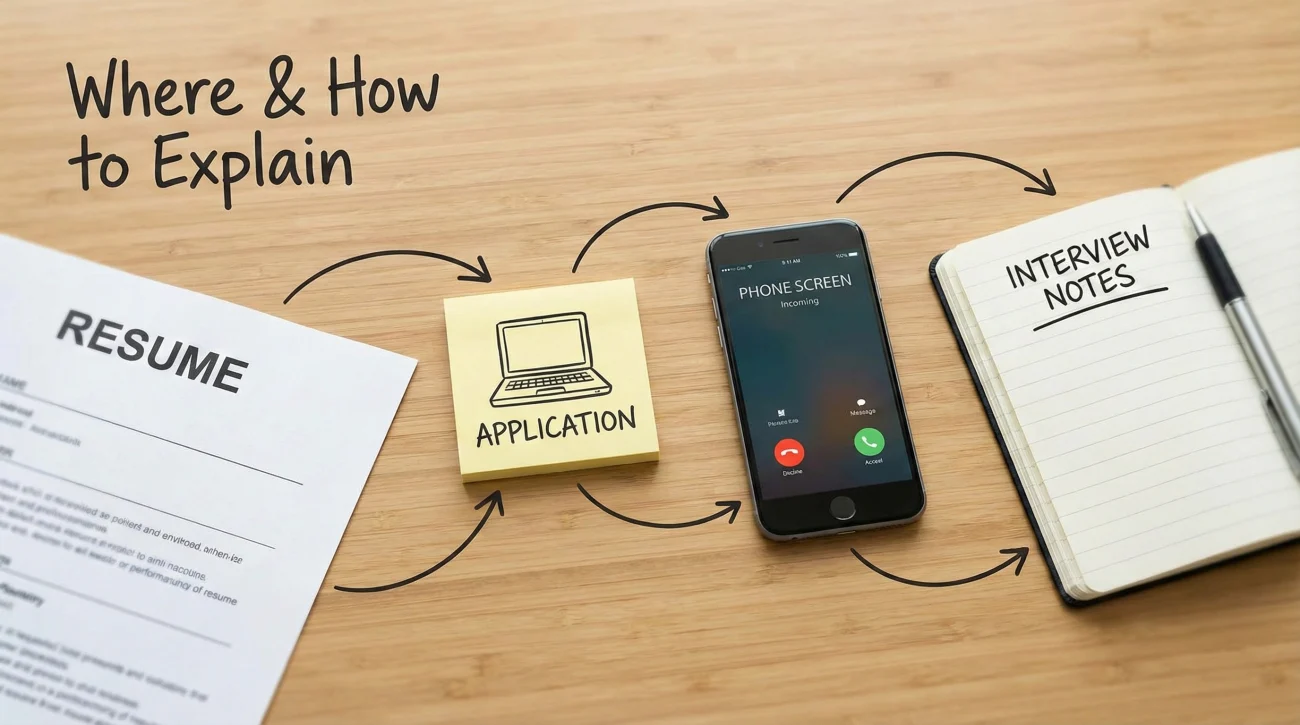
📄 Resume
A layoff note on your resume is optional. Add one if the timeline is confusing without it or if a brief note prevents worse assumptions. Keep it to one line max.
✅ Add a note when: Short tenure, gap after layoff, or company is not well-known
⏸️ Skip the note when: Long tenure with strong accomplishments, recent and obvious from dates
📝 Application Forms
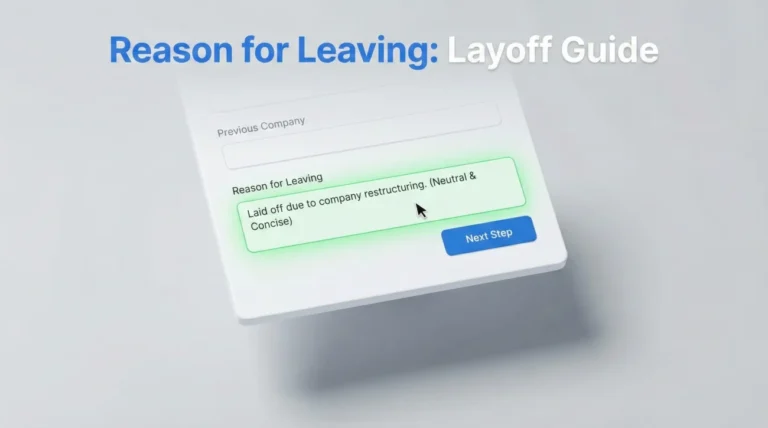
Most applications ask “reason for leaving.” Keep it short and structural. Never write emotional explanations or blame.
📞 Phone Screen
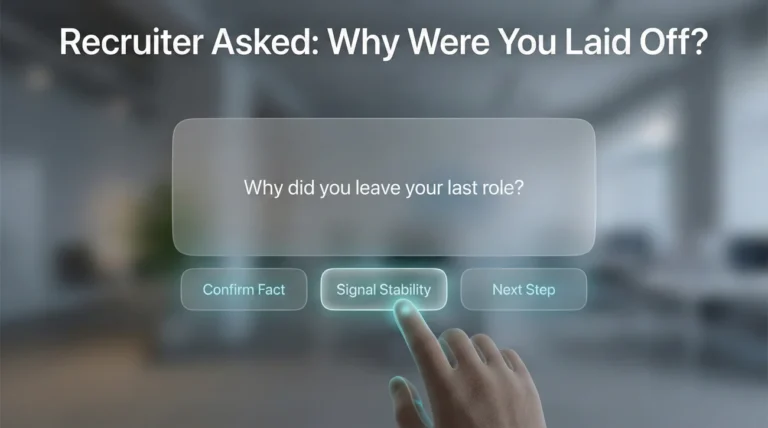
Recruiters often ask about layoffs early to screen out risky candidates. Have a 15-second answer ready that names the category, confirms it was structural, and pivots to your interest in this role.
🎤 Interview
Hiring managers may probe deeper. Use a 40-second answer that includes context, your accomplishments, and why you are excited about this opportunity. If they hint at performance concerns, have a calm follow-up ready.
Your LinkedIn end date should match your resume. You can add a brief note in the role description or use LinkedIn’s career break feature if there is a gap after the layoff.
✉️ Recruiter Messages
If a recruiter emails asking about the layoff before scheduling a call, reply with a short explanation and a request to move forward. Do not over-explain in writing.
4 Mini Scripts You Can Use Today
These scripts cover the most common layoff scenarios. Customize them with your details and practice until they sound natural.
Script 1: The 15-Second Phone Screen Answer
Use this when a recruiter asks about the layoff in an initial call. Keep it tight and pivot fast.
“My position was eliminated in March as part of a company-wide restructuring. About 20% of the workforce was affected. I am now focused on finding a role where I can apply my experience in [specific skill], which is why this opportunity caught my attention.”
Script 2: The 40-Second Interview Answer
Use this when you have more time to provide context in a full interview.
“In January, the company went through a significant restructuring after losing a major client. My entire team was dissolved as part of the cost reduction. Before that, I had led the migration project that saved 30% on infrastructure costs and delivered two weeks ahead of schedule. I am proud of what I accomplished there, and I am looking forward to bringing that same approach to a team like yours where [specific thing about the role or company].”
Script 3: The Performance Suspicion Response
Use this if the interviewer implies or asks directly whether the layoff was performance-related.
“I understand why you might wonder about that. The layoff affected the entire department, not just my role. My performance reviews were consistently strong, and I am happy to share references from my manager there who can speak to my contributions. Would that be helpful?”
Script 4: The Recruiter Email Reply
Use this when a recruiter asks about the layoff via email before scheduling a conversation.
“Thanks for reaching out. The role ended due to a company-wide reduction in force in Q1. I had strong performance reviews and would be happy to discuss my accomplishments in that role. I am very interested in this opportunity and would love to schedule a call. Does [day/time] work?”
💡 Pro Tip: Practice these scripts out loud until you can deliver them without hesitation. The goal is to sound confident and matter-of-fact, not rehearsed or defensive.
Mistakes That Make Layoffs Look Worse

Even with the right information, delivery errors can undermine your explanation.
- ❌ Being Vague: “They had to make some cuts” sounds like you are hiding something. Name the specific category and scope.
- ❌ Blaming the Company: “Management made terrible decisions” or “they had no idea what they were doing” makes you look bitter. Stick to neutral facts.
- ❌ Over-Explaining: If your layoff explanation takes more than 45 seconds, you are saying too much. Interviewers start wondering what you are compensating for.
- ❌ Sounding Apologetic: “Unfortunately I was let go” or “I am sorry to say” makes the layoff sound like your fault. State it as a fact, not a confession.
- ❌ Forgetting to Pivot: If you end with the layoff, you leave the interviewer in that negative space. Always finish with why you are excited about this role or what you are looking for next.
Matt, a sales director, kept making the over-explaining mistake. He would spend three minutes detailing the company’s financial problems, the leadership conflicts, and exactly which teams were cut. By the time he finished, interviewers had mentally moved on. We cut his explanation to 40 seconds, and his callback rate doubled.
Special Cases That Need Extra Care
Some layoff situations are trickier than others. Here is how to handle the hard cases.
Short Tenure Layoffs
If you were laid off after less than a year, recruiters wonder if you were a new hire cut first or if you struggled to ramp. Your explanation needs to do two things: establish that it was structural and prove you contributed during your short time there.
A data analyst named Sandra was laid off 5 months into her role when the startup ran out of funding. She felt embarrassed about the short tenure. But she had built the company’s entire analytics dashboard in that time. We led with that accomplishment, then mentioned the funding failure as context. Interviewers stopped asking follow-up questions about the short tenure because she had already demonstrated value.
Multiple Layoffs
Two layoffs in five years might be bad luck. Three looks like a pattern. If you have been laid off more than once, your story needs to explain why without making you look like a target.
Focus on structural factors that were outside your control: industry downturns, company pivots, acquisition consolidation. Show strong performance during each stint. And articulate clear criteria for your next role that signal you are being selective, not desperate.
Leadership Role Layoffs
If you were a director, VP, or executive who got laid off, the questions are sharper. Why did the company keep other leaders? Did you push back on something? Were you part of a failing strategy?
Your explanation needs to separate your performance from the structural decision. Mention specific achievements, reference organizational changes that affected your role, and be prepared to discuss your leadership style and lessons learned without sounding defensive.
Quiet Layoffs With No Public News
When a major company does layoffs, it is often in the news and easy to verify. When a smaller company quietly cuts staff, there is no external validation. Recruiters may wonder if “layoff” is just your word for “fired.”
In these cases, proactively offer verification: references from colleagues who were also affected, documentation if you have it, or specific details about the scope and timing that can be confirmed. Do not wait for suspicion to build.
Verification and References After a Layoff
Background checks verify dates and titles, but references fill in the story. Managing both is critical.
What Background Checks Reveal
Standard employment verification confirms your job title, start date, and end date. Some also confirm salary and eligibility for rehire. They typically do not reveal the reason for separation or layoff details.
Your main concern is consistency. If your resume says you left in March but the company reports February, that discrepancy gets flagged. Use exact dates that match what HR has on file.
Choosing References After a Layoff
Ideally, include at least one reference from the company that laid you off. This could be your direct manager, a skip-level leader, or a peer who worked closely with you. Their willingness to speak positively signals that the layoff was not performance-related.
If your manager was also laid off, even better. They have no incentive to protect the company and can speak freely about your contributions.
If no one from that company is available or willing, use strong references from earlier roles and be prepared to explain why you cannot provide one from your most recent position.
Briefing Your References
Before listing anyone, have a quick conversation. Let them know how you are describing the layoff and what points you would appreciate them emphasizing.
“Hey, I am in active job search mode and wanted to give you a heads up that I might list you as a reference. As you know, the company went through that restructuring in March. I have been describing it as a position elimination due to budget cuts. If anyone asks, I would appreciate if you could speak to the dashboard project we worked on together and how I handled the deadline crunch. Does that work for you?”
Most people are happy to help if you make it easy. Give them the framing and talking points, and they will use them.
Managing the Gap After a Layoff
If there is time between your layoff and your next role, that gap needs management too.
Gaps Under 3 Months
A short gap after a layoff is normal and expected. You do not need to explain it beyond “job searching.” Focus your energy on the layoff explanation, not the gap.
Gaps of 3 to 6 Months
At this length, interviewers may ask what you have been doing. Have a ready answer that includes productive activities: upskilling, freelance projects, consulting, volunteering, or focused job searching. The goal is to show forward motion, not stagnation.
Gaps Over 6 Months
Longer gaps require more deliberate framing. Consider whether the gap should be addressed separately from the layoff or as part of the same story. Include any recent activity that demonstrates current skills and readiness.
Andrew, a project manager, was laid off and then spent 8 months caring for a sick family member before returning to job search. He tied the two together: “I was laid off in January, and shortly after, I took time to help a family member through a health situation. That is now resolved, and I have been focused on finding the right next role for the past two months.” Clean, honest, forward-looking.
Deep Dive Guides for Specific Situations
This hub gives you the framework. The guides below go deeper into specific scenarios and touchpoints.
Name It, Frame It, Move On
Layoffs are common. The Bureau of Labor Statistics tracks millions of them every year. You are not damaged goods, and you do not need to apologize.
What you do need is a clear, confident explanation that names the structural category, acknowledges your accomplishments, and pivots to why you are excited about what comes next. Practice it until it feels as natural as describing your last project.
A layoff is something that happened to your company. Do not let a shaky explanation make it look like something that happened because of you.
For complete scripts, wording guides, and scenario-specific playbooks, explore the cluster articles linked above. And for the broader framework on handling any crisis exit, see the full how to explain being laid off resource collection.
❓ FAQ
🤔 Should I mention the layoff on my resume?
It depends on your situation. If the layoff created a confusing timeline, a very short tenure, or is recent enough that it is your last role, a brief note can prevent worse assumptions. If you had long tenure and strong accomplishments, the layoff may be obvious from dates and does not need explicit mention. See the cluster guide on resume placement for specific rules.
📞 What if the recruiter asks about the layoff in the first 30 seconds?
This is common. Have your 15-second script ready. Name the category, confirm it was structural, and pivot to your interest in the role. Do not get pulled into a long explanation during a phone screen. The goal is to check the box and move on to your qualifications.
⚠️ How do I handle performance suspicion?
Address it calmly and directly. Mention the scope of the layoff (how many people, which teams), offer to share references who can speak to your performance, and pivot back to the role requirements. Getting defensive or protesting too much makes suspicion worse.
📝 What should I write on application forms for “reason for leaving”?
Keep it short and structural. “Position eliminated – restructuring” or “RIF – company downsizing” works. Never write emotional explanations, blame, or lengthy justifications. The form is for classification, not storytelling.
🔄 I have been laid off twice. How do I explain the pattern?
Multiple layoffs require a narrative that explains the pattern without making you look like a target. Focus on structural factors in each case, show strong performance during each role, and articulate clear criteria for your next role to signal stability. The cluster guide on multiple layoffs covers this in depth.
⚠️ Disclaimer: ResumeSolving provides resume, cover letter, and job search communication guidance for informational purposes only. It is not legal, medical, financial, or professional counseling advice. Hiring decisions vary by company, role, location, and individual circumstances, so we do not guarantee interviews, offers, or outcomes. Always use your own judgment, verify requirements directly with the employer, and follow local laws and workplace policies. When a situation is sensitive, we prioritize privacy-safe, recruiter-appropriate wording, and you never need to share personal details you are not comfortable disclosing.