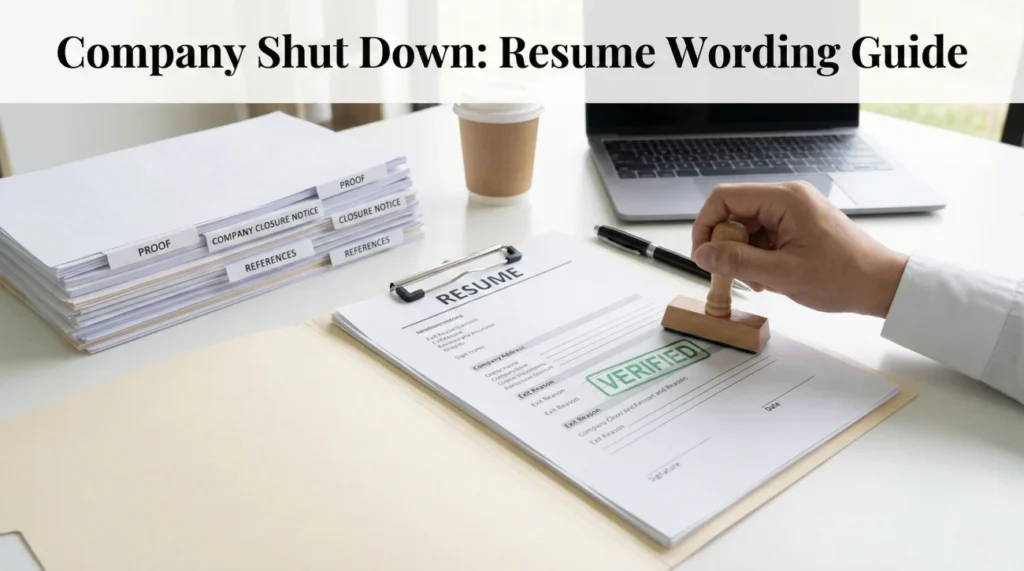
- If your past employer shut down, your goal is verifiability, not a dramatic explanation.
- Use a neutral closure label only when it prevents confusion, not as a “confession line.”
- Prepare a simple verification path: One contact, one document, one calm sentence.
When the Company Is Gone, Recruiters Stop Thinking About “Reasons” and Start Thinking About Proof
I have watched solid candidates lose momentum for one boring reason: The employer on their resume could not be easily verified. When a company shuts down, the hire risk is not your performance. The hire risk is administrative uncertainty. This is why company shut down resume wording needs to be simple, consistent, and easy to confirm.
A defunct employer can trigger a strange kind of suspicion if your wording sounds like you are trying to pre-empt questions. The fix is not more detail. The fix is a stable label, a clean timeline, and a verification path you can explain in one breath.
What Recruiters Actually Worry About in a “Company Shut Down” Case
In my HR circle, we describe this as a “missing receipt” problem. The work may be real, but the paper trail is fuzzy. If the hiring process includes a third-party background check, the vendor may ask for a phone number, HR email, or a verifier who can confirm dates and title. When that goes nowhere, the candidate gets stuck in follow-up requests.
Key Point: The goal is to remove uncertainty. Do not write your resume line as if you are defending yourself. Write it as if you are making verification easy.
The three avoidable mistakes that create new questions
First, candidates over-explain the closure. That can sound like they are trying to sell a story. Second, they hide the closure until the last minute, and then scramble when a recruiter asks for proof. Third, they mix labels across documents, for example “restructuring” on the resume and “company closed” on the application. That mismatch is what triggers extra scrutiny.
⚠️ Warning: If you use a closure label, keep it consistent across resume, application, and any background check form. Consistency is your credibility signal.
Now that you know what creates doubt, the rest of the page is about choosing one stable label and placing it in the right document, so the shutdown does not become a “credibility conversation.”
Six Wording Options That Sound Stable, Not Defensive
Most people only need one clean label. The best option depends on what you are trying to prevent: A mistaken “fired” assumption, confusion about a gap, or verification delays because nobody can contact the employer.
Think of these as six small tools. Pick one that matches the reality of your situation, then lock it in and stop tweaking. When candidates keep “improving” the wording, they usually end up with multiple versions that do not match each other.
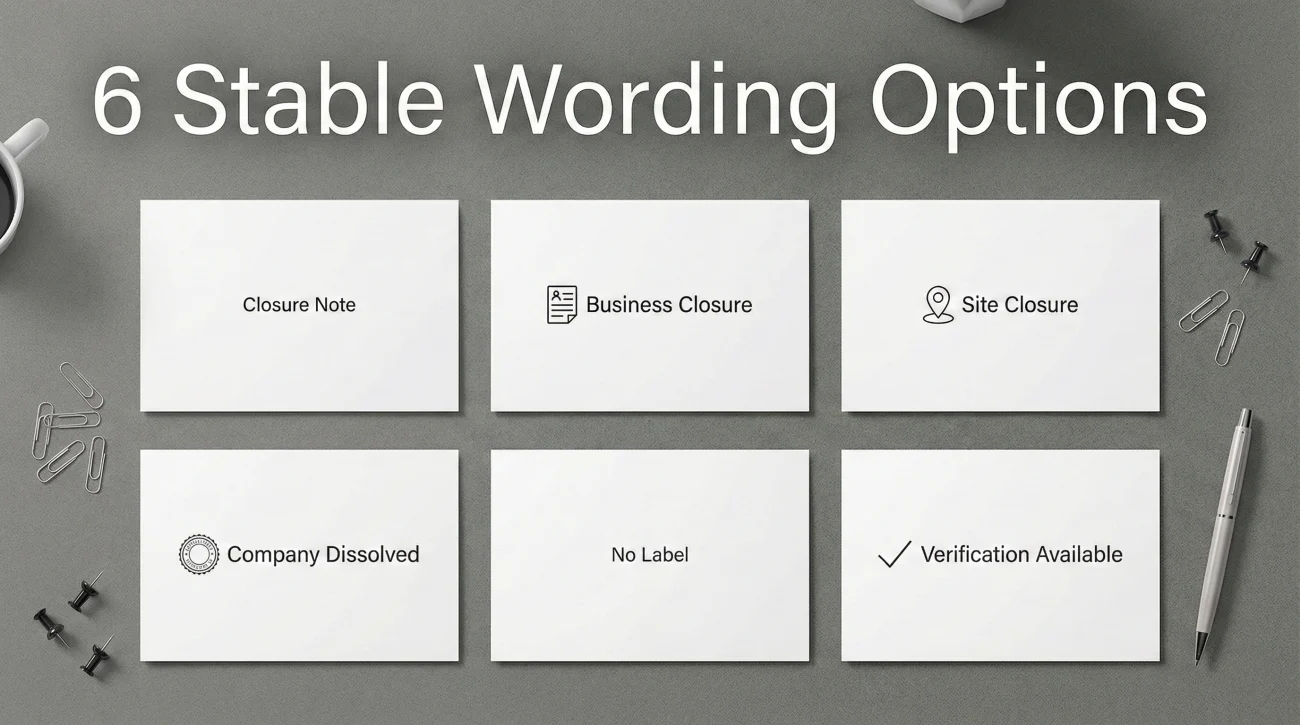
Option 1: A quiet closure note as the last bullet
This is the cleanest choice when you expect verification questions and you want to prevent a recruiter from guessing why the company cannot be reached. The key is placement. Put the closure note once, at the very end, so the role still reads like an impact story first.
Use this when the company name is unfamiliar, the website is gone, or you have seen background check vendors struggle with similar employers. Keep it one line and keep it neutral.
– Built weekly inventory forecasting model, reducing stockouts by 18%
– Partnered with Finance to reconcile vendor variance, cutting errors by 25%
– Company closed in 2024; Verification available via former HR administrator
If you choose this approach, do not add a second closure line elsewhere in the same entry. One mention reads like clarity. Two mentions starts to feel like a warning label.
Option 2: Put the closure reason in the application, not the resume
This is often the best option when your resume already reads clean and the closure does not explain a visible gap. Many application forms explicitly ask for “reason for leaving,” and that is the right place for a simple admin label.
It keeps your resume focused on outcomes while still staying consistent with the hiring workflow. You are not hiding anything. You are putting the information where it belongs.
If you do this, keep your resume entry normal and be ready to use one calm sentence when asked verbally. You do not need to volunteer it twice.
Option 3: “Role ended due to site closure” for branch or location shutdowns
Use this when the company still exists, but your site, branch, region, or business unit closed. This wording prevents a common misunderstanding: Recruiters see a familiar brand and assume verification will be easy, then get confused when the local office no longer exists.
Keep the phrasing narrow to your situation. “Site closure” is specific enough to explain why your role ended without implying performance issues or personal conflict.
– Improved renewal rate from 78% to 86% across mid-market accounts
– Trained 6 new CSMs on onboarding workflow and escalation routines
– Role ended due to regional site closure
Do not add a long explanation about why the site closed. If the company’s reasons matter, they will come up later in conversation. Your resume job is to keep the timeline readable.
Option 4: “Company dissolved” only when it matches the paper trail
Some candidates use stronger legal language because it sounds official, then get stuck when asked to support it. If your separation letter, public notice, or formal records use “dissolved,” you can use it too. If not, stick with “company closed.”
This option is about alignment, not sophistication. The simplest label is usually the safest label.
– Closed month-end for 12 locations, improving on-time reporting to 98%
– Standardized expense coding, reducing rework by 30%
– Company dissolved (2022)
If there is any doubt about whether you can support the term, swap it to “company closed.” The meaning stays clear, and the risk of mismatch drops.
Option 5: Use no closure label, but keep a clean script ready
This option works when the closure does not create confusion on the page. Your dates read clean. The company name is recognizable enough. There is no gap that needs explanation. In that case, the resume can stay purely about your work.
You still prepare the verification path in your back pocket, but you do not turn the resume into a pre-emptive defense. If a recruiter asks, you answer in one calm sentence and move back to outcomes.
People often feel nervous and want to “tell the whole truth up front.” In practice, that usually creates more questions than it solves.
Option 6: “Verification available” only when you actually have a verifier
This is useful when the company is fully gone and you know a background check will hit a wall. But it only works if you truly have someone reliable who can confirm dates and title, and you are confident they will respond if contacted later in the process.
Keep it generic on the resume. Do not name the verifier publicly. Offer details only when the employer asks for it during screening or the background check step.
– Coordinated vendor timelines for 40+ client events per year
– Reduced last-minute change orders by 15% via tighter briefing process
– Company closed; Verification available upon request
If you do not have a verifier, skip this wording. A “verification available” note that you cannot back up is the fastest way to turn a routine check into a credibility problem.
Once you pick one option, keep it consistent across resume, application, and any form you fill out later. Consistency is what makes the shutdown feel boring and administrative, which is exactly what you want.
Next, the only question that matters is placement: Resume, application, or background check. Each one has a different job.
Where to Put the Closure Detail Without Making It a “Headline”
This is the part most articles skip. They talk about what to say, but not where to say it. In practice, your process has three documents. Each document has a different job.
If you place the shutdown note in the wrong place, it becomes the loudest thing on the page. The goal is to keep the shutdown small and the work big.
| Document | What to write | Why it works |
|---|---|---|
| Resume | Usually nothing, or a short closure note as the last bullet | Keeps the resume impact-focused, avoids defensive tone |
| Application form | Reason for leaving: Business closure / Company closed | Provides consistent admin detail where it is expected |
| Background check | Verifier info + one supporting document if requested | Turns a dead-end verification into a clean alternative path |
If you decide to mention the closure on the resume, do it once. One line. No extra story. The more you explain, the more a reader wonders what they are supposed to be worried about.
The Verification Reality Check: What You Can Control
I will make this practical. Recruiters and background check vendors do not need a documentary film. They need a way to confirm two things: Your dates and your title. Sometimes they also try to confirm eligibility for rehire, but many defunct employers cannot provide that, so the process shifts to what you can reasonably document.
What if there is no HR, no phone number, and the website is dead?
That is normal in a closure case. Your job is to offer an alternative verifier and one supporting document, and to keep your wording consistent. Consistency prevents the “is this made up?” spiral.
One more thing that helps a lot: Do not put a verifier’s name on the resume. A resume is not a background check form, and naming a person publicly creates privacy issues and a new point of friction.
💡 Pro Tip: Your calmness is part of the signal. A short, neutral answer can feel more credible than an explanation that tries too hard.
A Simple Verification Checklist You Can Prepare in 15 Minutes

One of my former colleagues, Delilah, used to run pre-employment screening at a mid-sized healthcare group. She told me something that stuck: The candidates who made verification easy did not look “more innocent.” They looked more employable because they reduced process friction.
- ✅ One verifier: Former HR admin, payroll contact, or direct manager who can confirm title and dates
- 🧾 One document: Offer letter, pay stub, W-2, or separation letter that shows employer name and your identity
- 📍 One identifier: Company legal name variation, DBA name, or location detail that matches your document trail
- 🗓️ One clean timeline: Month and year format that stays identical across resume and forms
- 🧠 One sentence script: A neutral closure statement you can repeat without improvising
⚠️ Warning: Do not invent contact info. If you do not have a valid HR contact, say the company is closed and provide the alternative verifier when asked.
Five Calm Replies When a Recruiter Asks About the Shutdown
Here are scripts you can use. Each one is designed to answer the question, close it, and move back to your skills. The moment you start narrating the collapse, you accidentally make the collapse the story.
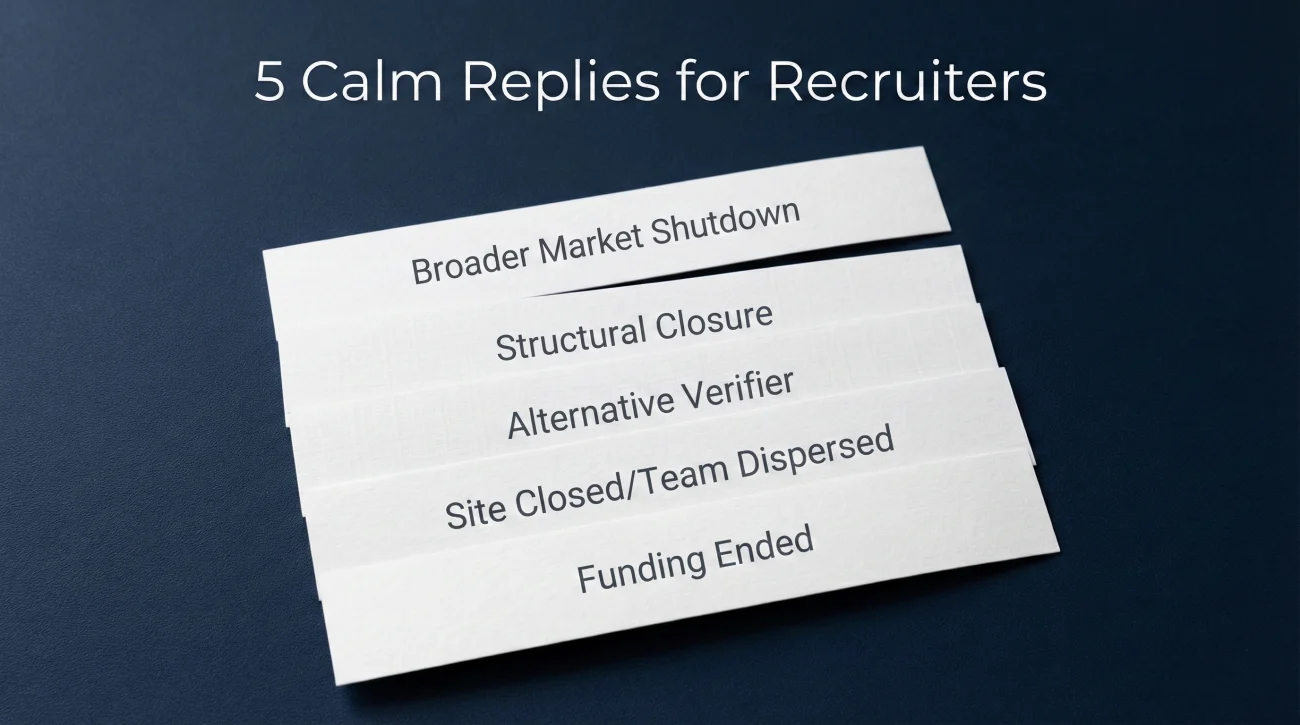
Script patterns that work:
These are short on purpose. In real calls, the recruiter wants to keep moving. Your job is to give them a clean label and a bridge back to your work.
“The company closed during a broader shutdown in the market. My dates and title are easy to verify through a former administrator if you need that later. The work I did there is what I would love to talk about.”
“It was a business closure, not a performance issue. I can share a verifier if your process needs it. For this role, the closest match is the project work where I reduced cycle time.”
“The employer no longer operates, so standard HR verification is not available. I can provide an alternative verifier and documentation if required. Should I walk you through the outcomes I delivered?”
“The site closed and the team dispersed. I kept a clean paper trail and can support my employment dates if needed. What matters most is the scope I owned and the results.”
“The company shut down after funding ended. I was already performing well and the closure was structural. Happy to share verification details when you reach that step.”
Notice what these do. They do not argue. They do not overshare. They offer verification without turning your conversation into an investigation.
Real Cases: How the Same Closure Can Read “Stable” or “Messy”
I am going to give you two real patterns from candidates I have seen, with names changed. These cases look similar on paper, but the wording choices change how recruiters experience them.
Case 1: The resume tried to “pre-explain” and created doubt
Kim worked at a small retail tech startup that shut down after a funding round fell through. Her resume included a long bullet about the shutdown, the market, and the founder’s decisions. It was honest, but it read like a defense statement. The recruiter’s first question became: “Is there something we are not hearing?”
❌ Note: When your resume sounds like a justification, it invites a credibility audit.
Case 2: The resume stayed outcome-focused, and verification was handled later
Mitch had a similar story: A company closure, no HR left, no website. His resume said nothing about the closure. When asked, he used one calm sentence and offered a verifier only if needed. The recruiter moved on quickly because the answer felt complete, not evasive.
💡 Pro Tip: “Complete” does not mean detailed. It means the question feels closed.
In both cases, the work history was real. The difference was how much uncertainty the recruiter had to carry while reading the resume.
Common Wording Mistakes That Make a Shutdown Look Like a Personal Problem
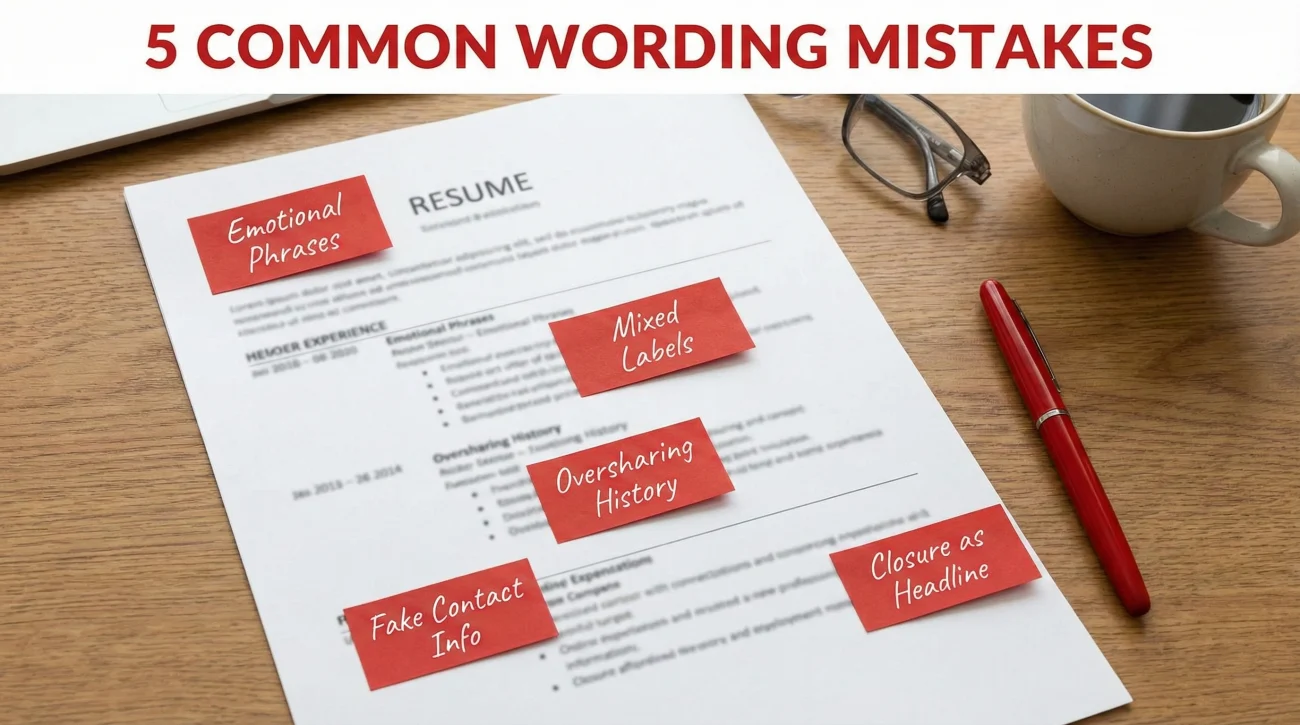
These show up a lot in low-quality templates. They are not always lies, but they often create the wrong implication.
- Writing emotional phrases that shift attention away from your work
- Using different labels across documents, for example “restructuring” in one place and “company closed” in another
- Adding a paragraph about the founder, investors, or market collapse on the resume
- Listing fake or outdated contact info to “look complete”
- Turning the closure into the last line of every job bullet, which makes it feel like a pattern
Most of the time, your resume only needs to do one thing: Make the experience feel normal. Normal means predictable formatting, outcome-driven bullets, and a closure label only if it reduces confusion.
Final: A Shutdown Is Not Your Story, Your Proof Path Is
When a past employer disappears, the win is not a perfect explanation. The win is a boring, verifiable timeline that does not slow down the hiring process. That is what company shut down resume wording should do. It keeps a structural event from turning into a credibility conversation.
If you keep one rule, keep this one: Say less on the resume, keep labels consistent everywhere, and be ready with a calm verifier option if the process asks for it.
❓FAQ
🔎 Should I write “company closed” directly on my resume?
Only if it prevents confusion or explains a visible gap. If your timeline reads clean without it, you can leave it off and answer in one sentence when asked.
🧾 What if a background check cannot reach anyone at the company?
Offer an alternative verifier and one supporting document. The goal is to confirm dates and title, not to recreate the entire company history.
🤝 Can a former coworker verify my employment?
Sometimes, but it depends on the employer’s process. A former manager or payroll administrator is usually stronger than a peer because they are closer to official records.
🎯 Will adding the closure note make recruiters think I was fired?
A short, neutral label usually does the opposite. Over-explaining can create doubt. Keep it simple and consistent across documents.
🧠 What is the safest one-sentence answer in an interview?
Use a neutral closure label, then bridge to your work. For example: “The company closed, so the role ended structurally. I can support my dates if needed. The best match to this role is the project work where I delivered X.”
⚠️ Disclaimer: ResumeSolving provides resume, cover letter, and job search communication guidance for informational purposes only. It is not legal, medical, financial, or professional counseling advice. Hiring decisions vary by company, role, location, and individual circumstances, so we do not guarantee interviews, offers, or outcomes. Always use your own judgment, verify requirements directly with the employer, and follow local laws and workplace policies. When a situation is sensitive, we prioritize privacy-safe, recruiter-appropriate wording, and you never need to share personal details you are not comfortable disclosing.