- Recruiters will not translate your experience for you. Your resume must explicitly connect old skills to new role requirements.
- Career change risk centers on three fears: no proof you can do the work, no context for why you are switching, and generic claims without evidence.
- The strongest career change resumes add proof before switching: projects, certifications, volunteer work, or freelance in the target field.
The Translation Problem
A recruiter spends six seconds on your resume. They see job titles from one industry and you are applying to another. They do not pause to consider how your skills might transfer. They move to the next candidate whose background obviously matches.
This is the translation problem. You know your project management skills from construction apply to tech. You know your teaching experience demonstrates the communication skills needed for corporate training. You know your retail management translates to operations. But the recruiter does not know any of that unless you tell them explicitly.
A marketing manager named Jacob spent eight years in hospitality marketing before deciding to move into tech. His resume listed hotel campaigns, tourism partnerships, and event promotions. He applied to 40 SaaS marketing roles with almost no responses. The skills were transferable – digital campaigns, conversion optimization, customer segmentation – but his resume spoke hospitality language, not tech language.
We rebuilt his resume around the target role. The summary positioned him as a growth marketer, not a hospitality marketer. Bullets emphasized digital acquisition and retention metrics. A new section highlighted a HubSpot certification and a volunteer project for a tech nonprofit. Same experience, translated into the language his target employers spoke. He received interview requests within two weeks.
Understanding career change resume challenges means understanding that your job is translation. You must decode your past experience and recode it in the vocabulary of your target field. Recruiters will not do this work for you. They do not have time, and frankly, it is not their job. It is yours.
What Recruiters Fear About Career Changers
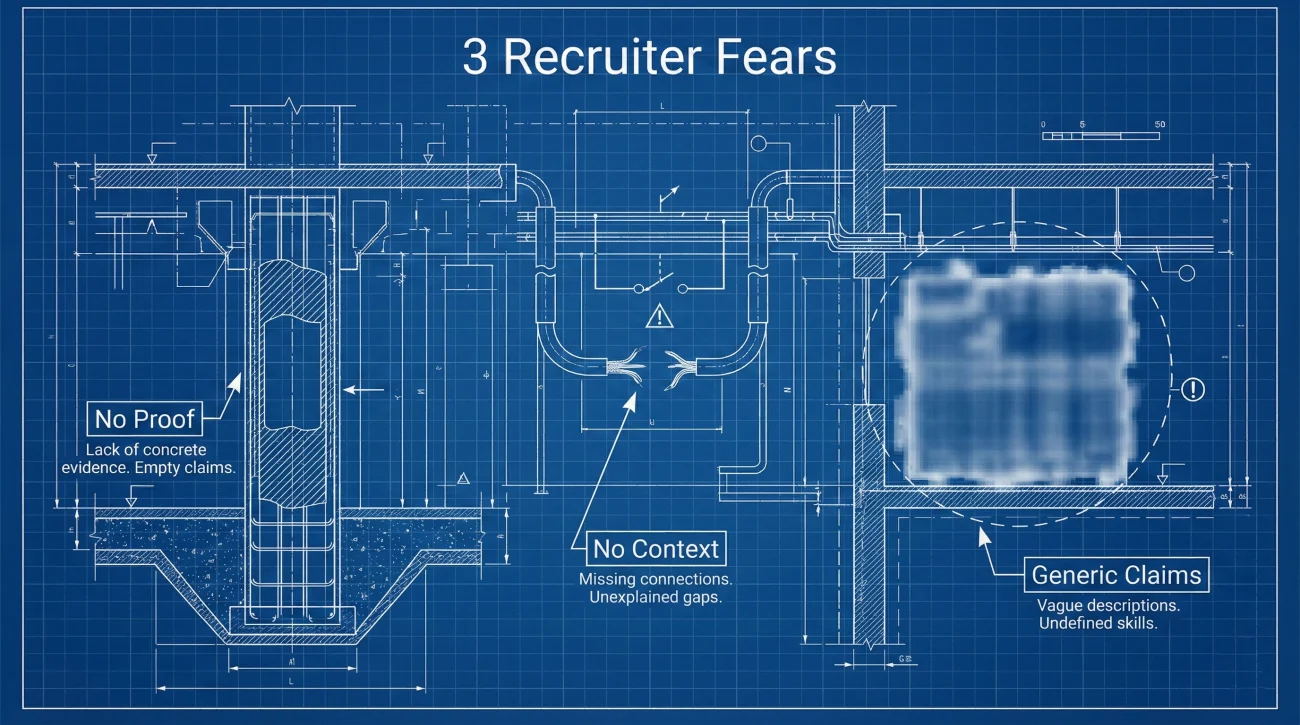
Three concerns make recruiters hesitate on career change candidates:
📋 No Proof Risk. You claim you can do the job, but you have never actually done it. Every other candidate has direct experience. Why should they take a chance on someone who might fail? Your resume must provide evidence – not just assertions – that you can perform in the new role.
❓ No Context Risk. Why are you switching? Is this a genuine passion or a desperate escape from a failing career? Are you running toward something or running away? Without clear motivation, recruiters assume the worst: you could not succeed in your original field.
🌫️ Generic Claims Risk. “Transferable skills” and “quick learner” are meaningless without specifics. Every career changer claims adaptability. What makes you different? Generic language signals you have not done the work to understand what the target role actually requires.
Your materials must address all three: proof you can do the work, clear context for why you are switching, and specific rather than generic claims about your qualifications.
Switch-Risk Checklist
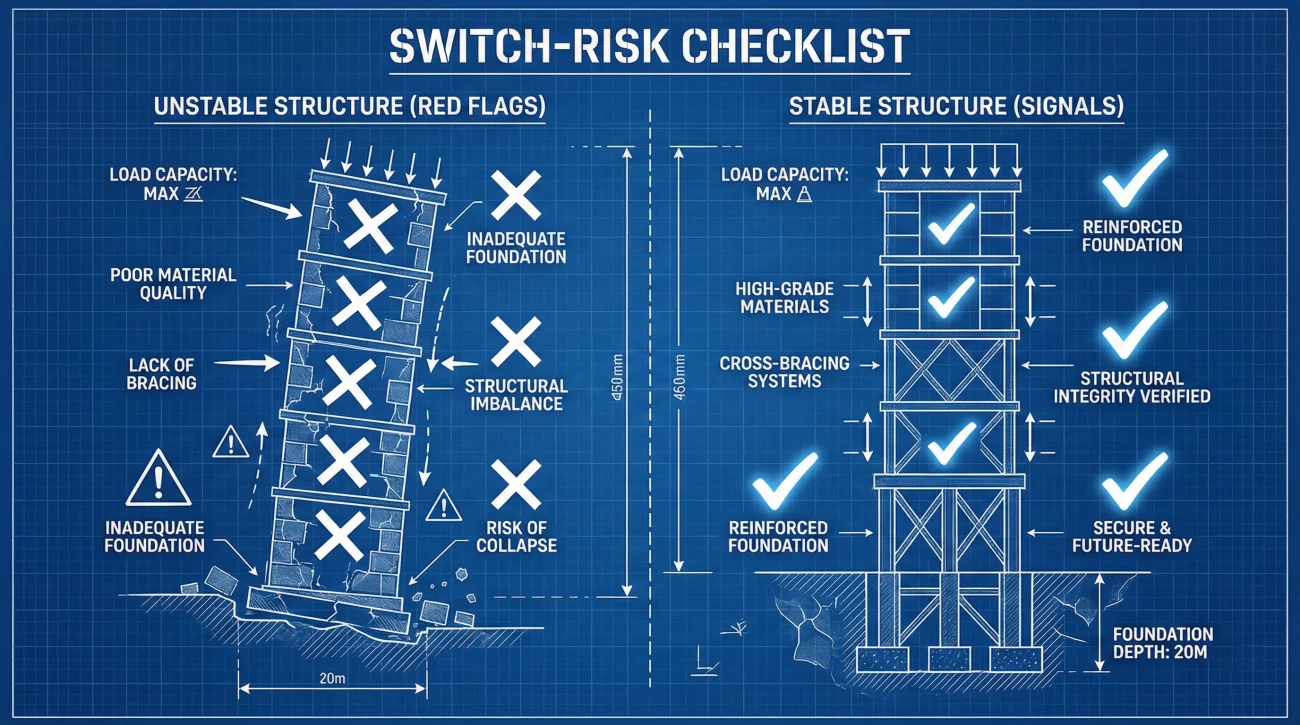
Audit your resume against these signals before applying:
🚩 Red Flags That Signal Risky Career Changer
- 🚩 Summary mentions old industry prominently
- 🚩 No explanation of why you are changing
- 🚩 Skills section lists abilities without proof of application
- 🚩 Bullets use jargon from old field that does not translate
- 🚩 No certifications, projects, or training in new field
- 🚩 “Seeking new challenge” or “passionate about learning” language
- 🚩 Target role unclear from resume content
✅ Signals That Suggest Prepared Career Changer
- ✅ Summary leads with target role and transferable proof
- ✅ Bullets translated into target industry language
- ✅ At least one credential or project in new field
- ✅ Clear narrative connecting past to future
- ✅ Specific about which role you want, not “open to opportunities”
- ✅ Volunteer work, freelance, or side projects showing commitment
💡 The Proof Test: If you removed all your job titles, would someone reading your bullets know what industry you came from? If yes, you have not translated enough.
The Translation Framework
Translation is not about lying. It is about selecting which truths to emphasize and how to phrase them. Follow this framework:
Step 1: Decode the Target Role
Read 10-15 job descriptions for your target role. List every requirement, skill, and responsibility mentioned. Note the exact language used. This becomes your translation dictionary.
Step 2: Map Your Experience
For each requirement you identified, find where you have done something similar – even if the context was different. Project management is project management whether it was construction timelines or event logistics. Data analysis is data analysis whether it was retail sales or patient outcomes.
| Target Requirement | Your Experience (Before Translation) | Translated Version |
|---|---|---|
| “Cross-functional collaboration” | Coordinated between kitchen, front desk, and housekeeping | Led cross-functional coordination across 3 departments |
| “Stakeholder management” | Worked with parents and school administrators | Managed stakeholder relationships including executives and external partners |
| “Data-driven decision making” | Used sales reports to adjust inventory | Applied data analysis to optimize operations, reducing overstock 20% |
| “Process improvement” | Changed how we handled returns | Redesigned customer service workflow, cutting resolution time 35% |
Step 3: Fill Gaps With Proof
Where you cannot map existing experience, you need to create proof. This might mean certifications, volunteer projects, freelance work, or online courses with portfolio outcomes. A career changer with no proof asks employers to take a leap of faith. A career changer with proof asks them to evaluate evidence.
Four Scripts for Career Change Situations
These scripts address the most common career change conversations. Each one handles a different aspect of the switch – from explaining motivation to proving transferable capability.
Script 1: Why the Switch (30 seconds)
“I spent eight years in hospitality marketing and consistently found myself most engaged by the digital and analytics side of campaigns. Over time, I realized I wanted to focus entirely on that work rather than having it be part of a broader hospitality role. I’ve spent the last year building skills specifically for SaaS marketing – HubSpot certification, a volunteer project for a tech nonprofit – and I’m ready to make that my full-time focus.”
Shows intentionality, not desperation. Explains the pull toward new field.
Script 2: Addressing the Experience Gap (20 seconds)
“I know my background is different from typical candidates. What I bring is proven ability in the core skills this role requires – project coordination, stakeholder communication, data-driven decision making – plus fresh perspective from outside the industry. I’ve also invested in bridging the gap with [specific certification/project].”
Acknowledges the gap directly while pivoting to strengths.
Script 3: Transferable Skills Proof (25 seconds)
“The work is more similar than it might appear. In my teaching role, I designed curriculum for 150 students, tracked progress through assessment data, and adjusted programs based on outcomes. That’s the same cycle as program management in corporate settings – define goals, measure results, iterate. The context is different but the skill set is the same.”
Specific mapping from old role to new requirements.
Script 4: Commitment Signal (15 seconds)
“This isn’t an impulse. I’ve spent 18 months preparing – taking courses, building a portfolio, networking in the field. I’m making this change because I want to build a career here, not because I’m trying to escape something else.”
Counters the “desperate escape” assumption directly.
Common Career Change Mistakes
These errors seem reasonable but consistently undermine career change applications:
🚫 Leading with your old identity.
“Marketing professional with 10 years in hospitality seeking transition to tech” puts your old field first. Lead with your target: “Growth marketer with digital acquisition expertise and hospitality industry background.”
🚫 Overselling “transferable skills” without proof.
Everyone claims adaptability and quick learning. Prove it with specific examples of times you learned new domains quickly and delivered results. Abstract claims without evidence are worthless.
🚫 Applying broadly instead of targeting specifically.
Career changers who apply to “anything in tech” or “any marketing role” signal they have not done the work to understand what they actually want. Narrow focus increases success rate.
🚫 Skipping the proof-building phase.
Jumping straight into applications without certifications, projects, or any evidence of commitment to the new field. Employers see someone who wants to switch but has not invested in actually preparing.
🚫 Expecting employers to see the connection.
Your resume must make the translation explicit. “You might not realize it, but my teaching experience is basically program management” is not their job to figure out. Show them directly.
🚫 Hiding your background entirely.
Some career changers try to obscure their old field entirely. This backfires in background checks and interviews. Own your background while framing it as an asset, not something to hide.
Proof Options When You Lack Direct Experience
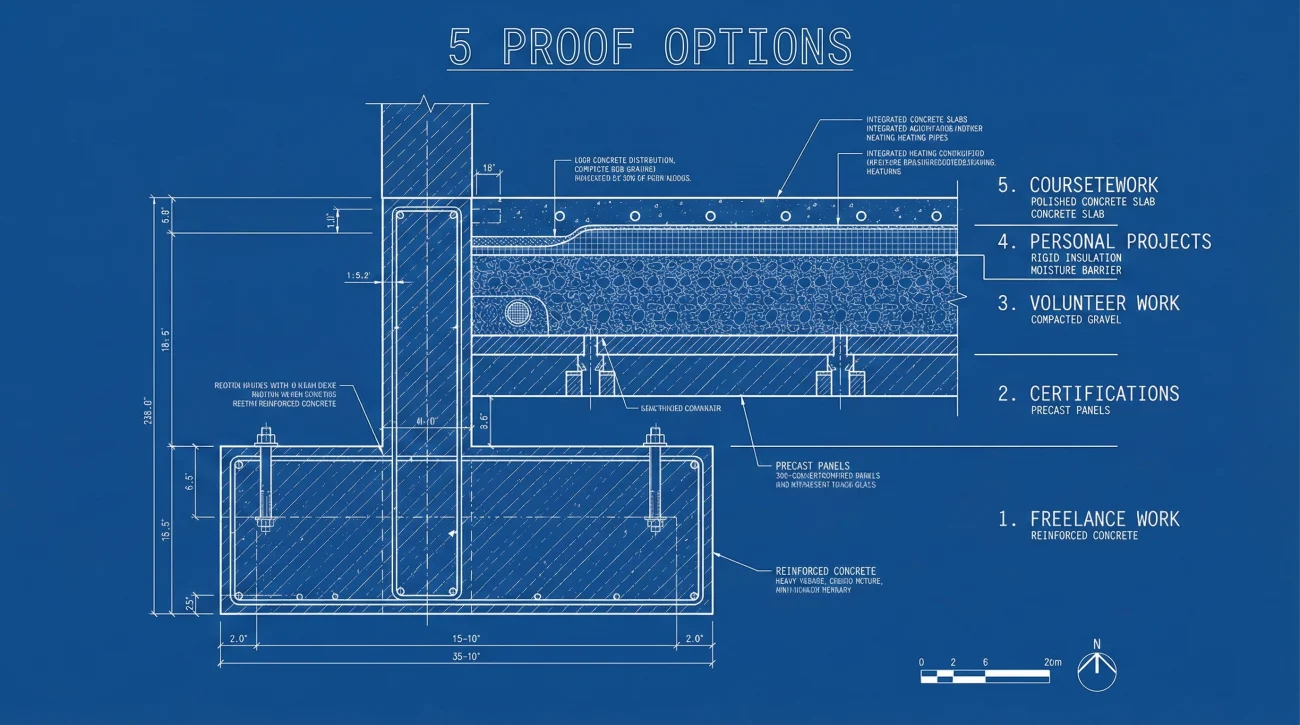
Creating proof before you switch dramatically increases your success rate. Options ranked by impact:
🏆 Freelance or Contract Work. Even one paid project in your target field provides real proof. “Freelance UX research for 2 clients” is worth more than any certification. Seek small projects on platforms like Upwork or through your network.
🎓 Certifications With Projects. Not all certifications are equal. Prioritize those requiring portfolio work or capstone projects. Google, HubSpot, and Coursera professional certificates often include practical components. List both the certification and the project outcome.
🤝 Volunteer Work. Nonprofits need skills they cannot afford. Offer your target skill set pro bono: marketing for a local charity, project management for a community organization, data analysis for a cause you care about. Real work with real outcomes.
📁 Personal Projects. Build something that demonstrates capability. A portfolio website, a data analysis project posted on GitHub, a marketing case study based on a real business. The project itself is proof of initiative and skill.
📚 Relevant Coursework. Weakest option but still valuable. Online courses from recognized providers show commitment. Combine with practical application – “Completed Google Analytics certification and applied framework to optimize personal blog traffic 40%.”
Resume Structure for Career Changers
Standard chronological format often works against career changers because it leads with irrelevant job titles from your old field. The reader sees “Hotel Marketing Manager” before they see any evidence of tech capability. Consider these structural adjustments to lead with relevance:
Summary First.
Lead with a summary that positions you for your target role. This is where you make the connection explicit: “[Target role] with background in [old field] bringing [specific transferable skills].”
Relevant Experience or Projects Section.
If you have any work in your target field – freelance, volunteer, projects – consider placing it above your chronological work history. This puts relevant proof first.
Skills Section Placement.
Move a targeted skills section higher on the page. Include only skills relevant to the target role, using the exact language from job descriptions.
Translated Bullets.
Every bullet in your experience section should be translated into target-role language. Remove industry jargon from your old field that does not translate.
Education and Certifications.
If you have recent credentials in your target field, place them prominently. Recent relevant training outweighs old irrelevant degrees.
Detailed Guides
| Article | Focus |
|---|---|
| Transferable Skills for a Career Change: How to Prove Them (Not Claim Them) | Translation method with proof-first bullets and quick evidence cues |
| Career Change Resume Summary: 7 Openings That Make the Switch Feel Obvious | Summary openers that connect past wins to the new target in one breath |
| Why the Career Change: A 45-Second Interview Answer That Sounds Intentional | 45-second answer structure with variations for different motivations |
| Career Change Cover Letter: One Paragraph That Connects the Dots | One-paragraph template that makes the pivot feel logical and earned |
| Career Change With No Direct Experience: What Counts as Proof | Proof types that hiring teams accept when your experience is adjacent |
| Projects Section for a Career Change: Make It Feel Like Real Experience | Project framing that reads like work experience without pretending |
| Tailoring a Career Change Resume: What to Mirror Without Keyword Stuffing | What to mirror from the job post and where to stop so it stays human |
| Job Title Tweaks for a Career Change: What Is Safe and What Is Not | Safe title edits, unsafe title edits, and how to keep trust intact |
| LinkedIn Headline for a Career Change: 12 Options That Match Your Target Role | Headline patterns that signal your target role without sounding fake |
| Career Change Resume Mistakes: 15 Red Flags That Kill Credibility | Credibility killers that make a pivot look confused, rushed, or risky |
Make the Translation Explicit
A career change resume succeeds when it does the translation work for the reader. Decode your past experience into its core skills. Recode those skills in target-field language using the exact vocabulary from job descriptions. Add proof where direct experience is missing – certifications, projects, freelance work, anything that shows real capability. Explain your motivation clearly so it sounds intentional, not desperate. The recruiter spending six seconds on your resume should immediately understand what you want and why you are qualified – even though your background is not traditional. That understanding does not happen by accident. You build it deliberately through every word choice, every bullet translation, every structural decision on the page.
❓ FAQ
🎯 Should I use a functional resume format?
Usually not. Purely functional formats raise red flags about what you are hiding. A hybrid approach works better: strong summary and skills section up top, followed by chronological experience with translated bullets. You get the benefits of leading with relevance without the suspicion functional formats attract.
📝 How do I address having no direct experience?
Acknowledge it briefly and pivot to what you do have: transferable skills, relevant projects, certifications, and genuine preparation. “My background is different, and that’s intentional – I bring [specific value] plus [proof of new field capability].”
💼 Should I take a lower-level role to break in?
Sometimes necessary but approach carefully. One level down is reasonable. Two or more levels down may make it hard to advance later. Consider whether the role provides genuine skill-building or just a foot in the door with limited growth.
🔍 How long should I prepare before switching?
Minimum 3-6 months of active preparation: coursework, projects, networking. Ideal is 6-12 months with at least one real-world project or freelance engagement in your target field. Rushed switches with no preparation have low success rates.
⚠️ Disclaimer: ResumeSolving provides resume, cover letter, and job search communication guidance for informational purposes only. It is not legal, medical, financial, or professional counseling advice. Hiring decisions vary by company, role, location, and individual circumstances, so we do not guarantee interviews, offers, or outcomes. Always use your own judgment, verify requirements directly with the employer, and follow local laws and workplace policies. When a situation is sensitive, we prioritize privacy-safe, recruiter-appropriate wording, and you never need to share personal details you are not comfortable disclosing.