- A resume summary is not an introduction. It is a credibility snapshot that makes everything below it easier to believe.
- Four elements make summaries work: target role clarity, proof hint, scope signal, and professional tone. Miss any one and the summary falls flat.
- Keep it between 3 and 5 lines. Longer summaries read like you are trying to hide weak experience behind words.
- The summary should answer “Why should I keep reading?” in under 10 seconds.
What a Resume Summary Actually Does
A resume summary sits at the top of your resume and gets about 6 seconds of attention. In those 6 seconds, it must convince a recruiter that the rest of your resume is worth reading carefully. That is its only job. Every word must earn its place.
A product manager named David had a strong background but kept getting screened out before interviews. His resume opened with: “Dynamic and results-oriented professional with a passion for innovation and a track record of success in cross-functional environments.” Fourteen words. Zero information. Recruiters learned nothing about what he did or what he wanted.
We rewrote it: “Product manager with 6 years leading B2B SaaS features from discovery to launch. Built recommendation engine that increased user engagement 34%. Looking for a senior PM role at a product-led company.” Same person. Now the recruiter knows exactly what David does, has evidence he can deliver, and understands where he fits.
The summary is not a place to express your personality or career philosophy. It is a compressed proof statement that makes the rest of your resume more believable.
Key Point: Your summary must answer three questions instantly: What do you do? What can you prove? What role are you targeting?
Summary Checklist: Four Elements That Work
Every effective resume summary includes these four elements working together. If any one of them is missing or weak, the summary loses its power to convince:
| Element | What It Does | How to Include It |
|---|---|---|
| Target role clarity | Tells recruiter what job you want | Lead with your target role title or function |
| Proof hint | Shows you have done this work successfully | Include one specific achievement with outcome |
| Scope signal | Calibrates seniority expectations | Mention team size, company stage, or project scale |
| Professional tone | Builds credibility through restraint | Avoid adjectives that describe personality, focus on work |
Self-Check Before Submitting
- ✅ Does the first line make your target role obvious?
- ✅ Does at least one sentence include a specific, verifiable outcome?
- ✅ Can a recruiter tell your seniority level from the summary?
- ✅ Is it under 5 lines?
- ✅ Does it avoid vague adjectives like “dynamic,” “passionate,” or “results-driven”?
- ✅ Would you believe this if you read it about someone else?
The Summary Formula
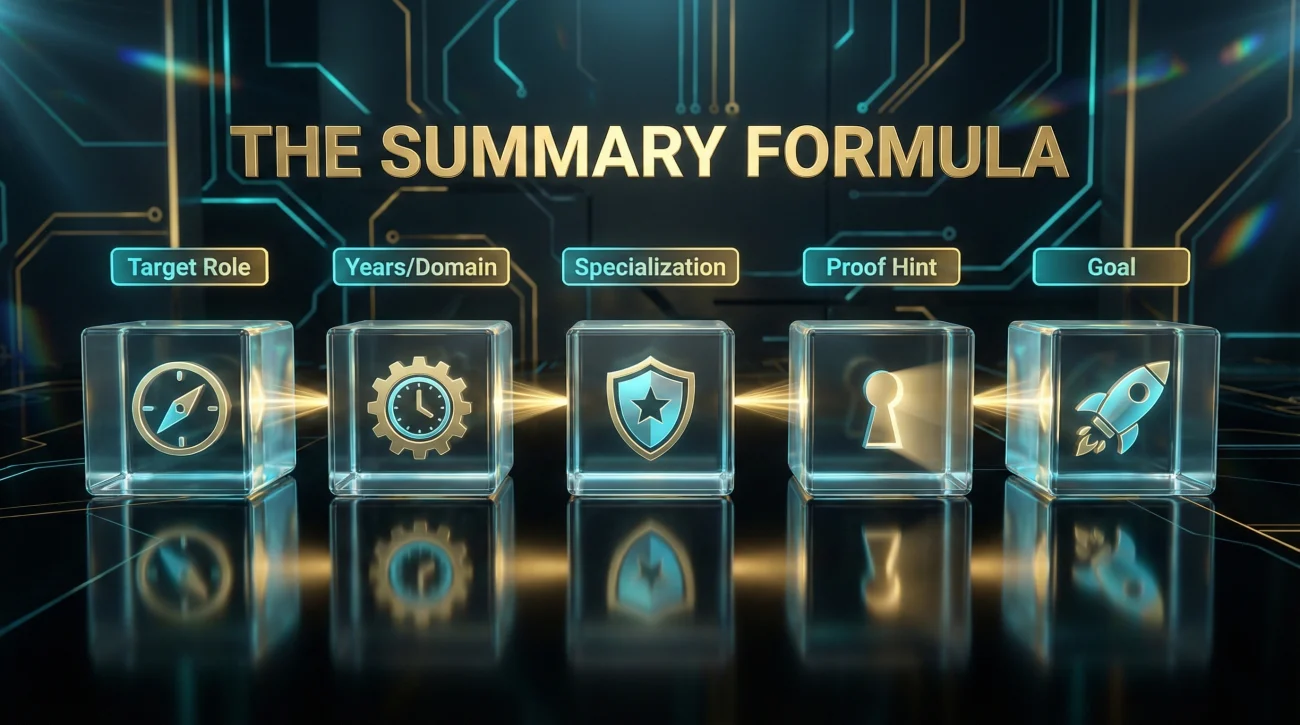
Use this formula as a starting point for writing your summary. Adjust based on your situation and industry norms, but keep the core structure intact to ensure you hit all four essential elements:
[Target Role] + [Years/Domain] + [Specialization] + [Proof Hint] + [What You Want Now]
Formula Applied
Notice how each part of the formula appears:
- Target role: Senior UX Designer
- Years/Domain: 7 years, fintech and healthcare
- Specialization: digital experiences, mobile banking
- Proof hint: redesign improved task completion 28%
- What you want: senior design role, product company, end-to-end ownership
Four Mini Scripts for Different Situations
These scripts address the most common summary challenges job seekers face. Adapt the structure and language to your specific situation while keeping the core elements intact.
Script 1: Standard Professional Summary
Use this when you have clear, relevant experience and a straightforward target role.
Script 2: Career Change Summary
Use this when changing careers. Lead with your target role, then show the bridge between old and new.
Script 3: Freelance to Full-Time Summary
Use this when transitioning from independent work. Emphasize continuity and collaboration.
Script 4: Gap Recovery Summary
Use this after a career gap. Signal readiness through recent activity rather than explaining the gap.
Summary vs Objective: Which to Use
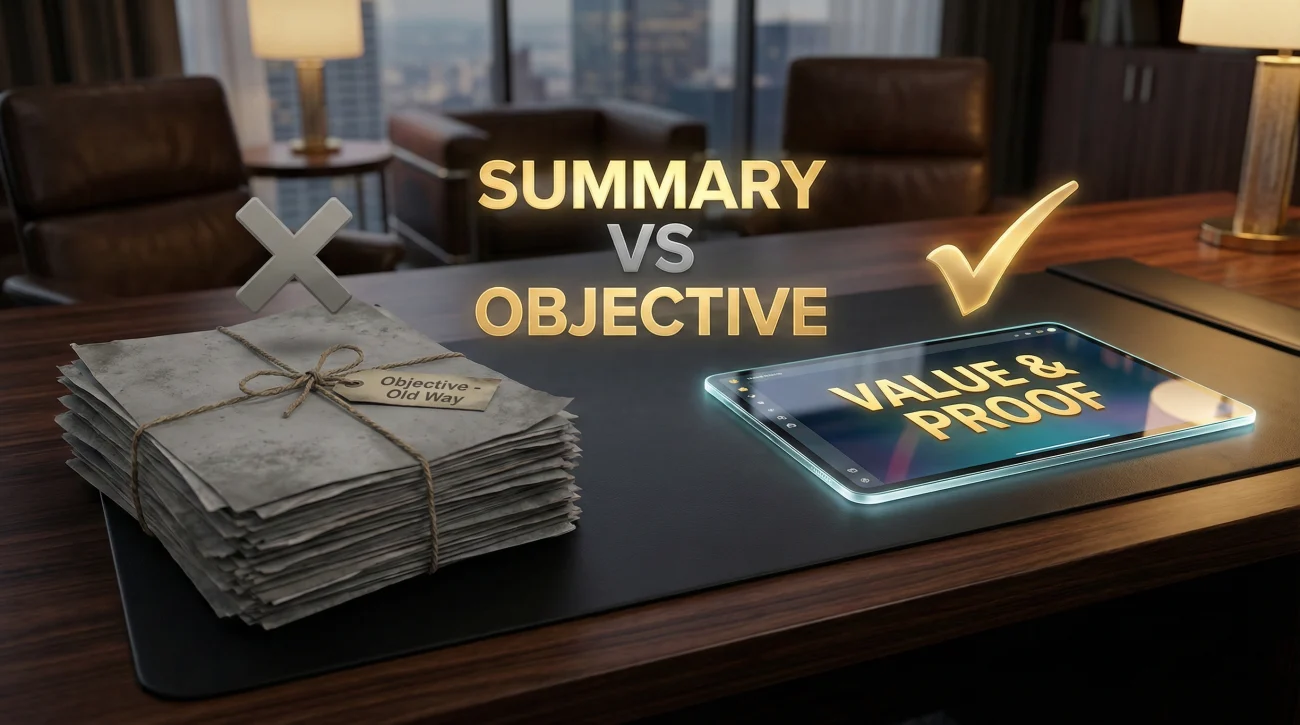
Resume objectives were popular decades ago. They focused entirely on what you wanted from employers: “Seeking a challenging position where I can utilize my skills.” Today, that approach reads as self-centered and unhelpfully vague.
Summaries focus on what you offer: “Marketing manager with 5 years driving demand generation.” This approach is far more useful to recruiters because it answers their question, not yours.
When Objectives Still Work
Objectives can work in two specific situations:
- Entry-level with no experience: When you have nothing to summarize, a clear objective shows intent and focus
- Extreme career change: When your background gives no clue about your target, an objective clarifies direction
Even in these cases, hybrid approaches often work better. Start with an objective-style opening, then add a proof element:
💡 Pro Tip: If you are deciding between summary and objective, default to summary. When in doubt, proof beats intention.
Summary Length: Why Shorter Is More Credible
Long summaries signal insecurity to recruiters. They read like you are trying to overwhelm the reader with words because your actual experience is too weak to speak for itself. Tight, focused summaries signal confidence and competence.
Length Rules
- 3 lines: Ideal for straightforward backgrounds
- 4 lines: Fine when you need to address a pivot or special situation
- 5 lines: Maximum for complex backgrounds with multiple relevant threads
- 6+ lines: Almost always too long. Cut something.
A data analyst named Charly had a 9-line summary that tried to mention every tool she knew, every industry she had worked in, and every skill she wanted to highlight. It read like a keyword dump. We cut it to 4 lines focused on her target role and one strong proof point. Her callback rate improved immediately.
How to Trim Without Losing Proof
- Cut adjectives that describe personality (passionate, dedicated, motivated)
- Remove skills that appear in your experience section anyway
- Keep only your strongest proof point, not three medium ones
- Delete “responsible for” statements that just restate your job title
- Remove “seeking a challenging opportunity” language entirely
What to Avoid in a Resume Summary

Certain patterns destroy credibility instantly. Recruiters have seen these thousands of times and automatically discount resumes that use them. Remove these patterns completely from your summary:
Vague Adjectives
❌ Avoid: “Dynamic, results-oriented professional with a passion for excellence”
These words mean nothing because everyone uses them. They take up space without adding information.
Claiming Everything
❌ Avoid: “Expert in marketing, sales, operations, product management, and team leadership”
Claiming expertise in everything makes you look unfocused and probably not expert in any of them.
Third-Person Voice
❌ Avoid: “John is a skilled engineer with experience in multiple frameworks”
Third person sounds pretentious on a resume. Use first person (without the “I”) or implied first person.
Generic Company Language
❌ Avoid: “Seeking a position at a forward-thinking company where I can make an impact”
This could apply to literally any job. It tells the recruiter nothing about fit.
Empty Outcome Language
❌ Avoid: “Track record of success” or “history of delivering results”
These phrases claim outcomes without specifying any. Replace with one concrete example.
Where to Place Your Summary
Summary placement affects how recruiters process your resume. The standard and most effective placement is immediately below your contact information and above your experience section.
Recommended Order
- Name and contact information
- Headline or title (optional but recommended)
- Summary (3-5 lines)
- Experience section
This order works because the summary appears exactly where recruiters look first after noting your name. It frames everything that follows.
Placement Mistakes to Avoid
- Burying it after skills: A summary after a skills section loses its framing power
- Combining with headline: If you have both, keep them separate for visual clarity
- Making it too prominent: The summary should not visually dominate the page
- Adding a label: “Professional Summary” headers are optional and often unnecessary
💡 Pro Tip: If your resume uses a two-column layout, the summary should span the full width at the top, not be squeezed into a sidebar.
Common Summary Mistakes
After reviewing thousands of resumes, I see the same summary errors repeatedly. These patterns destroy credibility and waste valuable space:
Mistake 1: The Buzzword Stack
Piling adjectives without substance creates noise: “Dynamic, results-driven, innovative professional with a passion for excellence and a commitment to success.” This sentence contains zero information.
Fix: Replace every adjective with a specific fact or achievement.
Mistake 2: Repeating Your Job Title
Summaries that just restate what is already in the experience section waste space: “Marketing manager who manages marketing campaigns and marketing teams.”
Fix: Add proof or specialization that goes beyond the job title.
Mistake 3: The Autobiography Opening
Starting with your career history instead of your value: “After graduating from State University in 2015, I began my career at…”
Fix: Lead with your target role and strongest proof, not chronology.
Mistake 4: The Skills Dump
Listing tools and technologies without context: “Proficient in Excel, PowerPoint, Salesforce, HubSpot, Google Analytics, Tableau, and SQL.”
Fix: Save the tool list for a dedicated skills section. Summary should focus on outcomes.
Mistake 5: The Desperate Closer
Ending with needy language: “Eager to find a company that will give me a chance to prove myself.”
Fix: End with confidence about what you bring, not what you need.
Summaries for Hard Cases
Some situations require adjusted approaches because the standard formula does not quite fit. Here is how to handle the most common challenging scenarios while maintaining credibility:
No Experience
When you lack professional experience, substitute with projects, coursework outcomes, certifications, or internships. Be specific about what you built or achieved, even if the scale was small.
Overqualified for Target Role
When applying for a lower-level role, your summary should signal intentional scope choice, not desperation. Emphasize craft focus over leadership ambition.
Founder Transitioning to Employee
When moving from founder to employee, your summary must counter flight risk and ego concerns. Lead with your target employee role, not your founder identity.
Choose Your Next Step
This hub covered the resume summary framework. The clusters below go deep on specific situations and challenges you may encounter. If you need the core formula with step-by-step guidance, start with the “how to write” guide. If you are handling a specific situation like a career change, employment gap, or freelance background, jump to that cluster directly for tailored advice.
| Article | Description |
|---|---|
| Resume Summary vs Resume Objective: Which One Works Now | Decision rules for when to use summary, objective, or hybrid approach |
| How to Write a Resume Summary: A Simple Formula That Sounds Human | Core formula with 10 examples and tone checklist |
| Resume Summary Examples: 20 Short Summaries With Notes | Example bank grouped by intent with rationale for each |
| Resume Summary With No Experience: What to Say Without Sounding Empty | Proof alternatives for entry-level candidates with 10 examples |
| Resume Summary for a Career Change: 4 Patterns That Make the Switch Feel Logical | Career change patterns with 12 examples and routing to career change hub |
| Resume Summary for Freelancers: Signal Continuity and Team Readiness | Freelance-specific patterns emphasizing stability |
| Resume Summary for Founders: Sound Hireable Without the Founder Ego | Founder-specific patterns countering flight risk concerns |
| Resume Summary When You Are Overqualified: Signal You Want This Scope | Downlevel patterns with scope acceptance cues |
| Resume Summary After a Gap: How to Signal Readiness Now | Gap-aware patterns focusing on recent activity proof |
| Resume Summary Length: How Many Lines and Why Too Long Looks Fake | Length rules with trimming examples |
| Resume Summary Mistakes: 15 Red Flags That Kill Credibility | Common errors with fixes and self-check before submitting |
| Where to Put a Resume Summary: Placement Rules That Get Read | Placement relative to headline and other sections |
Making Your Summary Work
The resume summary is one of the highest-leverage improvements you can make to your resume. It takes 6 seconds to read and determines whether the recruiter keeps reading carefully or moves to the next candidate in the stack.
Get the four elements right: target role clarity, proof hint, scope signal, and professional tone. Keep it between 3 and 5 lines. Cut every word that does not add concrete information. Test it by asking: would I believe this if I read it about someone else? If the answer is no, revise until it feels credible.
When your summary works well, everything below it becomes more credible. The recruiter already knows what to look for and already believes you might be able to deliver it. Your experience section becomes confirmation rather than discovery. That fundamental shift in recruiter mindset is exactly what gets you to the interview stage.
❓ FAQ
🎯 Do I need a summary if my experience is straightforward?
A summary always helps, even with straightforward experience. It gives the recruiter a frame for interpreting everything below. Without it, they have to figure out your target and strengths from scanning your experience, which takes more cognitive work and increases the chance of misinterpretation.
📝 Should I customize my summary for each job application?
Yes, for roles you care about. The target role in your summary should match the job you are applying for. The proof hint should be relevant to that role’s requirements. A generic summary that could apply to any job is a missed opportunity.
💼 Can I use bullet points in my summary?
Generally avoid them. Summaries work best as short paragraphs that read smoothly. Bullet points in a summary often signal you could not figure out how to write coherent prose. Save bullets for your experience section.
🔍 Should I include soft skills in my summary?
Rarely. Soft skills like “excellent communicator” or “team player” are self-assessments that recruiters discount. If communication is genuinely relevant, show it through proof: “Presented strategy recommendations to C-suite quarterly” demonstrates communication better than claiming it.
⚠️ What if I am applying to very different types of roles?
Create different versions of your resume with different summaries. A summary optimized for product management roles will not work well for project management roles, even if your experience supports both. Tailor each version to its target.
⚠️ Disclaimer: ResumeSolving provides resume, cover letter, and job search communication guidance for informational purposes only. It is not legal, medical, financial, or professional counseling advice. Hiring decisions vary by company, role, location, and individual circumstances, so we do not guarantee interviews, offers, or outcomes. Always use your own judgment, verify requirements directly with the employer, and follow local laws and workplace policies. When a situation is sensitive, we prioritize privacy-safe, recruiter-appropriate wording, and you never need to share personal details you are not comfortable disclosing.