- If you mention a layoff in a cover letter, do it in one small paragraph, not as the theme of the letter.
- Use a neutral label (RIF, restructuring, position eliminated), then add one stability signal that closes the story.
- Skip the layoff paragraph entirely unless the timeline creates an obvious question (recent end date, current notice, or short tenure).
The Real Problem: Your Cover Letter Is Not a Confessional
I once worked with a product marketer named Lynn who had been swept up in a team-wide reduction. Her resume was fine. Her portfolio was strong. Her cover letter, though, opened like a breakup text. Three paragraphs of context, one paragraph of apologies, and then a small, timid sentence about why she wanted the job.
When we rewrote it, we kept exactly one line that explained what happened. Everything else went back to what the cover letter is supposed to do: Show fit, show judgment, and make the next step feel easy.
If you are searching for how to explain being laid off in a cover letter, you are probably trying to solve one of two fears:
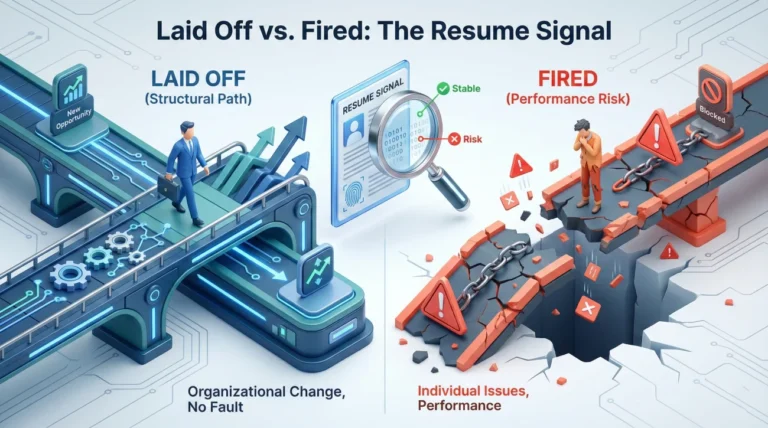
- You worry the reader will assume performance issues.
- You worry the reader will assume instability, like you are a flight risk or a “mess” they will inherit.
💡 Pro Tip: The goal is not to convince them the layoff was unfair. The goal is to make the timeline feel normal and closed.
When You Should Mention a Layoff in a Cover Letter
The internet gives you two loud, opposite rules: Always mention it, or never mention it. Real hiring does not work like that. It depends on whether the timeline creates a question that distracts from your fit.
| Situation | Should you mention the layoff? | Why |
|---|---|---|
| Resume shows your last role ended recently (past 0 to 6 months) | Usually yes, one short paragraph | It removes the “what happened” loop so the reader can focus on your match. |
| You are still employed but you have a layoff notice date coming | Sometimes, one sentence | It prevents confusion if dates overlap or if you are interviewing “early.” |
| Your last role ended 12+ months ago and you already explain the gap elsewhere | Usually no | Repeating it can make the layoff feel like your identity instead of an event. |
| Short tenure (under 6 months) and you worry it looks like a bad fit | Yes, but label it structurally | You want “business change” to land before “short tenure” becomes a story. |
| Career switch or relocation is the real reason you are applying | Only if the timeline forces it | The reader should remember your direction, not your last employer’s budget problem. |
⚠️ Warning: If you mention a layoff, do not put it in your opening line unless the job posting explicitly references a restructuring or merger context you can mirror. Otherwise you start the letter with a problem instead of value.
The One Paragraph Structure That Does Not Create New Questions

Here is the structure I use when a layoff mention is helpful. It is short on purpose. It is designed for skim-reading.
[Neutral label] + [Scope] + [Closure signal] + [Immediate pivot back to role fit]
Step 1: Use a neutral label that signals “business event”
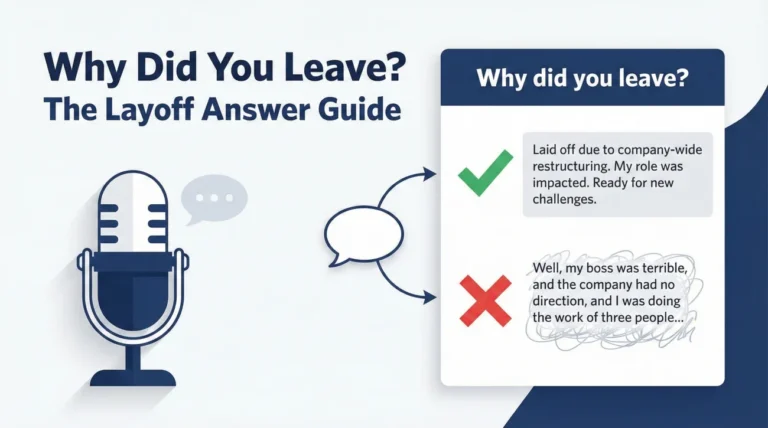
Neutral labels do two things at once. They explain why the role ended, and they quietly tell the reader you understand hiring language. “Laid off” is not wrong, but it can feel personal. Structural labels feel less emotional.
- Reduction in force (RIF)
- Restructuring
- Position eliminated
- Team consolidation after acquisition
Step 2: Add scope so it cannot sound like a performance exit
Scope can be one phrase. You are not litigating the past. You are showing it was not a one-person decision.
- “Company-wide”
- “Department-wide”
- “Part of a broader reorg”
- “Role eliminated during budget reset”
Step 3: Add one closure signal that says “I am stable now”
This is the missing piece in most templates online. They explain the layoff but forget to close the loop. Closure can be as simple as what you did next: contract work, training, shipping a project, or finishing a transition plan.
💡 Pro Tip: Closure is not “I learned resilience.” Closure is concrete: What you shipped, completed, or built right after.
Two Cover Letter Templates You Can Paste Without Sounding Dramatic
These are designed as add-on paragraphs. You can place them after your opening hook (why this role) or right before your closing. Keep them tight.
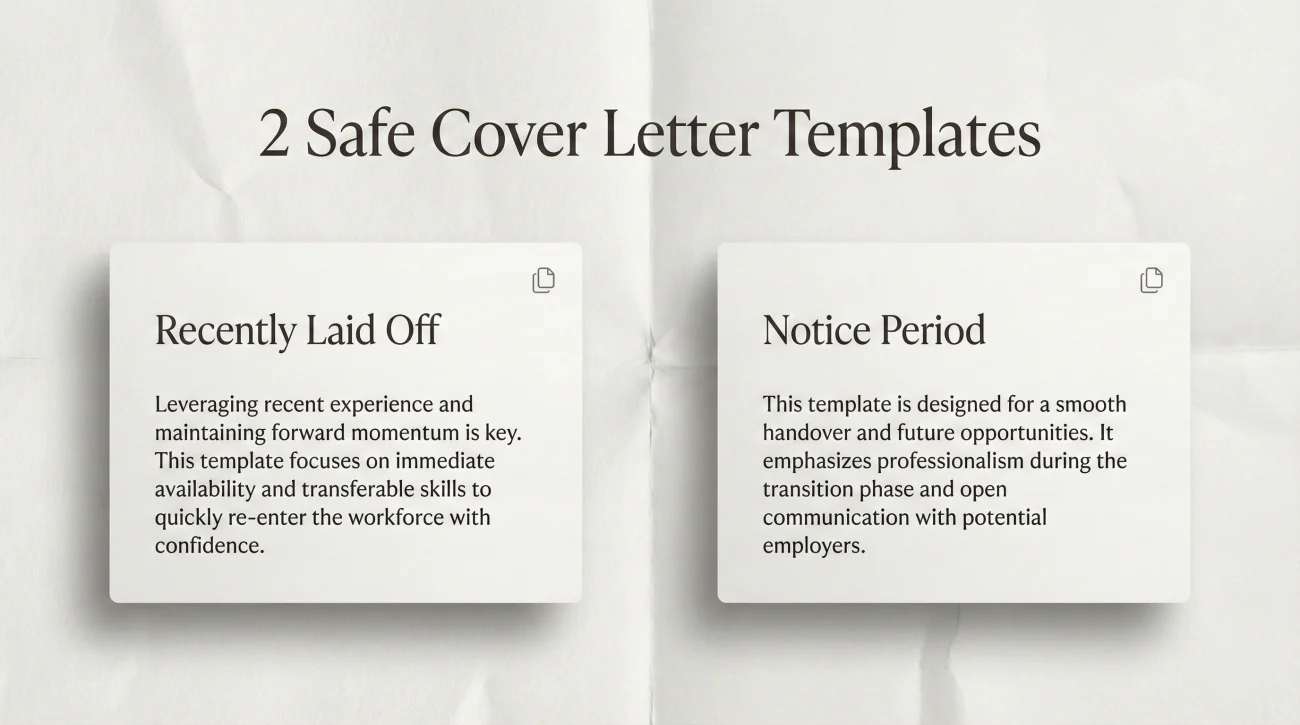
Template 1: Recently laid off and actively interviewing
I was affected by a company-wide restructuring and my role was eliminated in December. Since then, I have stayed active by [short proof of momentum: consulting, shipping a project, completing a credential], and I am now focused on roles where I can apply my experience in [relevant domain] to [role priority from the posting].
Where this works best: You need a clean, calm cover letter layoff explanation because your resume end date is fresh and you do not want the reader filling in blanks.
Template 2: Still employed, but a layoff notice is driving your timing
My team is currently going through a restructuring and my position is scheduled to end in February. I am applying now because I want a smooth transition into a role that emphasizes [skill area] and [impact area], which is exactly what drew me to this opening.
Where this works best: You are trying to avoid confusion about why you are searching “early,” and you want your reason to feel normal, not secretive.
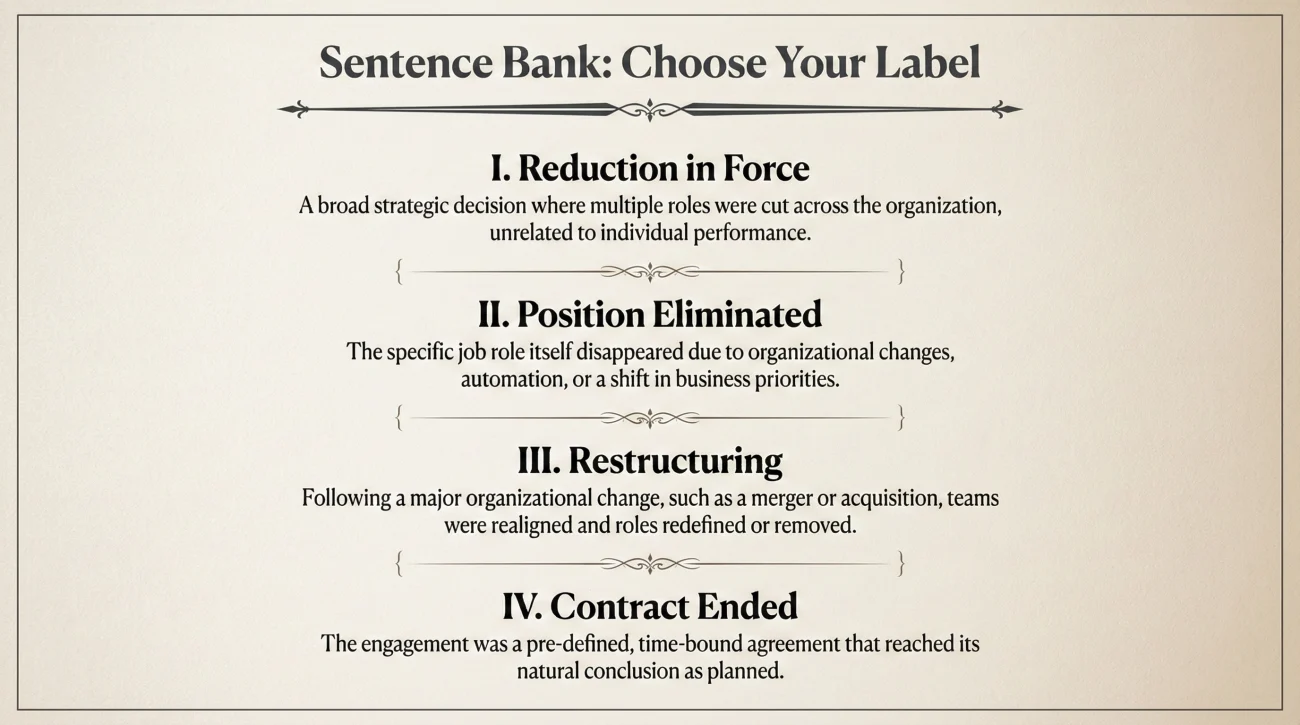
Sentence Bank: Pick the Label That Matches What Actually Happened
Most people get into trouble because they pick a label that is either too dramatic, too legal-sounding, or simply inconsistent with their resume. This section is a plain-language menu. You choose one label that fits, write one clean sentence, and then pivot back to fit.
One rule keeps you safe across almost every scenario: Write the label the way your former employer would describe it on a verification call. If you are not sure, pick the simpler wording.
Reduction in force (RIF)
This is the cleanest label when headcount cuts hit multiple roles and the decision was driven by budget or a broader reset. It tends to read “structural” immediately, which is helpful when you want to avoid any performance interpretation.
I was impacted by a reduction in force during a company-wide cost reset, and I am now targeting roles focused on [X].
If your resume already shows a recent end date, this single line can be enough to stop the reader from filling in blanks.
Position eliminated
Use this when the job itself disappeared, not when the company simply reduced headcount. It fits situations like product line shutdowns, functional consolidation, or moving a team into another region. It is also a strong choice when your tenure was short and you want “structural” to land fast.
My role was eliminated as part of a reorganization that consolidated the function into another region.
If you add a second sentence, make it a pivot back to the job you want, not a story about internal politics.
Restructuring after acquisition
This label is for M&A situations where overlap is expected and roles get duplicated. Recruiters have seen it enough that you rarely need to explain more than the trigger and the outcome. If you were part of a transition plan, you can hint at that with one concrete closure line.
Following an acquisition, our teams were consolidated and my position ended as part of the reorg.
If you want a closure signal, keep it practical: handoff completed, documentation delivered, knowledge transfer finished.
Contract ended
This one matters because people sometimes call every end date a layoff, and that can create a mess later. If it was fixed-term work or a project engagement, say that. It reads simpler, and it avoids turning a planned end into a dramatic event.
The project concluded as scheduled, and I am now focused on full-time roles in [area].
If the contract ended early because scope changed, you can still keep it calm. The key is that it remains time-bound work, not a performance story.
What Low Quality Advice Gets Wrong (And What to Do Instead)

Here is what I see in generic templates. They are not “bad writing.” They are bad risk management.
❌ Note: Do not write a layoff paragraph that sounds like a complaint ticket. If a reader feels pulled into your past employer’s drama, you lose control of the story.
Mistake 1: Turning the layoff into a character statement
Lines like “I am resilient and stronger than ever” are not evil, they are just empty. They also invite the reader to wonder what happened behind the scenes.
Do this instead: One structural label, one scope signal, one proof marker of momentum. Then move on.
Mistake 2: Over-explaining and accidentally implying performance problems
When people write “I exceeded expectations, my manager loved me, the company still let me go,” the reader often hears anxiety. Anxiety reads like risk.
Do this instead: Keep it calm and short. Your achievements belong in the body of the cover letter, not as a defense inside the layoff paragraph.
Mistake 3: Putting the layoff at the center of your opening
If your first paragraph is about the layoff, you force the reader to start in “problem mode.” Your opening should be about fit, not history.
Do this instead: Open with why you want the role and what you can deliver. If needed, add the layoff paragraph later as a small clarity note to address layoff in cover letter without hijacking the letter.
A Quick Reality Check: What Recruiters Actually React To
A recruiter friend of mine (in-house, mid-sized SaaS) described it like this: They do not “judge layoffs.” They judge how candidates handle uncertainty. The cover letter is a signal of judgment.
“If the cover letter reads like a defense, I assume the candidate will be defensive in the process.”
That does not mean you hide facts. It means you keep the tone adult and forward-facing. A good layoff line reads like a calendar entry, not a diary entry.
Three Mini Examples With Different Levels of Detail
Example A: One sentence, ultra minimal
My role ended as part of a department-wide restructuring, and I am now focused on positions where I can deliver [impact] in [domain].
Example B: Two sentences, with one proof marker
I was impacted by a reduction in force during a company cost reset in November. Since then, I have remained active by completing [credential] and delivering [project outcome], and I am excited about this role because it aligns with [posting priority].
Example C: Short tenure, needs structural clarity
After a team consolidation, my position was eliminated shortly after I joined. I am now prioritizing roles that need [skill] and [skill], and your posting stood out because of the emphasis on [specific scope].
These count as a laid off cover letter example set because they show the same idea at different “detail levels,” so you can match the situation without oversharing.
Final: Make the Layoff a Closed Fact, Not the Theme of Your Letter
A layoff is common. The mistake is making it feel emotionally large. When you use a neutral label, add a scope signal, and close the loop with one proof marker, you remove the reader’s urge to speculate.
If you only remember one rule, remember this: Your cover letter should lead with fit, not fear. The layoff note is just a small clarity tool, used only when the timeline forces it.
And if you want the broader crisis framework that helps you keep the rest of your materials consistent, treat this as part of how to explain being laid off in a cover letter, not a one-off apology paragraph.
❓FAQ
🧠 Should I mention a layoff in the first paragraph of my cover letter?
Usually no. Start with why you want the role and what you can deliver. Add the layoff note only if the timeline creates an obvious question that would distract a reader.
🧩 What is the safest wording for a layoff in a cover letter?
Use a structural label: “restructuring,” “reduction in force,” or “position eliminated.” Add one scope phrase like “company-wide” so it cannot sound personal.
🧾 Do I need to explain a layoff if it happened a year ago?
Not usually. Repeating it can keep the reader anchored in your past. If there is a gap, address the gap cleanly and keep the layoff detail minimal.
🧯 What if my layoff was after only a few months in the job?
That is one of the cases where a short structural label helps. You want “team consolidation” or “role eliminated” to appear quickly so the reader does not invent a performance story.
🎯 Can I say “I was laid off” directly, or is that too blunt?
You can say it directly if you keep it short and neutral. The tone matters more than the word. Avoid emotional framing, blame, or long explanations.
⚠️ Disclaimer: ResumeSolving provides resume, cover letter, and job search communication guidance for informational purposes only. It is not legal, medical, financial, or professional counseling advice. Hiring decisions vary by company, role, location, and individual circumstances, so we do not guarantee interviews, offers, or outcomes. Always use your own judgment, verify requirements directly with the employer, and follow local laws and workplace policies. When a situation is sensitive, we prioritize privacy-safe, recruiter-appropriate wording, and you never need to share personal details you are not comfortable disclosing.