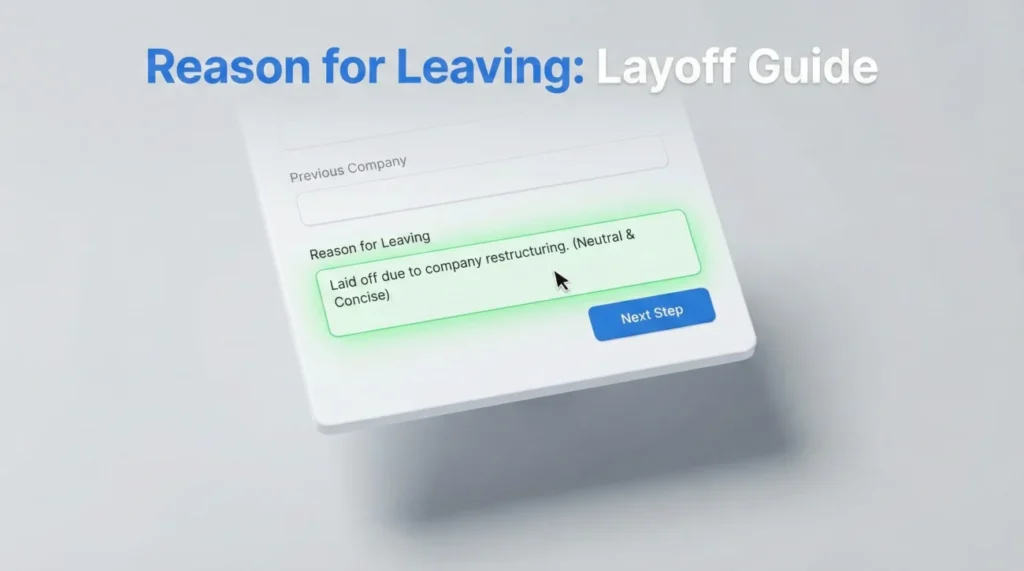
- Your “Reason for leaving” field is a classifier, not your life story.
- Use one layoff label that matches what your company would confirm, then stop.
- Add one optional signal only when it reduces doubt, not to “sell” the layoff.
The Quiet Problem With “Reason for Leaving” on Applications
Most candidates treat the “Reason for leaving” box like a mini cover letter. It is not. It is closer to a label printer. If you were laid off, your best move is to keep the label clean, consistent, and boring. That is exactly what reason for leaving laid off should sound like: A closed administrative fact, not an emotional narrative.
I learned this the hard way from watching strong candidates get stuck in the same loop. They were not rejected because they were laid off. They were rejected because their wording accidentally created uncertainty: Were they fired. Are they still in conflict with the employer. Are they hiding performance issues. Are they still unavailable.
One candidate, Jana, was a project manager in a tech layoff. Her application had a 60 character limit. She wrote: “Laid off due to budget cuts, still hurts, but ready now.” She meant well. The system did not care. The recruiter read “still hurts” and wondered if she would be defensive in an interview. We replaced it with a neutral label and a single stability signal. Same experience, completely different feel.
Key Point: On an application, clarity beats charisma. You are trying to remove doubt, not win hearts.
What the Form Is Actually Classifying
Employers ask “Reason for leaving” for three boring reasons: Verification, risk screening, and consistency. Many companies will only confirm job title and dates, but the application still becomes part of your hiring record. That is why the safest strategy is to use wording that your former employer would not dispute.
⚠️ Warning: Do not label yourself “laid off” if the truth is termination for cause. Keep it accurate and simple.
| Application field type | What the employer is trying to sort | What your answer should do |
|---|---|---|
| Short text box (often 60 to 200 chars) | Category label for the exit | Use a 3 to 7 word layoff label, then stop |
| Dropdown list (Layoff, Resigned, Terminated, Other) | High-level risk bucket | Select “Layoff” if true, then mirror it in text |
| Checkbox style (RIF, Reorg, Closure) | Operational vs performance-based exits | Pick the operational category your company used |
| Optional “Explain” box | Consistency and readiness | Add one calm add-on if it reduces uncertainty |
Another pattern I see: Candidates over-correct because they think “laid off” sounds like “not chosen.” That fear leads people to stuff the box with proof. You do not need to litigate your performance in a form field. You only need to remove ambiguity.
My colleague Marcus (an HRBP) coached a finance analyst through this after a reorg. The candidate kept adding: “Top performer, but impacted.” It read defensive. We moved performance proof to the resume bullets where it belongs, and kept the form answer clean. He got the interview, and the recruiter never even asked a follow-up.
12 Layoff-Only “Reason for Leaving” Answers You Can Paste
Everything below is designed for applications. Short, neutral, and consistent. If you need a quick rule: Write it the way an HR verification call would describe it.
One more thing: If the form already has a dropdown where you select “Laid off,” your text should not fight it. Mirror it, do not reinvent it.
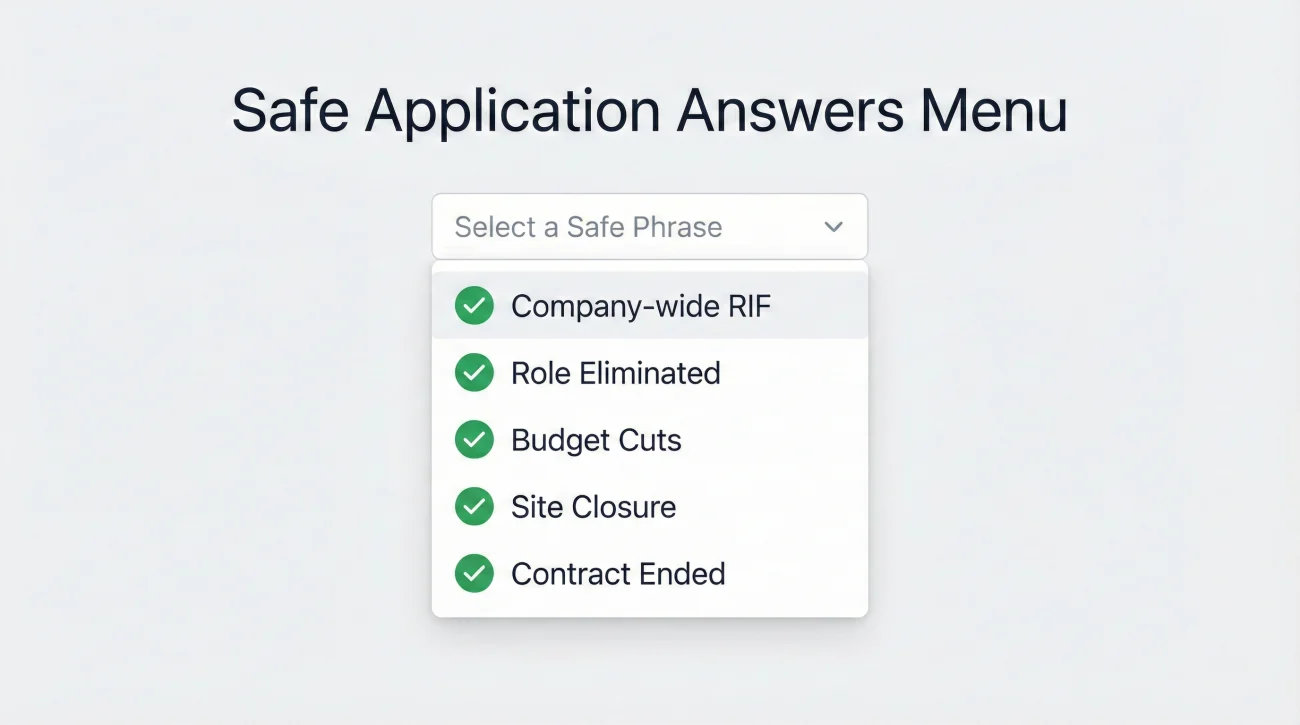
Company-wide RIF (Reduction in Force)
Use this when cuts were broad enough that nobody would reasonably interpret it as a one-person decision. It reads clean, and it matches what most HR teams will confirm in a verification call.
If the form is tight on characters, go even shorter. You do not need to spell out your emotions or the business context.
Short: Company-wide RIF.
Reorganization and role eliminated
Use this when the company changed structure and your position was removed rather than replaced. This is a solid choice if “RIF” feels too formal for your situation, or if the company used “restructuring” language internally.
Keep it factual. The word “reorg” is enough, you do not need to explain whose strategy changed.
Short: Role eliminated in reorg.
Budget cuts impacting the department
This fits cases where the cut was localized to a team or function. The key is to keep it as finance language, not personal language.
If you worry it sounds vague, remember the goal here is classification. Your resume bullets are where the detail belongs.
Short: Budget cuts.
Site closure or location shutdown
Use this when a facility, office, plant, or region shut down. It is one of the easiest labels for recruiters to process because it clearly points to operations, not performance.
This is also helpful when the company still exists, but your location does not. It prevents confusion later in the process.
Short: Site closure.
Department consolidation (two teams merged)
Use this when teams merged and duplicate roles were removed. It is common after leadership changes or org redesign, and it is not a red flag on its own.
If the form is short, you can keep it simple. The recruiter will understand what “consolidation” implies without extra explanation.
Short: Team consolidation.
Business downturn (market or revenue decline)
Use this when layoffs were driven by broader cost control due to revenue pressure. It can be especially normal in cyclical industries or during market contractions.
Do not add commentary about leadership. “Cost reduction” already communicates the point.
Short: Cost reduction layoff.
Contract ended (not performance related)
Use this when the work was fixed-term or project-based and the contract simply ended without renewal. This is different from a layoff in some companies, but many applications still want a “reason for leaving” label that stays neutral.
If you were hoping for an extension, you do not need to say that here. The label should stay clean.
Short: Contract ended.
Program cancelled or funding pulled
Use this when an initiative was stopped and roles were cut with it. This is a clear operational story: The work ended, so the role ended.
Keep the wording simple and avoid adding the timeline of why funding changed. That usually creates more questions than it solves.
Short: Program cancelled.
Acquisition or merger restructuring
Use this when integration created overlap and redundancies. Recruiters have seen this pattern enough that it rarely needs explanation.
If you are worried it sounds corporate, that is fine. In a form field, corporate language often reads safer than emotional language.
Short: Post-merger restructuring.
Product line discontinued
Use this when your team existed to support a specific product or service and that line was discontinued. It is a clean label that usually prevents “why did you leave so quickly” follow-ups.
Do not add your opinion about the decision. Keep it as a structural fact.
Short: Product line discontinued.
Role moved to another region or outsourced
Use this when the work continued, but the job moved. This label is useful because it explains why the role ended without implying your performance was the issue.
If the application has a character limit, “role relocated” is often enough.
Short: Role relocated.
Layoff with immediate rehire eligibility (if you know this is true)
Use this only if you are confident it matches the records and the company’s internal status. If you are guessing, skip it. A form field is not the place to gamble with accuracy.
When it is true, it can quietly reduce doubt without turning into a performance argument.
Short: Restructuring; rehire eligible.
If you are staring at the form thinking, “Which one is safest,” pick the one that matches how your company framed the exit internally. Some employers will describe it as “reduction in force,” others as “role eliminated,” others as “site closure.” Your job is to mirror the official flavor, not invent a new one.
💡 Pro Tip: If you were part of a large layoff wave, “Company-wide reduction in force” often reads calmer than “budget cuts” because it signals scale and removes the personal angle.
Three Consistency Rules That Keep You Out of Trouble
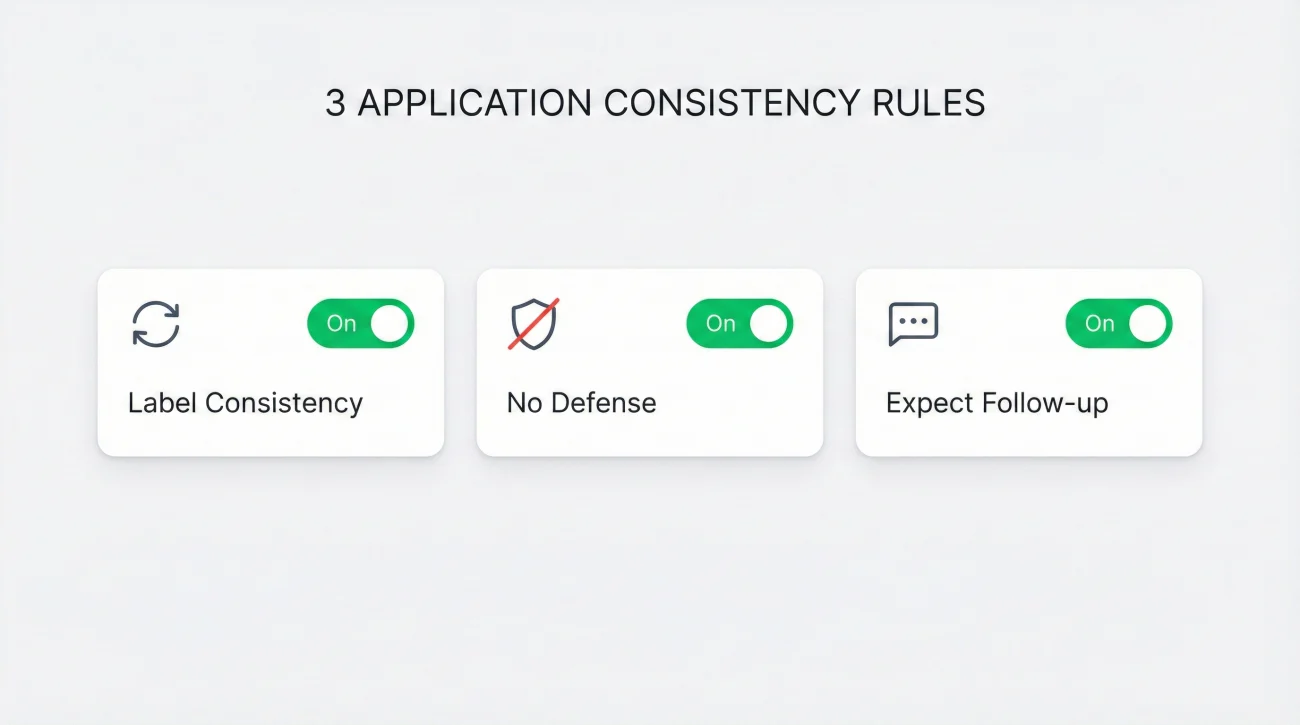
When recruiters get uneasy about layoffs, it is rarely the layoff itself. It is the mismatch across documents. Your application says one thing, your resume implies another, your interview answer adds a third. That is when people start probing.
Rule 1: Use One Label Everywhere
Pick one primary label (RIF, restructuring, role eliminated, site closure) and repeat it across the application and your interview explanation. Consistency reads truthful even when the details are brief.
Rule 2: Do Not Defend Performance in the Form Field
Performance proof belongs in your achievements, not in “Reason for leaving.” If you feel tempted to write “top performer,” pause. It often reads like you are arguing with an invisible accusation. Put measurable outcomes in the resume bullets instead.
– Built forecasting model that improved weekly accuracy by 18% and reduced stockouts in two regions
– Partnered with Finance to automate variance reporting, saving 6 hours per week across the team
Rule 3: Expect One Follow-Up Question
Even if the application is the main focus, be ready for the next line in a phone screen. Keep it short and neutral.
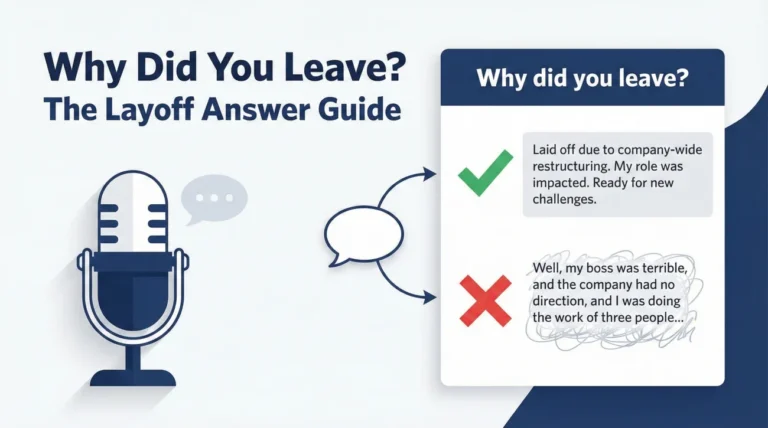
“Yes, it was a company-wide reduction in force. My role was impacted during the restructure. I wrapped up handover cleanly, and I have been ready to start immediately.”
That is it. Notice what is missing: Anger, blame, oversharing, and a desperate attempt to prove worth inside a single sentence.
Five Optional Add-Ons That Signal Readiness Without Oversharing
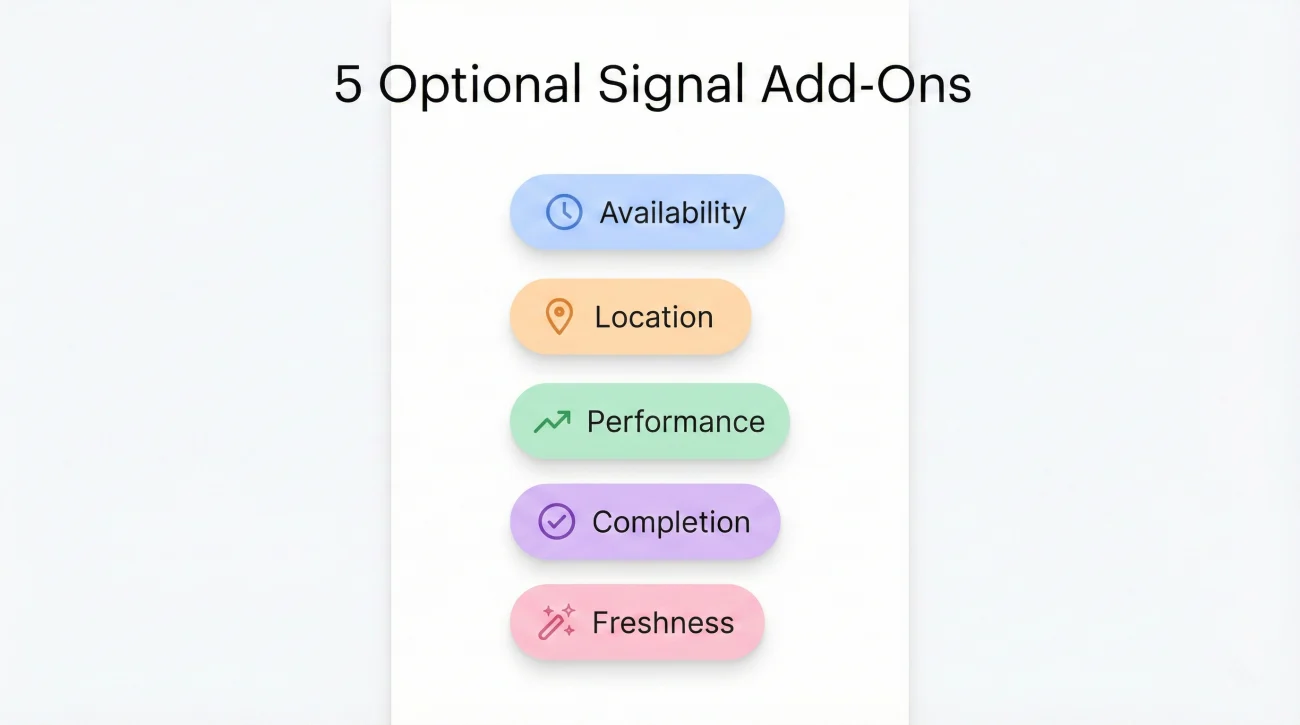
Sometimes the form gives you a second box, or you know the role is sensitive (security, finance, leadership). That is when an add-on can help. The mistake is using add-ons by default. Use them only if they reduce a specific doubt.
- ✅ Availability signal: “Available to start immediately.”
- 📍 Location clarity: “Relocation not required; already local.”
- 📈 Performance context (light touch): “Consistent strong reviews prior to RIF.”
- 🧾 Completion signal: “Transition completed; handover finalized.”
- 🧠 Skill freshness: “Completed upskilling during search (course/cert).”
Here is how to combine them without turning it into an essay.
Template: Layoff Label + Readiness (Most Common)
Use this when the recruiter’s biggest question is simply: Can you start and move forward cleanly.
Example: Role eliminated during restructuring. Available to start immediately.
Template: Layoff Label + Clean Closure (For Anxious Recruiters)
Use this when you suspect they worry about conflict, messy exits, or unfinished handover.
Example: Company-wide RIF. Transition completed and handover finalized.
Template: Layoff Label + Skill Freshness (For Longer Searches)
Use this when your search has been longer and you want one calm signal that you stayed current.
Example: Position ended due to site closure. Completed SQL refresh course during search.
If the form uses stiff HR language like “separation reason,” do not overthink it. Treat it the same way: Choose the operational label that matches your exit paperwork, and keep your explanation short.
Final: Keep It Boring, Keep It Consistent, Get the Interview
A layoff is not a character flaw. The application field just is not the place to prove that. Pick the one label your employer would confirm, add one optional signal only if it reduces doubt, and keep the rest of your credibility where it belongs: Your achievements.
If you want the broader Crisis Management framing for layoffs and how to keep the story stable across resume, applications, and recruiter screens, build around reason for leaving laid off as a neutral, closed fact, not a mini confession.
❓ FAQ
🎯 Should I write “laid off” or “role eliminated”?
If both are true, choose the version that matches how the company framed it internally. “Company-wide RIF” and “role eliminated during restructuring” are both clean. The key is to pick one label and repeat it everywhere.
🧩 What if the form only has “terminated” as an option?
Some systems use “terminated” as a catch-all for employment ending. If there is a text field, clarify with a neutral phrase like “Laid off due to reduction in force.” If there is no text field, do not panic. Recruiters usually ask follow-ups when they need clarity.
📌 Do I need to explain the layoff in detail on the application?
No. Most of the time, detail creates new questions. Give a clean classification and stop. Save context for the interview if asked.
💡 Can I add “top performer” to protect myself?
It often reads defensive in a form field. If you want to reassure, use one calm add-on like “eligible for rehire” only when you are confident it is accurate. Put performance proof in measurable resume bullets instead.
🧾 What if I was laid off twice in a short period?
Keep each exit label clean and consistent. Use the same structure for both (for example “company-wide RIF” both times), then let your resume achievements carry stability. If asked, keep the explanation short and focus on what you delivered in each role.
⚠️ Disclaimer: ResumeSolving provides resume, cover letter, and job search communication guidance for informational purposes only. It is not legal, medical, financial, or professional counseling advice. Hiring decisions vary by company, role, location, and individual circumstances, so we do not guarantee interviews, offers, or outcomes. Always use your own judgment, verify requirements directly with the employer, and follow local laws and workplace policies. When a situation is sensitive, we prioritize privacy-safe, recruiter-appropriate wording, and you never need to share personal details you are not comfortable disclosing.