- If you were laid off twice, your goal is not to “prove you’re unlucky”. Your goal is to remove pattern doubt with a simple story spine and one proof hook.
- Use one consistent label, add one stability signal, and include one verification-friendly detail. That is enough for most screens.
- Prepare a short interview answer that closes three fears: Performance, judgment, and commitment. Do not over-explain the company’s drama.
Why Two Layoffs Feels Like a Pattern (Even When It Is Not)
If you’re searching laid off twice how to explain, you’re not really asking for sympathy. You’re asking for control. You want the reader to stop connecting dots that don’t belong together.
I’ve watched this play out from the other side of the table: Not as “judgment”, but as risk management. When a resume shows two layoffs, the first reaction is rarely moral. It’s practical: “Is there something here I’m not seeing?”
And the truth is: Repeated layoffs trigger a specific mental shortcut. Not “they’re bad”, but “there might be a repeating factor”. It’s unfair when the market is chaotic, but it’s common. Your job is to make the story boring again, in the best way.
Key Point: A single layoff reads as an event. Two layoffs can read as a pattern unless you add one stability signal and one proof hook.
One candidate I worked with, Taylor, had two layoffs in 18 months. Both were real restructures. But her resume made it worse: The dates were tight, the companies were unfamiliar, and the job titles looked like early startup turbulence. She wasn’t rejected for being laid off. She was rejected because nobody could quickly tell whether she chose unstable situations or whether unstable situations chose her.
What Recruiters Actually Worry About When Layoffs Repeat
When layoffs repeat, the screen is not looking for a perfect explanation. It’s looking for missing information. The fears usually fall into three buckets, and each bucket can be closed with one clean sentence.
| The doubt | What it sounds like in their head | What closes it |
|---|---|---|
| Performance doubt | “Were they quietly selected?” | A proof hook that is verification-friendly (scope, metrics, review signal). |
| Judgment doubt | “Do they keep picking unstable places?” | A short selection logic (why you joined, what you screened for after). |
| Commitment doubt | “Will they leave or churn again?” | A stability signal (target role focus, tenure intent, role fit clarity). |
⚠️ Warning: The fastest way to make this worse is to argue. If you sound defensive, you confirm there’s something to defend.
I once sat in a debrief where a hiring manager said: “I don’t mind the layoffs. I mind that the story is messy.” That sentence changed how I coach this problem. Your strategy is not a long explanation. Your strategy is a crisp structure.
The Narrative Spine That Works for Multiple Layoffs

Most advice tells you to “be honest and move on.” That’s incomplete when you’re dealing with repeated layoffs recruiter concern. You need a spine that makes two events feel like one market reality, not two personal failures.
Here’s the spine I use when coaching candidates through this, and it maps well to both resume context and interview context.
[Market Event] + [Your Role Was Strong] + [Your Selection Logic Now] + [Stability Signal]
Each part has a job:
- Market Event: Frames the layoffs as structural, not personal drama.
- Your Role Was Strong: Adds one proof hook, not a speech.
- Your Selection Logic Now: Shows learning and judgment without blaming anyone.
- Stability Signal: Makes your next move look intentional and sticky.
My colleague Daniel (also HR, different industry) calls it “closing the loop.” If the loop stays open, the interviewer will close it for you, and they will not be generous.
8 Proof Hooks That Reduce Pattern Risk Without Overexplaining

You don’t need to prove you were a star. You need to prove you were not quietly filtered out. The best proof hooks are ones that feel checkable, not emotional.
Scope Hook: “I owned a measurable slice of the work.”
Use this when the companies are unfamiliar. Mention the size of the budget, pipeline, territory, product area, or system you owned.
Example: Owned onboarding for 120+ enterprise customers across EMEA.
Metrics Hook: “My outcomes were stable even if the company was not.”
Pick one metric that matters in your function. Keep it simple and defensible.
Example: Reduced churn by 9% quarter over quarter during restructuring.
Selection Hook: “The layoffs were broad, not targeted.”
If you can share it cleanly, add a scale signal: Team-wide, org-wide, or percentage-based.
Example: Role impacted in a 20% org reduction.
Reference Hook: “Someone credible will vouch for me.”
This is not “I have great references.” It’s a quiet signal that your performance story is consistent.
Example: Happy to share references from my direct manager and cross-functional lead.
Rehire Hook: “Eligible for rehire” (use carefully).
Only use this if you are confident it’s true and it won’t create a verification mismatch.
Example: Eligible for rehire upon request (only use if verified).
Fit Hook: “I’m narrowing, not scrambling.”
This is especially strong for multiple layoffs career narrative. Show that your target role is consistent and your search is selective.
Example: Targeting B2B lifecycle roles where retention and activation are the core mandate.
Stability Hook: “I’m not hopping categories.”
Commitment doubt grows when your titles look random. Show continuity in function, level, and domain.
Example: Staying in enterprise CS leadership, not switching into a new function.
Learning Hook: “I changed my screening criteria.”
This is where you show judgment without sounding bitter.
Example: After the second restructure, I shifted toward teams with longer runway and clearer unit economics.
💡 Pro Tip: Pick one hook for resume context and one different hook for interview context. Repeating the exact same line can sound rehearsed.
Two Layoffs Resume Wording That Sounds Stable (Not Defensive)
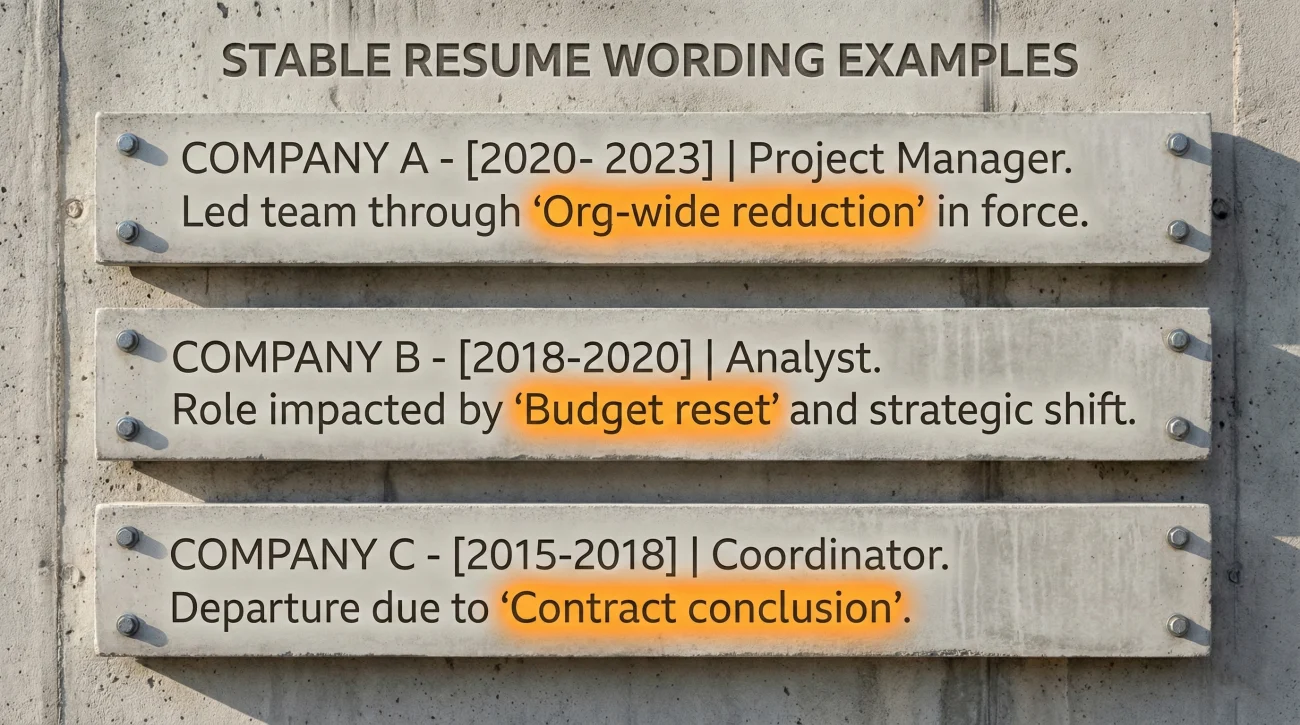
This is the trap: You try to be “transparent,” and you accidentally write a mini press release. Keep it to one line, and make the line do a job.
Below are examples you can copy and adapt for two layoffs resume wording. These are written to be boring, neutral, and easy to skim.
Role impacted in an org-wide reduction; maintained renewal coverage for 40+ enterprise accounts.
Position eliminated during restructuring; launched onboarding refresh that improved activation by 12%.
Team reduced after budget reset; delivered weekly forecasting model used by VP Finance.
⚠️ Warning: Avoid “unlucky,” “unexpected,” “sudden,” “devastating,” or any language that turns your resume into a diary. Emotional adjectives invite emotional interpretation.
If you’re worried “this still looks like churn,” add one stabilizer elsewhere: A short summary line that shows focus. Not an apology, just direction.
6 Interview Scripts for Consecutive Layoffs

Interview answers fail when they do one of two things: They over-explain company chaos, or they under-explain and sound evasive. The sweet spot is short, structured, and calm.
These scripts are written for consecutive layoffs interview answer situations. Swap the nouns, keep the structure.
Script 1: Both layoffs were broad restructures
“Both exits were part of broader restructures, not performance issues. In each role, I hit my core deliverables and can share references. After the second restructure, I became more selective about runway and team stability, which is why I’m focused on roles like this one where the mandate is clear and long-term.”
Script 2: Startup shutdown plus later reduction
“The first exit was a startup shutdown. The second was a reduction tied to a budget reset. What stayed consistent was my function and results. The change I made was in how I screen. I now prioritize teams with predictable runway and clearer ownership, so my next role is built to last.”
Script 3: Short tenure creates commitment doubt
“I understand how the timelines can raise questions. The exits weren’t voluntary moves. They were restructures. What I’m looking for now is stability and fit, and I’m intentionally targeting roles where I can stay and build over multiple years. I’m not shopping for variety. I’m looking for a home base.”
Script 4: They ask, “Why did it happen twice?”
“The honest answer is market timing plus company conditions. The useful answer is what I changed. I tightened my criteria and shifted toward organizations with clearer runway signals and more stable mandates. The work I did in both roles was solid, and I can walk you through outcomes.”
Script 5: They hint at performance without saying it
“If you’re wondering about performance, I’m glad to address it directly. The layoffs were not performance-driven. My reviews were strong, and I can provide references. I’ve stayed focused on the same function, and I’m looking for a stable team where that focus compounds.”
Script 6: You want to pivot without sounding like you’re running
“The restructures clarified what I do best and what I want next. I’m not pivoting because I failed. I’m narrowing toward roles where my strengths match the long-term need. I can show you the outcomes from my last two roles, and I’m focused on a stable environment to build deeper impact.”
💡 Pro Tip: Practice the first sentence until it sounds like a fact, not a defense. Your tone is part of the proof.
A Real-World Example: How We Reframed “Bad Luck” Into a Stable Story
A friend of mine, Andre, worked in revenue ops. Two layoffs, back to back. His first instinct was to “explain everything”: The board, the burn rate, the failed acquisition. It sounded like a meltdown documentary.
We stripped it down. One market sentence. One proof hook. One selection change. One stability signal. Suddenly, his story felt like a professional navigating a messy market, not a person dragging chaos behind them.
Here’s what changed most: He stopped trying to convince people he was “not the problem.” He started giving people a structure that made the question irrelevant.
| Before | After |
|---|---|
| Long explanation of company drama and leadership decisions. | One sentence: Market event + broad impact + your results. |
| Emotional framing: “It was brutal, I didn’t see it coming.” | Neutral framing: “Org-wide reduction tied to budget reset.” |
| No screening logic, looks like repeating choices. | Clear screening logic: Runway indicators and role mandate clarity. |
Within a month, he wasn’t “defending layoffs” anymore. He was interviewing like a stable candidate who simply had two external events on the timeline.
Final: Your Story Needs One Spine, Not Two Apologies
Two layoffs do not require you to become a spokesperson for the economy. They require you to remove pattern doubt with structure. Give one market frame, add one proof hook, then show the selection logic you use now. That is what makes repeated layoffs feel like context, not character.
If you want a broader framework to keep the layoff story calm and consistent across your resume, cover letter, and interviews, you can build it around laid off twice how to explain and keep everything else verification-friendly.
❓ FAQ
🎯 Should I write “laid off” on the resume if it happened twice?
You usually can, but you do not have to. If you include it, keep it neutral and short, and pair it with one proof hook. The goal is to prevent guessing, not to add a storyline.
🧠 Will recruiters assume I was the problem if layoffs repeat?
Some will wonder, but “wondering” is not a verdict. You close it with a calm structure: Broad event, your outcomes, and a stability signal. Defensive explanations create more suspicion than the layoffs themselves.
🧾 What if I do not know how broad the layoff was?
Do not guess. Use a safer label like “restructuring” or “budget-driven reduction” without percentages. Then rely on a different proof hook like scope, outcomes, or references.
🔍 Should I mention “eligible for rehire” to prove it was not performance?
Only if you are confident it is accurate and it will not backfire in verification. If you are unsure, skip it and use metrics or scope instead. Precision beats bravado here.
🧩 How do I explain multiple layoffs without sounding like I blame the company?
Describe the event, not the villains. “Org-wide reduction tied to budget reset” is neutral. Then pivot to your selection logic now. That keeps you professional and avoids sounding bitter.
⚠️ Disclaimer: ResumeSolving provides resume, cover letter, and job search communication guidance for informational purposes only. It is not legal, medical, financial, or professional counseling advice. Hiring decisions vary by company, role, location, and individual circumstances, so we do not guarantee interviews, offers, or outcomes. Always use your own judgment, verify requirements directly with the employer, and follow local laws and workplace policies. When a situation is sensitive, we prioritize privacy-safe, recruiter-appropriate wording, and you never need to share personal details you are not comfortable disclosing.