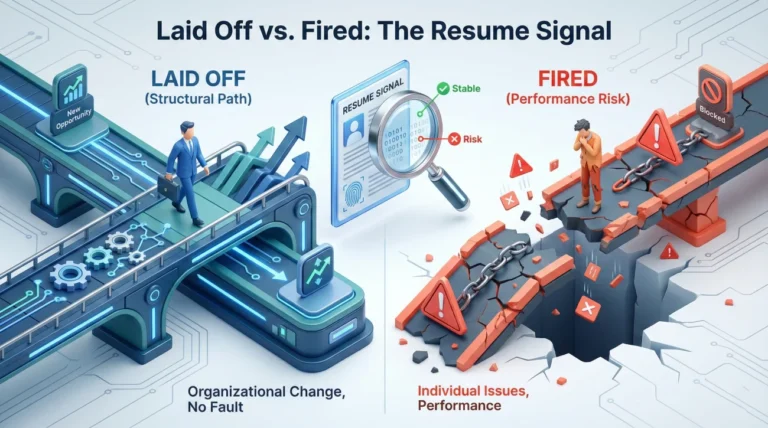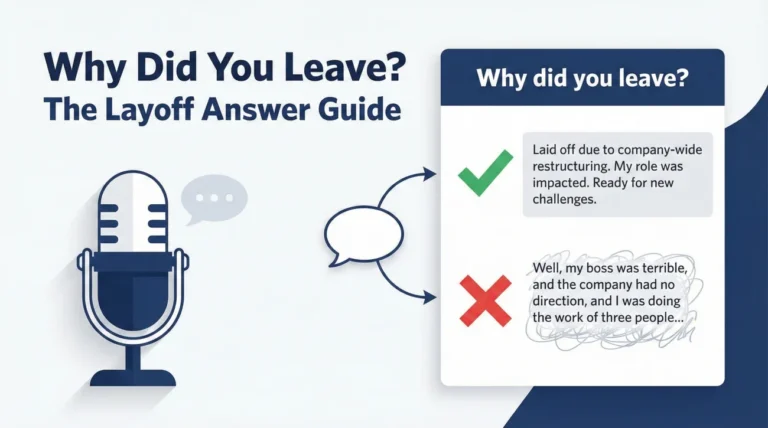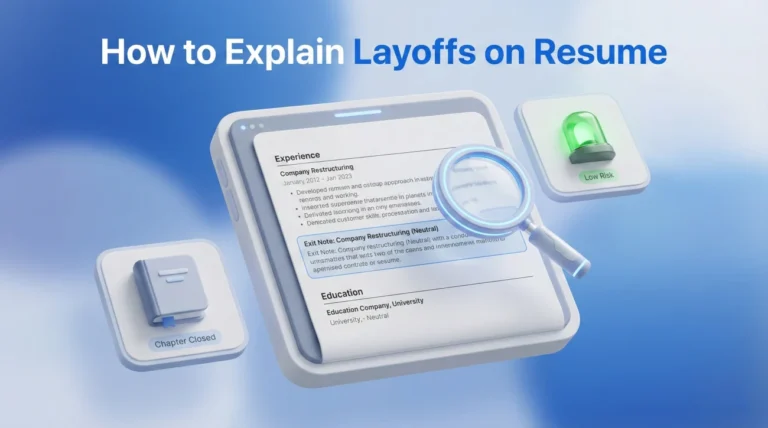
- A three-month job loss gets evaluated twice: The layoff reason and the short-tenure signal.
- Your goal is not to prove innocence. Your goal is to make the story feel structurally normal and closed.
- Use one neutral label, one stability marker, and one forward-looking bridge, then stop talking.
A Three-Month Layoff Is Two Problems, Not One
I have watched strong candidates spiral on this exact scenario: laid off after 3 months, no warning, no drama, and yet the recruiter’s face changes the moment the timeline lands. The candidate hears the question behind the polite smile: “So what really happened?”
The truth is, short tenure triggers a different mental checklist than a normal layoff. A longer job can be cut for budget reasons and nobody assumes you were the issue. A three-month job can still be a budget cut, but the human brain makes a faster, harsher story: mismatch, performance, personality, or a hiring mistake.
This article is built for that dual-risk. Not to help you “spin” or overexplain, but to help you create a version of events that feels ordinary, contained, and safe to move past. You will get placement rules, a speaking framework, and six examples you can copy and tailor.
Key Point: With short tenure, the recruiter is not only evaluating what happened. They are evaluating whether you are the type of risk that repeats.
Why Recruiters Get Suspicious So Fast

When I train junior recruiters, I tell them to separate “event risk” from “pattern risk.” A layoff is usually an event. Short tenure can look like a pattern even if it is not. The candidate might have one short role in a decade, but the screen still asks: “Is this the beginning of a trail of short stays?”
There are three common assumptions people make when they see a three-month role end:
- Mismatch: The role was not what you expected, or you were not what they expected.
- Performance: You did not ramp fast enough, or you were managed out during probation.
- Instability: You jump quickly, and this is a preview of how you will behave again.
Most advice online says “just say it was a layoff and move on.” That is not wrong. It is incomplete. With short tenure, “layoff” is not a full answer. You need one extra stability marker that makes the situation feel structurally normal.
⚠️ Warning: The more defensive your tone becomes, the more the listener assumes there is something to defend.
First Decision: Do You Even Keep the Three-Month Job on Your Resume?
People want a universal rule here, but it is context-dependent. What matters is not “three months.” What matters is whether the role adds credibility or adds confusion.
| Scenario | Best Resume Move | Why It Works |
|---|---|---|
| You shipped something real (project, client deliverable, measurable output) | Keep it, add a neutral layoff label | Work product beats timeline anxiety |
| The role was mostly onboarding, little output, and you already have strong prior experience | Optional: Omit it if it creates more questions than value | You are not required to include every short stop |
| You are early-career and need any relevant experience | Keep it, but keep the explanation minimal | Relevance matters more when you have fewer entries |
| The company is known for layoffs or had a public reduction | Keep it, label it as workforce reduction | External context lowers suspicion |
| Multiple short roles already exist on your resume | Keep it only if it adds a unique skill or brand value | Too many short roles becomes a pattern signal |
I worked with a product analyst named Landon who was laid off after 6 months at a startup that lost funding. We kept the role on the resume because he had shipped a pricing dashboard that later became a talking point in interviews. The short tenure still existed, but the output gave the recruiter something concrete to hold onto.
💡 Tip: If the role stays on the resume, make sure at least one bullet is a strong outcome or deliverable. A short timeline with generic bullets is what triggers “maybe they did not do much.”
The Three-Part Framing Framework That Stops the Spiral
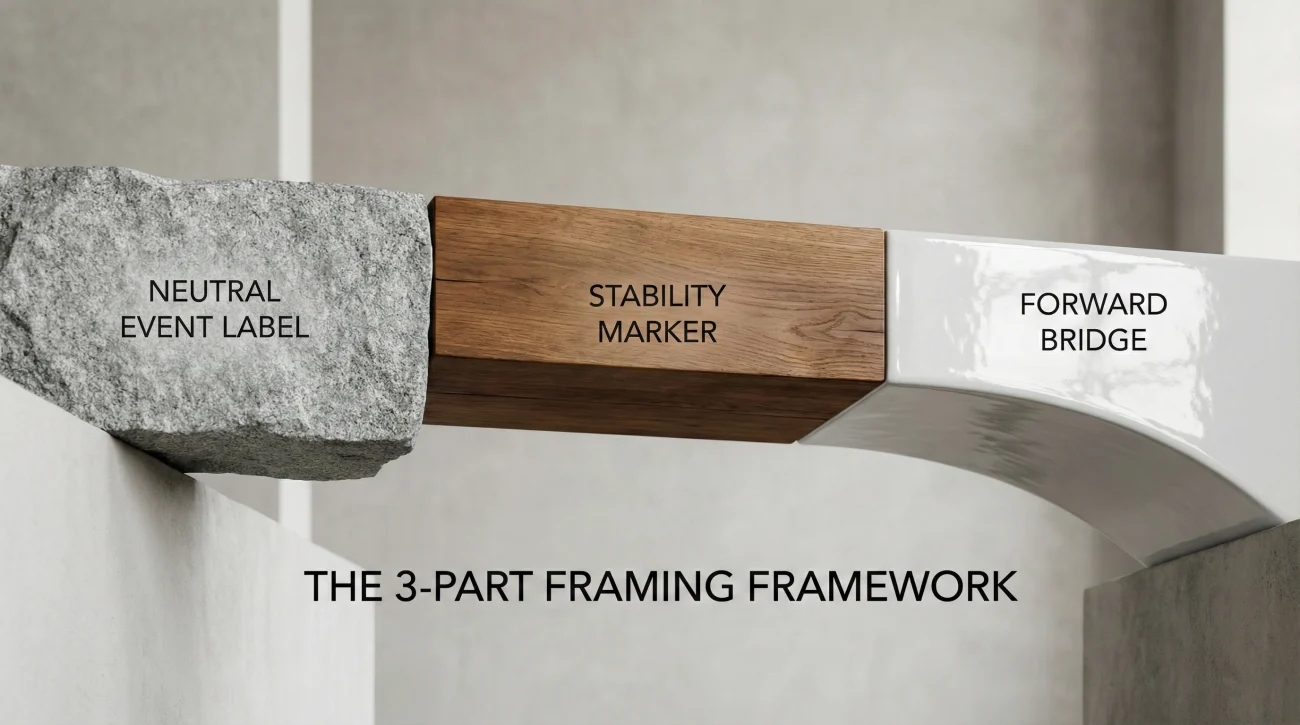
If you remember one thing, remember this: you are not trying to persuade someone that you were not at fault. You are trying to make the story feel normal enough that they can move on and evaluate you for the job in front of them.
Use this structure in interviews, recruiter screens, and even in your own head so you do not improvise:
[Neutral Event Label] + [Stability Marker] + [Forward Bridge]
- Neutral Event Label: “Role eliminated,” “workforce reduction,” “team reorg,” “budget-driven cut.”
- Stability Marker: One sentence that signals your standing was solid: performance feedback, ramp progress, scope delivered, or eligibility to rehire.
- Forward Bridge: One sentence that connects your work to the next role, then you stop talking.
Short tenure already creates tension. Over-detail adds heat. The framework keeps you from wandering into a long story that starts sounding like an argument.
What Counts as a Stability Marker (Without Oversharing)
Stability markers are not “proof.” They are cues. Recruiters are scanning for cues because they do not have time to investigate your full context during a first screen.
Here are stability markers that work well for a short-tenure layoff without dragging the conversation into politics:
- “My manager offered to be a reference.”
- “The decision affected multiple roles, not just mine.”
- “I had completed ramp and delivered [X] before the cut.”
- “I left on good terms.”
- “I received positive ramp feedback before the restructure.”
Here is a clean version that sounds calm and finished:
“I joined in a growth phase, and three months later the company restructured and eliminated several roles, including mine. My manager offered to be a reference, and I’m now focused on finding a team where I can build and deliver over a longer horizon.”
That is enough. The moment you keep talking, you usually start adding emotion, and that is when the listener starts wondering what else is underneath.
Resume Wording: Where to Put the Layoff Signal Without Making It Loud
Most candidates either hide the layoff completely or announce it like a headline. You want it visible enough to prevent confusion, quiet enough to avoid stealing attention.
Five placement rules that consistently work:
- Keep the label in the date line or as a short parenthetical, not as a bullet.
- Use one neutral phrase, not a full sentence.
- Avoid emotional words like “unexpected” or “devastating.”
- Make your first bullet an output, not a task list.
- If the role had little output, prioritize one strong skill signal and move on.
(Role eliminated during team restructure)
– Built an onboarding KPI dashboard used in weekly leadership reviews
– Partnered with Sales Ops to refine lead scoring inputs for pipeline forecasting
Think of the note as context, not content. It should not be the loudest thing in the entry.
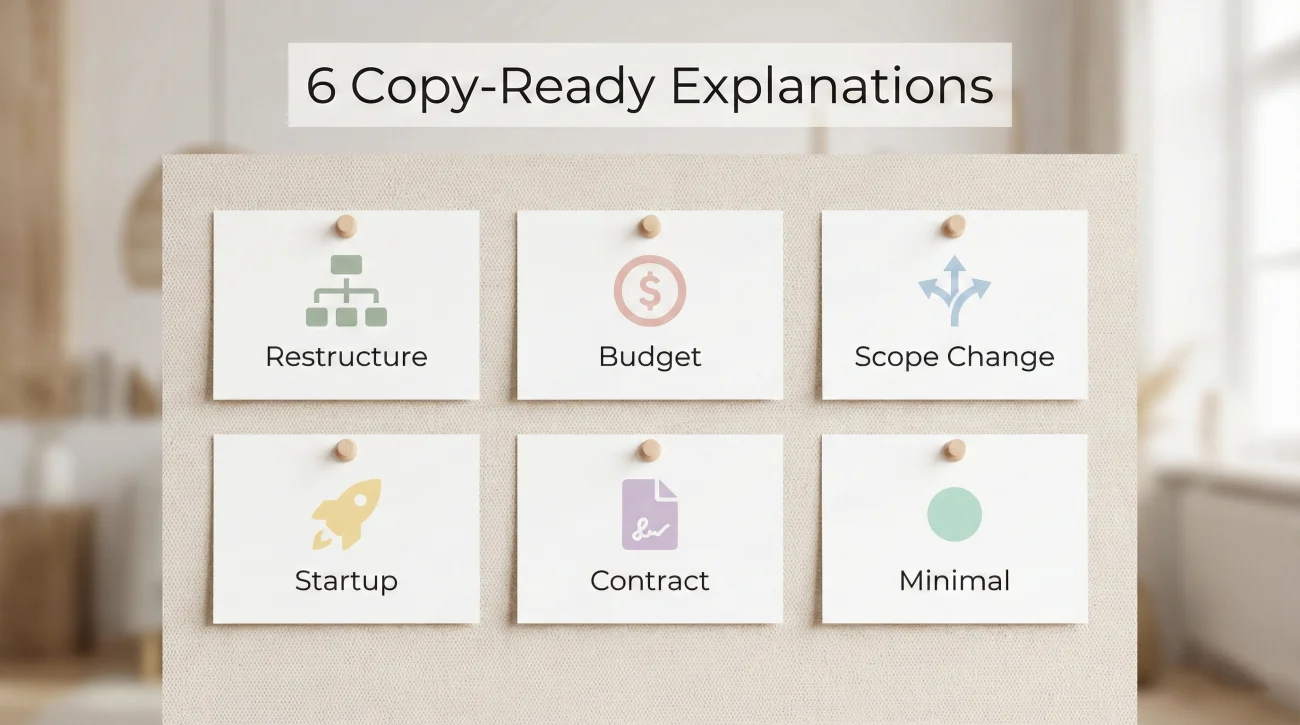
Six Copy-Ready Explanations You Can Use in Interviews
Each option below is built to sound stable and finished. Copy the structure, then swap in your own stability marker. Keep it to three sentences. If you extend it, you usually start sounding defensive without realizing it.
Team restructure after a hiring freeze
Use this when hiring slowed, then the company reshaped teams quickly. You do not need to explain the internal logic. You just need to label the change, show you were ramping, then bridge forward.
“Three months in, the company restructured and reduced the team. My role was eliminated as part of that change. I had completed ramp and delivered early work on [X], and I’m now targeting teams with stable headcount planning.”
If you do not have a deliverable yet, drop the [X] line and replace it with “I left on good terms.” Keep it simple.
Budget cut that impacted multiple roles
This is the cleanest shape when you were one of many. The phrase “affected multiple roles” does a lot of work without you having to defend yourself.
“It was a budget-driven reduction that affected multiple roles, including mine, shortly after I joined. I left on good terms and can provide a reference if helpful. I’m focused on roles where I can build longer-term impact.”
If you cannot provide a reference, do not mention it. Use a different stability marker that is true for you.
Role scope changed and the position was removed
Use this when priorities shifted and your role stopped making sense on the org chart. Keep it neutral. Avoid anything that sounds like you are criticizing leadership.
“The role changed direction quickly and the company consolidated the function. My position was eliminated rather than re-scoped. I’m looking for a role with a clearer long-term mandate in [area].”
Try to keep [area] tight. One clear direction reads stronger than a list.
Startup funding shift
This happens often and is widely understood. You do not need to talk about runway or investors. A single sentence about funding and a calm bridge is enough.
“The startup missed a funding milestone and reduced headcount. My role was impacted early. I’m proud of what I contributed in a short window, especially [X], and I’m now prioritizing teams with more predictable planning.”
If [X] is sensitive, describe it without naming details. “Early customer onboarding work” can be enough.
Contract ended early because scope was reduced
Use this when the engagement was planned longer but the work got cut back. The stability marker is the deliverable you did complete.
“It was planned as a longer contract, but the scope was reduced and the engagement ended early. I delivered [X] during the time I had. I’m now looking for a full-time role where I can own outcomes end to end.”
Keep your tone matter-of-fact. If you sound frustrated, the listener starts picturing conflict.
Ultra-minimal answer when you want to move on fast
This is for screens where you can feel the conversation drifting into interrogation. Give a complete shape, then steer it back to the job.
“It was a workforce reduction early in my tenure. I left on good terms and I’m ready to move forward. I’m excited about this role because [bridge to job].”
Make the bridge specific to the job you are interviewing for. One concrete reason is enough.
The Pattern That Usually Makes It Worse: Over-Apologizing
A colleague in HR once called this “the confession trap.” Candidates walk in already ashamed, so they apologize for the layoff, apologize for the short tenure, then keep talking until they accidentally suggest they were the issue.
We worked with a customer success manager who had a three-month role end in a reduction. He opened every answer with “I know it looks bad.” That single line was doing damage because it told the listener what to think before they had decided anything.
Once we tightened his story into the three-part framework and practiced the exit, the conversations changed. Not because the facts changed, but because the answer stopped sounding unresolved.
💡 Tip: If your explanation keeps getting longer every time you tell it, you do not need more facts. You need a shorter script.
Common Mistakes That Make a Short Role Look Like a Firing

Most damage happens accidentally. People think they are being transparent, but the framing makes it worse.
- Leading with emotion.
- Leading with blame.
- Over-precision with internal timelines and names.
- Trying to prove innocence in the wording.
- Inconsistent dates across resume, LinkedIn, and forms.
⚠️ Warning: Consistency matters more than perfection. Pick your wording and keep it the same across resume, LinkedIn, and interviews.
Answer the question the recruiter is actually asking: “Is this safe to move past?” If you give them a safe shape, they will usually move on quickly.
Final: Keep It Closed, Then Bring It Back to Value
A three-month layoff does not need a big explanation. It needs a clean label, one stability marker, and a bridge back to your work. That combination removes the two scary assumptions and keeps you from drifting into a defensive tone.
If you keep the role on your resume, keep the layoff note quiet and let output speak. If you omit it, stay consistent on forms so you do not create contradictions later. Either way, practice a short answer that you can repeat under stress.
When you are laid off after 3 months, the goal is not to win a debate. The goal is to make the story feel closed so the interviewer can get back to evaluating what you can do next.
❓ FAQ
🎯 Should I include a three-month job on my resume?
Include it if it adds credibility, skills, or real output. Omit it if it only adds confusion and you already have strong experience without it. The key is consistency across resume, LinkedIn, and any official forms.
🧠 Will recruiters assume I was fired if I say “role eliminated”?
Not if you keep it simple and add one stability marker, like “team reduction” or “affected multiple roles.” What increases suspicion is overexplaining or sounding defensive.
✅ What is the safest one-sentence explanation for interviews?
Use: neutral event label + stability marker + forward bridge. Example: “The team restructured and my role was eliminated; I left on good terms and I’m now focused on [role] where I can build longer-term impact.”
📌 Can I list only the year to hide the short timeline?
You can, but do it carefully. Year-only dates can reduce visual emphasis, but they can also look like you are hiding something if the rest of your resume uses months. Pick one date format strategy and keep it consistent.
🧩 What if the layoff happened during probation?
Keep the explanation structural and minimal. Avoid debating performance. If you have a stability marker like “manager reference” or “multiple roles affected,” use it. Then bridge to why the next role is a better long-term fit.
⚠️ Disclaimer: ResumeSolving provides resume, cover letter, and job search communication guidance for informational purposes only. It is not legal, medical, financial, or professional counseling advice. Hiring decisions vary by company, role, location, and individual circumstances, so we do not guarantee interviews, offers, or outcomes. Always use your own judgment, verify requirements directly with the employer, and follow local laws and workplace policies. When a situation is sensitive, we prioritize privacy-safe, recruiter-appropriate wording, and you never need to share personal details you are not comfortable disclosing.