- If they ask what you’ve been doing while unemployed, they’re really testing proof, not your calendar.
- Use one of 3 short evidence patterns so your answer feels structured, calm, and verifiable.
- Keep 5 control lines ready so the conversation doesn’t drift into over-explaining or personal details.
This question is not about time. It is about proof.
I remember a candidate named Laura who had been out of work for nine months. She did everything “right” on paper: she applied daily, tracked roles in a spreadsheet, rewrote her resume three times, and even took a course. But in interviews she kept losing the room at the exact same moment.
“So… what have you been doing since you were unemployed?”
She treated it like a morality test. She started explaining the layoff, the job market, the recruiter ghosts, the anxiety, the bills, the way her confidence dipped. Everything was true, but the interviewer did not hear proof. They heard a story that felt unbounded.
When we rebuilt her response, we made one change: we stopped describing her time and started showing evidence. The goal is not to sound busy. The goal is to sound like a professional whose skills are still sharp, still current, and still safe to bet on.
If you want a simple handle to remember, your answer should sound like an “evidence tour” that lasts under a minute. That is how you turn what have you been doing since you were unemployed interview into something that works for you.
⚠️ Warning: The fastest way to lose this question is to overshare. If your answer sounds like an apology, a rant, or a therapy session, you accidentally hand them a bigger risk signal than the gap itself.
What they are really checking for when they ask
Most interviewers are not trying to shame you. They are doing a quick risk scan. They want to know whether the gap changed your ability to deliver, whether your story is stable, and whether you can communicate like someone who will be easy to work with.
I’ve seen this question asked in gentle ways and in blunt ways. Either way, the subtext is usually one of these:
- Are your skills still current enough to start fast?
- Is there a reason you are avoiding (or cannot answer) that makes the hire risky?
- Do you take ownership of your next step, or do you drift?
- Can you summarize clearly, or do you spiral into details?
| What they scan for | What “proof” sounds like | What to avoid |
|---|---|---|
| Skill currency | A recent output, project, or structured practice | “I took a course” with no result |
| Stability | A calm timeline and a simple reason, then forward motion | Long backstory with emotional peaks |
| Judgment | Boundaries: what you share, what you keep private | Oversharing health, family, conflict, or money |
| Execution | Concrete actions tied to the role you want now | Random activities that do not connect |
| Communication | One minute, structured, then a clean handoff back | Unstructured explanation that drags on |
So you are not trying to “justify unemployment.” You are demonstrating readiness. The next section gives you three short patterns you can pick from depending on what you actually have.
Three evidence patterns that work in real interviews
Pick one pattern and stick to it. Mixing patterns mid-answer often sounds like you are searching for something to say. A clean structure makes even a thin situation sound intentional.
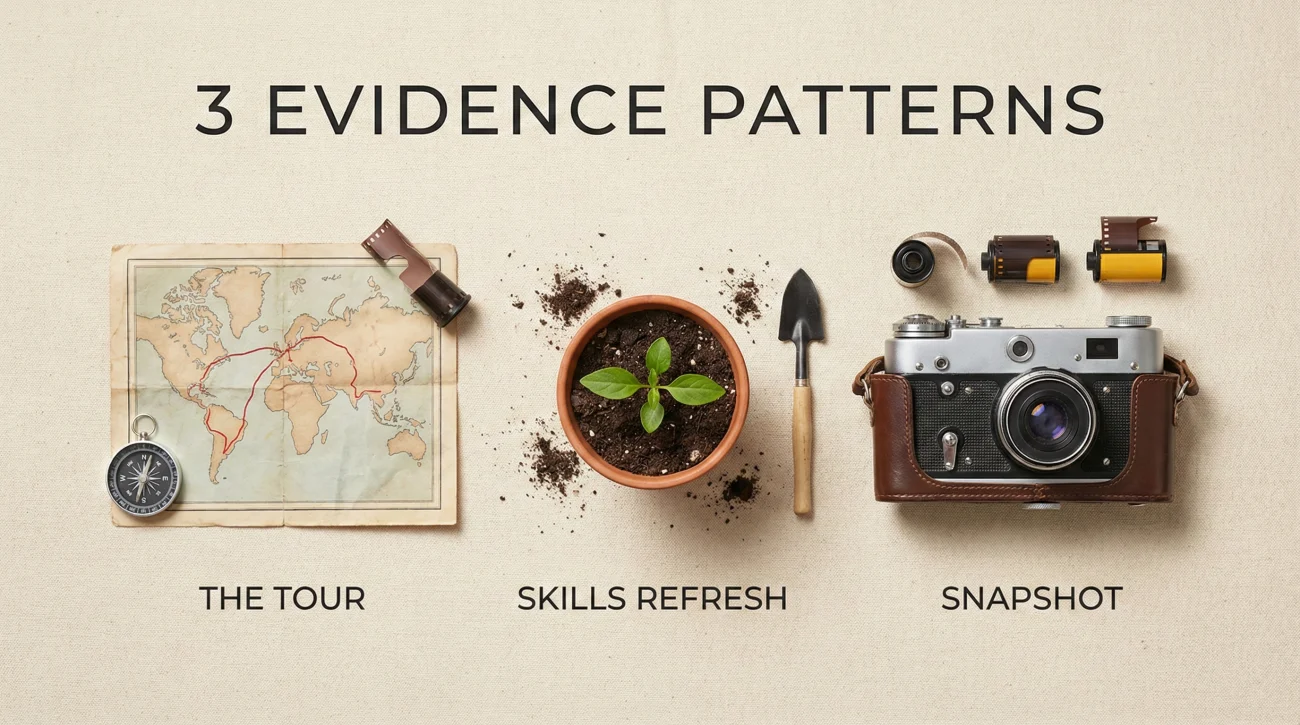
Pattern 1: The evidence tour
This is the simplest pattern. You give them three proof points, each one short, each one connected to the role you are interviewing for. You are not listing “life tasks.” You are showing professional outputs or professional behaviors.
[One-line context] + [Proof point 1] + [Proof point 2] + [Proof point 3] + [Bridge back to role]
“After my role ended, I kept my work momentum in three ways.
First, I built a small case study around [skill], including [output] and a short write-up of results.
Second, I refreshed [tool/skill] by doing [structured practice], and I can walk you through my approach.
Third, I stayed close to the field by [industry activity], so I’m current on how teams are solving [relevant problem].
That’s why I’m confident I can step into this role and contribute quickly.”
When I coached a candidate named Leo, he kept answering this question with “I’ve been applying everywhere.” That line is honest, but it is not proof. We replaced it with an evidence tour built around two small outputs and one structured routine. He did not suddenly become “more qualified.” He simply sounded easier to hire.
Pattern 2: Skills refresh with output
This pattern is for people who did learn or practice during the gap. The key is that the output matters more than the learning. “I took a course” is weak. “I used the course to build X” is strong.
[Skill] + [Output] + [What you measured or improved] + [How it maps to the role]
“I used the time to refresh my [skill]. I didn’t just study it, I built [specific output], and I tested it by [simple measurement].
What I’m bringing into this role is the ability to [role-relevant impact], because I’ve been practicing that exact workflow recently.”
💡 Pro Tip: If you cannot show an output, describe a before and after. What was weak, what improved, and how you know. Proof can be a result, a decision, or a process you can explain clearly.
A hiring manager once told me, “When someone says ‘I learned a lot,’ I can’t evaluate that. When someone says ‘Here’s what I built and why I made these choices,’ I can.” That is the mindset this pattern serves.
Pattern 3: Problem-solver snapshot
This pattern is powerful when you do not have a big portfolio but you do have judgment. You pick one problem relevant to the job, explain how you would approach it, and reference any small proof you can. It makes you sound like a colleague, not an applicant begging for a chance.
[Role-relevant problem] + [Your approach] + [Small proof] + [Invite questions]
“One thing I kept sharp while I was between roles was how I tackle [problem]. My approach is usually [step 1], then [step 2], then [step 3].
I used that approach recently on [small example], and I’m happy to walk through the tradeoffs if that’s useful.”
This is the pattern I use when a candidate has a gap caused by something private. You do not need to disclose private details to sound credible. You need to sound like someone who can solve the company’s problems without drama.
Ten proof examples you can use without faking a perfect story
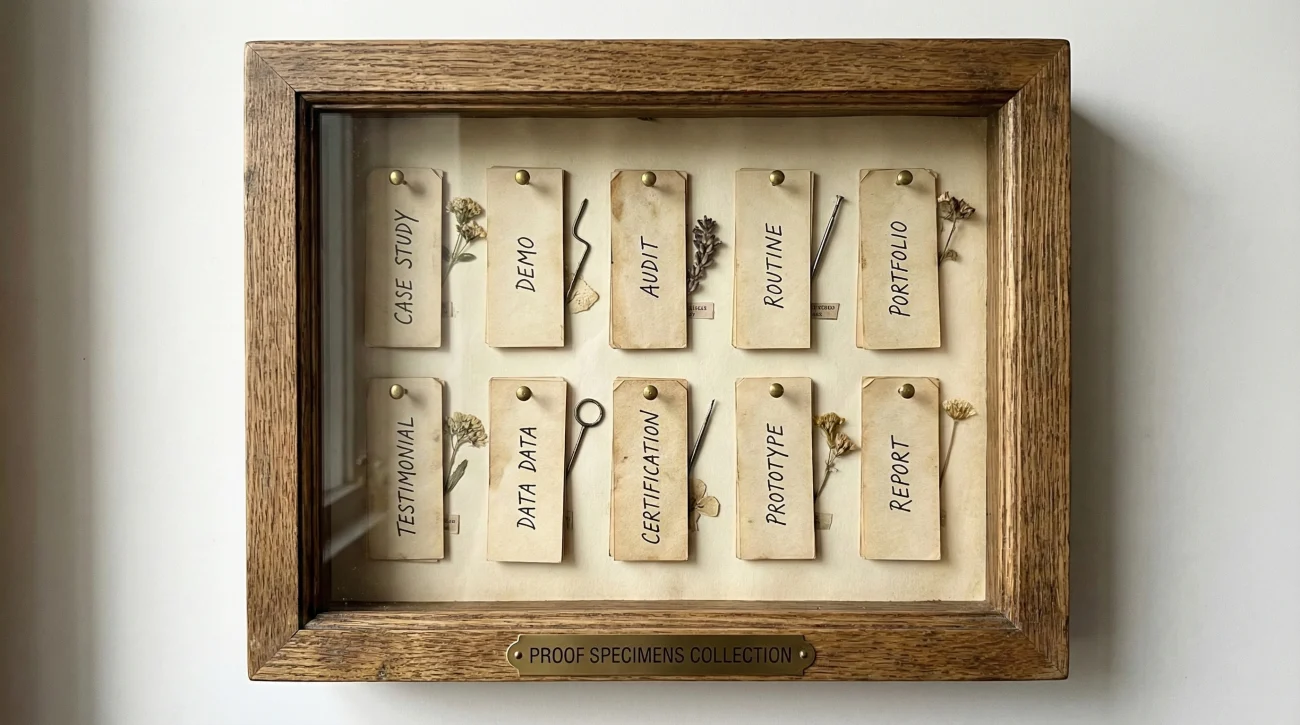
Most advice online repeats the same three ideas: courses, volunteering, freelancing. Those can help, but proof is broader than that. Proof is anything that demonstrates skill currency, discipline, and relevance.
Here are ten proof examples. You do not need all ten. You need one to three that you can explain clearly and truthfully.
- ✅ A one-page case study: “Here was the problem, here was my approach, here was the result.”
- ✅ A small build or demo: a dashboard, a landing page, a script, a portfolio piece, a sample analysis.
- ✅ A before and after audit: you reviewed a process, a document, a workflow, and improved it with clear reasoning.
- ✅ A structured practice routine: weekly mock interviews, weekly writing, weekly code katas, daily role-relevant drills.
- ✅ A role-relevant volunteer task: not “I volunteered,” but “I did X that matches this job’s core skill.”
- ✅ A consulting micro-project: a small paid or unpaid project with a defined scope and a deliverable.
- ✅ A peer review loop: you joined a community where your work is reviewed, and you can explain what you changed.
- ✅ An industry synthesis: you tracked trends and turned them into a short memo or summary you can discuss.
- ✅ A teaching moment: you mentored someone, led a study group, or documented a process for others.
- ✅ A decision log: you ran a focused job search with a clear strategy and can explain your targeting logic.
❌ Note: Avoid proof that sounds like filler. “I stayed busy” is not proof. “I learned a lot” is not proof. “I did some stuff” is not proof. Pick evidence that has a shape: output, routine, or decision.
If you are thinking, “I have none of these,” you probably have at least one in a smaller form. For example, caring for a family member is not a portfolio. But a calm, structured routine of staying current in your field can still be proof. Proof does not have to be public. It has to be credible.
Five control lines to keep your answer professional and short
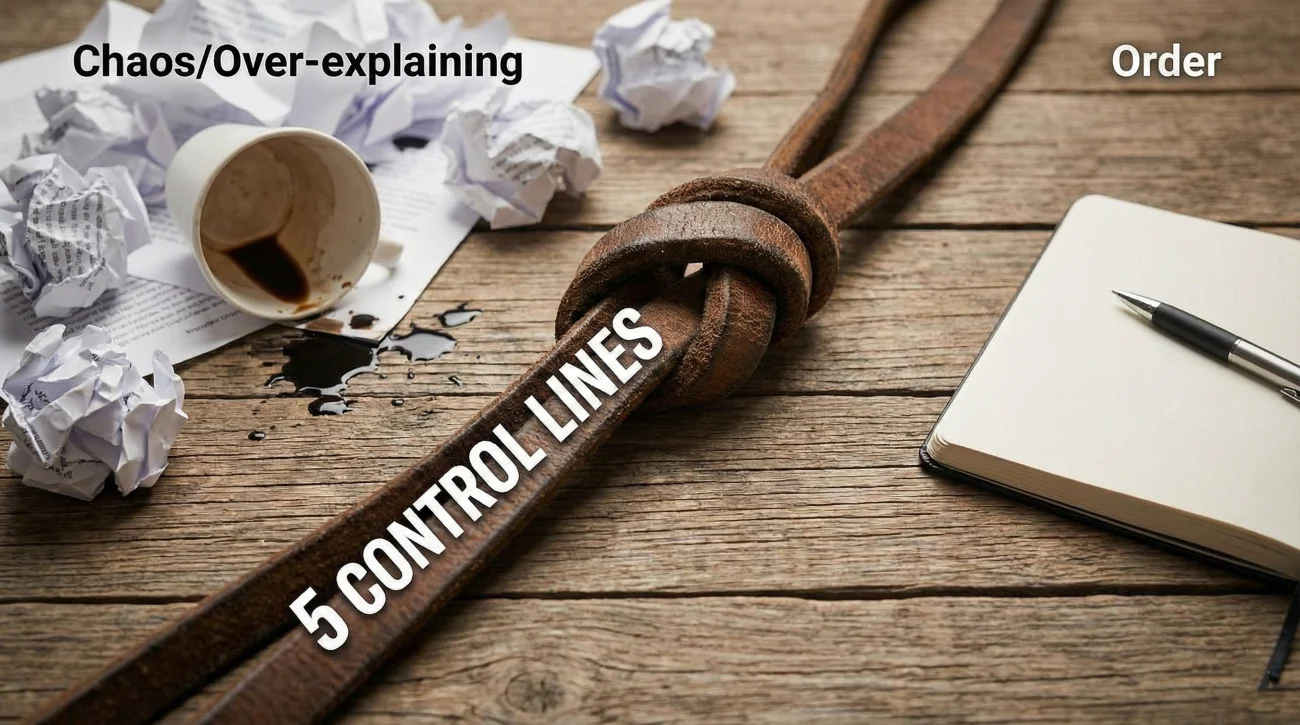
Here is the part most articles miss: you need lines that protect you from drift. Drift happens when you start explaining why the gap happened, you feel judged, and you try to repair that feeling by giving more detail. The interviewer rarely needs that detail.
These five “control lines” are not lies. They are boundaries. Use them to keep the answer under a minute and guide the interviewer back to job-relevant ground.
- 🎯 “The short version is: I’m ready to contribute now, and here are the three proof points.”
- 🎯 “There’s a longer personal story, but it isn’t relevant to the work. What matters is what I did to stay current.”
- 🎯 “I can share more context if needed, but I’d rather focus on how I’ll deliver in this role.”
- 🎯 “I kept the gap stable and intentional, and I can show you the outputs I produced during that period.”
- 🎯 “If you’re asking about readiness, I’m comfortable walking through my recent workflow.”
One of my favorite coaching moments was with Sabrina, a project manager who had a messy layoff story. Every time she talked about it, her tone shifted from confident to defensive. We used the second control line exactly as written. It allowed her to keep her dignity without sounding evasive.
“There’s a longer personal story, but it isn’t relevant to the work. What matters is what I did to stay current.”
Notice what that line does: it does not pick a fight, it does not apologize, and it does not invite interrogation. It calmly redirects. Most interviewers respect that, because it signals maturity.
💡 Pro Tip: Say your control line, then immediately deliver your proof. A control line without proof can sound like a dodge. Proof is what makes the boundary feel reasonable.
How to adapt your evidence tour in three common situations
The pattern is stable, but your emphasis changes based on your situation. Here are three common versions that come up in real interviews.
Situation 1: The gap is long enough that you feel exposed
When the gap is long, the interviewer’s risk scan gets louder. Your job is not to “defend” the length. Your job is to show current behavior and stable judgment.
“I know the gap looks long on paper, so I’m going to keep this concrete.
I stayed current by [routine], I produced [output], and I’m up to date on [role-relevant area].
If it helps, I can walk you through one recent example of how I approached [problem].”
Keep your voice calm. Fast talking signals anxiety. Calm structure signals stability.
Situation 2: You did not volunteer, freelance, or build a flashy project
This is where many people panic and start inventing a “productive gap.” Do not do that. You can still show proof through routine, role-relevant practice, and the ability to explain your approach.
“I’m going to be straightforward: I focused on finding the right role, and I kept my skills sharp with a structured routine.
Each week I did [practice], reviewed [examples], and refined [skill]. If you want, I can share the way I think through [role problem].”
This answer works because it is honest but not empty. You are not saying, “I was just applying.” You are saying, “I stayed in motion with a professional routine.”
Situation 3: The reason for the gap is private and you do not want to discuss it
You are allowed to keep private things private. The trick is to sound stable, not secretive. Use a neutral reason, then jump straight to evidence.
“I had a personal situation to handle, which is resolved now. What matters for this role is that I kept my skills current and I’m ready to work.
During that time I focused on [proof point 1] and [proof point 2], and I’m confident about stepping into this work.”
If someone pushes for details, repeat a control line and redirect to proof. You are not being difficult. You are being professional.
Final
This question feels personal because it points at a vulnerable stretch of time. But your best answer is not a confession, and it is not a performance of busyness. It is a short, calm evidence tour that sounds like a colleague explaining how they stayed sharp.
If you rehearse one pattern, pick one to three proof points, and keep your control lines ready, you can turn what have you been doing since you were unemployed interview into a moment that builds trust instead of draining it.
❓ FAQ
🧭 How long should my answer be?
Aim for 30 to 60 seconds. Lead with structure, give one to three proof points, then hand the conversation back by inviting a role-relevant question.
🧩 Should I say I have been “job searching”?
You can, but do not stop there. “Job searching” is not proof. Pair it with evidence: a routine, an output, or a role-relevant practice you can explain clearly.
🛡️ What if they ask for the reason I was unemployed?
Give a short neutral reason, then immediately move to proof. If the reason is private, keep it private and redirect to readiness and evidence.
🧪 Do I need a portfolio to make this work?
No. A portfolio is one kind of evidence. A structured routine, a decision process you can explain, or a small output can be enough if it is relevant and recent.
🎛️ What if I start rambling because I feel judged?
Use a control line, then deliver proof. Rambling usually happens when you try to “repair” a feeling. Structure replaces emotion with clarity.
⚠️ Disclaimer: ResumeSolving provides resume, cover letter, and job search communication guidance for informational purposes only. It is not legal, medical, financial, or professional counseling advice. Hiring decisions vary by company, role, location, and individual circumstances, so we do not guarantee interviews, offers, or outcomes. Always use your own judgment, verify requirements directly with the employer, and follow local laws and workplace policies. When a situation is sensitive, we prioritize privacy-safe, recruiter-appropriate wording, and you never need to share personal details you are not comfortable disclosing.