- A caregiving gap rarely scares recruiters because of the reason. It scares them because your resume leaves “Is this still happening?” unanswered.
- The fastest fix is a proof stack: 1 availability signal, 1 recent work-like artifact, and 1 support-in-place cue. You do not need all three, but you should show at least two.
- This guide gives you 15 proof ideas, 8 copy-ready bullets with explanations, and a short narrative you can use without oversharing.
Lynda had the kind of pre-gap track record that usually earns callbacks. Strong reviews, steady promotions, and managers who would happily vouch for her work. Then she spent 14 months caring for a family member, and the applications started landing in a quiet place: no interviews, no clear rejection, just silence.
When we looked at her resume together, it was not the caregiving gap itself that was hurting her. It was the uncertainty her resume created. Nothing on the page told a recruiter whether she was fully available now, whether the situation had stabilized, or whether she might disappear mid-onboarding.
This article is about returning to work after caregiving proof that hiring teams actually believe. Not a generic “take a course” checklist. Real signals that reduce doubt about availability, reliability, and ramp-up, while keeping your personal life private.
What recruiters are really trying to de-risk
What are recruiters quietly checking when they notice a caregiving gap?
Most recruiters are not judging the caregiving choice. They are doing fast risk triage. They have a role to fill, a manager who wants predictability, and a pipeline that can feel endless. A caregiving gap becomes a question mark if your materials do not close the loop.
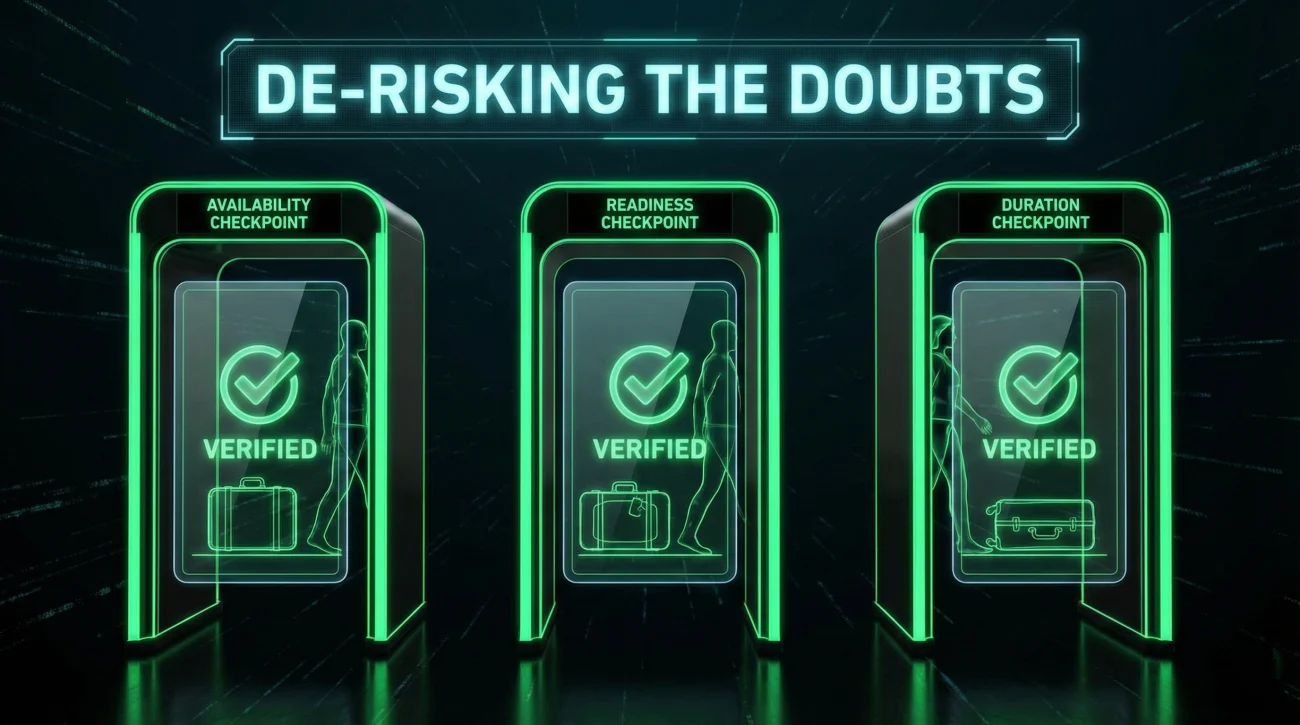
The three doubts that lead to the “quiet no”
Doubt 1: Availability uncertainty. They cannot tell if you are still on-call, still handling emergencies, or still needing last-minute schedule changes. Even supportive teams still need reliable coverage.
Doubt 2: Readiness uncertainty. They wonder if tools changed, if your skills are current, and whether you are back in a work rhythm that fits deadlines and collaboration.
Doubt 3: Duration uncertainty. They worry the return might be temporary, like you are “trying it” until caregiving pulls you back again.
A recruiter I trust once said something blunt but useful: When two candidates are close on skill, the one who feels stable and predictable usually wins. Not because the other is less capable, but because uncertainty is expensive.
“I’m not trying to know your story. I’m trying to know if I can plan around you.”
That quote is the north star for this guide. You do not need to explain more. You need to show evidence that the present is stable.
The proof stack recruiters trust
A single line like “Family caregiver (2024 to 2025)” explains the gap, but it does not answer the present. The best resumes do something calmer: they reduce ambiguity with proof.
Think in layers. You do not need all three to be perfect, but you should show at least two so the reader stops guessing.
Layer 1: One clear availability signal
This is the shortest, calmest way to remove uncertainty. It is not a confession. It is a factual statement about what you can commit to now.
Good availability signals include a start date, a schedule range, or a short stability cue like “support coverage in place.” You are not obligated to share medical details or family specifics.
Returning after a family caregiving period with support coverage in place; available for full-time roles and ready to start March 10.
If you only do one thing from this article, do this: Add one sentence that makes your current availability obvious. Most caregiving resumes fail because they never say “here is what work looks like for me now.”
Layer 2: One recent work-like artifact
Recruiters believe what they can picture. A small contract, a portfolio refresh, a returnship, a measurable volunteer deliverable, a tool recertification tied to the role, a short project with a clear output.
The artifact is not about being busy. It is about showing you can operate in a work rhythm again: deadlines, updates, quality, and follow-through.
Completed a 6-week operations project with weekly deliverables, rebuilding a reporting workflow and documenting SOPs.
Notice what this does: It gives the recruiter something to evaluate that is not your personal life. It turns the conversation back to work.
Layer 3: One support-in-place cue
This is the part many articles skip, and it is where credibility often lives for caregivers. A simple cue that says you have a reliable plan, not just hope.
Support-in-place cues can be as simple as “shared coverage” or “external support arranged.” You are not required to name who, where, or why. The goal is to close the loop on unpredictability.
Care responsibilities are now shared and scheduled; backup coverage is arranged during work hours.
A quick map from concern to proof
Sometimes recruiters do not have time to “interpret” your situation. They scan for a clean answer to three fears: consistency, readiness, and whether your return is stable. This table is here so you can match each fear with one signal, then place that signal where it will actually get seen.
| Recruiter concern | What they need to see | Signals that work |
|---|---|---|
| “Are they available consistently?” | Predictable schedule, no ambiguity | Start date, hours window, stability cue, support-in-place line |
| “Are they work-ready again?” | Recent outputs tied to the role | Contract, portfolio refresh, measurable project, role-specific recertification |
| “Will this change next month?” | Plan is real, not theoretical | Shared coverage, backup coverage cue, routine already tested with commitments |
The goal is not to “prove your life.” It is to stop the reader from guessing, so they can evaluate your work again.
15 proof ideas that say “I’m back and stable now”
This list is intentionally artifact-based. It helps you build caregiver re-entry proof without turning your resume into an emotional explanation. Pick the proofs that match your target role and what is true for you.

Availability proofs
Availability proof is about clarity. You want the reader to stop wondering if you can show up consistently.
- 📅 Start date clarity: “Available to start March 10” or “Immediately available.”
- 🕒 Schedule window: “Available Mon to Fri, standard business hours” (or your real window).
- 📍 Commute readiness: “Relocated and settled in [City]” or “Within 20 minutes of site.”
- 💻 Remote readiness: Home office setup, stable internet, core collaboration tools listed.
- 🔁 Routine signal: A recurring commitment that proves weekly consistency (cohort, shift, contract cadence).
If your target job requires shifts or occasional overtime, you can still do this. Just define your actual window. The problem is not limits. The problem is vagueness.
Readiness proofs
Readiness proof is about showing you can execute again. Recruiters relax when they see recent, role-relevant output.
- A micro-contract: 10 to 40 hours of paid work tied to the role.
- A returnship or structured re-entry program.
- A portfolio refresh with 2 to 3 recent pieces that match the job.
- A role-specific tool recertification that is current, not random learning.
- A deliverable you built: SOP, dashboard, template library, workflow map, case study.
One hiring manager told me they trust “a small fresh artifact” more than “a long explanation.” It is easier to believe what you can inspect.
Support-in-place proofs
Support-in-place proof answers the fear that your schedule will change without warning. Keep it simple and factual.
- A short support note: “Support coverage is in place for work hours.”
- Shared coverage cue: “Care responsibilities are shared and scheduled.”
- External support cue: “Ongoing external care support arranged.”
- Transition proof: “Returned to a consistent weekly schedule since [Month].”
- Backup plan cue: “Backup coverage is arranged for work hours.”
You are allowed to protect your privacy here. The goal is not to satisfy curiosity. The goal is to remove uncertainty.
8 resume bullets you can copy, with the “why this works” explained
These bullets communicate availability signals after caregiving while keeping your personal life private. Each one is paired with a short explanation so you can choose what fits your situation.
📌 Returned to a consistent Mon to Fri schedule and completed a 6-week contract supporting a team’s weekly reporting cadence.
Returned to a consistent Mon to Fri schedule and completed a 6-week contract supporting a team’s weekly reporting cadence.
❓ Why it works: It pairs stability (schedule) with proof (contract). That combo tells a recruiter you are not guessing about your availability, you are already operating again.
Make it yours by naming the output: A dashboard, a weekly report package, a vendor tracker, a process doc. Output makes it feel real, not performative.
🧭 Re-entered the workforce with support coverage in place; available for full-time roles with standard business hours.
Re-entered the workforce with support coverage in place; available for full-time roles with standard business hours.
❓ Why it works: It answers the hidden question directly, without details. It is calm, closed, and present-focused.
If “support coverage” feels too direct for you, soften it to “returning with a stable schedule in place.” You still close the loop, but you reveal less.
🧰 Refreshed core tools (Excel, Google Sheets, Slack, Asana) and rebuilt a reporting workflow with documented SOPs.
Refreshed core tools (Excel, Google Sheets, Slack, Asana) and rebuilt a reporting workflow with documented SOPs.
❓ Why it works: It signals readiness through tangible work outputs, not generic learning. “Documented SOPs” implies real execution and handoff skill.
Keep the tool list honest and role-relevant. Two to four tools is enough. The proof is the workflow you rebuilt, not the software name-dropping.
🧾 Completed a portfolio refresh: 3 new deliverables aligned with target roles (case study, dashboard, process map).
Completed a portfolio refresh: 3 new deliverables aligned with target roles (case study, dashboard, process map).
❓ Why it works: It shows momentum and relevance. Recruiters can picture what you will do in the job because you have recent examples that look similar.
Best practice: Pick deliverables that match the job posting language. If the role is operations-heavy, show process and tracking. If it is customer-facing, show communication artifacts.
📈 Led a volunteer operations project with weekly deadlines, improving turnaround time and tracking outcomes across 8 weeks.
Led a volunteer operations project with weekly deadlines, improving turnaround time and tracking outcomes across 8 weeks.
❓ Why it works: The word “weekly” signals cadence, and “outcomes” signals accountability. It feels like work because it behaves like work.
Be specific about the result if you can: Fewer errors, shorter turnaround, cleaner tracking. If you cannot measure, describe a concrete before and after process change.
🗂️ Delivered a short-term project end-to-end (scope, timeline, stakeholder updates) to re-establish working rhythm.
Delivered a short-term project end-to-end (scope, timeline, stakeholder updates) to re-establish working rhythm.
❓ Why it works: It hits readiness without overexplaining the gap. “End-to-end” plus stakeholder updates implies reliability and communication, two things caregiving gaps often get unfairly questioned on.
Make it stronger by naming the deliverable: A launch checklist, a client onboarding pack, a process map, a content calendar, a QA workflow.
🤝 Reactivated professional references and joined structured peer review sessions to sharpen interview readiness.
Reactivated professional references and joined structured peer review sessions to sharpen interview readiness.
❓ Why it works: It signals you are back in a professional environment again. It also hints at social proof, which quietly reduces skepticism.
Use this when you have strong references and you are comfortable with them being contacted. Do not include it if your reference situation is complicated right now.
🧩 Re-entered with a phased workload plan already tested via consistent weekly commitments and measurable outputs.
Re-entered with a phased workload plan already tested via consistent weekly commitments and measurable outputs.
❓ Why it works: It answers “is this realistic?” with “it’s already working.” Recruiters relax when your plan is proven, not aspirational.
Keep the phrase “phased workload” only if it is true and stable. If you are fully ready for full-time now, say that directly instead.
💡 Pro Tip: Quick rule: If you can pair one stability cue with one artifact, do it. That pairing turns “I’m back” from a claim into something believable.
Where to place the proof so it actually gets seen
Caregivers often put the gap label in the middle of the resume and hope the reader understands. The reader usually does not. They skim top-down, looking for confidence and recent relevance.
So place proof where eyes naturally go, then keep the gap label minimal.

Placement 1: One sentence in your summary
This is where you remove uncertainty early. Keep it calm. One sentence is enough.
If you are worried it will “sound needy,” remember what it really is: It is a scheduling fact, like any other availability detail.
Operations coordinator with 6+ years in scheduling and vendor coordination. Returning after a family caregiving period with support coverage in place; available for full-time roles and ready to start March 10.
Placement 2: A recent “Project” or “Contract” entry
This is the easiest way to show readiness without arguing for it. List a real, time-bound artifact like work: dates, title, and 2 to 3 outcome bullets.
It can be paid or unpaid. The key is that it looks like work: deadlines, deliverables, and measurable results.
Independent Project | Feb 2026 to Mar 2026
Built a weekly reporting pack and tracker system; documented SOPs and handoff notes for consistent execution.
Placement 3: A minimal gap label, then back to results
If you label the gap, keep it clean and short. One line. No emotional bullets underneath. Your proof should live elsewhere.
The goal is not to make caregiving look like employment. The goal is to keep the resume focused on your work identity, with the gap treated as a closed chapter.
A short narrative that works in interviews and cover letters
This is the “say less, show more” version. It keeps your story true, closed, and forward-facing. You can use it spoken, or adapt it into two sentences for a cover letter.
I stepped away for a family caregiving period that required my full attention. The situation is now stable with coverage in place, and I’m returning to full-time work. To refresh my working rhythm, I completed a recent project with weekly deadlines and measurable outcomes. I’m available to start on [date].
If you want this to feel even more concrete, swap “recent project” for the real artifact: contract, portfolio refresh, returnship, or volunteer deliverable. The more inspectable the proof is, the less you need to explain.
Availability mistakes that trigger doubt
These patterns accidentally make a closed chapter sound ongoing. Fixing them is often the difference between “no response” and “let’s talk.”
- 🚩 Using open-ended language like “currently caregiving” with no present-focused availability line.
- 🚩 Writing an emotional explanation that reads unstable, even if your situation is fully resolved.
- 🚩 Listing “Full-time caregiver” with multiple bullets that add detail but provide no work-relevant proof.
- 🚩 Hinting at flexibility needs without framing them as manageable and supported.
- 🚩 No recent artifacts at all: no project, no deliverable, no proof of working rhythm.
💡 Pro Tip: You do not need to sound “unlimited.” You just need to sound clear. Clarity reads as confidence.
What this looks like in real life
Lynda’s fix: One line plus one artifact
Lynda’s original resume had a gap label and then nothing that answered the present. We added one availability sentence in her summary and created a short “recent project” entry based on volunteer ops work she had actually been doing with weekly deliverables.
She told me interviews changed tone immediately. Instead of “So what happened?” she started getting “Tell me how you rebuilt that workflow.” That is the goal: move the conversation from your life to your work.
A colleague’s approach: Support-in-place without oversharing
A former coworker, Andre, took time off for a family situation he did not want to discuss. His resume never explained details. It did one simple thing: it confirmed stability and availability in one sentence, then it highlighted a recent portfolio refresh that matched the roles he wanted.
It was not fancy. But it removed ambiguity. And recruiters rarely reward ambiguity with patience.
The “good limits” story: Clarity beats pretending you have none
Another candidate, Lina, was returning to work with a real constraint: she could not do late nights or unpredictable travel. Early on, she tried to hide that, hoping to get in the door first. It backfired because her materials felt vague and evasive.
When she got clear about her true schedule window and targeted roles that matched it, her response rate improved. The surprising part: she did not become “less hireable.” She became easier to plan around. That is what most teams want.
⚠️ Warning: Proof cannot fix a mismatch. If a job truly requires unpredictable on-call hours, heavy travel, or constant overtime, do not force-fit your story. Aim for roles where your stable schedule is a feature, not a conflict.
Final: Make “I’m back” feel obvious, not arguable
After caregiving, you do not need to sell the gap. You need to remove doubt about the present.
Build a simple proof stack, then place it where recruiters actually look: one availability signal near the top, one recent work-like artifact they can evaluate, and a support-in-place cue if it is true for you.
If you want a broader framework for handling employment gaps without oversharing, returning to work after caregiving proof can be a solid reference point. Use it to guide what you include, then tailor the proof to the role you are targeting.
When you do it right, returning to work after caregiving proof does not feel like an argument. It feels like a calm signal that your present is stable and your work is current.
❓ FAQ
🧭 Do I have to write “caregiver” on my resume?
No. You can label the period as “family leave” or “career break” and keep it minimal. The bigger priority is adding proof signals elsewhere so the gap does not become the only thing they notice.
✅ What’s the best single proof if I have nothing recent?
Start with one role-relevant artifact you can complete quickly: a portfolio refresh, a measurable volunteer deliverable, or a short contract. Pair it with a clear availability sentence so your story feels current, not paused.
🧩 Should I explain my caregiving situation in detail to seem honest?
You can be honest without being detailed. Most hiring teams do not need specifics. A calm, closed statement plus proof of present availability usually reads as more professional than a long explanation.
📍Where do I show availability without sounding desperate?
Use one sentence in your summary or cover letter: start date, schedule range, and a simple stability cue if true. Keep it factual, then move straight into your value and recent proof.
🛠️ Is a functional resume format better for caregivers?
Sometimes, but it is not a magic fix. Many recruiters still want chronology. A safer approach is a clean timeline plus a recent project entry and a clear availability line near the top.
💬 What if they ask, “Will you still be caregiving?”
Answer the present, not the past. Confirm your availability and reliability in one or two sentences, mention that coverage is arranged if true, then pivot to your recent artifact and role fit.
⚠️ Disclaimer: ResumeSolving provides resume, cover letter, and job search communication guidance for informational purposes only. It is not legal, medical, financial, or professional counseling advice. Hiring decisions vary by company, role, location, and individual circumstances, so we do not guarantee interviews, offers, or outcomes. Always use your own judgment, verify requirements directly with the employer, and follow local laws and workplace policies. When a situation is sensitive, we prioritize privacy-safe, recruiter-appropriate wording, and you never need to share personal details you are not comfortable disclosing.