- Job hopping is a pattern signal, not a number. Three short stints in a row triggers concern. Ten years of varied roles does not.
- Recruiters fear flight risk: that you will leave them too. Every answer must include a commitment signal for this specific role.
- Separate what you can control (how you present it) from what you cannot (the actual history). Structure and framing matter.
- Contract work, layoffs, and internal transfers often look like job hopping but are not. Label them correctly.
What Recruiters Actually See When They See Job Hopping
When a recruiter scans a resume and sees multiple short stints in a row, one question dominates their thinking: Will this person leave us too? Every other concern, whether skills, culture fit, or salary expectations, becomes secondary to the flight risk calculation.
A software engineer named Tomás came to me after being rejected from three final-round interviews in a row. His technical skills were strong. His interviews went well. But his resume showed five jobs in six years, none lasting more than 18 months. Hiring managers kept choosing “safer” candidates with longer tenures.
The frustrating part was that Tomás had good reasons for each move. One company ran out of funding. Another had a toxic engineering culture. A third was a contract role that ended as planned. But his resume presented all five roles identically, with no context, making his history look like chronic restlessness.
We restructured his resume to separate contract work under a consulting umbrella, added brief context notes for the layoff, and wrote a summary that emphasized his current target and commitment. Same history. Different presentation. He received an offer within six weeks.
Understanding job hopping on resume challenges is not about hiding your history. It is about presenting it in a way that answers the flight risk question before it becomes a rejection.
Key Point: Job hopping triggers flight risk calculations. Your materials must show why this role is different and why you will stay.
Pattern-Risk Checklist
Before sending any application, evaluate your resume against these pattern-risk signals:
| Risk Signal | What Recruiter Thinks | How to Counter It |
|---|---|---|
| 3+ roles under 18 months in a row | “This is a pattern, not bad luck” | Group contract work, add context for layoffs, show what changed |
| No clear progression or theme | “They do not know what they want” | Write a focused summary with clear target role |
| Vague reasons for leaving | “They are hiding something” | Brief neutral context that closes the question |
| Lateral moves without explanation | “Could not get promoted anywhere” | Frame as intentional scope or domain choices |
| Recent roles shorter than older ones | “Getting worse, not better” | Emphasize stability signals and commitment cues |
| Mix of contract and perm with same formatting | “Cannot tell what is what” | Label contract work clearly, consider umbrella grouping |
| No commitment language anywhere | “They will leave us too” | Add commitment cues in summary and interview answers |
| Bitter or blame tone about past roles | “They will badmouth us too” | Neutral, forward-looking language throughout |
💡 Pro Tip: The single most important counter-signal is specificity about why this role is different. Generic statements about “looking for stability” sound desperate. Specific statements about why this company and scope match your goals sound intentional.
Decision Map: What to Keep, Cut, and Reframe
Job hopping requires strategic decisions about how to present your history. Here is how to approach each element:
What to Keep
- Roles that show progression or skill development
- Longer tenures that anchor your timeline
- Relevant experience even if brief
- Contract work clearly labeled as contract
- Internal transfers showing growth at one company
What to Cut or Minimize
- Very short irrelevant roles (under 3 months, unrelated field)
- Duplicate information across similar roles
- Excessive detail on older or shorter positions
- Roles that add to the pattern without adding value
What to Reframe
- Multiple contracts: Group under consulting umbrella
- Layoff-driven moves: Add brief structural context
- Internal transfers: Show as growth within one employer
- Early career exploration: Condense older roles
- Startup roles: Note company stage and outcomes
Structure Options
| Situation | Recommended Structure |
|---|---|
| Mix of contract and permanent roles | Separate consulting section or umbrella entry for contracts |
| Multiple roles at same company | Nested format showing progression under one employer |
| Early career exploration, now focused | Condense early roles, expand recent relevant ones |
| Layoffs creating short stints | Brief context notes indicating structural cause |
| Genuine pattern of short stays | Strong summary with commitment cues, selective detail |
Four Mini Scripts for Job Hopping
These scripts address the specific concerns that job hopping patterns trigger. Adapt them to your situation while keeping the commitment signals.
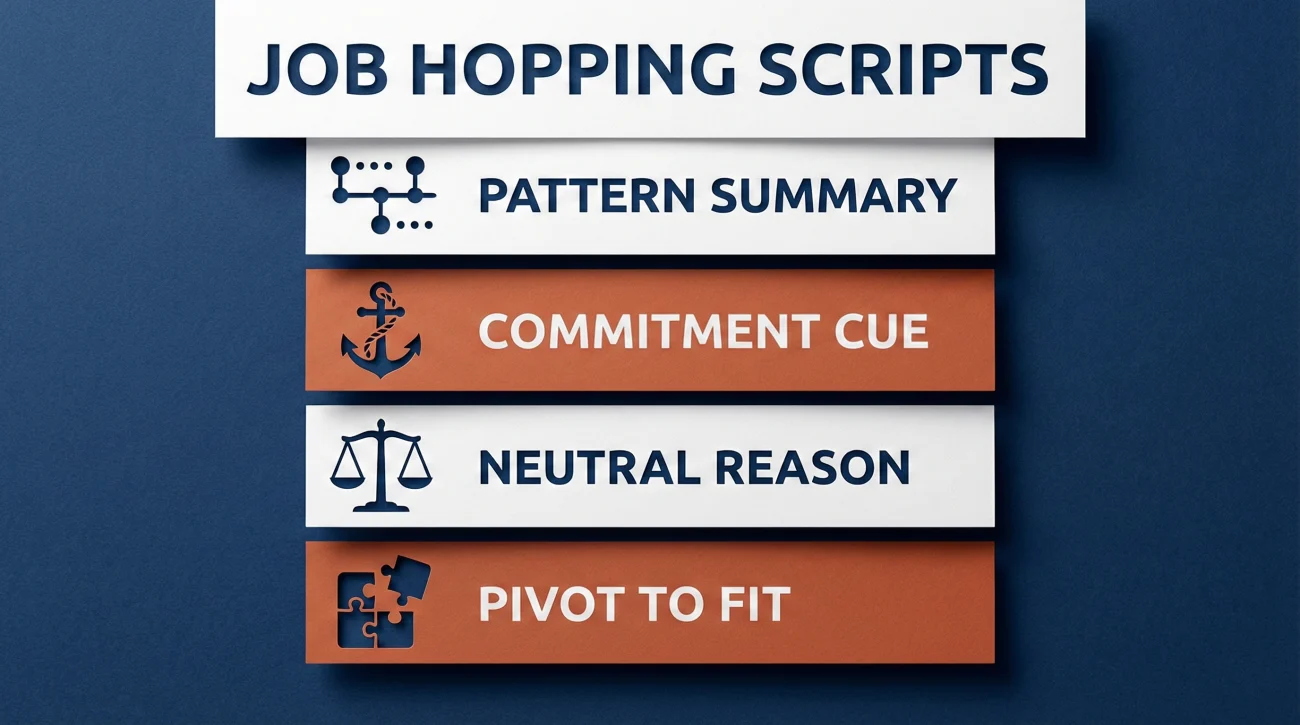
Script 1: Pattern Summary (For Resume or Interview Opening)
“My early career involved some exploration across different company stages and team structures. That experience helped me understand where I do my best work: mid-size companies with established products where I can focus on depth rather than breadth. That clarity is why I am targeting this specific type of role now.”
This one turns the timeline into a learning arc. It helps the reader see intent and direction, instead of assuming you kept leaving because you were unhappy everywhere.
Script 2: Commitment Cue (For Interview)
“I am looking for a role where I can build something over multiple years, not just ship and move on. The scope here matches what I want to be doing long-term, and the team structure supports the kind of sustained focus I am looking for. I am not interested in another short stint.”
Say this when you feel the flight risk question sitting in the room. It is direct, calm, and it makes your time horizon explicit without sounding defensive.
Script 3: Neutral Reason Line (For Specific Short Stint)
“That role was a contract position that ended when the project delivered. I enjoyed the work but was always clear it was a defined engagement, not a permanent role.”
Keep this tight and factual. The goal is to label the stint, close the loop, and move on before you accidentally invite a long cross-examination.
Script 4: Pivot to Role Fit
“What I learned from those experiences is what environment helps me succeed. This role has the three things I have identified as essential: clear ownership, a collaborative team, and complex problems worth solving long-term. That is why I am particularly interested in this opportunity.”
This is your exit ramp from the past. After one clean explanation, shift the conversation to what you want now and why this role fits the criteria you are choosing on purpose.
Different Types of “Job Hopping”
Not all short-tenure patterns are the same. Different causes require different framing.
Contract Work
Multiple contracts are not job hopping. They are how contract work operates. The fix is clear labeling and structure.
Make the contract nature visible at a glance: Either group contracts under one consulting umbrella entry, or label each role as “Contract” (and keep the end date clean and matter-of-fact).
Layoff-Driven Moves
When short stints result from layoffs, the pattern is structural, not personal. But recruiters cannot tell the difference without context.
Add one neutral context note only where it is needed: “Company downsized,” “Startup funding ended,” or “Division eliminated.” One short line is enough to close the question without turning your resume into a defense memo.
Internal Transfers
Multiple roles at one company should show growth, not instability. The fix is formatting.
Use a nested format: One overall company line with the full tenure, then each role underneath with its own dates. It reads as progression inside one employer instead of a string of exits.
Startup Volatility
Startups fail, pivot, and reorganize frequently. Multiple short startup roles are common in some industries.
Give the reader a quick anchor so they do not fill in the blanks: Note the stage and outcome in plain language, like “Series A startup, acquired after 14 months” or “Pre-seed company, ceased operations due to market conditions.”
Genuine Pattern
Sometimes the pattern is real: you have left multiple jobs quickly for various personal reasons. This requires direct addressing.
Own it calmly in your summary and be ready for the interview follow-up. The goal is one stable, believable story about what changed, why this role fits your criteria, and what makes your next move a multi-year one.
Interview Questions to Prepare For
Job hopping guarantees certain interview questions. Prepare for these specifically:
“Why have you had so many jobs?”
Structure your answer: acknowledge the pattern, explain what you learned, show why this role is different, add commitment cue.
“Why did you leave [specific short role]?”
Give a brief, neutral explanation for that specific situation. Do not over-explain.
“How do we know you will not leave us too?”
This is the real question behind all job hopping concerns. Answer it directly with specifics about why this role is different.
“What are you looking for in your next role?”
Use this to demonstrate clarity and intentionality. Show that you have thought carefully about fit.
Resume Structure for Job Hoppers
How you structure your resume significantly affects how the pattern reads:
Option 1: Consulting Umbrella for Contracts
Provided product management consulting to early-stage technology companies. Key engagements:• Series B fintech (8 months): Led payments feature from discovery to launch
• Healthcare startup (6 months): Defined MVP roadmap and user research process
• E-commerce company (10 months): Owned checkout optimization, improved conversion 18%
Option 2: Nested Format for Internal Moves
TechCorp Inc. | 2019 – 2024
Senior Product Manager (2022 – 2024)
• Led platform team of 8 engineers…
Product Manager (2020 – 2022)
• Owned mobile app features…
Associate Product Manager (2019 – 2020)
• Supported enterprise dashboard…
Option 3: Brief Context Notes
(Company ceased operations due to funding)
• Built recommendation engine from scratch…
⚠️ Warning: Do not add defensive context to every role. Use notes sparingly for situations that genuinely need explanation. Over-explaining looks worse than the pattern itself.
Consistency Across All Documents
Job hopping scrutiny means your story must be airtight across every touchpoint. Mismatches create doubt that compounds the flight risk concern.
| Touchpoint | What to Verify |
|---|---|
| Resume | Dates match LinkedIn exactly. Contract roles clearly labeled. Context notes consistent with interview story. |
| Same structure as resume. No roles appearing that are not on resume (or vice versa). | |
| Application forms | “Reason for leaving” fields match what you will say verbally. Dates match resume. |
| Phone screen | Brief pattern explanation ready. Same framing as written materials. |
| Interview | Detailed answers for each short stint. Commitment cues match summary language. |
| References | Briefed on your framing. Will not contradict your reasons for leaving. |
| Background check | All employers listed will verify. Dates are accurate. |
💡 Pro Tip: Create a master document listing each role with exact dates, your stated reason for leaving, and what each reference will say. Review it before every application and interview.
Language Red Flags to Avoid

Certain phrases amplify the flight risk signal even when you mean well. Replace these patterns:
Risky Reasons for Leaving
- ❌ “I was bored” → ✅ “I had mastered the core challenges and was ready for new complexity”
- ❌ “Not challenging enough” → ✅ “Looking for deeper technical problems to solve”
- ❌ “Bad culture” → ✅ “Seeking a team environment with clearer feedback loops”
- ❌ “Terrible manager” → ✅ “Looking for a management style that supports my growth”
- ❌ “No growth opportunities” → ✅ “Seeking a role with defined advancement path”
- ❌ “Company was a mess” → ✅ “Seeking a more structured operating environment”
Weak Commitment Language
- ❌ “Looking for stability for now” → ✅ “Looking for a long-term home”
- ❌ “Ready to settle down” → ✅ “Clear about what I want and where I work best”
- ❌ “Hoping this one works out” → ✅ “Confident this role matches my target criteria”
- ❌ “I think I would stay” → ✅ “I am looking for a multi-year commitment”
Common Mistakes That Make Job Hopping Look Worse

These approaches seem reasonable but actually amplify the flight risk signal:
- Hiding Roles Entirely: Removing short roles creates unexplained gaps, which trigger different concerns. Background checks may also reveal the omission.
- Blaming Every Employer: If every job ended because of problems with the company, recruiters assume you are the common factor.
- Over-Explaining Each Move: Long explanations for every transition make the resume read like a defense brief. Keep context notes minimal.
- No Commitment Language Anywhere: Without signals that you intend to stay, recruiters assume you will leave again.
- Treating All Short Stints Identically: Contracts, layoffs, and voluntary departures are different. Format them differently.
Choose Your Next Step
This hub covered the job hopping framework and the key decisions you need to make. The clusters below go deep on specific situations and formatting challenges. If your pattern involves layoffs, see the Layoff hub for those specific scripts. If it involves terminations, see the Fired hub. If toxic workplaces drove the pattern, see the Toxic Exit hub for guidance on framing those situations professionally.
| Article | Description |
|---|---|
| Too Many Jobs on Your Resume: What to Keep, What to Cut, What to Combine | Inclusion decision checklist with 3 strategies and examples |
| Short Stints on a Resume: A Clean Way to Explain Them | 8 short-stint explanation lines with pivots |
| Why Have You Had So Many Jobs: A 45 Second Interview Answer | Core interview structure with 6 scenarios and reassurance lines |
| Why You Left So Soon: A Safe Answer When It Was Not a Crisis | Short-tenure scripts for non-layoff, non-termination situations |
| How to List Multiple Short-Term Jobs on a Resume: 6 Clean Examples | Example pack for different pattern types |
| Contract Work That Looks Like Job Hopping: How to Show Continuity | Structure options for separating contract work from job hopping |
| Internal Transfers vs Job Hopping: Show Growth Without Confusion | Display formats for multiple roles at one company |
| Short Stints Caused by Layoffs: How to Frame the Pattern | Narrative structure for layoff-driven patterns |
| Multiple Short Jobs Because Workplaces Were Toxic: Frame Without Drama | Pattern framing for toxic-driven moves with neutral language |
| Probation Period Ended: How to Explain a Short Tenure | Framework for very short stints that ended at probation |
| Cover Letter Paragraph for Job Hopping | One tight paragraph template for pattern-risk cases |
| Job Hopping Red Flags: Phrases That Trigger Flight Risk | 18 red flags with replacements and self-check |
For layoff-specific guidance, see the Layoff hub. For termination situations, see the Fired hub. For toxic workplace exits, see the Toxic Exit hub.
Breaking the Pattern
The job hopping on resume challenge is ultimately about one thing: convincing recruiters and hiring managers you will stay this time. Every formatting choice, every explanation, every interview answer should contribute to that single goal.
Separate contract work from permanent roles. Add context for layoffs and structural changes. Group internal transfers to show growth. Write a summary that demonstrates role clarity. Prepare interview answers with specific commitment cues.
You cannot change your work history. But you absolutely can change how recruiters interpret it. Present your experience in a way that shows intentionality rather than instability, learning rather than failure, and clarity about what you want rather than desperation for any job. That version of your story is not spin. It is the full context that your bare chronology does not provide.
❓ FAQ
🎯 How many short jobs counts as job hopping?
There is no magic number. It is about pattern, not count. Three roles under 18 months in a row looks like a pattern. One short role surrounded by longer tenures does not. Recent history matters more than distant history.
📝 Should I remove short jobs from my resume?
Usually not entirely. Removing roles creates gaps and background checks may reveal them anyway. Better to reframe, group, or add brief context than to hide roles completely.
💼 What if all my short stints were contracts?
Contracts are not job hopping. Label them clearly as contract work and consider grouping under a consulting umbrella. The issue is not the tenure length but the impression of instability.
🔍 Will job hopping always hurt me?
Not always. Some industries expect more movement. Startups, agencies, and contract-heavy fields see more short tenures as normal. The key is understanding what is typical in your target industry and framing your history accordingly.
⚠️ How do I answer when they directly ask if I will leave?
Be direct and specific. Explain what you learned about where you work best, why this role matches that, and what you are looking for long-term. Generic reassurances sound hollow. Specific fit statements sound credible.
⚠️ Disclaimer: ResumeSolving provides resume, cover letter, and job search communication guidance for informational purposes only. It is not legal, medical, financial, or professional counseling advice. Hiring decisions vary by company, role, location, and individual circumstances, so we do not guarantee interviews, offers, or outcomes. Always use your own judgment, verify requirements directly with the employer, and follow local laws and workplace policies. When a situation is sensitive, we prioritize privacy-safe, recruiter-appropriate wording, and you never need to share personal details you are not comfortable disclosing.