- If you say “the market is bad” without a pivot, you sound passive or blamey.
- Your goal: Name reality briefly, show what you did anyway, then tie it to this role.
- Use one of the 5 frames below, avoid the 6 risky lines, and keep a clean 25-second version ready.
When “The Market Is Bad” Turns Into a Red Flag
I’ve sat on both sides of this moment: A candidate takes a breath, looks a little tired, and says the quiet part out loud. “Honestly, the job market is terrible right now.”
Sometimes they are right. Sometimes they are very right. But the problem is not accuracy. The problem is what the sentence signals when it lands without context. In interview language, “the market is bad” can accidentally translate into: “I have no plan, I’m discouraged, and I need you to rescue me.”
That is why how to explain the job market is bad in an interview is not about pretending everything is fine. It is about framing reality without sounding like you are handing your agency to the economy.
A real example: I once interviewed a product marketer named Angelique. Great portfolio, sharp thinking, solid leadership. She had been searching for months. The first time she tried to explain it, she spent two minutes on hiring freezes, ghosting, and how unfair ATS filters are. None of it was “wrong.” But by the end, I had more questions about her energy and strategy than her skill.
We rewrote her answer into a 25-second version that acknowledged the market, showed her actions, and ended with fit. The next week, she told me the hiring manager literally nodded and said, “That makes sense. Thanks for being clear.” Same reality, different signal.
💡 Pro Tip: You do not need to win an argument about the economy. You need to earn confidence that you will perform in this job.
What The Interviewer Is Actually Listening For
When someone says “the market is bad,” most interviewers instantly check three things. Not because they are heartless, but because they are trying to predict risk.

Signal 1: Ownership
Do you sound like a person who responds to constraints, or a person who freezes inside them? Ownership does not mean you caused the market. It means you can still make decisions inside a tough context.
Signal 2: Judgment
Can you read the room and communicate professionally? Blaming, ranting, or spiraling suggests poor judgment. A calm, measured frame suggests you can work with stakeholders, handle ambiguity, and stay constructive.
Signal 3: Momentum
Even if your timeline is longer than you wanted, do you have proof of movement? Interviewers love signs of momentum: Targeted outreach, skill refresh, freelance projects, measurable output, or clear strategy shifts.
⚠️ Warning: The sentence “The market is bad” becomes risky when it is the ending. Make it the beginning of a story, then pivot fast.
5 Framing Options That Sound Honest, Not Blamey
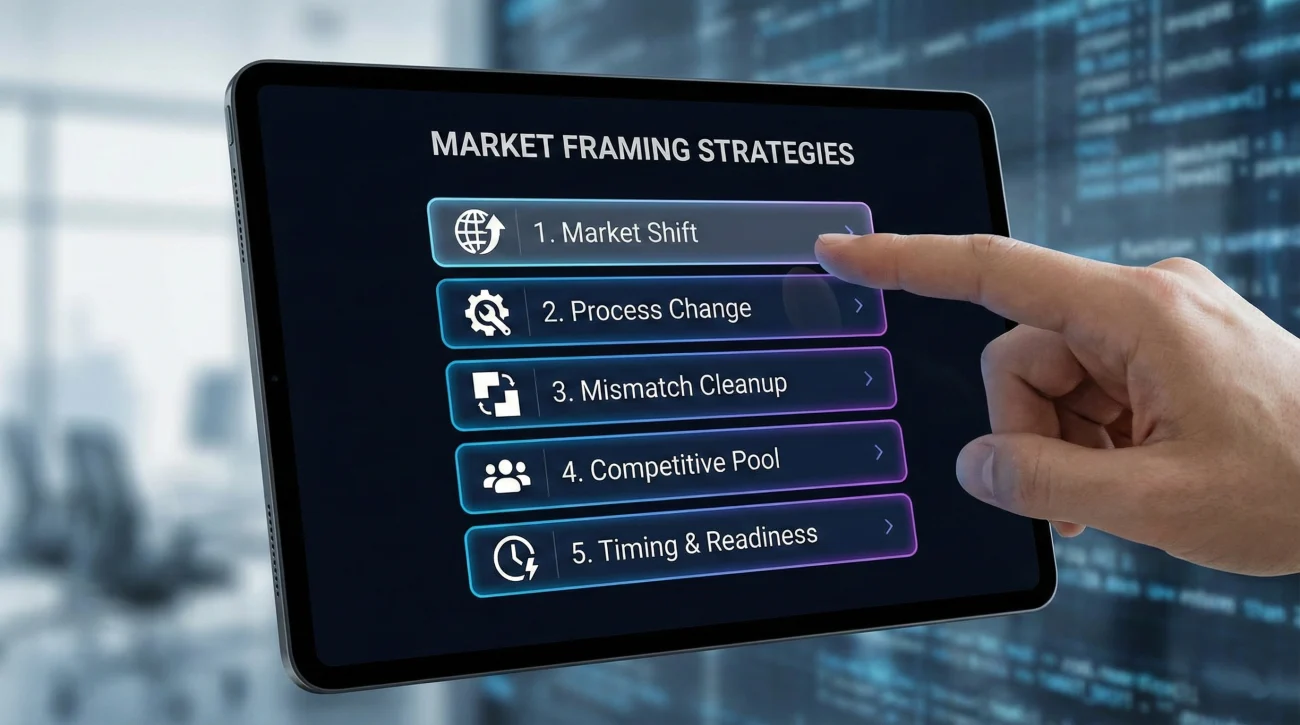
Below are five frames I’ve used with candidates across long job searches. Choose one that matches your real situation. Do not mix all five. One clean frame is stronger than a long explanation.
1️⃣ Frame 1: “Market shift” plus targeted focus
This is the safest “default” frame when your industry slowed down or hiring became more selective.
“The market tightened in my space, so I got more targeted. I narrowed my search to roles where I’ve already delivered outcomes like X and Y, and I adjusted my approach to focus on fewer, higher-fit opportunities.
Use when: You have a clear target role and can name what “fit” looks like.
2️⃣ Frame 2: “Process change” plus what you learned
Sometimes the market is not just “bad.” The process is different: More rounds, slower decisions, higher bar. You can name that without complaining.
“Hiring cycles are longer right now, and I’ve seen more multi-round processes. I adapted by building tighter case examples and getting clearer about the roles where I can contribute fastest.
Use when: You can show a concrete adjustment you made.
3️⃣ Frame 3: “Mismatch cleanup” plus a strategic reset
This is for candidates who started broad and then realized they were chasing the wrong roles or selling the wrong story.
“My early search was too broad. Once I saw what employers were prioritizing, I refined my positioning and focused on roles where my strongest evidence lines up with the job.
Use when: You want to explain time without sounding stuck.
4️⃣ Frame 4: “Competitive pool” plus differentiator proof
If you are applying into a crowded market, saying “competition is intense” is fine. The key is: Show how you compete.
“There’s a strong candidate pool right now, so I’ve been leaning into proof. I’m bringing clear examples of outcomes, not just responsibilities, and I’m being selective about roles where that evidence matches.
Use when: You can name one measurable win, a portfolio, or a case story you can point to.
5️⃣ Frame 5: “Timing” plus readiness for this role
This frame is excellent when you are talking to a company that is hiring steadily, but your prior search happened during a slower period.
“The timing in my sector has been slower, but I’ve stayed active and ready. What I like about this role is it matches the work I do best, and I can contribute quickly in these areas.
Use when: The company is clearly hiring and you want to reassure them you are not “waiting for luck.”
One phrase you can borrow (and keep short) is the long-tail people search for: job market is bad interview answer. But treat it like a label, not a speech. Label the context, then move.
6 Lines That Backfire (And What To Say Instead)
These are real lines I’ve heard. They usually come from stress, not bad intent. Still, they create a “low control” impression.
| ❌ Risky line | ✅ Safer version |
|---|---|
| “No one is hiring. It’s impossible.” | “Hiring has been slower, so I’ve shifted to a more targeted search and stronger proof in my materials.” |
| “Recruiters keep ghosting me.” | “Response rates vary, so I track what works and focus on channels where I get higher signal, like referrals and role-specific outreach.” |
| “ATS is broken.” | “I updated my resume to be clearer, more role-aligned, and easier to scan.” |
| “Companies want unicorns.” | “The bar is higher, so I focus on roles where my evidence matches the priority outcomes.” |
| “It’s all politics.” | “I’ve learned timing and internal alignment matter, so I ask better questions early and prioritize teams that can hire.” |
| “I applied to hundreds of jobs.” | “I started broad, then went more focused to increase quality conversations.” |
❌ Note: If you feel angry about the market, that is human. But your interview is not the place to process it. Save the emotion for a friend. Bring the signal to the interviewer.
4 Pivot Scripts That Make The Market Mention Safe

Here is the structure I use most: [Context] + [Your action] + [Proof] + [Fit]. The pivot is the engine. It turns “market” into “capability.”
Pivot Script 1: The 25-second clean version
“Hiring has been slower in my space, so I got more targeted. I focused on roles like this where I’ve already delivered [specific outcome]. That’s why I’m excited about this position, because the priorities line up with what I do best.”
Pivot Script 2: When they ask why it is taking longer
“The market is more selective, and I’m being selective too. I’m prioritizing roles where I can add value quickly, not just any role. In the meantime, I’ve been doing [project, consulting, coursework] to stay sharp and keep momentum.”
Pivot Script 3: When you need to explain unemployment due to the market
You can use the phrase directly once, then move. Use it calmly, not defensively: explain unemployment due to job market.
“I was impacted by a slow hiring market, and I treated it like a project. I tightened my target list, improved my proof stories, and stayed active through [action]. What I’m looking for now is a role like this where my strengths map clearly to the work.”
Pivot Script 4: When they push on your search strategy
“I test and refine my approach. I track where I get quality conversations, I prioritize those channels, and I keep improving my story. The result is fewer random applications and more high-signal discussions, like this one.”
“Totally fair question. The market has been slower, so I got more targeted. I can walk you through the roles I’m focusing on and why this one stands out.”
If you want a simple anchor for recession interview answer, try this: Name the constraint in one sentence, then show the action you took inside it. Recession is context. Your choices are the story.
A Quick Practice Routine That Stops You From Over-Explaining
The biggest failure mode here is not negativity. It is length. Candidates talk too long because they are trying to prove the market is real. You do not need to prove it. You need to show you are effective anyway.
Prepare 3 versions: 20 seconds, 45 seconds, 90 seconds
Your 20-second version should be your default. The 45-second version is for follow-ups. The 90-second version is only if they ask for detail and you can stay calm.
💡 Pro Tip: The moment you feel yourself listing reasons, stop and pivot to proof.
Mini checklist before you say the line out loud
- ✅ Did I keep the market mention to one sentence?
- ✅ Did I name an action I took, not just something that happened to me?
- ✅ Did I include one piece of proof: A metric, a deliverable, or a concrete output?
- ✅ Did I end by tying it to this role’s priorities?
If the interviewer asks a broader question like “What have you been doing while unemployed?” your answer should still use the same pivot logic. That question is really: “Do you have momentum?”
⚠️ Warning: If you feel tempted to say “I’ve been applying everywhere,” translate it into strategy. “I refined my target list” sounds like judgment. “Everywhere” sounds like panic.
Final: A Market Mention Is Fine If Your Agency Is The Headline
Acknowledging the reality of a tough market is acceptable provided that your personal agency remains the headline. While longer hiring cycles and increased competition are undeniable facts, they should not dominate your narrative. Your task in any conversation is to ensure that your strategic choices and professional proof speak louder than the economic conditions surrounding your search.
When addressing a delay, limit the external context to a single sentence before pivoting immediately back to your value. Mastering how to explain the job market is bad in an interview requires this specific discipline. It allows you to connect long searches or gaps to your readiness without turning your story into an apology, ensuring you sound like a candidate who is prepared to deliver results regardless of the climate.
❓ FAQ
🎯 Should I ever say “the job market is bad” directly?
Yes, but keep it to one sentence and make sure it is not your conclusion. Treat it like a label for context, then move immediately into your actions and proof. If you cannot pivot cleanly, skip the line and lead with your strategy instead.
🧠 What if the interviewer seems skeptical that the market is tough?
Do not debate. Skepticism is often a test of composure. Stay calm and return to what you control: Your targeting, your outreach, your improvements, and the evidence you can show. The moment you argue, you turn a neutral topic into a conflict.
🧩 How do I answer if they say “Other people are getting hired”?
Acknowledge it briefly, then redirect to fit. You can say: “Absolutely, and I’m focused on roles where I’m the strongest match.” Then mention one specific fit reason or outcome. This keeps you from sounding defensive and reminds them you are not competing in every market, only the one that matches your strengths.
📌 Is it better to talk about my strategy than the market?
Usually yes. Strategy signals ownership and judgment. You can still nod to the market if it is relevant, but strategy is the safer headline. If you had a long search, strategy also prevents the conversation from feeling like an apology.
🛠️ What is the fastest way to stop myself from rambling?
Memorize your 20-second version and practice it until it feels natural. Then add one proof point you can swap in based on the role. When your brain wants to “explain,” your script gives you a track to follow: Context, action, proof, fit.
⚠️ Disclaimer: ResumeSolving provides resume, cover letter, and job search communication guidance for informational purposes only. It is not legal, medical, financial, or professional counseling advice. Hiring decisions vary by company, role, location, and individual circumstances, so we do not guarantee interviews, offers, or outcomes. Always use your own judgment, verify requirements directly with the employer, and follow local laws and workplace policies. When a situation is sensitive, we prioritize privacy-safe, recruiter-appropriate wording, and you never need to share personal details you are not comfortable disclosing.