- You do not need a dramatic story. You need a clean timeline, a neutral reason, and a clear “I’m back” signal.
- Prepare two versions: A 20-second answer for screens, and a 60-second answer for hiring managers.
- Most follow-ups are predictable. If you pre-build your pivots, the topic dies quietly.
The Real Problem With Sabbaticals in Interviews
I have watched candidates lose an interview for the same reason, over and over: Not because they took time off, but because they explained it like it was an open-ended life documentary.
If you’re googling how to explain sabbatical in interview, you’re probably feeling that pressure: You want to be honest, but you do not want to hand a stranger a shovel to dig into your personal life.
Here’s the truth: Most interviewers are not offended by a sabbatical. They are trying to answer three practical questions in their heads:
- Is this break finished, or is it still ongoing in some form?
- Are you current and ready to perform in this role now?
- Is there a risk you will disappear again soon?
So the goal is not to “justify” your time off. The goal is to close the loop, show readiness, and move on.
What Interviewers Actually Probe When They Hear “Sabbatical”
In a lot of advice online, you’ll see “Be concise” and “Focus on growth.” That’s correct, but incomplete. In real interviews, the follow-ups are extremely predictable.
| Interviewer Concern | What They Might Ask | What Your Answer Must Do |
|---|---|---|
| Closure | “So what made you come back now?” | Signal that the break had an end, and you’re in “work mode” again. |
| Stability | “Are you planning to take time off again?” | Give a calm, direct “No plan” message without sounding defensive. |
| Currency | “How did you stay current while away?” | Offer 2 to 3 concrete touchpoints (tools, reading, projects, practice). |
| Motivation | “Why did you take it?” | Use a neutral reason that does not invite medical, family, or drama details. |
| Readiness | “What did you miss out on while you were away?” | Frame it as tradeoffs you accepted, then show how you caught up. |
That question set shows up frequently in interview prep lists, including the classic “Are you planning to take time off again?” and “How did you catch up when you returned?”
The One Sentence Structure That Keeps You Safe

If you only steal one thing from this article, steal this structure. It works because it answers the three hidden questions: Closure, readiness, stability.
[Time Frame] + [Neutral Purpose] + [Closure Signal] + [Bridge to Role]
💡 Pro Tip: Your “neutral purpose” can still be true and still be private. It just needs to be professional and closed.
Workplace Q&A threads get this right: Keep it professional, objectively true, and use the insight in a positive light without opening a personal can of worms.
Your 20-Second Answer (Recruiter Screen Version)
This is the version you use when time is tight, the recruiter is scanning, and you want the topic to die fast.
“I took a planned sabbatical from March to September to focus on a personal project and reset my professional direction. That chapter is complete, and I’m now fully focused on returning to a full-time role where I can apply my experience in [X] and grow in [Y]. That’s why this position caught my attention.”
Notice what is not in the script: No trauma, no confession, no long explanation. You gave a timeline, you closed the loop, then you bridged to the role.
“I left to take intentional time off, and now I’m excited about this opportunity.”
That framing shows up in real-world discussions too: People report they get fewer follow-ups when they frame sabbatical as intentional, then pivot to the role and energy for what’s next.
Your 60-Second Answer (Hiring Manager Version)
This version adds just enough substance to sound intentional, not vague. The trick is: Add specifics that are “professional-safe.”
“I took a planned sabbatical from March to September. I used the time to step back, sharpen a few skills, and work on a structured personal project with clear milestones. It was intentional and time-boxed. I’m back because I’m ready for a role with real ownership again, and I’m specifically looking for a team that needs someone strong in [X], which is why your job description stood out.”
⚠️ Warning: If your sabbatical was triggered by a messy situation, do not narrate the mess. Give the clean version, then move forward.
Pick the Right “Reason” for Your Sabbatical Type
Most low-quality advice treats all sabbaticals as the same. They are not. Here is a quick chooser that keeps you out of trouble.
| Sabbatical Type | Safe Angle | Risky Angle to Avoid |
|---|---|---|
| Travel | Planned time-boxed travel, perspective, returning focused | “I just wanted to disappear for a while” |
| Study or certification | Skill refresh tied to the role | Listing every course like a transcript |
| Caregiving or family | Personal responsibilities, now resolved | Medical details or ongoing uncertainty |
| Writing a book or creative project | Time-boxed project management and discipline | Rants, grudges, or “exposing” an industry |
| Burnout recovery | Short, neutral reset language, now ready | Deep mental health disclosure in early rounds |
In burnout-related threads, you can see why neutral wording is common: People warn that “burnout” can become a competitive disadvantage if you frame it as instability.
Pivot Lines That End the Topic Politely

This is the missing piece on most pages online: The exact sentences that close the sabbatical topic and move the interview back to your value.
- “That break was time-boxed, and it’s complete. What I’m focused on now is bringing my experience in [X] into a team like yours.”
- “I’m happy to share the high-level context. The key point is: I’m fully available and excited to commit to a role long-term.”
- “The sabbatical helped me reset priorities. Now I’m looking for a role where I can own outcomes in [X].”
- “I treated it like a project with a start and end. I’m now back in execution mode, and your role fits the direction I chose.”
- “I’m confident the break is behind me. Would it be helpful if I walk you through how I’d approach [problem from their JD]?”
That “run toward something, not away from something” framing is echoed in real candidate discussions too, and it works because it shifts the tone immediately.
The Follow-Up Question Bank (And Clean Answers)
You should assume you will hear at least two of these. The goal is to answer, then pivot back to role-related evidence.
🧭 “Why did you take a sabbatical?”
Give a neutral purpose in one sentence, then close.
“It was a planned, time-boxed break to focus on a personal project and reset priorities. It’s complete, and I’m excited to be back in a full-time role.”
🔒 “Are you planning to take time off again?”
This is a stability check. Be direct and calm.
“No, I’m not planning another break. The reason I’m interviewing is that I’m ready to commit to a long-term role again.”
This question is common enough that it’s worth rehearsing.
🧠 “How did you stay current while you were away?”
Offer 2 to 3 proof points. Keep them simple and believable.
“I stayed current by (1) following releases and best practices in [tool or domain], (2) doing a small project to keep my hands in the work, and (3) regularly reviewing case studies and talks from teams I respect.”
🧩 “What did you miss out on while you were away?”
This is a trap if you sound anxious. Treat it as a tradeoff you managed.
“I knew I’d miss some day-to-day momentum, so I built a catch-up plan. I’m comfortable ramping fast, and I can share how I’ve done that in past transitions.”
🎯 “So why this role, and why now?”
This is your moment. Make the sabbatical the setup, not the headline.
“Because I’m back in execution mode. I’m specifically looking for a role where I can own outcomes in [X], and your team’s focus on [Y] lines up with what I want to build next.”
Three Real-World Examples I’ve Seen Work
I’ll keep these specific, because generic advice is cheap.
Andréia: The “Travel Sabbatical” That Sounded Serious
Andréia was a product ops lead who took five months to travel. In her first interviews, she described the trip like a vlog. The result: Interviewers kept asking questions about her personal life instead of her work.
We rebuilt her answer into the 20-second script, then added one proof point: She tracked a weekly “industry digest” during the break. The travel stayed in the background, and the story became: Planned, time-boxed, back and ready.
Victor: The “Book Project” Without the Drama
Victor took a sabbatical to write a book. The risky version was: “I had to get out because the industry is broken.” That invites conflict and follow-ups.
He switched to: “I took a time-boxed break to complete a writing project with milestones, and I’m now ready to return full-time.” That keeps the story objectively true and professional.
Asha: The “Burnout Reset” With Clean Boundaries
Asha had a real burnout period. In early rounds, she avoided deep disclosure and used neutral language. That choice matters because “burnout” wording can get interpreted as instability if you frame it wrong.
Her script was short: “I took a planned reset, it’s complete, and I’m ready to commit.” Then she proved readiness with a portfolio walkthrough.
❌ Note: The interviewer does not need the entire truth to make a hiring decision. They need enough truth to trust you.
Red Flags That Make a Sabbatical Sound Like a Problem
These are the phrases that accidentally keep the sabbatical open, which triggers more probing.
- “I just needed to get away from everything.”
- “I wasn’t sure what I wanted, so I stopped working.”
- “It’s been hard for me to get back into it.”
- “I might do it again if things get stressful.”
- “Honestly, I don’t like working for companies.”
Swap them for closure signals:
- “It was planned and time-boxed, and it’s complete.”
- “I used it to reset priorities, and now I’m focused on returning full-time.”
- “I’m in execution mode again, and I’m ready for long-term ownership.”
A 10-Minute Practice Routine Before Your Interview
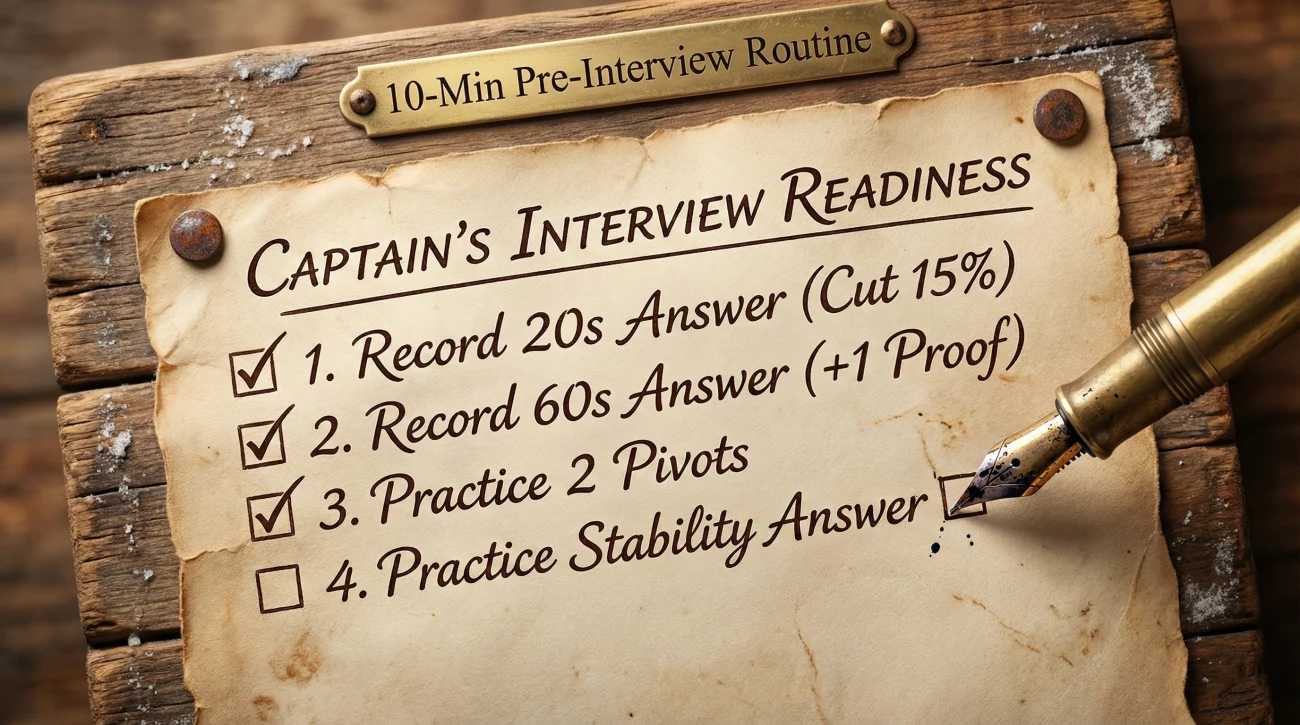
If you do not rehearse, you will ramble. Rehearsal is not “being fake.” It’s being safe.
- ✅ Record your 20-second answer once, then cut 15% of the words.
- ✅ Record your 60-second answer once, then add one proof point about staying current.
- ✅ Practice two pivots so you can end the topic on demand.
- ✅ Practice the stability question: “Are you planning to take time off again?”
A strong answer should sound like a decision, not a confession.
Final: The Cleanest Way to Explain a Sabbatical
If your sabbatical explanation is doing its job, it will feel almost boring. Timeline. Neutral purpose. Closure. Bridge to the role. Done.
Most sabbatical interview question follow-ups are really just stability checks. If you answer cleanly and pivot back to the job, the topic ends fast.
When you explain a career break in an interview, keep the story closed and present-focused. If your break involved burnout, keep the language neutral early on and follow it with proof of readiness. That’s the difference between a story that stays safe and one that invites extra probing.
❓ FAQ
🎯 Do I have to say why I took a sabbatical?
No. You need to give a professional, objectively true reason that closes the loop. You can keep personal details private while still being credible.
🧠 Should I mention burnout or mental health in early interview rounds?
Usually, keep it neutral early on. You can say it was a planned reset, that it’s complete, and that you’re ready to commit. Save deeper personal context for later, only if it helps.
🧩 What if my sabbatical was just travel and nothing “productive”?
You do not need to pretend you were doing certifications every day. A time-boxed travel sabbatical can still be framed as intentional and complete. Add one or two light “stayed current” touchpoints, then pivot to the role.
🔒 How do I answer “Are you planning to take time off again?”
Directly and calmly: No plan for another break, and you are interviewing because you are ready to commit long-term.
🛠️ How do I prove I’m still current after time off?
Offer 2 to 3 proof points: A small project, specific tools you kept up with, and how you practiced staying sharp. Keep it short and believable.
🌱 What if the interviewer keeps pushing for personal details?
Use a boundary sentence, then pivot back to the job: “I’m happy to share the high-level context. The important part is that it’s complete, and I’m fully available now.” If they keep pushing, that tells you something about the culture.
⚠️ Disclaimer: ResumeSolving provides resume, cover letter, and job search communication guidance for informational purposes only. It is not legal, medical, financial, or professional counseling advice. Hiring decisions vary by company, role, location, and individual circumstances, so we do not guarantee interviews, offers, or outcomes. Always use your own judgment, verify requirements directly with the employer, and follow local laws and workplace policies. When a situation is sensitive, we prioritize privacy-safe, recruiter-appropriate wording, and you never need to share personal details you are not comfortable disclosing.