- A “Full-Time Caregiver” entry can help your timeline, but the wrong wording can accidentally make you sound like clinical staff.
- The safe approach is: name the period, show stability now, and translate what you did into planning and reliability, not medical duties.
- This page gives 8 resume entry examples, 10 bullet patterns, and a list of risky duty phrases to avoid.
The Caregiver Resume Entry Trap: You Want Credibility, Not A Nursing Job
If you type full time caregiver resume entry example into Google, you’ll see a lot of advice that assumes you are applying for a caregiver role. That is not what many people mean. Many people are trying to explain a gap, not change careers into healthcare.
I’ve seen this go sideways in real hiring conversations. A candidate I’ll call Linda added a “Full-Time Caregiver” entry with bullets like “administered medication” and “monitored vital signs.” She meant it as proof she was responsible and active. The hiring manager read it as: clinical duties, licensing questions, liability questions. The gap entry accidentally became the most controversial part of her resume.
This article fixes that exact problem. It shows you how to list caregiving in a way that closes your timeline and signals reliability, without implying you were practicing medicine.
💡 Pro Tip: The resume goal is simple: clarify the timeline and protect credibility. You can do that without writing a medical job description.
What Recruiters Are Actually Checking When They See “Full-Time Caregiver”
Most recruiters are not judging caregiving itself. They’re forecasting risk in two areas: whether the gap is still open ended, and whether your schedule is stable enough for the role.
| Hidden question | What they want to hear | What triggers concern |
|---|---|---|
| Is the situation still controlling their time? | A calm stability signal | “Ongoing,” “continuing,” “24/7” language |
| Are they current and work ready? | Proof of recent rhythm | A long gap with no current signal |
| Did they do clinical work without training? | Non-clinical wording | Medication, vitals, wound care, injections |
That third line matters more than people expect. If your bullets sound clinical, you can trigger questions you did not mean to invite. Even if you did some of those tasks at home, your resume does not need to frame them as professional clinical responsibilities.
Key Point: You can describe caregiving as coordination, planning, safety, and reliability without implying licensed medical duties.
The Safe Structure For A Caregiving Resume Entry

If you want a caregiver entry that fits most professional resumes, use a structure that reads like a timeline closure, not a job pitch for healthcare.
[Neutral title] + [Date range] + [One stability line] + (Optional) [One rhythm marker]
Choose A Neutral Title That Signals Timeline, Not A Clinical Role
For most candidates, “Family Care Period” or “Caregiving Leave” reads more neutral than “Full-Time Caregiver.” You can still be honest without turning it into an occupational identity.
If you want to use “Full-Time Caregiver” because it matches your reality, pair it with language that clearly stays non-clinical. The examples below show you how.
Add One Stability Signal That Describes Your Work Reality Now
This is the sentence that stops follow-up anxiety. It should be true, simple, and repeatable. You are not promising life will never change. You are describing your schedule as predictable now.
⚠️ Warning: Do not write a stability line you cannot defend in an interview. If the role requires unpredictable hours and your situation cannot support that, the solution is role fit, not prettier wording.
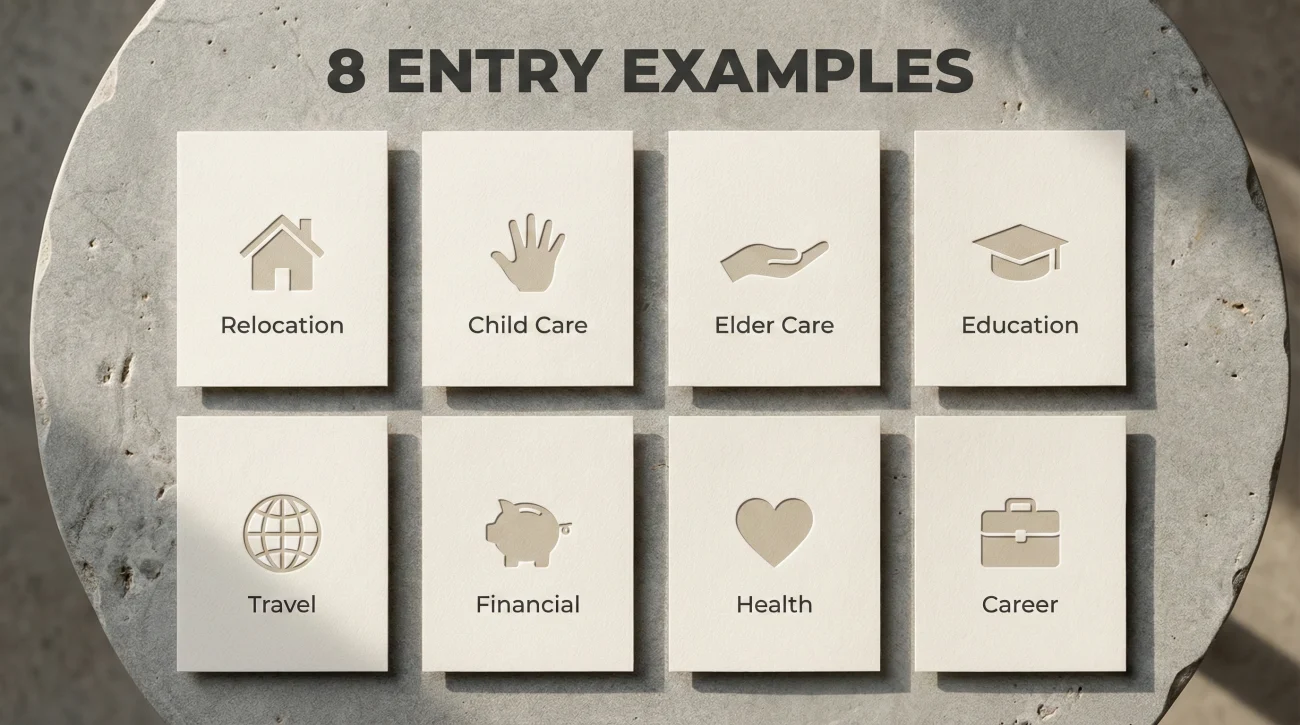
8 Full-Time Caregiver Resume Entry Examples That Stay Non-Clinical
These examples are written to close a timeline and protect you from sounding like clinical staff. Adjust dates and wording to match your situation. Keep it boring on purpose.
Example 1: Elder Care At Home, Care Plan Now Stable
Use this if the most intense phase is over and your availability is consistent again.
Supported an aging parent through a structured care plan transition; schedule is stable and I’m available for consistent full-time work
Example 2: Ongoing Support, Predictable Availability
Use this if caregiving still exists in your life but no longer creates surprise scheduling.
Ongoing family support with predictable hours; available for consistent full-time work and reliable deadlines
Example 3: Long-Distance Care Manager Style
This is common with siblings, travel coordination, and vendor management. It reads operational, not clinical.
Coordinated appointments, logistics, and home support services remotely; schedule is stable and I can commit to a standard work cadence
Example 4: Assisted Living Transition And Paperwork Heavy Phase
Use this if your time went into forms, insurance, moving, and systems setup. It is real work, just not clinical work.
Managed relocation, documentation, and ongoing support setup; transition is complete and my availability is stable
Example 5: Child With Special Needs, Return To Work With Predictable Coverage
This focuses on structure and coverage, not personal detail.
Provided structured support for a family member; coverage plan is in place and I’m available for consistent full-time work
Example 6: End-Of-Life Care, Now Resolved
If you want the entry to be minimal and non-emotional, keep it to timeline and readiness.
Took time away for family caregiving responsibilities; returned to full-time availability and consistent schedule
Example 7: Shared Caregiving With Siblings Or A Support Network
This lightly signals coverage without turning into family drama.
Shared caregiving coordination within a support network; schedule is predictable and I can meet standard business hours
Example 8: Add A Rhythm Marker Without Inventing A Job
Use this if the gap is long and you want to show current work cadence. Keep the proof marker generic if you need privacy.
Availability is stable now and I’m ready for consistent full-time work
Re-established work rhythm through structured weekly deliverables and stakeholder communication
❌ Note: Do not add clinical sounding bullets unless you are applying for healthcare roles and you can credential what you’re claiming.
10 Bullet Patterns That Translate Caregiving Into Professional Strength
These are patterns, not exact claims. Choose what is true for you. The goal is to express planning, coordination, reliability, documentation, and calm problem solving.
| Bullet pattern | What it signals |
|---|---|
| Coordinated schedules, appointments, and transportation to keep weekly routines predictable | Planning and operational reliability |
| Maintained documentation, contacts, and key information to reduce last-minute confusion | Systems thinking and accuracy |
| Managed vendor and service coordination, including home support, supplies, and follow-ups | Stakeholder management |
| Built a clear communication rhythm across family and support providers to avoid surprises | Communication discipline |
| Handled time-sensitive logistics under pressure while keeping commitments consistent | Execution under stress |
| Created contingency plans to protect work blocks and maintain predictable availability | Boundary setting and ownership |
| Tracked recurring tasks and deadlines using simple systems to prevent slippage | Process and follow-through |
| Coordinated transitions, paperwork, and scheduling changes with minimal disruption | Change management |
| Improved routine efficiency by simplifying steps and creating clear handoffs | Optimization mindset |
| Maintained professional readiness through consistent weekly output and accountability | Current work rhythm |
💡 Pro Tip: If you include bullets, keep it to two or three. A gap entry should never take more space than a real job.
Risky Duty Phrases To Avoid If You Are Not Applying For Healthcare Roles
This is the part most “caregiver resume examples” miss. A lot of templates include phrases that sound like licensed clinical work. If you’re using caregiving to explain a gap, those phrases can create the wrong interpretation.
Clinical Sounding Phrases That Invite Credential Questions
- Administered medication
- Monitored vital signs
- Performed wound care
- Provided injections
- Managed medical treatment plans
- Conducted patient assessments
- Ensured HIPAA compliance
Safer Alternatives That Still Sound Responsible
You can still describe responsibility without claiming clinical authority. Here are examples of safer phrasing that stays in the lane of coordination and routine.
| Instead of | Use language like |
|---|---|
| Administered medication | Coordinated medication schedules and refills to support routine consistency |
| Monitored vital signs | Tracked routine needs and communicated changes to appropriate providers |
| Managed treatment plans | Coordinated appointments, follow-ups, and documentation within an established care plan |
| Patient assessments | Maintained clear notes and escalated concerns through the right channels |
Key Point: Your resume should not imply you practiced healthcare. It should imply you can plan, coordinate, and deliver consistently.
Real World Notes From Candidates And Colleagues
I’m not going to pretend there’s one universal “best” way to list caregiving. The right wording depends on what you’re applying for and what you can defend calmly in conversation.

Linda: The Resume Entry Created A Licensing Question She Did Not Expect
Linda’s wording leaned clinical because she pulled it from a caregiver job template. The hiring manager did not accuse her of lying, but the questions shifted. The interview time got eaten by clarifying what she meant, instead of evaluating her actual professional skills.
When we rewrote her entry as “Family Care Period” with coordination bullets, that noise disappeared. Same truth, different interpretation.
A Recruiter Friend’s Rule: “Don’t Make Me Guess Liability”
A recruiter I work with on operations roles told me something simple: if an entry makes her wonder about liability or credentials, she loses time. When she loses time, she moves on. That is not cruelty, it is workflow.
This is why non-clinical wording is protective. It makes the reader comfortable enough to keep reading.
A Candidate With A Long Gap Who Won Interviews With One Rhythm Marker
A candidate I’ll call Jim had a long caregiving break and felt insecure about “skill freshness.” What helped him was not adding more caregiving detail. What helped was one line that proved cadence: structured weekly output and accountability.
Once he could say “I’m already back in a steady rhythm,” his gap stopped feeling like a mystery and started feeling like a closed chapter.
Final: Make The Entry About Timeline And Reliability, Not Clinical Identity
A caregiver entry serves as a strategic bridge to close your timeline gaps without creating confusion about your professional identity. Instead of detailing clinical tasks, focus on demonstrating structured responsibility and predictable availability during this period. This approach transforms a personal gap into a professional full time caregiver resume entry example that integrates seamlessly with your Career Recovery framework, establishing your reliability and readiness to step back into the workforce.
❓ FAQ
🧩 Should I literally write “Full-Time Caregiver” on my resume?
You can, but a neutral label like “Family Care Period” often creates fewer assumptions. If you use “Full-Time Caregiver,” keep the wording non-clinical and add one stability signal.
📅 How many bullets should I add under the caregiving entry?
Two or three is usually enough. If the entry becomes longer than your real jobs, it can make the gap the headline.
🛡️ What if I did do medical tasks at home?
You can still keep resume wording non-clinical if you are not applying to healthcare roles. Focus on coordination, routine, documentation, and communication rather than clinical claims that invite credential questions.
✅ How do I show I’m work ready after a long caregiving break?
Add one proof marker of recent rhythm if you can: structured weekly deliverables, a short contract, or any accountable output. Rhythm is what reduces the “out of practice” fear.
⚠️ Disclaimer: ResumeSolving provides resume, cover letter, and job search communication guidance for informational purposes only. It is not legal, medical, financial, or professional counseling advice. Hiring decisions vary by company, role, location, and individual circumstances, so we do not guarantee interviews, offers, or outcomes. Always use your own judgment, verify requirements directly with the employer, and follow local laws and workplace policies. When a situation is sensitive, we prioritize privacy-safe, recruiter-appropriate wording, and you never need to share personal details you are not comfortable disclosing.