- Recruiters fear four things about founders: flight risk, ego problems, vague scope, and unverifiable claims. Address all four.
- Translate your founder title to match the target role. “CEO” often hurts more than it helps.
- Show collaboration, not solo heroics. Prove you can take direction and work within structure.
- Use 4 mini scripts: title explanation, company description, “why employee now” answer, and commitment cue.
Why Founder Experience Gets Rejected
You built something from nothing. You wore every hat, made every decision, and figured things out that most employees never have to face. That should be impressive, right?
To recruiters, it is a red flag.
Not because they do not respect entrepreneurship. But because every time they have hired a founder, something went wrong. The founder got bored with “regular” work. The founder could not take feedback from a manager. The founder left after six months to start another company. The founder’s “metrics” turned out to be exaggerated or unverifiable.
Your job is to prove you are different. And that requires deliberate translation of your experience into language that addresses their fears.
Johanna ran a content marketing agency for four years before deciding she wanted to join a tech company as Head of Content. She had managed teams, landed Fortune 500 clients, and built systems that still run without her. But her applications went nowhere. Her resume screamed “business owner,” and recruiters assumed she would be impossible to manage.
We rebuilt her materials using the framework in this guide. Within six weeks, she had three offers. The experience was the same. The framing changed everything.
The Four Fears You Must Neutralize
Every recruiter evaluating a founder applicant is running a mental checklist. Here are the four fears and how to counter them.
| Fear | What They Think | How to Counter |
|---|---|---|
| 🚀 Flight Risk | “They will leave to start another company” | Explain why you want to be an employee now with specific, believable reasons |
| 👑 Ego Problems | “They cannot take direction or feedback” | Show collaboration patterns, stakeholder management, and coachability |
| 🌫️ Vague Scope | “Did everything means good at nothing” | Translate your work into specific role outcomes with clear boundaries |
| ❓ Unverified Claims | “These metrics could be made up” | Add proof signals: tools used, team size, customer names if possible, references |
If your resume and interview answers address all four fears, you neutralize most of the founder bias. If you leave any one unaddressed, it becomes the reason for rejection.
Founder Risk Checklist
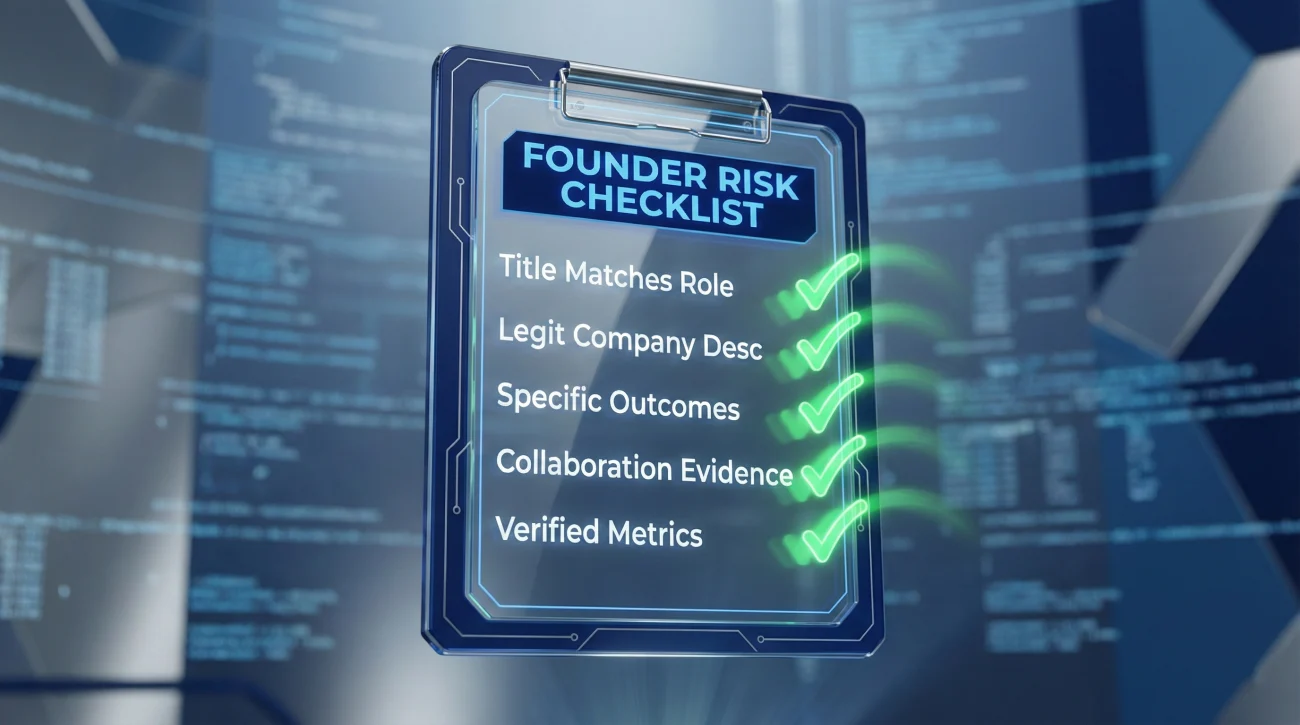
Before you apply, audit your materials against this checklist.
- ✅ Title matches target role, not founder ego
- ✅ Company description sounds legitimate, not hobby-level
- ✅ Bullets show specific outcomes, not “did everything”
- ✅ Collaboration evidence appears multiple times
- ✅ Metrics have context (team size, timeline, tools)
- ✅ “Why employee now” answer is ready and sounds genuine
- ✅ References can verify scope and outcomes
- ✅ LinkedIn aligns with resume framing
If you cannot check all eight boxes, your application has gaps that will cost you interviews.
Decision Map: Key Choices for Founder Resumes
What Title Should You Use?
“CEO” and “Founder” can backfire, especially if your startup was small or if you are targeting individual contributor roles. Consider titles that map to your target:
- 🎯 Targeting Product Manager → “Product Lead” or “Head of Product”
- 🎯 Targeting Engineering Manager → “Engineering Lead” or “Technical Co-founder”
- 🎯 Targeting Marketing Director → “Head of Marketing” or “Growth Lead”
- 🎯 Targeting Operations → “COO” or “Head of Operations”
- 🎯 Targeting Sales → “Head of Sales” or “Commercial Lead”
The rule: pick a title that is truthful and maps to the role you want. You can add “(Founder)” in parentheses if it adds context, but do not lead with it.
How Should You Describe Your Company?
A one-line company description adds credibility. Include: what the company did, who it served, and one scale indicator.
This sounds like a real company. Compare to: “Innovative startup disrupting the food industry.” That sounds like a side project.
How Do You Show Scope Without “Did Everything”?
Founders often write bullets like “Managed all aspects of the business.” This tells recruiters nothing and sounds like you were unfocused.
Instead, pick the 3-4 functions most relevant to your target role and write specific bullets for each. If you are targeting product roles, emphasize product work. If you are targeting ops, emphasize systems and processes.
What If Your Startup Failed?
Failed startups are not automatic disqualifiers. What matters is how you frame the failure. Focus on what you built, what you learned, and what changed. Avoid blame, drama, or excessive detail.
This sounds like a professional handling a difficult situation, not a reckless gambler.
How Do You Show Collaboration?
This is where most founders fail. They write bullets about their solo achievements and forget that recruiters want to see teamwork.
Add collaboration signals throughout your resume: cross-functional projects, stakeholder alignment, feedback incorporation, team mentoring, vendor management. These prove you can work within structure.
4 Mini Scripts for Founder to Employee Transitions
Script 1: Title Explanation
Use this if someone asks why you used “Product Lead” instead of “CEO.”
“Technically I was the CEO since I founded the company, but day-to-day I functioned as the product lead. I owned the roadmap, prioritization, and worked directly with engineering on delivery. I use Product Lead because it more accurately describes the work I did and the role I am targeting now.”
Script 2: Company Description
Use this when asked “What did your company do?”
“We built inventory management software for independent restaurants. At our peak, we had about 200 customers and a team of eight. I led product and worked closely with our engineering team on the core platform. We were seed-funded and operated for four years before I decided to transition back to a larger organization.”
Script 3: Why Employee Now
Use this for the inevitable “Why do you want to be an employee after running your own company?”
“Running my own company taught me a lot about building from zero, but I realized I am most energized when I can go deep on product rather than managing every function. I want to focus on the craft of product management within a team that has strong engineering and design partners. I have done the founder thing, and I know it is not what I want for my next chapter. I am looking for a place where I can contribute to something bigger than I could build alone.”
Script 4: Commitment Cue
Use this to signal you will stay, not bolt to start another company.
“I am not looking to start another company. I did that, I learned a lot, and now I want something different. I am looking for a role where I can have real impact on product direction without having to also worry about fundraising, payroll, and keeping the lights on. What I am excited about here is [specific thing about the role or company].”
💡 Pro Tip: The commitment cue works best when you name something specific about the company or role that you could not get as a founder. Generic “I want to join a team” sounds hollow. Specific “I want to work on problems at this scale” sounds real.
Mistakes That Kill Founder Applications
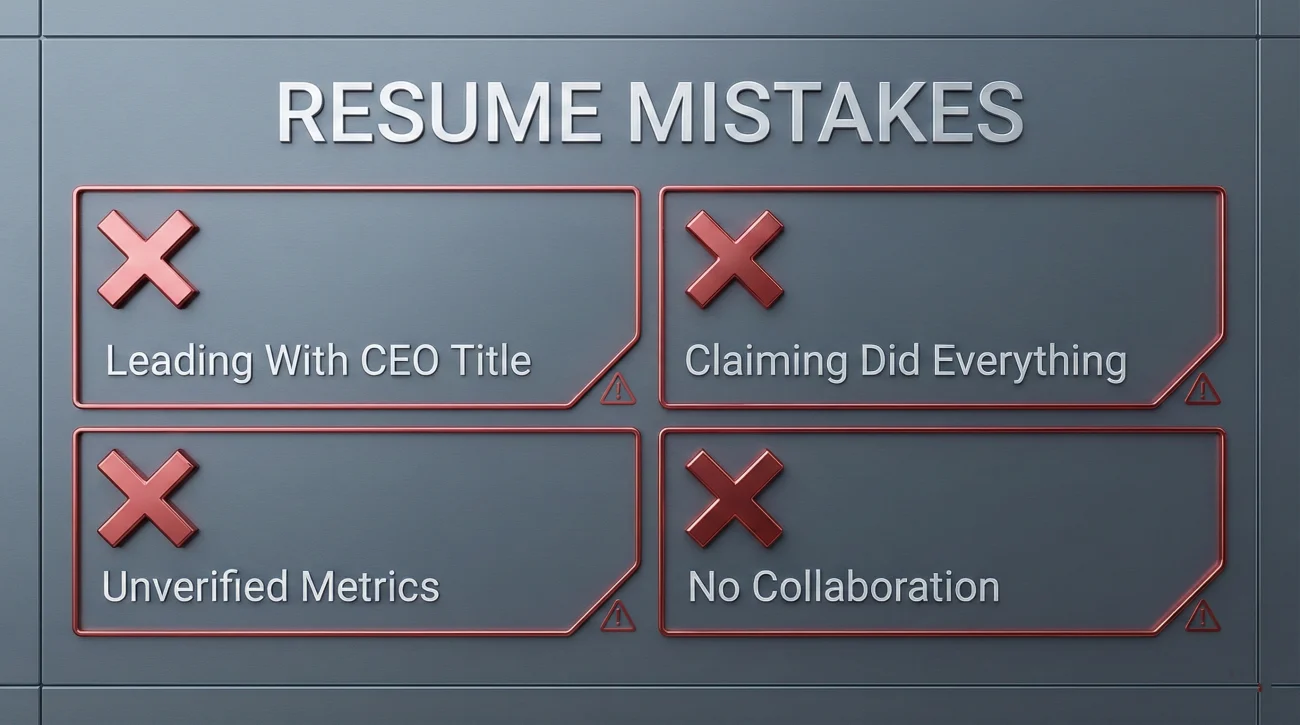
❌ Leading With “CEO” or “Founder”
Unless you are applying for executive roles, leading with CEO triggers the ego filter. Translate your title to match the target role.
❌ “Built Company From Scratch”
This sounds impressive to you. To recruiters, it sounds like you cannot work within existing structures. Replace with specific function-level accomplishments.
❌ “Did Everything”
This is the kiss of death. It tells recruiters you are unfocused and cannot describe your actual contribution. Pick the functions relevant to your target role and describe those specifically.
❌ Unverifiable Metrics
“Grew revenue 500%” means nothing without context. Add team size, timeline, starting point, and tools used. Better yet, have a reference who can verify.
❌ No Collaboration Evidence
If every bullet starts with “I” and describes solo achievements, recruiters assume you cannot work with others. Add cross-functional projects, stakeholder management, and team development.
❌ Vague “Why Employee Now” Answer
“Ready for a new challenge” sounds like you could not hack it as a founder. Give specific, positive reasons that explain your motivation without triggering suspicion.
Derek, a fintech founder, made the “did everything” mistake. His resume had bullets like “Handled all sales, marketing, product, and operations.” Recruiters had no idea what he was actually good at. We rewrote his resume to focus on the product work he wanted to do next, with specific metrics and collaboration examples. His callback rate went from near-zero to about 25%.
Verification and References for Founders
Founder experience is harder to verify than traditional employment. Background checks cannot call HR because you were HR. This makes references extra important.
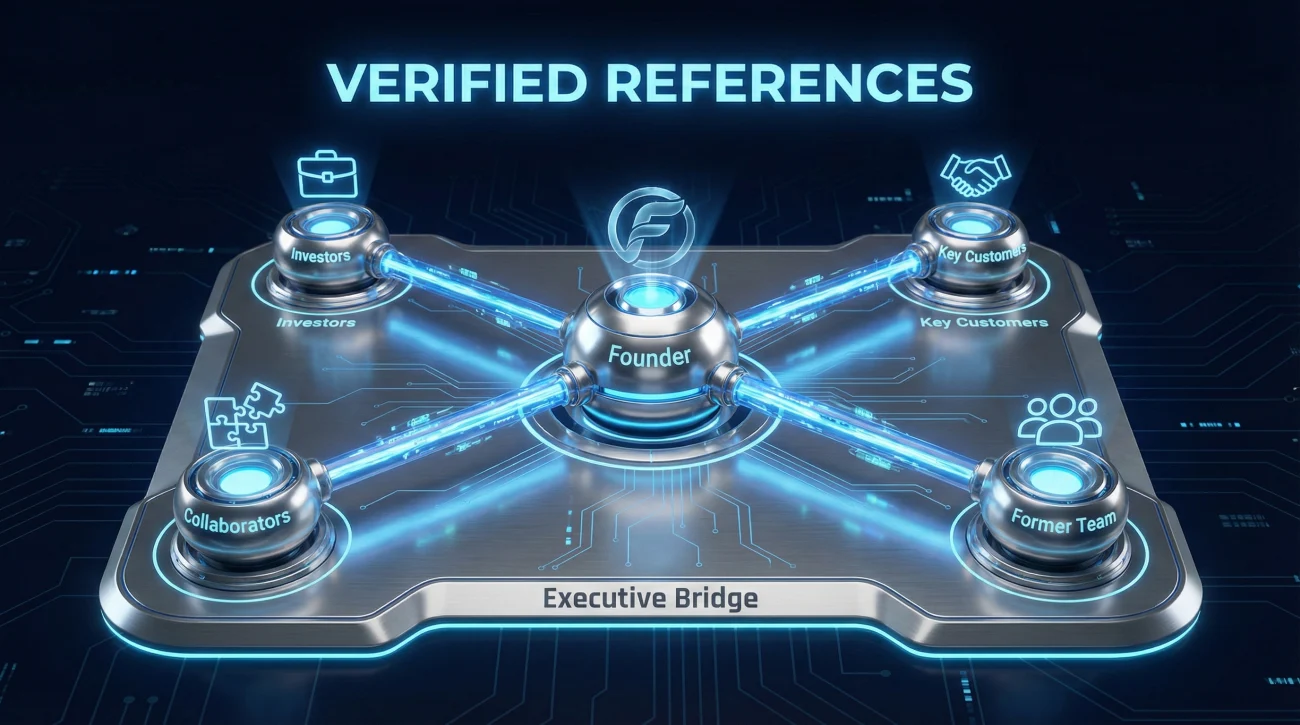
Who to Use as References
- Investors or advisors: They have no incentive to inflate your performance and can speak to your coachability and growth.
- Key customers: They can verify scope and outcomes better than anyone.
- Collaborators: Contractors, agencies, or partners who worked closely with you on specific projects.
- Team members: If you had employees, former team members can speak to your management style and collaboration.
Briefing Your References
Tell your references how you are positioning yourself. If you are downplaying the CEO title and emphasizing product work, they need to know that.
“Hey, I am applying for product management roles and positioning my founder experience as product leadership rather than general management. If anyone calls, it would be helpful if you could speak to the roadmap work we did together and how I collaborated with the engineering team. Does that work?”
LinkedIn Alignment for Founders
Your LinkedIn profile will be checked. If it says “CEO & Founder” in the headline while your resume says “Product Lead,” recruiters will notice the mismatch and wonder what else does not add up.
Headline Strategy
Your LinkedIn headline should match your target role, not your founder identity. Instead of “Founder & CEO at MyStartup,” try “Product Leader | B2B SaaS | Ex-Founder” or simply “Product Manager | Growth & Monetization.”
The “Ex-Founder” mention is optional. It can add credibility if your startup had real traction, or it can trigger bias if the role is junior. Use your judgment based on your target.
Experience Section
Your LinkedIn experience should use the same title and framing as your resume. If you are calling yourself “Product Lead” on the resume, use “Product Lead” on LinkedIn. Add “(Founder)” in the title if you want, but do not lead with CEO if that is not what your resume says.
The company description should match too. Same one-liner, same credibility cues. Consistency is what builds trust.
About Section
Use your About section to tell your pivot story briefly. Why you started a company, what you learned, and what you want now. This is where you can be slightly more personal than on a resume while still staying professional.
This tells the story, addresses the “why employee now” question, and signals what you want. Recruiters reading your profile get the answer before they even ask.
Deep Dive Guides for Founder Transitions
This hub gives you the framework. The guides below go deeper into specific scenarios.
| Article | Description |
|---|---|
| How to List Founder Experience on a Resume Without Sounding Vague | 3 structure options and examples for different founder profiles |
| Founder Job Title on a Resume: What to Use So Recruiters Do Not Roll Their Eyes | Title rules and 10 options mapped to target roles |
| Should You Put Your Startup on Your Resume: When to Include It and When to Downplay It | 7-question decision checklist for inclusion strategy |
| How to Describe a Startup That Failed on a Resume Without Sounding Reckless | Failure framing framework with 8 resume lines |
| Why Do You Want to Be an Employee Now: A Founder Interview Answer That Sounds Real | Core script with 6 variations and commitment cues |
| Founder Resume Bullet Points: 25 Bullet Starters That Sound Like an Employee Role | Bullet bank with metric patterns and proof nouns |
| How to Show Collaboration as a Founder (So You Do Not Look Like a Lone Wolf) | 8 collaboration patterns with bullets and interview lines |
| Founder Resume Summary: 7 Openings That Make You Sound Hireable | Copy-ready summaries with role mapping and commitment cues |
| Founder to Product Manager Resume: Translate Your Work Into PM Signals | PM-specific signal map and bullet examples |
| Founder to Engineering Manager: Show Engineering Leadership Without the Founder Ego | EM signal map with collaboration proofs |
| Founder to Operations Manager: Make Your Chaos Look Like Systems | Ops systems map with SOP proof list |
| Founder to Sales Manager: Turn Scrappy Selling Into a Repeatable Sales Story | Sales signal map with pipeline and proof artifacts |
| How to Describe Your Startup in One Line (So It Sounds Legit, Not Like a Hobby) | 10 one-liners with credibility cues |
| After the Startup Ended: How to Explain the Transition Gap Without Panic | Framework for the post-founder gap |
Make Your Founder Experience Work For You
Building a company is one of the hardest things you can do. The skills you developed, the problems you solved, the pressure you handled, all of that is valuable. But only if you can translate it into language that hiring managers trust.
Address the four fears. Translate your title and scope. Show collaboration, not solo heroics. Prepare your “why employee now” answer until it sounds natural and convincing.
The companies that reject founders out of hand are not the right fit anyway. The right company will see your experience as an asset. Your job is to help them see it by doing the translation work upfront.
Andre spent three years building a logistics startup before joining a Series C company as a product manager. He told me later that the translation work was harder than he expected, but once he cracked it, interviews became conversations instead of interrogations. The skepticism disappeared because he had already addressed it.
For specific scripts, bullets, and examples for every founder scenario, explore the cluster guides linked above. And for the complete framework on identity pivots, see the full founder to employee resume resource collection.
❓ FAQ
🤔 Should I use “CEO” or a functional title?
Use a functional title that matches your target role unless you are applying for executive positions. “Product Lead” or “Head of Growth” tells recruiters what you actually did and what you want to do next. “CEO” triggers flight risk and ego concerns. You can add “(Founder)” in parentheses if needed for context.
💥 How do I explain a failed startup?
Focus on what you built, what you learned, and how you handled the wind-down professionally. Do not blame investors, co-founders, or market conditions excessively. A clean shutdown with lessons learned sounds mature. Avoid drama and excessive detail.
📝 How much of my founder experience should I include?
Include what is relevant to your target role and cut what triggers the wrong assumptions. If you are targeting product roles, emphasize product work. If you are targeting ops, emphasize systems. Do not try to show “everything you did” because that reads as unfocused.
🎤 How do I answer “Why employee now?”
Give specific, positive reasons: desire to go deep on craft, wanting to work at scale, preference for focus over breadth, desire to learn from peers. Avoid anything that sounds like you failed as a founder or could not hack it. Your answer should make the transition sound intentional, not forced.
👥 Who should be my references?
Investors, advisors, key customers, and collaborators work well. They can verify your claims and speak to your coachability. Former team members can address collaboration and management style. Brief them on how you are positioning yourself so their comments align with your narrative.
⚠️ Disclaimer: ResumeSolving provides resume, cover letter, and job search communication guidance for informational purposes only. It is not legal, medical, financial, or professional counseling advice. Hiring decisions vary by company, role, location, and individual circumstances, so we do not guarantee interviews, offers, or outcomes. Always use your own judgment, verify requirements directly with the employer, and follow local laws and workplace policies. When a situation is sensitive, we prioritize privacy-safe, recruiter-appropriate wording, and you never need to share personal details you are not comfortable disclosing.