- A mental health gap is rarely the real concern. The real concern is whether your work cadence is stable now.
- A strong explanation protects privacy and still feels credible by using a neutral reason, a stability signal, and one proof marker.
- Consistency matters more than the wording itself. Pick one label and keep it aligned across resume, LinkedIn, and interviews.
The moment you say “mental health,” some interviews quietly change
Sam did not want sympathy. He wanted a job. He had a gap that came after a rough stretch of panic attacks and a medical leave that turned into something longer than he planned. He had done the work to get stable. He had routines again. He could show up.
But every time he practiced the gap question, he got stuck on the same fear: “If I say mental health, they will hear risk. If I do not say it, I sound evasive.”
That fear is not dramatic. It is practical. A lot of hiring teams still struggle to separate “a health chapter” from “future unreliability,” especially when they are under pressure to hire quickly.
This article is for people like Sam. It explains how to explain a mental health employment gap without turning your private life into interview content, and without making the employer guess a worse story than the truth.
💡 Pro Tip: You do not need the perfect wording. You need wording you can repeat calmly, consistently, and without oversharing.
What they are actually testing when they ask about a mental health gap
I have sat in enough hiring debriefs to know this question is rarely about curiosity. It is usually a forecast. The hiring manager is trying to predict whether the role will stay staffed and stable once the honeymoon phase ends.
They are testing stability and cadence
When someone has a gap for health reasons, many employers translate it into operational questions: Can you keep a schedule? Can you handle deadlines? Will the team need to adjust around unpredictable absence?
This is why vague answers can backfire. “Personal reasons” is technically true for many people, but it often increases uncertainty. Uncertainty is the thing most hiring teams reject, even when they like you.
They are listening for coherence across your timeline
With gaps, small inconsistencies get amplified. A “career break” on the resume, “health reasons” in the interview, and “sabbatical” on LinkedIn looks like three different stories.
One of my HR peers put it bluntly after a debrief: “I do not mind a gap. I mind a story that keeps changing.”
Key Point: Your goal is not to justify the gap. Your goal is to remove uncertainty about whether you can do the job now.
The privacy line most people miss
You can be honest without being detailed. Honesty in hiring means you do not create a false narrative that later collapses under basic verification. It does not mean you owe a stranger your diagnosis, your treatment plan, or the most vulnerable chapter of your life.
In real interviews, the healthiest boundary often sounds boring. It sounds like a mature adult who understands what is relevant to the job.
A simple rule that keeps you safe
Share what helps them evaluate performance. Do not share what they cannot fairly evaluate.
If you want language that stays truthful, a good neutral label is “health reasons” or “a health matter.” Mental health fits inside that. You are not lying. You are choosing scope.
⚠️ Warning: The more detail you add, the more the conversation becomes about your health instead of your work. That is rarely what you want.
The 3 part story that sounds stable without oversharing
If you take only one thing from this article, take this structure. It works because it answers the real concern, not the surface question.
[Neutral Reason] + [Stability Signal] + [Proof Marker]
| Part | What it communicates | Common mistake |
|---|---|---|
| Neutral Reason | You stepped back for a real reason, without inviting medical interrogation | Overexplaining, naming conditions, telling the whole story |
| Stability Signal | This is not an active crisis right now | Overpromising, using absolute guarantees |
| Proof Marker | You can sustain the cadence of the role today | Vague “I’m ready” statements with no anchor |
What counts as a proof marker
A proof marker is one concrete signal that your present life supports consistent work. It can be small. It just has to be defensible.
- Consistent contract work with weekly deliverables
- A volunteer role with a fixed schedule and accountability
- A structured program where you produced work over time
- A portfolio project with external feedback and a timeline you actually kept
💡 Pro Tip: Proof is not about being impressive. Proof is about being predictable in a good way.
Interview scripts that do not trigger follow up spirals
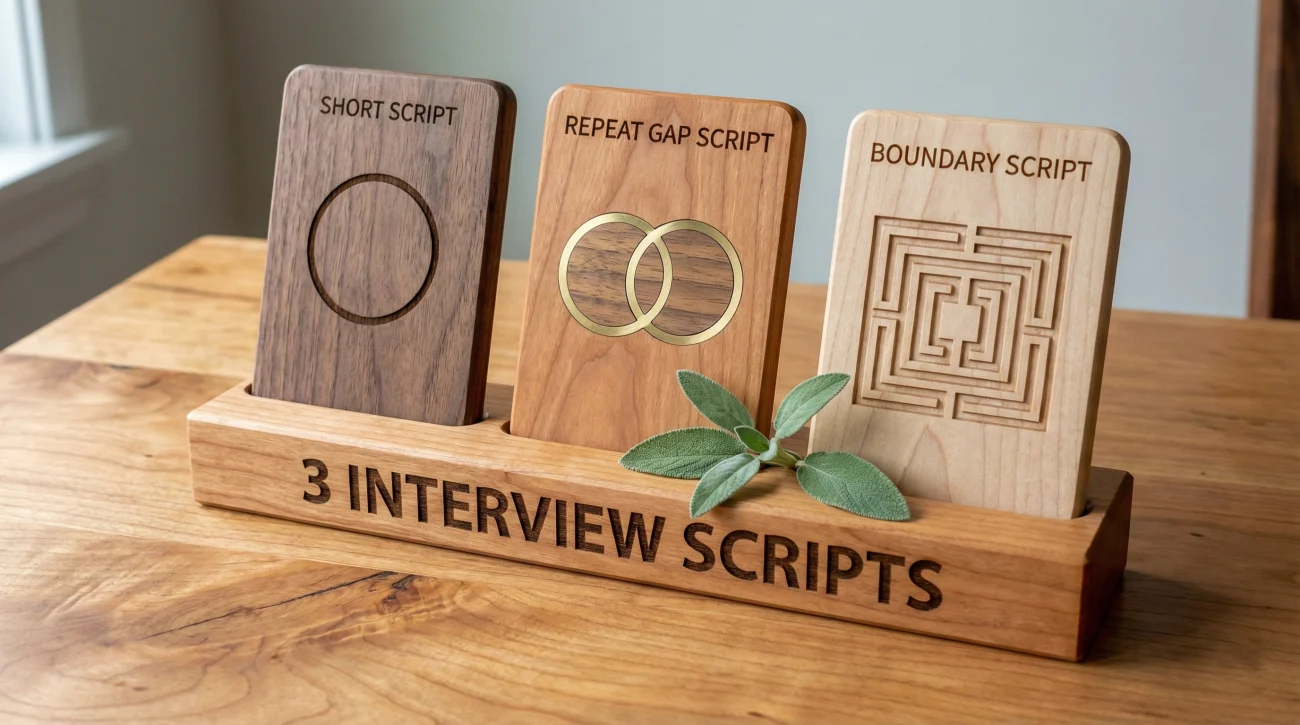
Below are three scripts. They are different on purpose. Some interviewers are respectful and move on. Some are anxious and ask twice. Some push for details. Your script should match the situation.
Script 1: short and stable
This is for interviews where the question is asked once and the tone is normal.
I stepped back for health reasons for a period of time.
It’s stable now, and I’m able to commit to full-time work.
I’m excited about this role because it fits how I work best: steady cadence, clear priorities, and ownership.
Script 2: the “repeat gap” version
This one adds a proof marker. It is useful when you can feel concern about the gap repeating. It also works well as an interview answer for mental health employment gap questions that come with a follow up like “Has that been resolved?”
I had to step back twice for health reasons.
It’s stable with a consistent plan, and my schedule is reliable now.
To make that concrete, I’ve been meeting weekly deadlines through a steady commitment for months.
I’m ready to bring that reliability into this role.
Script 3: when they push for medical details
This is your boundary script. It keeps you credible without turning the interview into a health conversation.
I’m not comfortable sharing medical specifics, but I can speak to work readiness.
The situation is managed, and I can consistently meet the demands of this role.
If it helps, I can share how I manage workload, communication, and deadlines so the team has confidence in my reliability.
❌ Note: Do not add details to “prove you’re honest.” That usually increases perceived risk.
What to write on the resume without inviting stigma
Most people try to solve the gap question on the resume. That usually makes the resume heavier and the reader more curious. For a mental health gap, it is often better to keep the resume clean and do the stability work in the interview.
Three safe approaches
Pick one approach and keep it consistent across documents.
| Approach | Best for | What it looks like |
|---|---|---|
| Dates only | Your experience is strong and the gap is not the first thing they see | Clean timeline, strong bullets, no special label |
| Neutral label | You want to prevent guessing on a long gap | “Career Break” with one neutral line |
| Bridge activity | You have a proof marker worth showing | Contract work, volunteer role, structured program |
Resume wording example that stays neutral
If you want a template, here is a safe baseline. This is a resume wording for mental health gap approach that avoids diagnosis and still signals readiness.
Health reasons, returned to full-time work readiness
Maintained structured commitments and skill development
💡 Pro Tip: “Health reasons” is usually enough. You are not required to label it as mental health.
Consistency checklist that prevents trust loss
When gaps exist, consistency becomes a credibility tool. These are the checks I run with candidates before they start interviewing.
- ✅ Use one label across resume, LinkedIn, and interviews
- 📅 Align date ranges everywhere, including background check forms
- 🗣️ Rehearse your answer once out loud so you do not improvise under stress
- 🎯 End every answer with how you work and what you deliver
⚠️ Warning: The fastest way to lose trust is to rotate wording every time you get nervous.
Hard cases: when the gap includes short stints or multiple leaves
This is where most generic advice fails. If your gap is paired with short roles or multiple leaves, the employer may worry about pattern and sustainability. You do not fix that by explaining harder. You fix it by anchoring the present.
If you have short stints after the gap
Do not try to defend every job. Choose the simplest coherent narrative: you returned, tested fit, and now you are targeting roles that match your stable cadence.
One candidate I worked with, Elise, had three short roles after a long break. She kept trying to explain each one. It sounded like chaos. We changed her story to one theme: “I returned, rebuilt routine, and learned what conditions help me do my best work.” Then we backed it with proof: a consistent six month contract with weekly deliverables. Her interviews stopped feeling like courtroom testimony.
If you are asked, “Will this happen again?”
This question is common, and it is a trap if you answer with certainty. The strongest answer is a stability signal plus boundaries around what you can promise. This is especially important for an explain mental health gap without disclosing diagnosis approach.
Key Point: Do not promise “never.” Promise what you can control: routines, communication, and reliable delivery.
Final: The Goal Is a Story You Can Repeat Without Flinching
A mental health gap does not require a complex narrative arc to be effective. You simply need a version of the timeline that feels steady by combining a neutral reason with a clear stability signal and a tangible proof marker. This preparation prevents nervousness from leading to improvisation during high-stakes conversations. By keeping your labels consistent and your dates aligned, you solve the challenge of how to explain a mental health employment gap in a way that protects your privacy and immediately refocuses the hiring team on the concrete results you are ready to deliver.
❓ FAQ
🧠 Should I say “mental health” directly in an interview?
You usually do not need to. “Health reasons” or “a health matter” is often truthful and sufficient. If you do say mental health, keep it brief, add a stability signal, and pivot back to work readiness.
🧩 What if my resume gap is long and I worry they will assume the worst?
Use a neutral label only if it prevents guessing. Keep it boring on purpose. Then use the interview to add the stability layer and one proof marker that shows consistent cadence now.
🛡️ How do I respond if they push for diagnosis or treatment details?
Set a boundary calmly. Say you are not comfortable sharing medical specifics, then redirect to work readiness and how you manage workload, communication, and deadlines.
✅ What is a good proof marker if I have not worked recently?
Choose something sustained and accountable: a steady volunteer commitment, a structured program with output over time, or a project with external feedback and deadlines you met. It is about reliability, not prestige.
⚠️ Disclaimer: ResumeSolving provides resume, cover letter, and job search communication guidance for informational purposes only. It is not legal, medical, financial, or professional counseling advice. Hiring decisions vary by company, role, location, and individual circumstances, so we do not guarantee interviews, offers, or outcomes. Always use your own judgment, verify requirements directly with the employer, and follow local laws and workplace policies. When a situation is sensitive, we prioritize privacy-safe, recruiter-appropriate wording, and you never need to share personal details you are not comfortable disclosing.