- A cover letter only helps when it prevents the employer from writing a worse story about your gap.
- Use a 4-sentence structure: acknowledge, reassure, evidence, forward.
- Avoid medical detail, emotional backstory, and conflict framing. Lead with readiness and stability signals.
- Two short templates below, plus a do-not-say list and follow-up handling.
Why This Topic Exists, And Why Most Advice Fails
If you are searching for a cover letter explaining employment gap for health reasons, you are not looking for “confidence.” You are looking for control. You want one clean paragraph that keeps the gap from turning into a spotlight moment, and you want to do it without giving away private medical information to strangers.
In hiring, gaps are rarely judged as morality. They are usually read as risk. The uncomfortable part is that the first person who “fills in the blanks” is often not you. It is the recruiter skimming your timeline fast, then making a quick internal story to keep moving.
Key Point: The cover letter is not a diary. It is a risk-management note that prevents a worse narrative from being invented on your behalf.
I learned this the hard way coaching candidates after a health-related break. One candidate, Sharon, had taken eight months off after a medical issue that is none of an employer’s business. She wrote a heartfelt cover letter about the fear of relapse, the way it impacted her identity, and how “work saved her.” She meant well. The recruiter read it as uncertainty about stability and stopped the process early.
A week later, we rewrote the same story in four sentences. No diagnosis. No emotional arc. Just closure and readiness. She still disclosed nothing personal, but the message finally matched what the hiring team needed to hear: “This is stable, and I can perform.” She got to final interviews.
⚠️ Warning: A health-related gap creates curiosity. Your goal is not to eliminate curiosity. Your goal is to prevent curiosity from turning into doubt.
The Decision Rule: Use a Cover Letter Only When It Helps
Most generic advice says, “Always address the gap.” That is lazy advice. In real hiring, the better rule is simpler: address the gap only when leaving it unaddressed will cause the employer to create a risk-based story that hurts you more than a short, neutral explanation would.
Here is the decision rule I use when coaching candidates for corporate roles, and it also works for smaller companies that skim faster. If the gap is obvious, recent, or directly conflicts with a role’s reliability requirements, your cover letter can help. If the gap is old, short, already explained by a clear return to work, or not visible on a quick scan, a cover letter can accidentally amplify it.
| When a cover letter helps | When a cover letter hurts |
|---|---|
| The gap is recent and sits at the top of your timeline, especially within the last 12 to 18 months. | The gap is small, older, or visually buried by later experience, and the letter would drag it into the spotlight. |
| The role is reliability-sensitive (client-facing, operations, deadlines, regulated environments), so the reader will wonder about consistency. | The role is portfolio-driven and you can lead with proof (work samples, results, shipped projects) without referencing the gap. |
| Your resume timeline has a clean “pause” with no current role, so the reader must interpret the blank space. | You already returned to work and the timeline now shows stability, making a gap explanation redundant. |
| You can explain it in one short paragraph that ends with a clear readiness signal. | You feel tempted to add medical detail, emotional context, conflict, or a long justification. |
💡 Pro Tip: If you cannot explain the gap without writing more than one paragraph, the cover letter is not your friend. Keep the story short enough that it cannot become the main story.
One of my HR colleagues, Jamie, used to say something that sounds harsh but is accurate: “Hiring teams do not have time to become your support group.” Jamie meant that even compassionate recruiters must protect the company from predictable performance risk. Your cover letter should respect that reality and still protect your privacy.
The 4-Sentence Structure Hiring Teams Actually Read
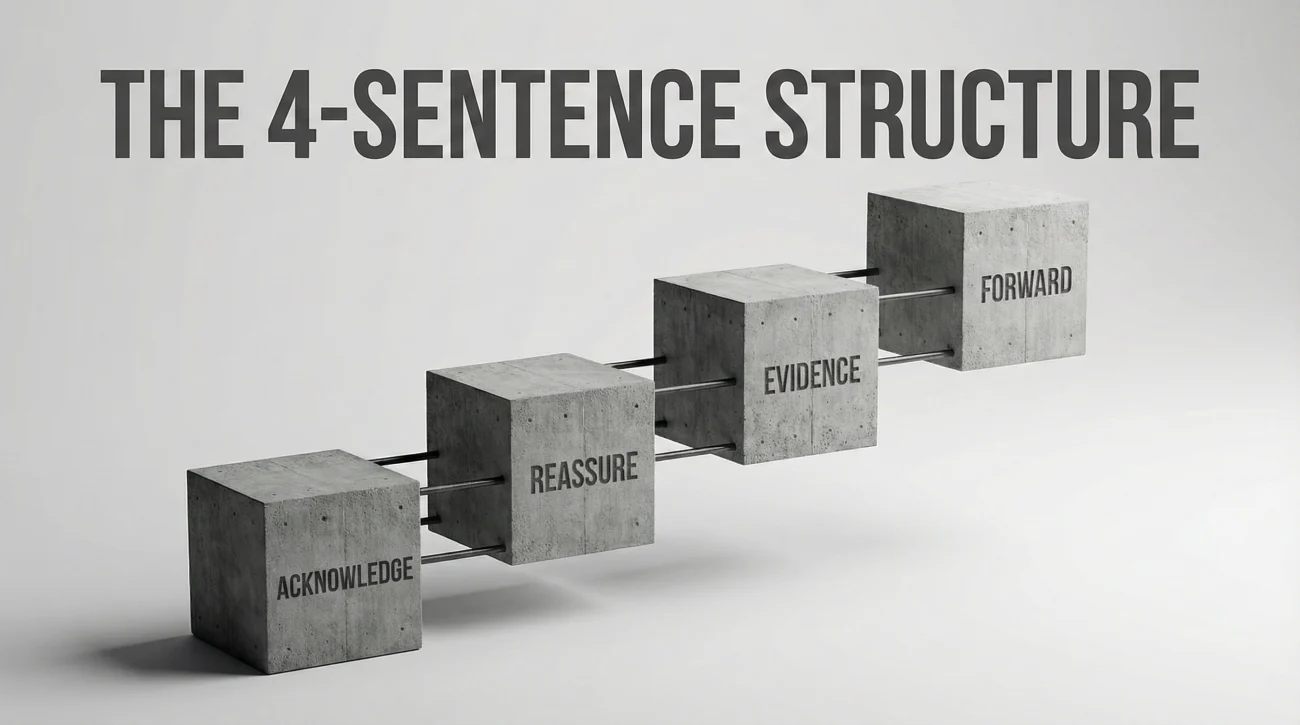
This is the structure I rely on when the candidate wants privacy but also wants the hiring team to feel calm. It works because it matches what recruiters are scanning for: closure, readiness, evidence, and forward motion. It is not about “winning sympathy.” It is about reducing uncertainty.
[Acknowledge] + [Reassure] + [Evidence] + [Forward]
Sentence 1: Acknowledge the gap without opening a medical file
State the time frame and keep the reason neutral. Use “health reasons” or “personal health reasons.” Do not add diagnosis, symptoms, or a dramatic explanation. You are not being dishonest. You are being appropriately private.
Sentence 2: Reassure with a closure signal
This sentence is where most candidates fail. They say “I am better” without giving the employer anything to hold onto. A closure signal is specific but not medical. It tells the reader that this is not the center of your next 90 days. You can say “resolved,” “stable,” “fully available,” or “ready for consistent full-time work.”
Sentence 3: Evidence, One concrete proof that you are role-ready
Evidence can be a recent project, a course with a deliverable, freelance work, volunteering with measurable output, or a small portfolio item. It is not about being impressive. It is about proving momentum. If you did nothing professional during the break, that is okay. Your evidence can be recent performance after returning, or proof of current capability such as a short project you completed last month.
Sharon’s evidence was simple: she rebuilt her portfolio, completed a small consulting project for a former client, and could talk about results without referencing her health. The recruiter did not need to know what happened medically. They needed to know she could perform.
Sentence 4: Transition back to role fit
Do not end your paragraph on the gap. End on the job. This is where you return the reader to the value you create and why you are applying. It also signals confidence without bragging.
Key Point: Your gap explanation is not a “section.” It is a bridge. The bridge should be short enough that no one wants to camp on it.
What Not to Say: Lines That Backfire (And What to Use Instead)
The fastest way to lose control is to write something that invites questions a recruiter should not ask. Even if the company is kind, they still have to evaluate reliability. If your line reads like an active condition, a conflict story, or an ongoing crisis, it can trigger avoidance.
| Do not write this | Why it backfires | Use this instead |
|---|---|---|
| I took time off because my depression got really bad and I could not function. | Reads like an active condition and raises fear about consistency. | Career break for personal health reasons. Situation resolved and ready to return to consistent work. |
| I was burned out from a toxic boss and needed to heal. | Centers conflict and implies future drama in the workplace. | Career break for health priorities. Fully available for steady full-time work. |
| My panic attacks started again so I stepped away for treatment. | Invites probing questions and can trigger risk-avoidance. | Health-related leave. Now stable, role-ready, and actively interviewing. |
| I had a long recovery and I am still managing it day by day. | Signals ongoing uncertainty, even if you are capable today. | Health-related career break. The issue is under control, and I am ready for consistent performance. |
❌ Note: If the most accurate sentence you can write includes ongoing symptoms, day-to-day management, or emotional processing, do not put it in the cover letter. Keep health private, and shift your proof into recent work outputs and references.
Template 1: When You Want a Clear Closure Signal
This template is for situations where the gap is recent and obvious, and you want the employer to feel calm about consistency. It is also useful when you can point to one practical evidence line. Keep it short. You are not writing a memoir, you are clearing a speed bump.
[Your Name]
[City, State]
[Phone] | [Email] | [LinkedIn]
[Date]
[Hiring Manager Name]
[Company Name]
Dear [Hiring Manager Name],
I am applying for the [Role Title] position because the scope of the work, especially [specific responsibility from the job posting], matches the way I have delivered results in cross-functional environments.
May 2025 to Dec 2025 was a career break for personal health reasons. The situation is resolved, and I am fully available for consistent full-time work.
To stay professionally sharp, I recently completed [one concrete project or deliverable], which required weekly deadlines and clear stakeholder communication. I am excited to bring that same structure and reliability to [Company Name], particularly in [team or business area].
Thank you for your time and consideration. I would welcome the chance to discuss how I can help [Company Name] achieve [business outcome relevant to the role].
Sincerely,
[Your Name]
Notice what this does: it acknowledges, closes, proves, and returns to fit. It does not invite a medical conversation. It also does not sound like you are asking the employer to validate your story.
Template 2: When You Want Maximum Privacy (But Still Need to Address the Gap)
This version is for candidates who want to keep the explanation extremely minimal. I have seen this work well for candidates applying into larger companies where recruiters move fast, and also for candidates who worry that any extra wording could be misread.
[Your Name]
[City, State]
[Phone] | [Email] | [LinkedIn]
[Date]
[Hiring Manager Name]
[Company Name]
Dear [Hiring Manager Name],
I am reaching out regarding the [Role Title] role. I am drawn to the position because it requires [two role needs], and those are areas where I have consistently delivered measurable outcomes.
Jun 2025 to Feb 2026 was a health-related career break. I am now stable, role-ready, and fully available for consistent work.
Most recently, I strengthened my readiness by [one proof line: finishing a project, completing a certification with output, supporting a client, shipping a portfolio item], and I would love to bring that momentum to [Company Name] in support of [team goal].
Thank you for considering my application. I would welcome the opportunity to speak and share examples of results relevant to this role.
Sincerely,
[Your Name]
💡 Pro Tip: If you do not have a proof line, create one before you apply. It can be small. A short project with a clear output is often enough to change how the letter reads.
If They Ask Follow-Up Questions: How to Answer Without Oversharing
Even if you write the perfect paragraph, you might still get a follow-up question. That is not always bad. Sometimes it is a normal check: can you work consistent hours, can you travel if needed, are there restrictions that matter for this role. You can answer those questions without disclosing medical detail.
One candidate I worked with, Sam, panicked whenever a recruiter asked anything related to the gap. Sam felt like refusing to answer would look suspicious. In practice, the best responses were calm and bounded. They acknowledged the question, answered what was relevant to the job, and returned to fit.
“I kept the time off private, but I can share what matters for the role. I am fully available for the schedule and can meet the core demands consistently.”
“There are no restrictions that would affect performance in this position. I am ready to return to steady full-time work, and I am excited about the scope of this role.”
“I appreciate you asking. The situation is resolved. I can commit to deadlines, workload cycles, and team rhythms, and I can share examples of recent work that show that.”
⚠️ Warning: Do not negotiate against yourself. If they ask a vague question like “What happened,” you can answer with a bounded statement and pivot to role readiness. You are allowed to have privacy.
If the company presses for medical specifics, that is a signal about their boundaries. I have seen candidates interpret it as “they care,” but sometimes it is simply poor interviewing discipline. Protect your privacy. Offer job-relevant assurance, then move forward.
Final: Keep It Short, Keep It Calm, Return to Fit
The hidden trap with health-related gaps is that candidates often strive to be understood when they actually need to be clear. Clarity involves acknowledging the timeline, reducing uncertainty, and steering the narrative back to your professional value. Your explanation should always conclude with readiness rather than emotion to ensure the hiring manager moves quickly past the pause.
By focusing on future performance instead of personal details, you maintain your privacy while demonstrating stability. This discipline allows you to craft a professional cover letter explaining employment gap for health reasons that aligns with the Career Recovery framework, ensuring your application is defined by your skills rather than your recovery history.
❓ FAQ
🎯 Should I mention a health-related gap in every cover letter?
No. Use the decision rule. If the gap is obvious and recent, mentioning it briefly can prevent a worse story from being created. If the gap is older, short, or already followed by stable work, a cover letter can accidentally amplify it.
🔒 How specific should I be about the health reason?
In most cases, you do not need to be specific at all. “Personal health reasons” is enough. Your goal is not to prove the legitimacy of your health situation. Your goal is to reassure the employer that you are ready for consistent performance.
🧩 What if I did nothing professional during the break?
Then keep the evidence line focused on current readiness, not what happened during the break. You can reference a recent portfolio item, a small project you completed after returning, or a skill demonstration relevant to the role. The evidence does not need to be big, it needs to be concrete.
📝 Can I use the same paragraph for multiple jobs?
You can reuse the 4-sentence structure, but you should adapt the “forward” sentence to the role. The fastest way to sound generic is to end with a vague statement about being “a great fit.” Name the work you will do and why you want that specific role.
💬 What if the recruiter asks for details anyway?
Answer what is job-relevant. Confirm schedule capability, travel ability if required, and consistency. Keep the health specifics private. A calm boundary plus a readiness statement is usually stronger than a long explanation.
✅ Is one paragraph really enough?
Yes, and it is often safer. One paragraph forces you to keep it neutral and focused on closure. If you feel you need multiple paragraphs to be “accurate,” that usually means the content is emotional or medical, and that is not what hiring teams can responsibly evaluate.
⚠️ Disclaimer: ResumeSolving provides resume, cover letter, and job search communication guidance for informational purposes only. It is not legal, medical, financial, or professional counseling advice. Hiring decisions vary by company, role, location, and individual circumstances, so we do not guarantee interviews, offers, or outcomes. Always use your own judgment, verify requirements directly with the employer, and follow local laws and workplace policies. When a situation is sensitive, we prioritize privacy-safe, recruiter-appropriate wording, and you never need to share personal details you are not comfortable disclosing.