- Two-year gaps trigger stability questions that shorter breaks don’t face, so your explanation needs more structure
- Use the 3-sentence story formula: pause reason, recovery actions, current readiness
- Include proof signals like recent projects, certifications, or volunteer work to show momentum
- Keep your story consistent across resume, application forms, and interviews to avoid red flags during verification
What Changes When the Gap Hits Two Years
A six-month gap rarely needs defending. A year prompts questions but not alarm. But somewhere around the 18-month mark, recruiter assumptions shift. I’ve watched it happen in real time during screening calls. The candidate mentions a two-year break, and the interviewer’s tone changes. Not hostile, but suddenly more careful. More probing.
The assumption isn’t that you were sick. It’s that you might not be ready. After two years away from professional environments, recruiters wonder whether you can still handle deadlines, office dynamics, the pace of actual work. They’re calculating risk, not judging your health. A marketing director named Derek put it plainly when I asked what went through his mind: “I’m thinking about ramp-up time. How long before this person is actually productive? And will they last, or will something pull them back out?” According to recent workforce surveys, roughly 30% of employers view extended gaps negatively not because of stigma, but because of productivity uncertainty.
This means your explanation needs to accomplish more than a shorter gap would require. You’re not just answering “what happened.” You’re neutralizing assumptions about readiness, stability, and commitment before they become objections. The good news: a structured story does this efficiently without oversharing anything personal.
The 3-Sentence Story Formula
Most people either over-explain their gap or under-explain it. The over-explainers launch into medical timelines, treatment details, and emotional journeys. By the time they finish, the interviewer is uncomfortable and unsure what to say. The under-explainers give one vague sentence and then go silent, leaving the recruiter to fill in blanks with worst-case assumptions.
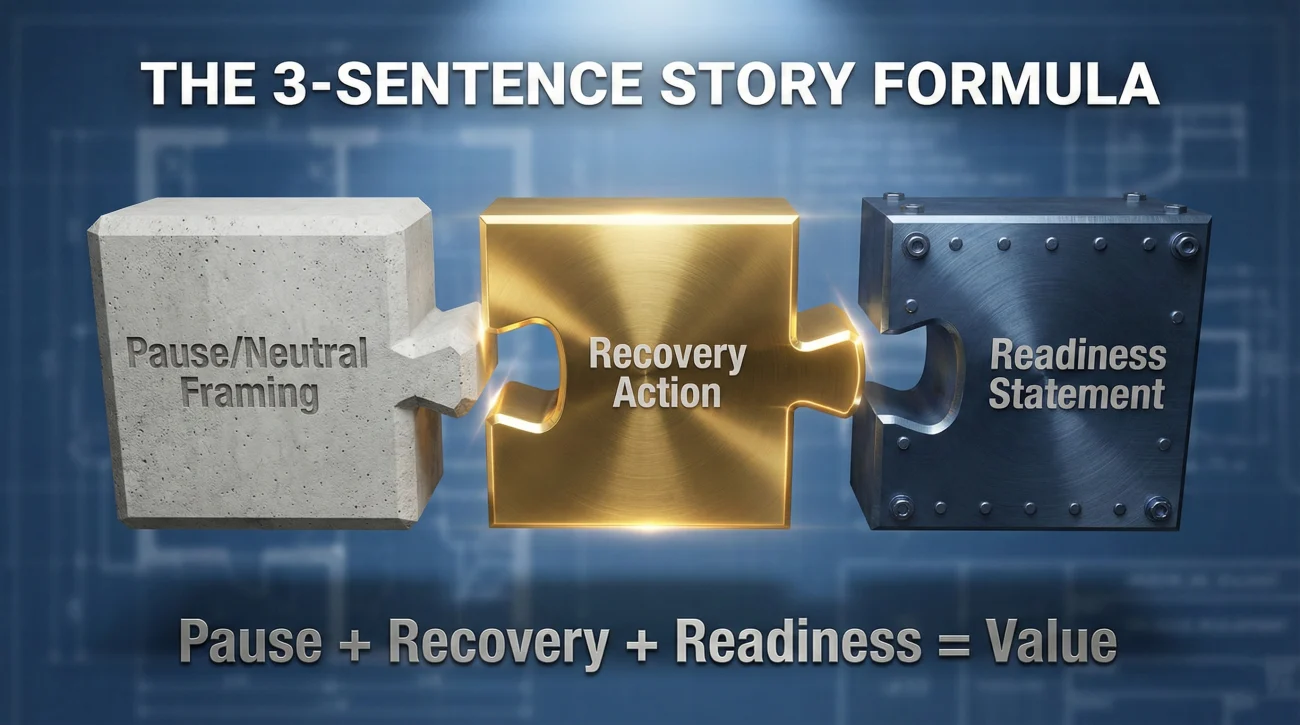
The 3-sentence story hits the middle ground. It’s structured enough to feel complete, short enough to not dominate the conversation, and specific enough to prevent follow-up probing. Here’s the formula:
[Pause + Neutral Framing] + [Recovery Action] + [Readiness Statement]
Sentence one acknowledges the gap with a neutral reason. Sentence two shows what you did during recovery that kept skills sharp or built new ones. Sentence three signals you’re ready and committed now. No medical details. No emotional processing. Just a clean narrative arc that answers their real question: can you do this job reliably?
Key Point: The formula works because it mirrors how recruiters think. They want to know why you stopped, what happened during the gap, and why you’re ready now. Three sentences, three answers, no loose ends.
The Formula in Action
A client named Kate had been out of project management for 26 months after a severe anxiety disorder made her previous role unsustainable. Her first instinct was to explain the whole trajectory: the breakdown, the therapy process, the gradual recovery. We rebuilt her answer using the formula instead:
Notice what’s missing: diagnosis, treatment specifics, emotional language. Notice what’s present: closure, evidence of activity, forward commitment. Kate used this in four interviews. Three moved forward. She accepted an offer within six weeks.
Another example from Jose, who spent two years recovering from a traumatic brain injury after a car accident. His physical recovery was complete, but he worried employers would assume ongoing limitations:
The phrase “fully cleared” does a lot of work here. It addresses the unspoken concern without requiring medical documentation or extended discussion.
10 Proof Signals That Show Readiness Without Oversharing

The middle sentence of your story needs evidence. Not just “I kept busy” but specific activities that signal professional capability. Here are ten options, ranked by how much credibility they carry with hiring managers:
| Proof Signal | Why It Works | Best For |
|---|---|---|
| Certification completed during gap | Shows initiative and current knowledge | Technical roles, regulated industries |
| Freelance or contract work | Proves you can still deliver under deadlines | Creative, consulting, tech roles |
| Volunteer leadership role | Demonstrates you can manage people and projects | Management, nonprofit transitions |
| Online courses with portfolio | Tangible output recruiters can verify | Design, development, marketing |
| Part-time consulting | Professional engagement without full-time demands | Senior roles, specialized expertise |
| Industry community involvement | Shows you stayed connected to your field | Networking-heavy industries |
| Personal project with measurable results | Proves execution ability | Entrepreneurial cultures, startups |
| Helping family business | Relatable, shows work ethic | Small business, operations roles |
| Structured skill refresh | Addresses the “are skills current” question directly | Fast-changing fields like tech |
| Healthcare provider clearance | Removes medical ambiguity when appropriate | Physical roles, safety-sensitive positions |
You don’t need all ten. Pick one or two that fit your actual experience. The goal is showing momentum, not listing every productive thing you did. A single strong proof signal beats a scattered list of minor activities.
💡 Pro Tip: If you completed something verifiable like a certification, mention it by name. “I earned my Google Analytics certification” lands harder than “I took some online courses.”
6 Safe Phrasing Examples by Situation
Different circumstances need different framing. Here are six variations of the 3-sentence story tailored to common situations I’ve seen in coaching sessions:
General Health Recovery
Mental Health Without Disclosure
Chronic Condition Now Managed
Surgery and Extended Recovery
Health Issue Overlapping with Family Care
Gradual Return After Long Absence
Each example follows the same structure but adjusts the language to match different realities. Pick the one closest to your situation and modify the proof signal to reflect what you actually did.
Keeping It Consistent Across Resume, Forms, and Interviews
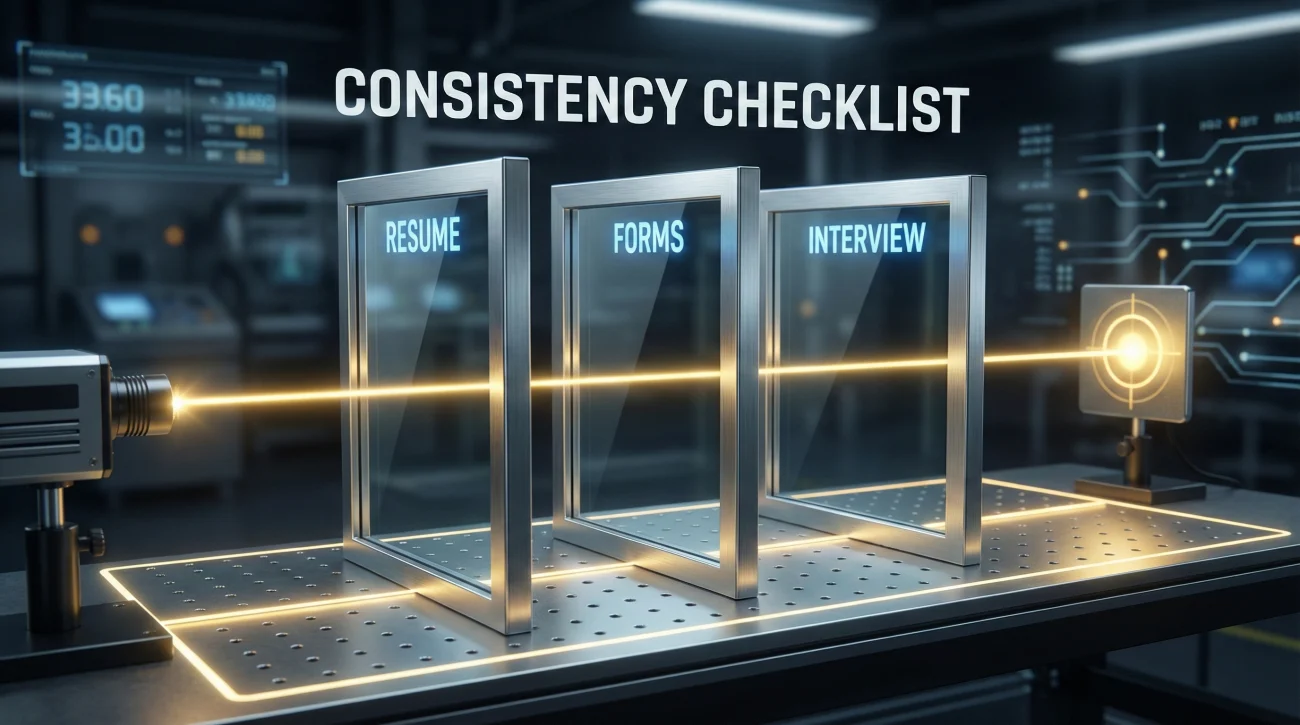
The most common way candidates undermine their own explanation is inconsistency. Their resume says one thing, their application form says another, and their interview answer adds details that contradict both. Background checks don’t verify your health story, but they do verify employment dates. If your timeline doesn’t match, you look dishonest even if you’re not.
Here’s a consistency checklist I give to every client with a long gap:
- Resume dates match application form dates exactly
- Gap explanation uses the same neutral framing everywhere
- Proof activities are listed consistently (same dates, same descriptions)
- LinkedIn timeline aligns with resume
- References are briefed on your gap story in case they’re asked
- No conflicting details between written and verbal explanations
A candidate I worked with, Janelle, nearly lost an offer because her application said “personal leave” while her interview answer mentioned “health reasons.” The recruiter flagged it during the reference check phase, not because it was disqualifying but because the inconsistency raised questions. We resolved it by having Janelle proactively email the recruiter with a clarifying note. She got the offer, but it was a preventable scare.
⚠️ Warning: Don’t add details in interviews that aren’t supported by your written materials. If your resume shows a clean gap with no explanation, your verbal answer should be brief. If your application includes a health-related note, your interview answer can expand on it slightly but shouldn’t introduce new information.
When They Push for More Details
Some interviewers don’t take the first answer. They follow up with “Can you tell me more about what happened?” or “Was it something serious?” This isn’t always inappropriate curiosity. Sometimes they’re trying to assess whether the condition might recur. But you don’t owe them medical details, and providing them rarely helps your candidacy.
Boundary statements that work:
- “I’d prefer to keep the specifics private, but I can assure you the situation is fully resolved.”
- “It was a health matter I needed to address. What I can tell you is that I’m cleared to work without restrictions.”
- “I appreciate the question, but I’m more comfortable focusing on what I bring to this role going forward.”
A candidate named Tomás used the second line after an HR manager asked twice about his gap. He told me later that the interviewer immediately backed off and shifted to discussing his qualifications. The key is delivering the boundary with warmth, not defensiveness. You’re redirecting, not refusing.
Briefing Your References
References rarely get asked about your health directly. But they sometimes get asked about your gap. If your reference says “I think she was dealing with some personal stuff” while you told the recruiter “I was caring for a family member,” the stories don’t match. Even small discrepancies create doubt.
A quick call or email to your references helps: “If anyone asks about my gap, I’ve been explaining it as taking time to address a health matter that’s now resolved. You don’t need to add anything beyond that if it comes up.” Most references appreciate the guidance because they want to help you succeed.
Moving Forward With Confidence
A two-year gap feels enormous when you’re living it. But from the recruiter’s side, it’s a data point to evaluate, not a disqualifier. The candidates who struggle aren’t the ones with long gaps. They’re the ones who can’t explain those gaps clearly, or who explain them in ways that raise more questions than they answer.
The 3-sentence story gives you control over that narrative. You decide what to share, how to frame it, and when to move the conversation forward. Combined with proof signals that demonstrate readiness and a consistent story across all your materials, you turn a potential weakness into evidence of resilience. That’s what understanding how to explain a 2 year employment gap for health reasons actually requires: structure, confidence, and just enough specificity to close the question without opening new ones.
❓ FAQ
🎯 Do I have to mention health at all for a 2-year gap?
Not always. If you have strong proof signals like certifications, volunteer work, or freelance projects, you can frame it as a “career break” or “personal sabbatical” without specifying health. The key is having something credible to point to. A completely blank two years with no explanation will prompt questions regardless of how you label it.
🧩 What if the interviewer asks follow-up questions about my health?
Use a polite boundary statement: “I’d prefer to keep the medical details private, but I can tell you the situation is fully resolved and won’t affect my work.” Most interviewers accept this. If they push further, it’s a signal about their company culture that might be worth noting.
🔍 Should I mention my gap proactively or wait for them to ask?
For two-year gaps, address it briefly in your cover letter or early in the interview. Waiting for them to ask lets their assumptions build. A proactive mention shows confidence and prevents the gap from becoming the elephant in the room.
📝 Can I use the same 3-sentence story in a cover letter?
Yes, with slight adjustments. In writing, you can expand the proof signal sentence to add more detail. Keep the total length to one short paragraph. Position it in the middle of the letter, not as the opening or close.
💡 What if I don’t have any proof signals to mention?
If you truly did nothing professional during the gap, focus on recovery as preparation. “I used that time to fully recover so I could return to work without limitations” is honest and forward-looking. Then emphasize your eagerness and commitment in the third sentence. Consider adding a recent proof signal now, even something small like a short online course, before you start interviewing heavily.
🧭 How do I handle a 2-year gap on application forms with limited space?
Condense to one sentence: “Personal health matter, now resolved. Completed [certification/activity] during this time.” If the form only allows a few words, use “Health-related, resolved” and save the full story for the interview.
⚠️ Disclaimer: ResumeSolving provides resume, cover letter, and job search communication guidance for informational purposes only. It is not legal, medical, financial, or professional counseling advice. Hiring decisions vary by company, role, location, and individual circumstances, so we do not guarantee interviews, offers, or outcomes. Always use your own judgment, verify requirements directly with the employer, and follow local laws and workplace policies. When a situation is sensitive, we prioritize privacy-safe, recruiter-appropriate wording, and you never need to share personal details you are not comfortable disclosing.