- The Market Reality: Data from January 2026 shows a “soft freeze”: hiring is happening (+130k jobs), but standards have skyrocketed.
- The 7.4-Second Rule: Research confirms recruiters spend under 8 seconds scanning a resume. We don’t read for potential; we scan to rule out risk.
- The Cost of Risk: With bad hires costing up to 200% of a salary (SHRM), employers in a steady market reject any resume that lacks immediate clarity.
The “Fine but Fuzzy” Problem in a Steady Market
In HR, the most dangerous job market isn’t when the headlines are screaming “Recession.” When the news is bad, candidates know they need to fight. They sharpen their materials, network aggressively, and prepare for a grind.
The truly difficult phase is what I call the “Silent Squeeze.” It’s exactly where we are right now.
The headlines look decent. The data looks stable. But for the individual job seeker, getting a first-round interview feels harder than ever. You submit applications, and they vanish into a void. You aren’t getting rejected because you are unqualified; you are getting ignored because you are “fine but fuzzy.”
Let’s look at the reality of the numbers. The Bureau of Labor Statistics (BLS) Employment Situation for January 2026 reports a payroll increase of 130,000 and an unemployment rate holding at 4.3%. On paper, this is a healthy, stabilized economy. But inside the hiring room, this data tells a different story: companies are maintaining, not scrambling.
Key Insight: In a 4.3% unemployment market, employers are not desperate. They have options. This means the “good enough” resume that worked in 2022 is now the resume that gets archived in 2026.
When hiring slows from “hyper-growth” to “strategic maintenance,” the burden of proof shifts entirely to the candidate. We aren’t looking for potential anymore; we are looking for immediate, low-risk value.
What Gets You Rejected in 10 Seconds (The Recruiter Lens)
There is a common myth that recruiters read resumes. We don’t. At least, not at first. We skim. And this isn’t just laziness; it’s a necessity driven by volume.
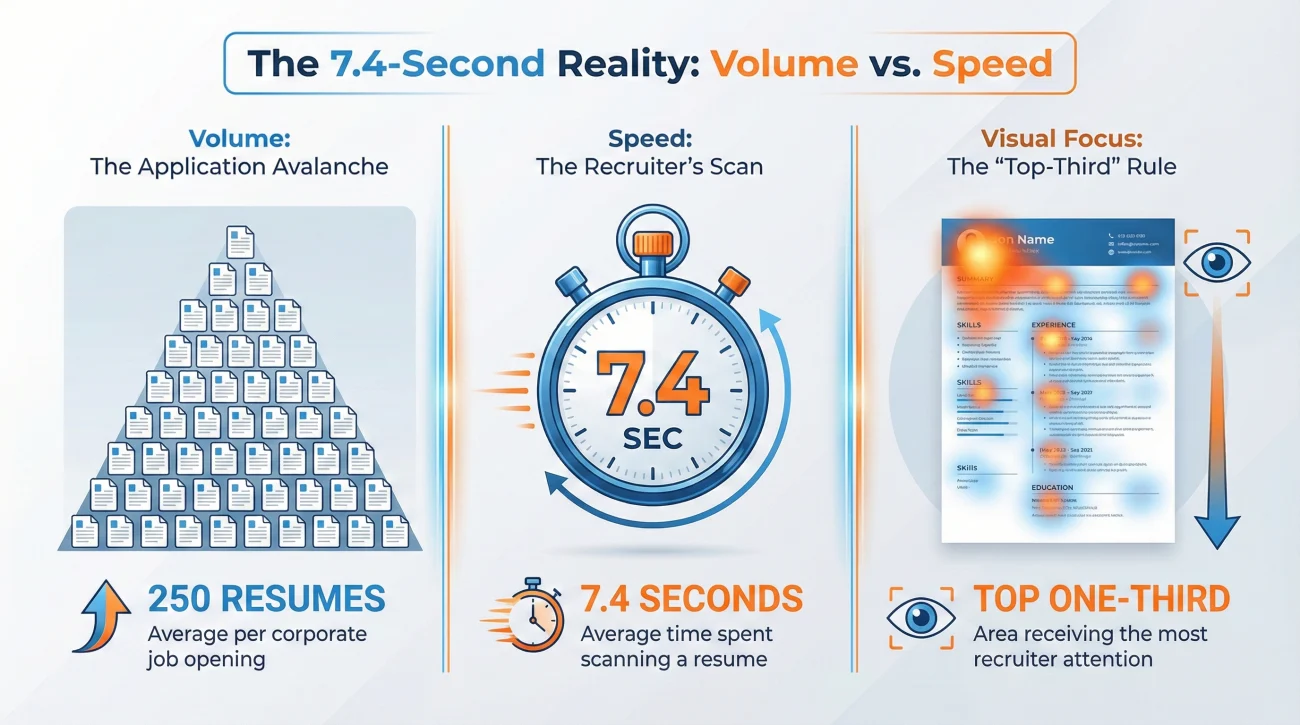
According to data from Glassdoor, the average corporate job opening attracts 250 resumes. Of those, only 4 to 6 people will get an interview. When I open a requisition today, I am facing a mountain of paperwork. I cannot read 250 documents word-for-word.
This behavior is backed by the famous eye-tracking study from The Ladders, which revealed that recruiters spend an average of just 7.4 seconds on their initial screen of a candidate’s profile. In that brief window, I am looking for signals that allow me to say “no” quickly so I can find the “yes.”
The Reality: If I have to read the second page or squint to figure out what you actually do, you have already lost. The 7.4-second clock doesn’t pause for you to explain yourself.
📝 Field Note: The “Top Third” Rule
In my time in HR, I have noticed a consistent pattern during market slowdowns. The decision to interview is almost always made based on the top one-third of the first page.
When the market is hot, I might scroll down to find a hidden gem. When the market is steady (like now), I stop at the summary and core skills. If that top section says “Experienced Professional with a history of success,” my eyes glaze over. That is “fuzzy.”
I need to see: “Senior Project Manager who delivered $2M in cost savings via Agile transformation.” That is value.
The biggest enemy of the modern resume isn’t a typo; it’s ambiguity. It is the failure to answer the question: “What problem do you solve?” immediately.
Mini Scenario: The Tale of Two Candidates
Let’s look at how this plays out in a real selection process. I recently reviewed candidates for a specialized Operations Manager role. Two candidates had almost identical tenure and education.
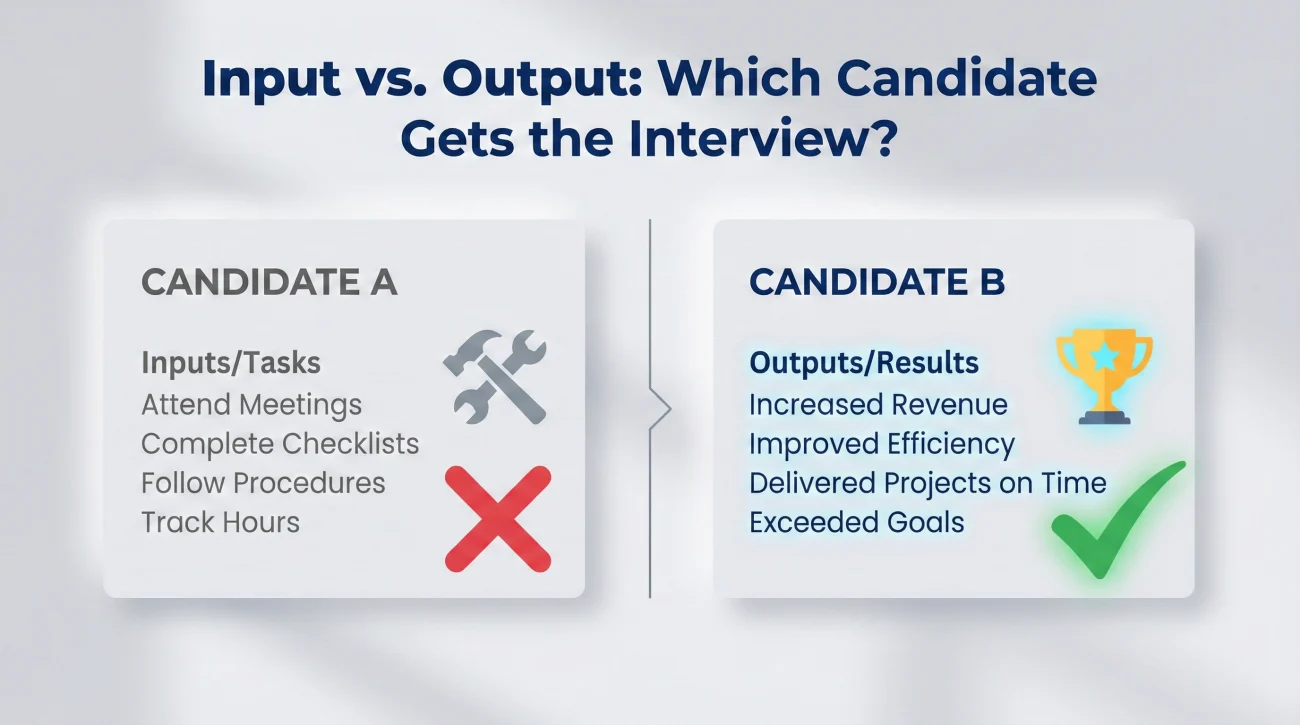
Candidate A: The “Doer” (Rejected)
Candidate A’s resume was professional but descriptive. It read like a job description.
- Summary: “Dedicated Operations Manager with over 10 years of experience in logistics and team leadership.”
- Bullet point: “Responsible for managing warehouse inventory and overseeing a team of 15 staff members.”
- Bullet point: “Ensured shipments were delivered on time and handled vendor communications.”
The Verdict: I passed. Why? Because “responsible for” tells me what they were supposed to do, not how well they did it. In a competitive market, doing the bare minimum of the job description is not a competitive advantage.
Candidate B: The “Solver” (Interviewed)
Candidate B had the exact same background but framed it through value.
- Summary: “Operations Manager specializing in high-volume logistics. Reduced overhead by 15% across two fiscal years while maintaining 99% on-time delivery rates.”
- Bullet point: “Orchestrated inventory flow for a 50,000 sq. ft. facility, reducing waste by 12% ($45k annually).”
- Bullet point: “Led a team of 15 during a WMS migration with zero operational downtime.”
The Verdict: Interviewed immediately. Candidate B didn’t just tell me they showed up to work; they proved they improved the business.
Key Insight: Candidate A described inputs (tasks). Candidate B described outputs (business results).
The 3 Signals Your Resume Must Show
To survive the 7.4-second scan in this specific economic cycle, your resume needs to transmit three specific signals instantly.
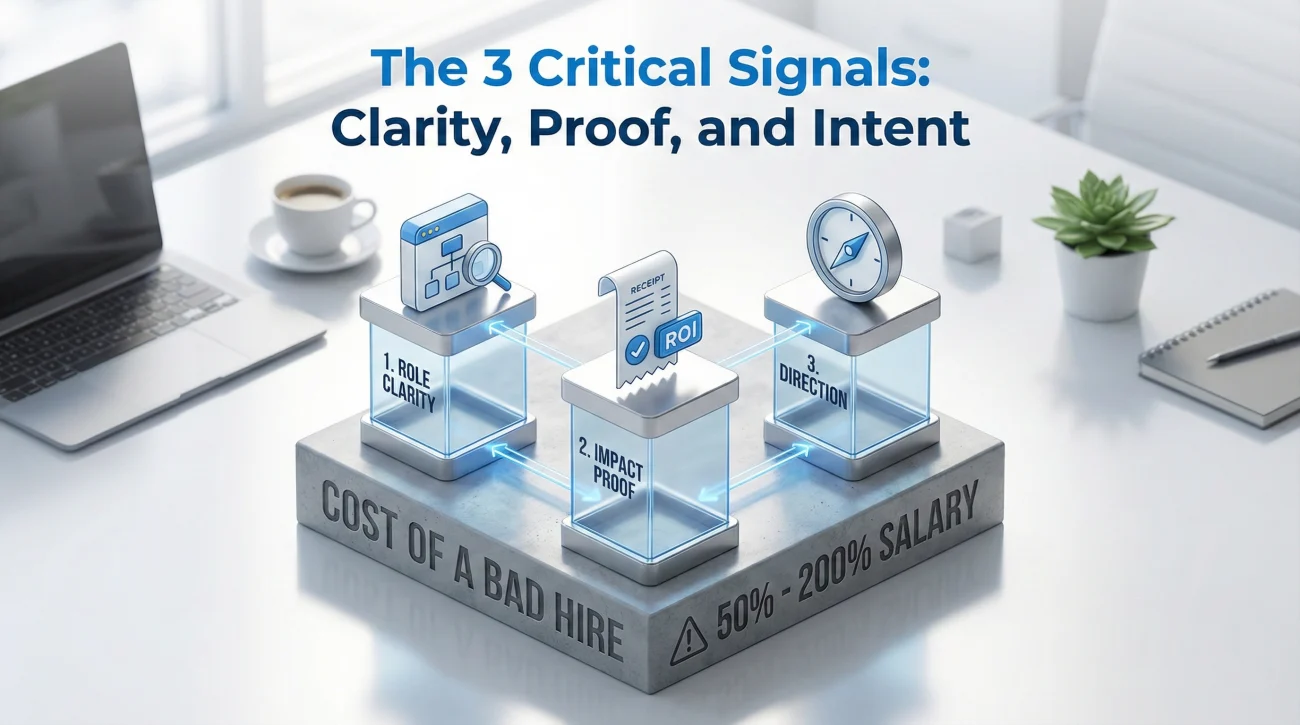
1. Role Clarity (The “Box” Signal)
Don’t make me guess what you are. Creative titles like “Chief Happiness Officer” or “Innovation Ninja” hurt you in a stabilized market. Companies are hiring for specific, budget-approved boxes.
If the job is for a “Senior Accountant,” your headline should be “Senior Accountant.” Connect the dots for the recruiter. If your background is a mix of sales and marketing, but you are applying for a Sales role, strip out the marketing fluff that distracts from your core signal.
2. Impact Proof (The “Receipts” Signal)
This is where 90% of resumes fail. Impact proof means attaching a scope or a result to your tasks.
You don’t always need dollar signs or percentages (though they help). You need context.
- ❌ Weak: “Wrote code for the mobile app.”
- ✅ Strong: “Developed the payment gateway feature for the iOS app used by 50,000 daily users.”
The second bullet provides scope. It tells me you can handle scale.
3. Direction (The “Intent” Signal)
In a 4.3% unemployment market, retention is a key metric for HR. Why? Because the cost of failure is astronomical.
According to the Society for Human Resource Management (SHRM), the cost to replace a professional employee can range from 50% to 200% of their annual salary. In a budget-conscious year like 2026, hiring the wrong person is a financial disaster.
If your resume looks like a “Jack of all trades” trying to be everything to everyone, you look like a flight risk. You need to signal that you want this specific path, reducing my perception of risk.
Common Mistakes That Scream “Low Value”
Even senior professionals fall into these traps. These errors are the primary reason qualified candidates get ghosted.
| Mistake | Why it Fails the 7.4-Second Scan |
|---|---|
| The Task List Dump | Listing 15 bullets of daily duties bores the reader. We know what a Sales Manager does; we want to know what you achieved. |
| The “Objective” Statement | Writing “Looking for a challenging role…” is outdated. Companies care about what they get, not what you want. Replace this with a “Professional Summary.” |
| Context-Free Achievements | “Awarded Employee of the Month” means nothing without context. “Awarded Top Performer out of 50 sales reps for Q3” is proof. |
Final Thoughts
The job market isn’t broken, but it is exacting. The “soft freeze” means that the jobs are there, the BLS data proves it, but the tolerance for risk has disappeared.
You cannot change the macroeconomics. You cannot force a company to hire faster. But you can control the narrative on your page. When you look at your resume today, ask yourself the hard question: “Is this safe?” vs. “Is this valuable?”
The candidate who gets the offer in 2026 isn’t necessarily the one with the most experience. It is the one who is the easiest to believe, the easiest to verify, and the easiest to hire.
❓ FAQ
📉 Does the 4.3% unemployment rate mean it’s bad time to look for a job?
No, 4.3% is historically healthy. However, it indicates a stabilized market rather than a rapid-growth one. Companies are hiring, but they are more selective and slower to make decisions compared to when rates are lower.
📄 How far back should my resume go in this market?
Focus heavily on the last 10-15 years. In a competitive market, recent, relevant experience outweighs historical seniority. Work older than 15 years should be minimized or removed unless critical to the specific role.
🤖 Will an ATS reject me if I don’t have the exact keywords?
The ATS is rarely the villain; it’s usually a lack of clarity. While keywords matter for searchability, humans still make the final call. Focus on standard job titles and clear skills rather than “stuffing” hidden keywords.
✍️ Should I include a summary on my resume?
Yes. In a fast-skim environment, a strong 3-sentence summary at the top allows you to control the narrative and highlight your “value proposition” immediately before the recruiter scrolls down.
📚 Data Sources & References
This article utilizes authoritative labor market data and industry studies to provide context for hiring trends. Below are the specific references used:
- BLS Employment Situation (January 2026):
Data Point: Total nonfarm payroll employment rose by 130,000; unemployment rate at 4.3%.
Context: Used to illustrate the “steady but selective” nature of the current hiring landscape.
View Official BLS Report (PDF) - The Ladders Eye-Tracking Study:
Data Point: Recruiters spend an average of 7.4 seconds on the initial resume scan.
Context: Highlights the critical need for immediate visual clarity and top-loaded value.
View Ladders Study - Glassdoor Hiring Statistics:
Data Point: Corporate job openings attract an average of 250 resumes.
Context: Illustrates the volume of competition and why “skimming” is a necessary recruiter behavior.
View Glassdoor Research - SHRM (Society for Human Resource Management):
Data Point: The cost of a bad hire can range from 50% to 200% of the employee’s annual salary.
Context: Explains why employers prioritize risk aversion and role clarity in a tight market.
View SHRM Resources
⚠️ Disclaimer: ResumeSolving provides resume, cover letter, and job search communication guidance for informational purposes only. It is not legal, medical, financial, or professional counseling advice. Hiring decisions vary by company, role, location, and individual circumstances, so we do not guarantee interviews, offers, or outcomes. Always use your own judgment, verify requirements directly with the employer, and follow local laws and workplace policies. When a situation is sensitive, we prioritize privacy-safe, recruiter-appropriate wording, and you never need to share personal details you are not comfortable disclosing.