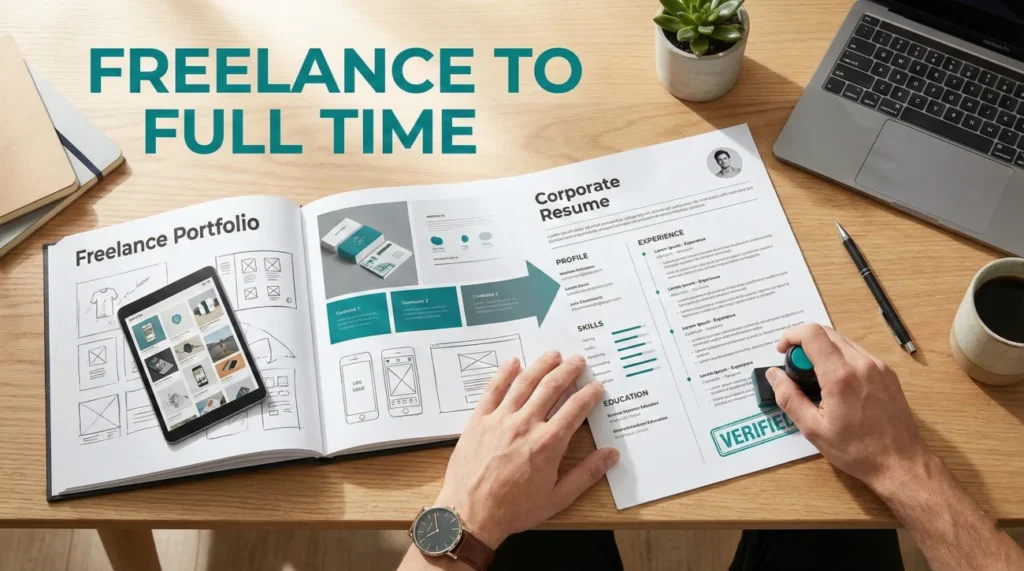
- Recruiters fear freelancers are unstable, inconsistent, and unable to work within teams. Your resume must counter all three signals.
- Structure matters more than content. How you organize freelance work determines whether it reads as a coherent career or chaotic gig-hopping.
- Continuity and collaboration are your two biggest proof points. Show long-term relationships and cross-functional work.
- The interview question “Why full time now?” requires a real answer about what you want, not just what you are escaping.
What Recruiters Actually Fear About Freelancers
When a recruiter sees freelance experience on a resume, three concerns flash immediately: Will this person stay? Can this person work within a team structure? Does this person deliver consistent quality or just random project bursts?
A UX designer named Monica came to me after six months of applications with zero callbacks. Her portfolio was strong. Her skills were current. But her resume listed twelve clients over four years. That was the problem. Twelve clients in four years looked like instability, not versatility.
We restructured her resume around three anchor clients she had worked with for 18+ months each. The other projects became supporting evidence under a consulting umbrella. Same work history. Completely different signal. She had three interviews within two weeks.
The challenge with freelance to full time resume positioning is not hiding that you were independent. Freelance experience can be a genuine asset: adaptability, client management, self-direction. The challenge is presenting it in a way that answers recruiter fears before they become objections.
Key Point: Freelance experience triggers stability and teamwork concerns. Your resume structure must proactively signal continuity and collaboration.
Stability Signal Checklist
Before sending any application, verify your resume passes these stability checks:
| Signal | What Recruiter Looks For | How to Show It |
|---|---|---|
| Continuity | Long-term relationships, not one-off gigs | Highlight retainers, renewals, multi-year engagements |
| Consistent scope | Clear expertise, not scattered random work | Group work by function, not chronologically by client |
| Collaboration | Experience working within teams | Show stakeholder management, cross-functional work, feedback loops |
| Professional infrastructure | Legitimate operation, not side hustle | Use consulting umbrella, mention processes, reference business outcomes |
| Intentional transition | Clear reason for wanting full-time now | Summary signals role fit, not desperation |
| Verifiable outcomes | Results that can be checked | Include metrics, artifacts, deliverable types |
A content strategist named Stefan had impressive freelance clients but listed them as separate short entries. Each looked like a 3-month contract that ended. When we consolidated under “Stefan Chen Content Strategy” with ongoing client relationships highlighted, the same history read as a stable consulting practice rather than unstable job-hopping.
💡 Pro Tip: If you have worked with any client for 12+ months, lead with that relationship. Long-term clients are your strongest stability proof.
Three Clean Structures for Freelance Work
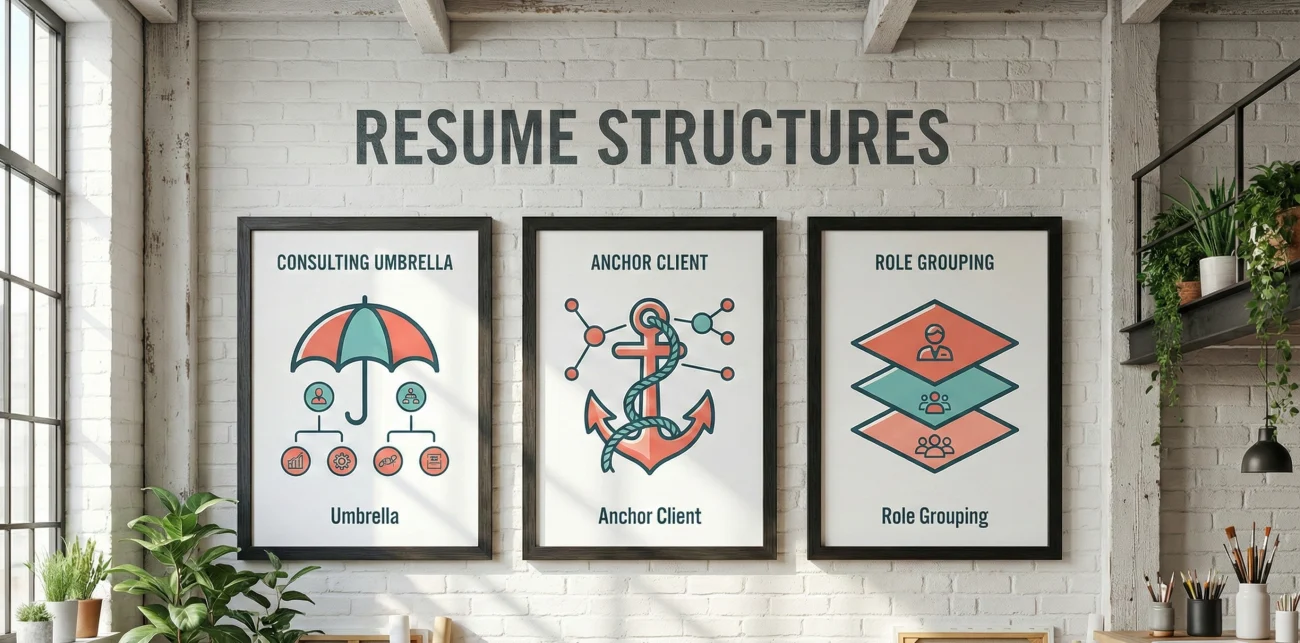
How you structure freelance experience determines whether it reads stable or chaotic. Choose based on your situation:
Structure 1: Consulting Umbrella
Best for: Multiple clients, consistent function, professional positioning
Senior Content Strategist | [Your Name] Consulting | 2020 – Present
Provide content strategy and editorial direction for B2B technology clients including [notable client types or industries]. Key engagements:
• 18-month retainer with enterprise SaaS company: developed content framework that increased organic traffic 47%
• Ongoing partnership with Series B startup: built editorial calendar and style guide from scratch
• Quarterly strategy projects for marketing agencies: delivered content audits and competitive analyses
This structure presents freelance work as a cohesive consulting practice. The umbrella creates one stable entry instead of multiple fragmented ones.
Structure 2: Anchor Client Focus
Best for: One or two dominant long-term relationships
Contract UX Designer | TechCorp Inc. (via independent contract) | 2021 – 2024
Embedded with product team on 3-year engagement, functioning as senior designer within cross-functional squad.
• Led redesign of checkout flow, improving conversion 23%
• Collaborated with engineering and PM on weekly sprint cycles
• Mentored two junior designers on design system implementation
This structure positions a long-term contract as essentially a job. The “(via independent contract)” note is honest without over-emphasizing the freelance nature.
Structure 3: Role-Based Grouping
Best for: Varied clients but consistent role type
Freelance Product Designer | 2019 – Present
Mobile App Design (8 projects)
• Designed end-to-end experiences for fintech, health, and e-commerce apps
• Delivered high-fidelity prototypes and design systems
Design Systems (4 projects)
• Built component libraries for startups scaling their design operations
• Created documentation enabling engineering handoff efficiency
This structure groups work by type rather than client, showing expertise depth rather than client quantity.
Four Mini Scripts for Freelance to Full Time
These scripts address the questions and objections freelancers face. Adapt the structure to your situation.

Script 1: Why Full Time Now
“Freelancing taught me how to deliver results independently and manage client relationships across different contexts. What I have realized is that I do my best work when I can go deep on one product over time rather than switching between multiple clients. I am looking for a role where I can build something sustained with a team, which is why this position is so appealing.”
This script frames full-time as a positive choice toward something, not an escape from freelance struggles.
Script 2: Can You Work Within a Team
“Actually, most of my freelance work has been embedded with client teams. At TechCorp, I participated in daily standups, collaborated with PMs on roadmap decisions, and worked through design reviews with the engineering team. The main difference between that and being an employee was the contract structure, not how I worked day to day.”
This script directly counters the “lone wolf” assumption with concrete collaboration evidence.
Script 3: Will You Stay or Go Back to Freelance
“I have thought about this carefully. Freelancing was the right choice when I needed flexibility and variety. Now I want depth and continuity. I am not looking for a stopgap until my next freelance opportunity. I am looking for a team and a product I can commit to long-term.”
This script addresses flight risk directly with commitment language.
Script 4: Explaining Gaps Between Clients
“Freelance work naturally has some variation in project timing. During slower periods, I focused on skill development, including completing a certification in [relevant skill] and contributing to open source projects. My pipeline was healthy overall, as you can see from the continuity of my major client relationships.”
This script normalizes freelance rhythm while showing productive use of downtime.
Freelance vs Contract vs Self-Employed: Label Choice
The words you use to describe independent work matter. Each label carries different signals:
| Label | What It Signals | Best For |
|---|---|---|
| Freelance | Independent professional, multiple clients | Creative roles, marketing, design, writing |
| Contract / Contractor | Temporary employee, single client at a time | Tech, engineering, corporate roles |
| Consultant | Strategic advisor, higher-level engagements | Senior roles, strategy, management |
| Self-Employed | Business owner, could mean anything | Avoid unless running actual business |
| Independent | Neutral, non-specific | When other labels feel awkward |
⚠️ Warning: Do not use “Contract” if you were genuinely freelancing for multiple clients simultaneously. Recruiters may verify with previous clients, and the mismatch will raise red flags.
Labels and Phrases to Avoid
- ❌ “Solopreneur” (sounds like LinkedIn buzzword)
- ❌ “Founder” when you were really just freelancing
- ❌ “CEO” of a one-person operation
- ❌ “Entrepreneur” without a real business
- ❌ “Side hustle” (sounds unserious)
- ❌ “Gig worker” (sounds unstable)
Showing Continuity Without Naming Confidential Clients
Many freelancers cannot name clients due to NDAs or relationship sensitivity. You can still show continuity:
Continuity Patterns That Work
- “18-month retainer with enterprise SaaS company” (duration + type)
- “Ongoing partnership since 2021 with Series B fintech startup” (timeframe + stage)
- “Renewed quarterly for 3 years” (renewal pattern)
- “Expanded from single project to full content operations” (relationship growth)
- “Referred by initial client to 4 additional engagements” (trust signal)
These patterns show stable relationships without revealing protected information.
Sample Bullets Showing Continuity
- Maintained 3-year retainer relationship with healthcare technology company, evolving from project work to strategic content partner
- Achieved 85% client renewal rate across 12 engagements over 4 years
- Expanded scope with anchor client from landing pages to full marketing site redesign over 18 months
- Built referral-based practice where 70% of new clients came from existing client recommendations
Proving You Can Work Within a Team

The lone wolf concern is real. Recruiters worry freelancers cannot take direction, collaborate effectively, or function within organizational structures. Counter this with explicit collaboration evidence:
Collaboration Patterns to Highlight
- Embedded team work: “Participated in daily standups with product and engineering”
- Stakeholder management: “Presented strategy recommendations to C-suite quarterly”
- Cross-functional projects: “Coordinated with sales, product, and customer success on launch”
- Feedback loops: “Incorporated weekly feedback from design reviews into iterations”
- Process participation: “Followed client’s agile methodology and sprint cadence”
- Handoff excellence: “Delivered documented specs enabling seamless engineering implementation”
A developer named Jason struggled to get interviews despite strong technical skills. His resume focused entirely on deliverables with no mention of how he worked with clients. We added collaboration context to every bullet: who he worked with, how he communicated, what processes he followed. His callback rate doubled.
Resume Summary: Signal the Transition
Your summary is prime real estate for addressing the “why full-time” question before it even becomes an objection. A freelance-focused summary that does not mention your transition intent signals you are still happily independent and not seriously committed to joining a company.
Summary Rules for Freelancers
- Lead with target role: “Product designer seeking full-time role” not “Freelance product designer”
- Include stability cue: Mention long-term engagements or consistent client relationships
- Add collaboration proof: Reference team environments or stakeholder work
- Signal intent: Make clear you are looking for permanent employment
Sample Summaries
Notice how both summaries acknowledge the freelance background while clearly signaling full-time intent and collaboration readiness.
References: Building a Credible List
Freelancers often struggle with references because they do not have traditional managers. Build your reference list strategically:
Reference Types for Freelancers
| Reference Type | What They Can Speak To | How to Find Them |
|---|---|---|
| Client project manager | Delivery quality, communication, reliability | Your main point of contact at longer engagements |
| Client team lead | Collaboration, technical skills, team fit | Someone you worked with daily on projects |
| Agency contact | Professionalism, consistency, quality | If you worked through agencies or as subcontractor |
| Collaborating freelancer | Partnership skills, reliability, expertise | Other freelancers you teamed up with on projects |
| Previous employer | Traditional work history, team performance | Manager from job before freelancing |
💡 Pro Tip: Brief your references on your full-time transition. Ask them to emphasize your collaboration skills and reliability, not just your independent capabilities.
Common Freelance Resume Mistakes
After reviewing hundreds of freelance resumes, I see the same errors repeatedly. These mistakes trigger instant rejection or deeper skepticism from recruiters evaluating independent workers for full-time roles:
Client Soup
Listing every client as a separate entry creates visual chaos. It looks like job-hopping even if each engagement was successful.
Fix: Consolidate under an umbrella or group by project type.
Vague Scope
“Provided design services” tells recruiters nothing. What did you actually do? What was the scale? What were the outcomes?
Fix: Specific deliverables, metrics, and business outcomes.
Missing Dates or Gaps
Freelance timelines are naturally variable, but unexplained gaps raise questions.
Fix: Use continuous date ranges for your freelance practice, with project details underneath.
No Full-Time Signal
If your resume reads like you are happily freelancing, recruiters wonder why you are applying for a job.
Fix: Summary should signal intentional transition to full-time role.
Solo Language Only
Every bullet starting with “I” and no mention of teams or stakeholders reinforces the lone wolf fear.
Fix: Include collaboration verbs and team context in at least half your bullets.
Choose Your Next Step
This hub covered the freelance to full-time framework. The clusters below go deep on specific situations and challenges you may face. If you need help with resume structure, start with the structures guide. If interviews are your weak point, the “why full time now” cluster walks through the core answer in detail with multiple variations.
| Article | Description |
|---|---|
| How to List Freelance Work on a Resume: 3 Clean Structures That Read Stable | Detailed structure options with 6 examples and common mistakes to avoid |
| Freelance vs Contract: Which Word to Use on a Resume | Label decision rules with options for different industries and situations |
| Long-Term Clients: How to Show Continuity on a Freelance Resume | 6 continuity patterns with 10 bullets showing stable relationships |
| Freelancer Resume Summary: 7 Openings That Make You Sound Ready for Full Time | Summary templates with stability and collaboration cues built in |
| Why Do You Want Full Time Now: An Interview Answer for Freelancers | Core interview structure with 6 variations and commitment signals |
| Cover Letter Paragraph for Freelance to Full Time | One tight paragraph template explaining your transition |
| When Freelance Looks Like Job Hopping: How to Fix the Pattern | Framework and 6 structure fixes for many-client histories |
| Self-Employed on a Resume: Wording That Sounds Legit | 10 labels and 6 one-liners with credibility cues |
| Gaps Between Clients: How to Explain Freelance Downtime | Framework for addressing variable freelance timelines |
| References for Freelancers: Who to Use When Applying for Full Time | Selection rules and briefing scripts for client references |
| How to Show Teamwork as a Freelancer | 8 collaboration patterns with 10 bullets proving you can work within teams |
| Contract to Permanent: A Credible Interview Answer | Script for contract-specific transition conversations |
Making the Transition Successfully
Freelance experience is not a liability. It demonstrates adaptability, client management skills, self-direction, and the ability to deliver results without constant supervision. These are genuinely valuable traits that many traditional employees lack.
The challenge with freelance to full time resume positioning is translation. You must present independent work in a way that answers recruiter concerns about stability, consistency, and collaboration. Structure your experience to show continuity through long-term relationships. Include explicit collaboration evidence in your bullets. Signal intentional transition in your summary. Prepare clear answers for why you want full-time now.
When you do this translation well, your freelance background becomes a genuine asset that differentiates you from candidates who have only worked in traditional employment structures. You bring outside perspective, client-facing skills, and proven ability to deliver without hand-holding. You understand what it means to satisfy stakeholders because your income depended on it. That combination is exactly what many employers want in their next hire.
❓ FAQ
🎯 Should I remove freelance work from my resume entirely?
Almost never. Removing it creates an unexplained gap, which is usually worse than showing freelance experience. The exception might be very short freelance periods that are irrelevant to your target role. In most cases, restructure and reframe rather than remove.
📝 Can I say I was an employee if I was really a contractor?
No. This is verifiable and lying about it can get offers rescinded or lead to termination later. You can position contract work to emphasize stability and team integration, but do not misrepresent the employment relationship.
💼 What if my freelance work was genuinely unstable with lots of short gigs?
Group it under an umbrella structure and focus on cumulative outcomes rather than individual client duration. Highlight any longer relationships even if they were smaller scope. Show what you learned and why you are seeking stability now.
🔍 How do I handle references when clients cannot be contacted?
Find collaborators within client organizations who can speak to your work: project managers, team leads, or colleagues you worked with directly. You can also use fellow freelancers you collaborated with or agency contacts who can verify your professionalism.
⚠️ Will employers think I will leave to freelance again?
This is a real concern. Address it directly in interviews with clear language about why you want full-time work now and what you are looking for that freelance cannot provide. Commitment cues in your resume summary also help.
⚠️ Disclaimer: ResumeSolving provides resume, cover letter, and job search communication guidance for informational purposes only. It is not legal, medical, financial, or professional counseling advice. Hiring decisions vary by company, role, location, and individual circumstances, so we do not guarantee interviews, offers, or outcomes. Always use your own judgment, verify requirements directly with the employer, and follow local laws and workplace policies. When a situation is sensitive, we prioritize privacy-safe, recruiter-appropriate wording, and you never need to share personal details you are not comfortable disclosing.