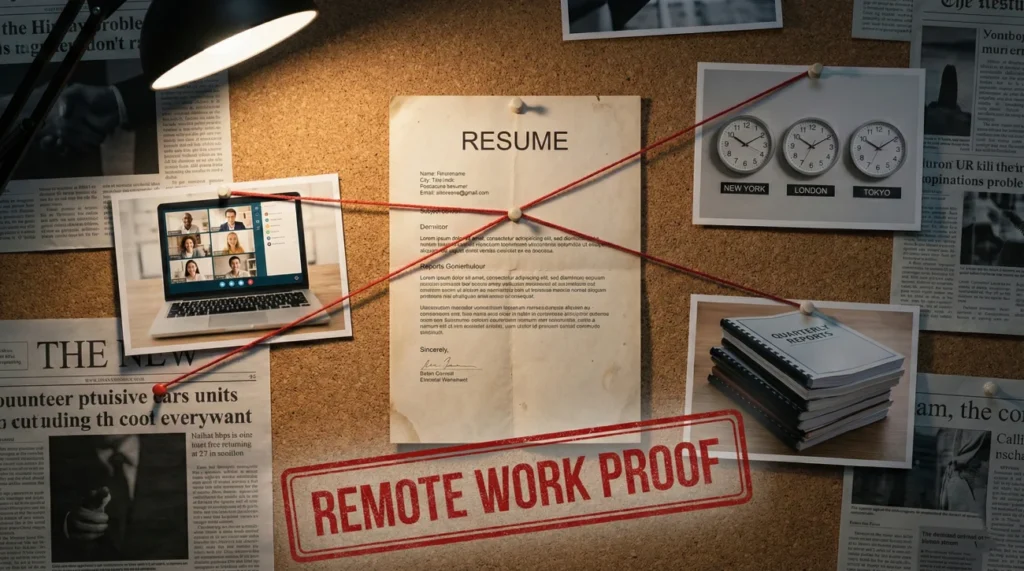
- Recruiters test four things for remote roles: self-management, communication discipline, documentation habits, and delivery reliability
- Remote proof means showing work patterns through accomplishments, not listing collaboration tools
- Where you place remote signals depends on your situation: header, summary, bullets, or skills section each serve different purposes
- No remote experience? You likely have transferable proof from independent projects, cross-location coordination, or async workflows
What Recruiters Actually Test When Screening for Remote Roles
When a recruiter evaluates candidates for a remote position, they are not checking whether you know how to use Zoom. They are testing for something harder to fake: evidence that you can deliver results without anyone watching.
I learned this distinction after a conversation with a hiring manager named Rebecca who had just rejected 40 candidates for a remote marketing role. Her feedback surprised me. Almost everyone listed the same collaboration tools. Almost no one showed proof they could actually work independently.
Remote work on resume positioning requires understanding what recruiters genuinely worry about when hiring someone they may never meet in person:
| What They Test | What They Fear | What Proves It |
|---|---|---|
| Self-management | You need constant reminders and check-ins | Deadlines met, priorities managed, output consistent |
| Communication discipline | They will not know what you are working on | Proactive updates, clear documentation, no surprises |
| Async habits | You require synchronous availability to function | Work across time zones, written handoffs, decision logs |
| Delivery reliability | Quality drops without office accountability | Consistent output, measurable results, stakeholder satisfaction |
The candidates Rebecca rejected all made the same mistake. They treated remote readiness as a feature to announce rather than a pattern to demonstrate. Their resumes said remote-friendly. Nothing in their experience bullets proved it.
Key Point: Remote proof is about demonstrating work patterns that signal low-maintenance, high-output behavior. Tools are just the medium. Habits are the message.
Decision Map: Where to Place Remote Proof on Your Resume
Remote signals can appear in multiple places on your resume. The right placement depends on your experience level and the role you are targeting. Here is how to decide:
Header or Location Line
Best for candidates who are location-flexible and want to signal remote availability immediately.
This works when you want to preempt location screening. If a company filters by geography before reading resumes, the Remote tag keeps you in consideration. However, this placement says nothing about your remote capabilities. It only states your preference.
Professional Summary
Best for candidates with substantial remote experience who want to position it as a core qualification.
Notice this summary never uses the word remote. It shows remote readiness through specific outcomes: distributed teams, time zones, documentation, async workflows, handoffs. Any recruiter hiring for remote positions recognizes these signals instantly.
Job Titles and Company Lines
Best for making remote experience scannable at a glance.
This placement helps when recruiters scan quickly. They see Remote before reading any bullets. For roles that were hybrid, you can use variations like (Hybrid – 3 days remote) to be precise without overstating.
Experience Bullets
Best for demonstrating remote capabilities through actual accomplishments. This is where most candidates fail and where you can differentiate.
The strong bullet shows the same reality but proves capability instead of stating it. Async review cycles, written briefs, and eliminated meetings are proof nouns that signal remote-ready work patterns.
Skills Section
Best for listing tools when the job description specifically mentions them or when you need to pass ATS keyword filters.
⚠️ Warning: A skills section listing Slack, Zoom, Teams, Asana, and Monday tells recruiters nothing meaningful. Everyone lists these tools. If you include collaboration tools, bury them among more substantive skills rather than featuring them prominently.
Proof Nouns: Words That Signal Remote Readiness
Certain words and phrases function as proof nouns. They signal remote-ready patterns without requiring you to explicitly announce that you worked remotely. Learn to weave these into your experience bullets naturally.

Documentation and Clarity Proof
- Created process documentation that…
- Built knowledge base covering…
- Wrote standard operating procedures for…
- Developed onboarding materials enabling…
- Maintained decision logs tracking…
Documentation proof matters because remote teams cannot rely on hallway conversations. If you document your work, you signal that your knowledge transfers without requiring your presence.
Async Communication Proof
- Established written update cadence…
- Created async review process…
- Managed stakeholder alignment through written briefs…
- Reduced meeting load by 40% through…
- Implemented status reporting system…
Distributed Coordination Proof
- Coordinated across [X] time zones…
- Led globally distributed team of…
- Managed handoffs between regional teams…
- Aligned stakeholders across [locations]…
- Maintained delivery cadence despite geographic spread…
Independent Delivery Proof
- Owned end-to-end delivery of…
- Self-directed project resulting in…
- Managed workload independently while…
- Delivered [X] without dedicated oversight…
- Maintained [metric] consistency across…
Key Point: Proof nouns work because they describe behaviors, not labels. Coordinated across 4 time zones proves more than Experienced remote worker claims.
Four Mini Scripts for Common Situations
These scripts show how to translate common experience into remote-ready proof. Adapt the structure to your situation.
Script 1: You Worked Fully Remote
When your role was explicitly remote, lead with outcomes and let the remote context support them.
Context: Remote customer success manager for 3 years
Managed portfolio of 45 enterprise accounts remotely, maintaining 94% retention through structured quarterly reviews and proactive written communication that averaged 2-hour response time across time zones.
Script 2: You Worked Hybrid
For hybrid roles, emphasize the remote-applicable skills without overstating your remote experience.
Context: Hybrid role, 3 days remote per week
Developed async project coordination system for hybrid team of 12, reducing in-office dependency by creating written handoff protocols that maintained velocity during remote days.
Script 3: You Have No Remote Experience
Without explicit remote history, find analogous proof from independent work, documentation, or cross-location coordination.
Context: Always worked in-office but had independent responsibilities
Led regional expansion project independently, creating documentation and status reporting that kept leadership aligned without requiring recurring meetings.
Script 4: You Managed Remote Team Members
Managing remote people proves you understand what remote workers need to succeed.
Context: In-office manager with remote direct reports
Managed team of 6 including 3 remote employees, implementing structured 1:1 cadence and written goal tracking that achieved 15% higher performance ratings than office-only teams.
Remote Proof Checklist
Before submitting your resume for a remote role, verify these elements:
| Element | Check |
|---|---|
| Location line | Includes (Remote) if you are location-flexible |
| Summary | Contains at least one proof noun: distributed, async, documentation, time zones |
| Experience bullets | At least 3 bullets demonstrate remote-ready patterns through outcomes |
| Tool mentions | Embedded in accomplishments, not listed as standalone skills |
| Metrics | Include measurable results that could only happen with reliable independent delivery |
| Language | No vague claims like self-starter or works well independently without proof |
💡 Pro Tip: Read your resume imagining you are a hiring manager who will never meet this candidate in person. Does the resume prove they can deliver without supervision? Or does it just claim remote experience without evidence?
Showing Async Habits Without Sounding Like a Productivity Blog
Async communication is the skill that separates remote workers who integrate smoothly from those who become coordination bottlenecks. But most candidates describe async habits in ways that sound generic or borrowed from productivity articles.
A content director named Mei had excellent async instincts. She wrote clear briefs, documented decisions, and rarely needed meetings to align stakeholders. But her resume said Experienced with asynchronous communication, which proved nothing.
We rewrote her bullets to show async habits through outcomes:
The rewritten bullet never mentions async. But anyone reading it recognizes the pattern: this person replaced meetings with written processes and maintained quality. That is async proof.
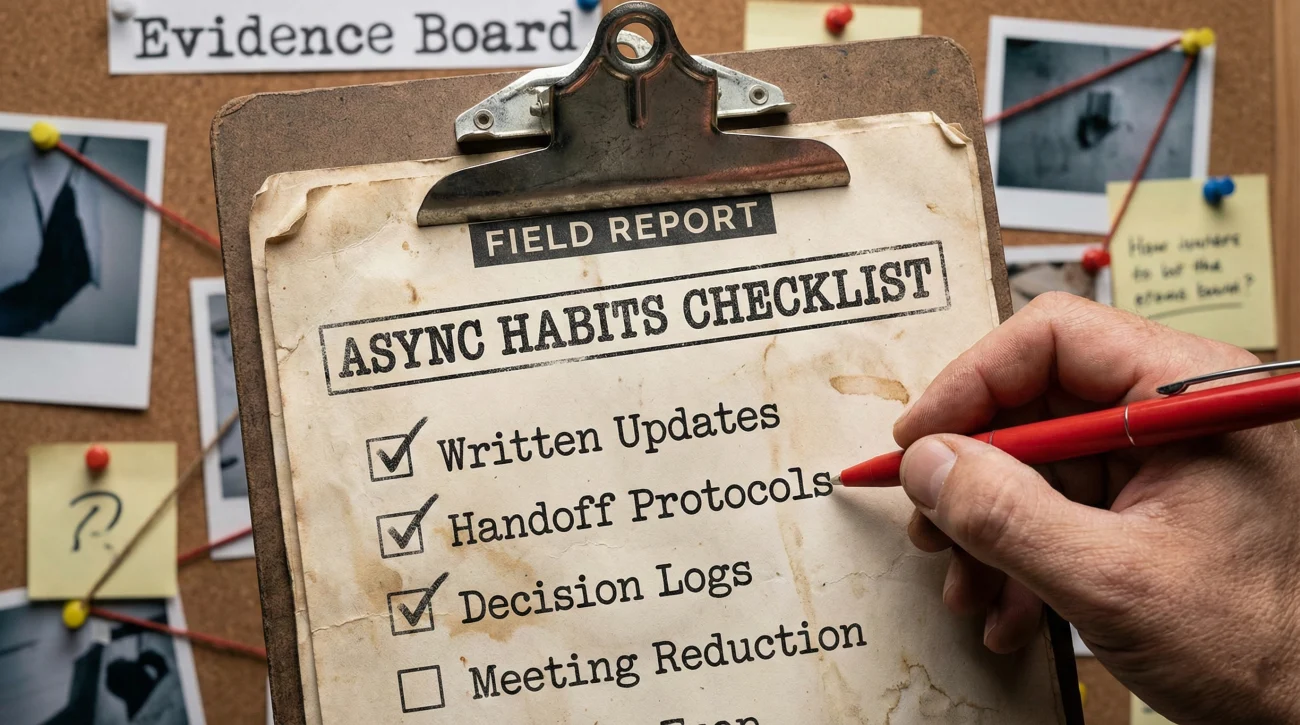
Async Patterns Worth Highlighting
Different async behaviors signal different capabilities. Choose patterns that match what your target role requires:
- Written updates replacing status meetings: Shows you can keep stakeholders informed without requiring their time
- Decision logs and rationale documentation: Shows decisions survive without you present to explain them
- Handoff protocols between shifts or time zones: Shows work continues smoothly when you are offline
- Expectation-setting communications: Shows you manage stakeholder relationships proactively
- Feedback loops that work asynchronously: Shows you can iterate without blocking meetings
- Meeting reduction or elimination: Shows you default to async and use sync time sparingly
💡 Pro Tip: The strongest async proof often involves reducing meetings or replacing synchronous processes with written alternatives. If you have ever eliminated a recurring meeting by creating a better async workflow, that bullet belongs prominently on your remote resume.
Common Remote Resume Mistakes That Kill Applications
After reviewing hundreds of remote-targeted resumes, I see the same mistakes repeatedly. These errors signal to recruiters that you do not actually understand what remote work requires.
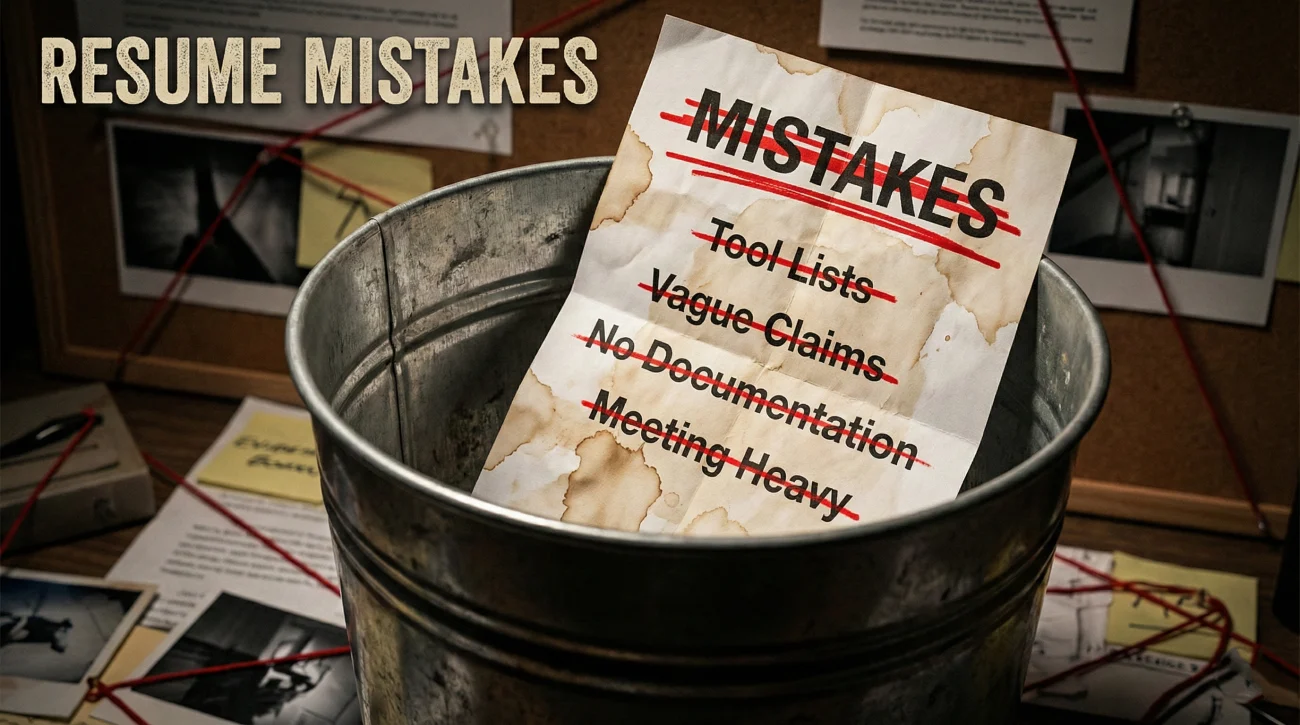
Mistake 1: Tool Lists as Primary Proof
Listing Slack, Zoom, Teams, Asana, Monday, and Notion in your skills section tells recruiters nothing except that you have used software most professionals have used. It is the remote equivalent of listing Microsoft Word as a skill in 2005. Everyone has it. It differentiates no one.
Fix: Embed tools inside accomplishment bullets where they add context. Built team dashboard in Notion that reduced status check-ins by 50% uses the tool meaningfully.
Mistake 2: Vague Self-Starter Claims
Self-motivated professional and works well independently are claims without proof. Recruiters have seen these phrases on thousands of resumes from candidates who turned out to need constant oversight.
Fix: Replace claims with evidence. Instead of self-motivated, show a bullet where you initiated something valuable without being asked. Instead of works independently, show a project you owned end-to-end with minimal supervision.
Mistake 3: No Documentation Evidence
Remote teams run on documentation. If your resume shows no evidence that you create, maintain, or contribute to shared knowledge, recruiters wonder whether you will become a knowledge bottleneck who can only transfer information through conversations.
Fix: Include at least one bullet showing documentation contribution. This could be process documentation, training materials, knowledge bases, or decision logs.
Mistake 4: Meeting-Heavy Accomplishments
Bullets that emphasize meetings, calls, and face-to-face interactions signal office-dependent work patterns. Facilitated weekly team meetings is not a remote-ready accomplishment.
Fix: Reframe around outcomes rather than activities. What did those meetings produce? Can you show results that came from coordination, regardless of medium?
Mistake 5: No Accountability Metrics
Remote roles require trust, and trust requires evidence. Resumes with no metrics force recruiters to take your effectiveness on faith. Most will not.
Fix: Add measurable results that demonstrate consistent delivery: on-time rates, quality scores, volume handled, stakeholder satisfaction. These metrics prove accountability without supervision.
How to Prove Remote Readiness Without Remote Experience
Many candidates assume they cannot compete for remote roles without explicit remote history. This is wrong. Remote readiness is about work patterns, and those patterns can come from many sources.
A project manager named Derek had never held a remote title. But when we analyzed his experience, we found plenty of transferable proof:
- 📝 He created documentation that let teams operate without his presence
- 🌍 He coordinated with vendors in different time zones
- 📊 He managed projects where stakeholders were in multiple offices
- ✅ He delivered work products independently without daily oversight
None of these required a Remote label on his job title. All of them proved he could function in a distributed environment.
Proof Sources When You Lack Remote Titles
| Source | What It Proves | Example Bullet |
|---|---|---|
| Cross-office coordination | You can align stakeholders without being physically present | Coordinated product launch across NY, Chicago, and LA offices through written briefs and video check-ins |
| Client relationships | You maintain professional relationships without proximity | Managed 30 client accounts primarily through email and scheduled calls, achieving 92% satisfaction scores |
| Documentation creation | Your knowledge transfers without your presence | Built process documentation enabling team to operate during my 3-week absence without escalations |
| Independent projects | You deliver without constant oversight | Owned quarterly reporting end-to-end, delivering 12 consecutive reports on time with minimal revision requests |
| Vendor management | You coordinate across organizations and time zones | Managed 5 external vendors across 3 countries, establishing communication protocols that reduced delays by 25% |
Choose Your Next Step
This hub covered the framework for remote proof. The clusters below go deep on specific situations. Choose based on what you need most:
| Article | Description |
|---|---|
| How to Show Remote Work Experience on a Resume: Proof Signals That Recruiters Trust | Placement rules, 10 proof signals, and 10 bullet examples for documenting remote roles |
| Async Communication Examples: What to Mention So You Sound Like a Real Remote Teammate | 6 patterns for async proof: written updates, decision logs, handoffs, expectations, feedback loops, meeting hygiene |
| Remote Collaboration Tools on a Resume: When It Helps and When It Looks Like Noise | Decision rules for tool mentions, 12 examples, and the mistakes that make you look generic |
| No Remote Experience: How to Prove You Can Work Remotely Anyway | Proof map for candidates without remote titles, 10 proof sources, and 10 bullet examples |
| Remote Work Achievements: Bullets That Prove Reliability Without Sounding Generic | 6 achievement patterns and 18 bullets covering clarity, cycle time, quality, and delivery predictability |
| Distributed Teams and Time Zones: How to Mention It Without Making It Weird | Rules for time zone mentions as scope cues, 8 examples, and the do-not-do list |
| Remote Work Interview Answers: Prove You Are Low-Drama and High-Output | 4 answer patterns for remote readiness questions with pivots back to outcomes |
| Location on a Remote Resume: What to List and What to Skip | Decision rules for city, time zone, and relocation notes that avoid confusion |
| Hybrid to Remote: How to Frame Your Experience as Remote-Ready | 3 patterns for presenting hybrid experience and a self-check to avoid overclaiming |
| Remote Resume Mistakes: 15 Red Flags That Make You Look Hard to Manage | Red flags including vague self-starter claims, tool lists, and accountability gaps with fixes |
The Proof Pattern That Works
Remote hiring has matured past the point where listing collaboration tools impresses anyone. Recruiters now filter for evidence that candidates can deliver without supervision, communicate without prompting, and coordinate across distance without drama.
The candidates who land remote roles understand this shift. They structure remote work on resume positioning around proof patterns rather than tool lists. They use proof nouns that signal work habits. They demonstrate outcomes that could only happen with reliable independent delivery.
Whether you have years of remote experience or none at all, the framework is the same: show the patterns that matter through accomplishments that prove them. Let your results speak louder than your labels.
❓ FAQ
🎯 Should I create a separate resume version for remote jobs?
Yes, but the changes are about emphasis rather than content. Your remote version should front-load proof nouns in your summary, add Remote tags to applicable job titles, and ensure your strongest remote-proof bullets appear early in each role. The facts stay the same. The framing shifts to highlight distributed work patterns.
📝 How many remote-proof bullets do I need?
Aim for at least one remote-proof bullet per role in your recent experience, with 3-4 total across your resume. More than that can make your resume feel repetitive. The goal is showing a pattern, not overwhelming with evidence. Quality proof in strategic positions beats quantity scattered randomly.
💼 What if my remote experience was during COVID and everyone was remote?
COVID-era remote experience still counts. What matters is what you accomplished and how you adapted. Focus bullets on systems you built, processes you created, or outcomes you delivered during that period. Avoid framing it as emergency adaptation. Frame it as demonstrated capability that you maintained for however long you worked that way.
🔍 Do I need to mention specific collaboration tools?
Only if the job description specifically lists them or if mentioning a tool adds meaningful context to an accomplishment. Built async review workflow in Notion that reduced approval time by 60% uses the tool as proof. Proficient in Slack and Zoom tells recruiters nothing useful. When in doubt, embed tools in accomplishments rather than listing them separately.
⚠️ Is it dishonest to emphasize remote proof if I want to eventually return to office work?
No. Demonstrating remote capabilities shows professional flexibility. The skills that make someone effective remotely also make them effective in hybrid or collaborative office environments. You are not claiming to want permanent remote work. You are proving you can function in distributed contexts, which is valuable regardless of where you ultimately sit.
⚠️ Disclaimer: ResumeSolving provides resume, cover letter, and job search communication guidance for informational purposes only. It is not legal, medical, financial, or professional counseling advice. Hiring decisions vary by company, role, location, and individual circumstances, so we do not guarantee interviews, offers, or outcomes. Always use your own judgment, verify requirements directly with the employer, and follow local laws and workplace policies. When a situation is sensitive, we prioritize privacy-safe, recruiter-appropriate wording, and you never need to share personal details you are not comfortable disclosing.