- You do not need to “confess burnout.” You need a stable decision story: Why you left, what changed, and why this role fits now.
- Use a 30-second core script, then switch to evidence: Boundaries, workload preferences, and what you did during the reset.
- Prepare for the real follow-ups: “What exactly caused it?”, “What if it happens here?”, and “Are you fully ready now?”
The problem is not burnout, it is how burnout sounds in an interview
Let’s name the fear: When you quit without another job lined up, interviewers do not only hear “I needed a break.” They quietly test judgment, stability, and how you handle pressure when it is not going your way.
And when you add burnout, the risk doubles. Not because burnout is rare, but because the word can land like a warning label: “Will this person disappear again when the work gets hard?” That is why a quit job due to burnout interview answer cannot be a diary entry. It has to sound like a professional decision with a clear closure signal.
I have seen strong candidates lose momentum here. Not because they were “wrong” to leave, but because their explanation sounded open-ended. It sounded like the crisis was still happening.
“So what happened there, exactly? And what makes you confident it will not happen again?”
This article gives you a set of answers that do three things at once: Protect your privacy, prove readiness, and keep you out of the blame game. It is not resignation advice. It is interview positioning after the fact.
What they are really testing when you say you quit without an offer
Most advice online says “stay positive.” True, but incomplete. The interviewer is usually running a faster mental checklist.
| Hidden concern | What your answer must signal |
|---|---|
| Impulse: Did you quit in a spike of emotion? | Deliberate decision: You noticed a pattern, tried reasonable fixes, then chose a reset. |
| Conflict: Are you difficult, or blaming others? | Neutral tone: No villain. Clear preferences for how you do your best work. |
| Stamina: Will you crumble under pressure? | Self-management: Boundaries, recovery habits, and a realistic workload model. |
| Availability: Are you truly ready now? | Closure: The situation is resolved, and you have a plan to stay well while performing. |
| Judgment: Why no offer first? | Adult reasoning: You chose short-term risk to protect long-term performance and health. |
Notice what is missing: You do not need a dramatic story. You need structure. If your answer has structure, it sounds like stability.
Should you say the word “burnout”
Real talk: In many industries, “burnout” is understood. In some, it is still interpreted like a reliability risk. So the decision is not moral. It is tactical.
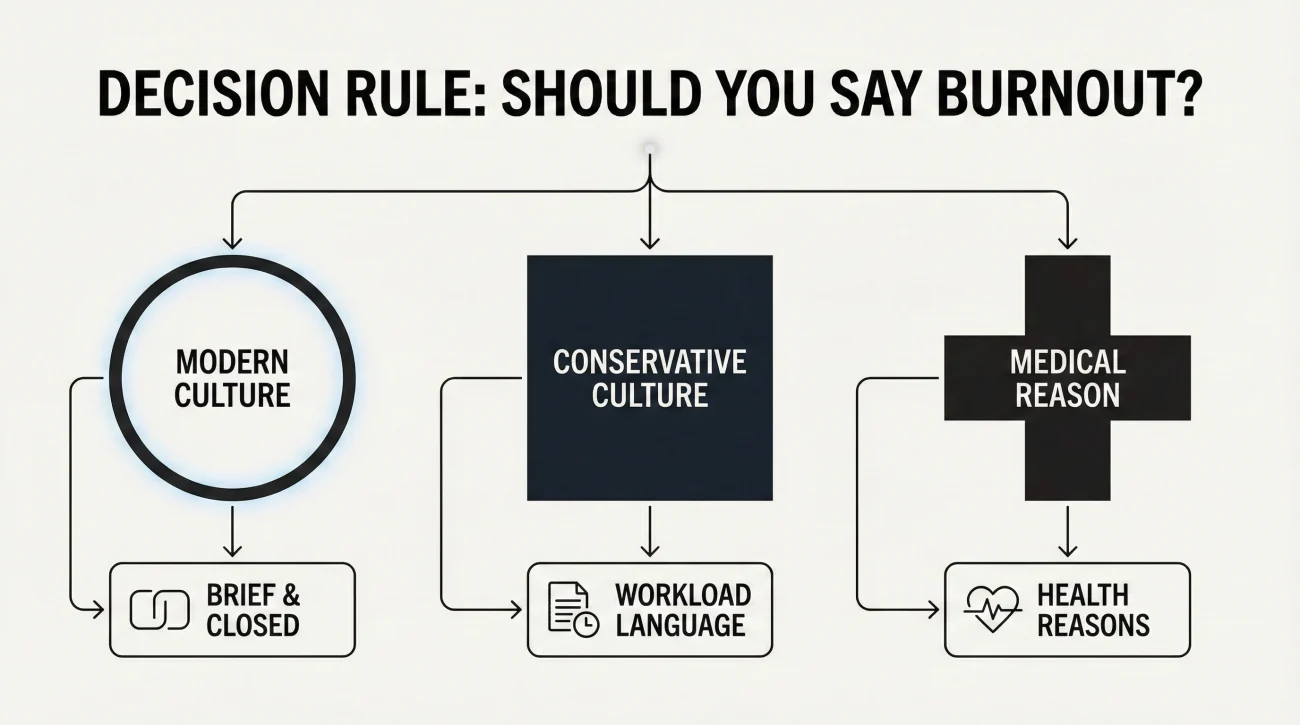
A simple decision rule you can use
- If you are applying to modern cultures that openly talk about wellbeing, you can say burnout, but keep it brief and closed.
- If you are applying to conservative cultures, client-heavy roles, or places that fetishize “always on,” use “sustainable workload” language instead.
- If you had a medical component, you can use “health reasons” and stop there. You are not required to disclose details.
⚠️ Warning: The dangerous version is not saying “burnout.” The dangerous version is sounding like you are still mid-crisis.
The phrasing that usually lands better
Try a “work sustainability” framing that does not deny what happened, but does not invite invasive questions:
Before (Risky):
I burned out because the place was toxic and the workload was insane, so I had to quit.
After (Stable):
I realized the workload model was not sustainable for long-term performance, so I made a planned reset and refocused on roles with healthier execution norms.
Your 30-second core script
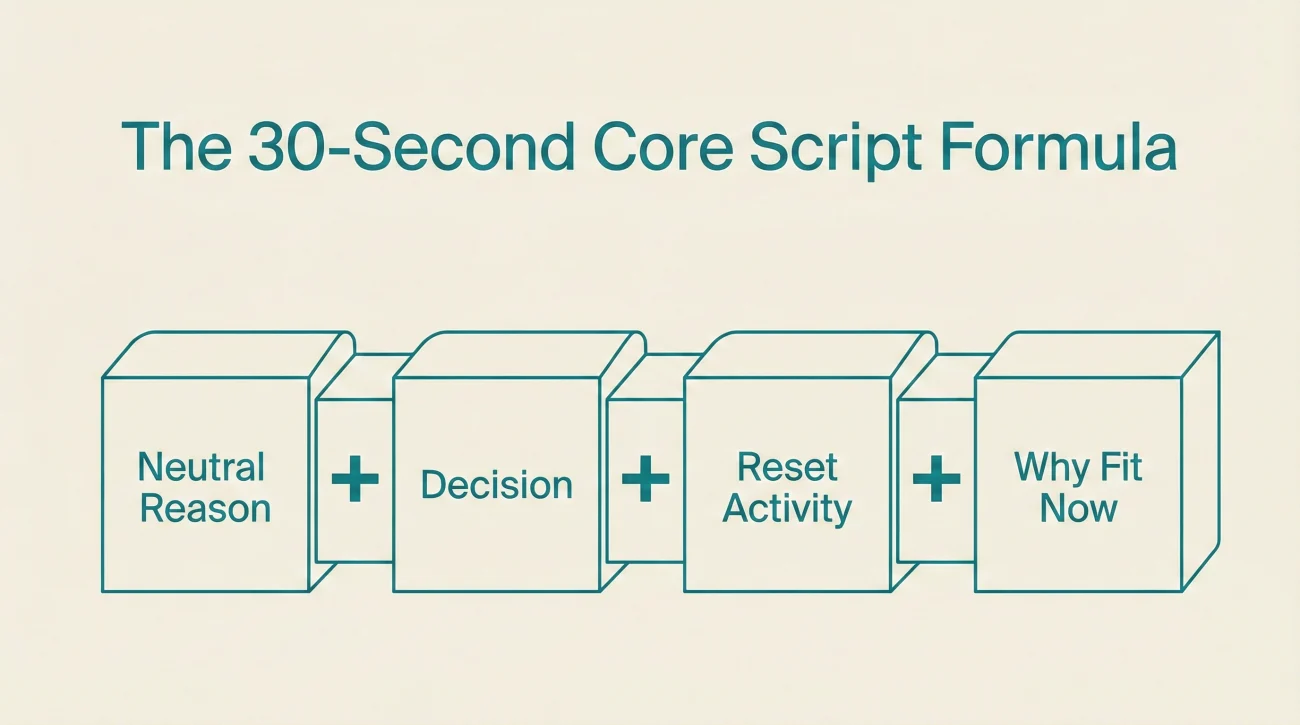
If you only memorize one thing, memorize this: Your answer should sound like a sequence of decisions, not a confession.
[Neutral reason] + [Decision] + [What you did in the reset] + [Why this role fits now]
Core interview answer (30 seconds):
I left my previous role because I recognized the workload pattern was not sustainable and it was starting to impact my performance over the long term.
I made a deliberate decision to step away, reset my routines, and get back to a healthier baseline.
During that time, I stayed sharp by keeping a steady schedule, updating my skills, and being intentional about the kind of team environment where I do my best work.
I am now focused on roles like this one, where the expectations are clear, priorities are managed well, and strong execution does not depend on chronic overextension.
That is it. No villains. No trauma dump. Clear closure. Clear direction.
Five variations for common interview situations
The core stays the same, but the angle changes depending on who is listening and what they are screening for.
Variation 1: Recruiter phone screen (keep it clean and fast)
I left because the role’s workload expectations became unsustainable for me long-term, and I chose a planned reset.
I am fully ready now and targeting teams with strong prioritization and realistic planning, which is why this role stood out.
Variation 2: Hiring manager (add responsibility and ownership)
I stayed longer than I should have while trying to solve the workload issue, and I learned to take earlier action when sustainability is at risk.
I stepped away intentionally, rebuilt my routines, and I am now looking for a role where priorities are set clearly and delivery does not rely on constant emergency mode.
Variation 3: Senior roles (signal governance, not endurance)
At a certain level, the job is not “who can survive the most hours.” It is governance: priorities, staffing, escalation, and decision quality.
I left after recognizing the operating model was not sustainable, took time to reset, and I am now focused on organizations that run with clearer priorities and healthier execution norms.
Variation 4: If you are asked directly “Why no offer first?”
I understand that question. In my case, the fastest way to protect my long-term performance was to step out, reset, and search with full focus.
It was a calculated short-term risk, and I approached it responsibly with a plan and a clear timeline.
Variation 5: If you want to use the word burnout carefully
I did experience burnout symptoms, and I treated it as a signal to course-correct, not as an identity.
I took time to recover and rebuild sustainable routines, and I am now ready for a role with clearer prioritization and healthier workload expectations.
💡 Pro Tip: Pick one variation and practice it out loud until it sounds boring. Boring is good. Boring sounds stable.
Three real-life patterns I have seen (and what worked)
I want to keep this grounded, because the internet is full of “perfect answers” that collapse in a real interview.
Mina: The oversharing spiral
Mina was a high performer in a startup. In her first interview after quitting, she tried to be “honest,” and five minutes later she was explaining internal politics, late-night pings, and how exhausted she felt. The interviewer’s face changed, not because they were cruel, but because the story sounded ongoing.
We rewrote it into a decision story. Same truth, different framing. She kept one sentence about the sustainability issue, then moved immediately to what she learned about boundaries and what kind of team she targets now. The follow-up questions got shorter. The conversation moved back to skills.
Jon: The “I can handle anything” trap
Jon did the opposite. He denied the whole thing and tried to act invincible. When asked about leaving without an offer, he shrugged and said he “just wanted freedom.” That sounded impulsive. It raised the judgment question even more.
What worked was a calm, adult sentence: “I chose a planned reset because I wanted to protect long-term performance.” No drama, no bravado, just a responsible decision.
Ruth: The readiness proof
Ruth had a longer gap. Her answer only started landing when she added proof of readiness: a consistent daily schedule, a skills refresh, and a clear work model she was targeting. Not hustle theater. Just signals that her life was structured again.
The follow-up questions you should expect (with safe answers)
These are the questions that separate “nice script” from “real interview survival.” Use the answers as templates, not as lines to recite like a robot.
What exactly caused it?
I keep it at the work-model level rather than individual people. The role moved into a pace that relied on constant urgency, and I learned I do my best work in environments with clearer prioritization and planning.
Why didn’t you fix it instead of leaving?
I did attempt reasonable fixes: I clarified priorities, asked for scope trade-offs, and adjusted routines. Eventually it became clear that the operating model was not changing, so I made a decision that protected my long-term performance.
How do we know it won’t happen here?
I pay attention to early signals now: unrealistic recurring deadlines, unclear ownership, and constant last-minute escalations. I address them earlier, and I manage workload with clearer boundaries and communication. I also choose teams where planning and priorities are explicit, which is what I am screening for in this process.
Are you fully ready to work now?
Yes. I took the time to reset deliberately, and I am back in a steady routine. I am interviewing because I am ready to contribute again, and I am being selective about fit so I can perform sustainably.
What did you do during the gap?
I kept structure. I maintained a consistent schedule, refreshed key skills, and stayed engaged with the field. I also used the time to reflect on what kind of working environment brings out my best performance.
Notice the pattern: Short answer, then pivot back to performance and fit.
Eight boundary lines for invasive questions
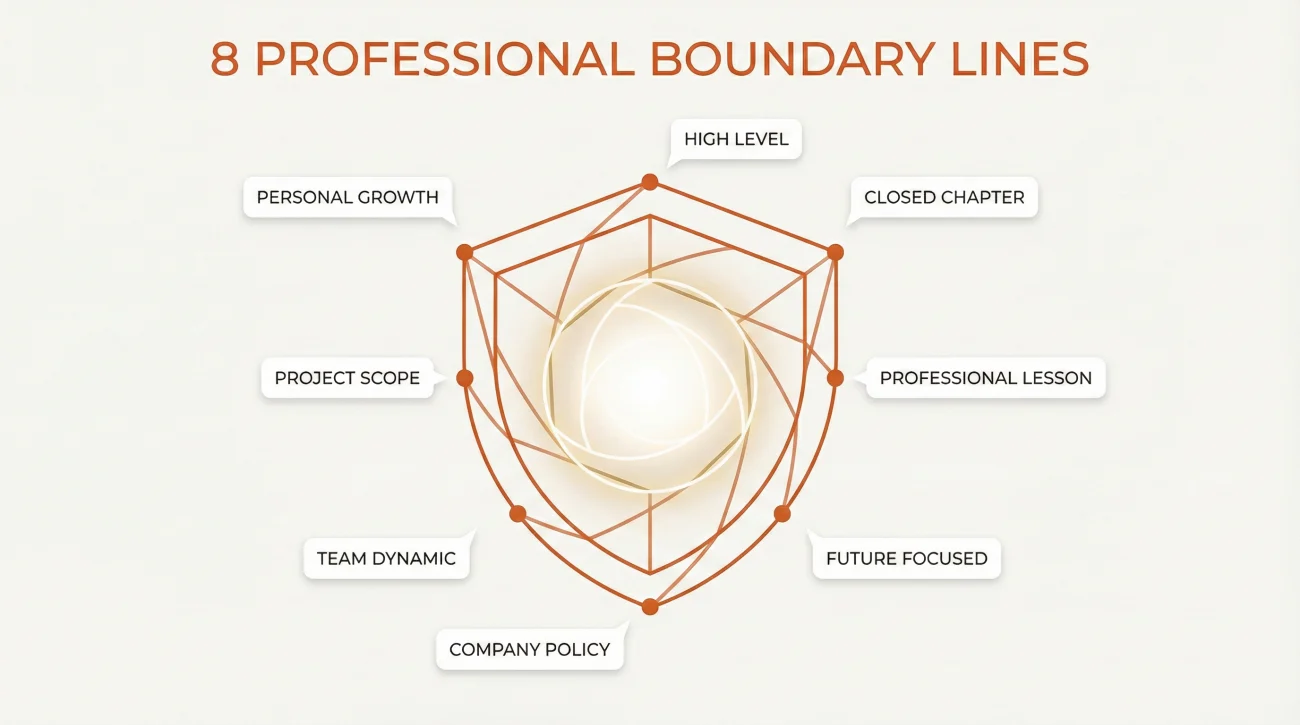
You can be respectful without giving away your private life. Here are lines that keep you professional and in control.
- “I am happy to keep it at a high level. The key point is that it is resolved, and I am ready now.”
- “I prefer not to share personal health details. What I can share is what I learned and how I work sustainably.”
- “I am not comfortable discussing individuals. I can talk about the work model and what I am looking for next.”
- “That period is closed. I am focused on the role in front of me and the value I can bring.”
- “I made a planned decision, and I approached the transition responsibly. I can walk you through what I did to stay ready.”
- “I understand the concern. The best proof is my current routine and the way I manage workload now.”
- “I am selective about fit because I want long-term performance, not short-term heroics.”
- “I can share the professional lesson: Earlier boundary-setting and clearer priority conversations.”
❌ Note: Do not negotiate with an interviewer who is trying to pull you into gossip, diagnosis, or blame. Your calm refusal is part of the signal.
How to handle the “quit without another job” stigma
Some employers still treat unemployment as a signal, even if they say they care about wellbeing. You cannot control that, but you can control how you frame the decision.
Two clean ways to justify the decision
- Time-boxed reset: You made a short-term plan, then executed it with structure.
- Long-term performance: You chose a controlled pause to protect the quality of your work and your health.
A line that often reduces judgment fast
I know quitting without an offer is not ideal. In my case, it was the most responsible option to reset quickly and return to work in a stable, sustainable way.
That sentence is not defensive. It is adult. It tells them you understand the risk, and you handled it intentionally.
Phrases to avoid (and what to say instead)
This is where so many candidates accidentally torch themselves. The wrong phrase makes you sound either fragile or angry. The right phrase makes you sound self-aware.
| Avoid saying | Say this instead |
|---|---|
| “It was toxic and they ruined my mental health.” | “The work model was not sustainable, so I made a planned reset and refocused on better-fit environments.” |
| “I could not handle it.” | “I recognized the pace was not sustainable long-term, and I course-corrected.” |
| “I had a breakdown.” | “I noticed burnout signals and responded early to protect performance and health.” |
| “My manager was the problem.” | “I am focused on clear priorities and planning, which is what I am screening for now.” |
Work the long-tail phrases naturally once, then move on:
- Quit due to burnout interview answer should sound closed and professional, not emotional.
- Left job without another job burnout needs a time-boxed plan and a readiness signal.
- Burnout resignation interview explanation should be about judgment and fit, not blame.
Final: Build a stability story, not a burnout story
A strong answer is not the one that makes the interviewer feel sorry for you. It is the one that makes them feel safe hiring you.
If you take only one thing, take this: Your explanation should have a beginning, a decision, and a closure signal. The decision is what makes you sound stable. The closure is what makes you sound ready.
When you frame it that way, your quit job due to burnout interview answer stops sounding like a risk, and starts sounding like maturity.
Then you pivot back to the job: What you can deliver, how you work, and what kind of environment lets you do your best work for the long haul.
❓ FAQ
🧭 Should I admit I quit because of burnout?
You can, but you do not have to. The safer goal is to communicate a sustainable work-fit decision with a clear closure signal. If you use the word burnout, keep it brief and immediately pivot to readiness and fit.
🧩 What if they think quitting without an offer is irresponsible?
Frame it as a time-boxed, planned reset that protected long-term performance. You are not asking them to approve your past. You are showing adult judgment and a clear plan.
🛡️ How do I answer if they ask for medical details?
Keep it high-level. You can say you prefer not to share personal health details, and then shift to what you learned and how you manage workload sustainably.
🧠 What if my gap is several months long?
Add proof of structure: a consistent routine, a skills refresh, and a clear target for your next environment. Long gaps sound less risky when your life sounds organized.
📌 Can I blame a toxic manager if it is true?
It might be true, but it is rarely useful. Blame invites drama and follow-up interrogation. Keep it at the work-model level and focus on fit and professional lessons.
🔁 What if they ask “What will you do if this happens here?”
Answer with early-signal awareness and communication habits: clarify priorities earlier, set boundaries, escalate risks sooner, and align on timelines. Then connect it to why you are choosing this role now.
⚠️ Disclaimer: ResumeSolving provides resume, cover letter, and job search communication guidance for informational purposes only. It is not legal, medical, financial, or professional counseling advice. Hiring decisions vary by company, role, location, and individual circumstances, so we do not guarantee interviews, offers, or outcomes. Always use your own judgment, verify requirements directly with the employer, and follow local laws and workplace policies. When a situation is sensitive, we prioritize privacy-safe, recruiter-appropriate wording, and you never need to share personal details you are not comfortable disclosing.