- A strong sabbatical entry removes ambiguity: dates, a neutral label, and a clear signal that the break is finished.
- Do not inflate a sabbatical into a fake job. Use proof based bullets if you have outputs, otherwise keep it short.
- Below are 9 copy ready entries by scenario, 12 bullet starters, and truth check rules that protect you from “implied employment.”
The real risk is not the sabbatical, it is the ambiguity
One of my candidates, Nicole, took nine months off after a brutal run of back to back product launches. She came back sharp and ready, but her resume had a quiet landmine: her last role ended, then the next line was simply “Personal break.” No dates. No context. No closure.
The recruiter did what humans do when details are missing: they guessed. The guess was not kind.
This is why sabbatical resume entry examples matter. Not to “spin” your life. To remove uncertainty. A good entry reads like a clean chapter that ended, so the reader can move on to your actual work history.
⚠️ Warning: If your sabbatical entry makes the reader pause to interpret it, it is already doing damage.
What recruiters scan for in a sabbatical entry
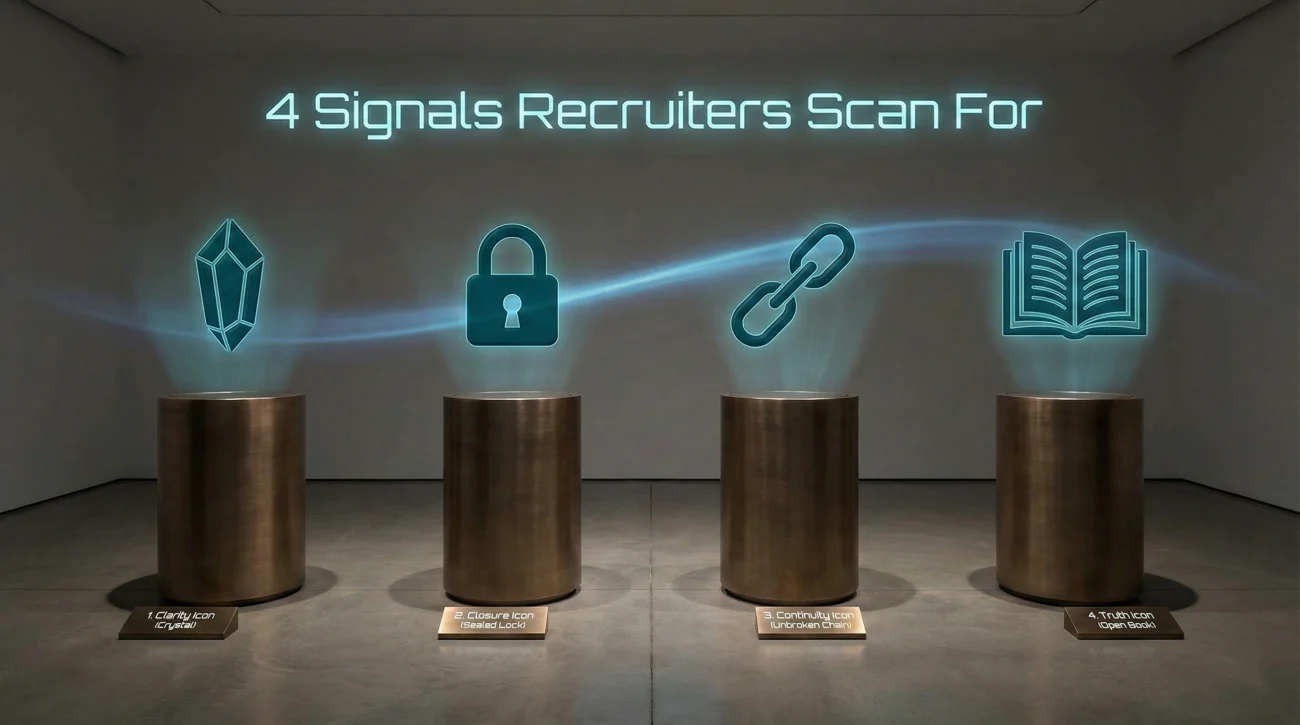
Most advice online says “be honest” and “highlight transferable skills.” True. But in real screening, people check for a handful of signals that decide whether your entry feels normal or suspicious.
- Timeline clarity: dates that match the rest of your resume and do not force mental math
- Closure signal: wording that clearly communicates the break ended
- Professional continuity: a small sign you stayed capable, even if you did not “work”
- Truth alignment: no phrasing that implies employment you cannot back up
🗝️ Key Point: The best sabbatical entry is boring in the right way. Clear dates, a neutral label, and a finished chapter.
I once reviewed a resume where someone labeled a six month break as “Independent Consultant” with three vague bullets like “advised stakeholders.” In the interview, the hiring manager asked one follow up question: “Who was the client?” The candidate froze. That moment mattered more than the entire formatting of the resume.
Where to place the sabbatical so it reads clean
You have three common options. The best one is the one that keeps your timeline readable without turning your break into a story time section.
| Placement | Best when | Keep it safe by |
|---|---|---|
| Experience section entry | Your break is visible and you want a clean timeline | Using dates, neutral label, 2 to 3 bullets max |
| Separate “Career Break” section | You want to keep Experience strictly paid roles | Keeping it short and not emotional |
| One line in the summary | The break was short or your recent work is very strong | Stating the break ended and you are available |
This article focuses on the first option: a clean entry inside the sabbatical experience section approach, because it solves the “gap math” problem fast.
A simple formula that makes the entry feel real

You do not need clever wording. You need structure.
[Neutral Title] + [Dates] + [Focus] + [Closure Signal]
Neutral titles that do not sound like a confession
Choose a title based on what you can honestly support:
Personal Sabbatical (general privacy), Professional Sabbatical (skill work or portfolio), Independent Study (structured learning), Writing Sabbatical (published or consistent output), Volunteer Project (only if the org is real and nameable).
The closure signal most entries forget
A closure signal is one short line that tells the reader the break is finished. Without it, the reader may wonder if you are still on leave.
💡 Pro Tip: Closure can be as small as “Sabbatical concluded in Oct 2025; returned to full time availability.” It is not dramatic, it is practical.
9 sabbatical resume entry examples by scenario
Each example is designed to paste into an Experience section. Match the formatting style of your other roles. Same tense, same date style, same bullet rhythm.
Example 1: Travel sabbatical with a structured learning angle
– Followed a structured language plan with weekly speaking practice and documented progress milestones
– Managed multi region travel logistics including budgets, scheduling, and coordination across vendors
– Sabbatical concluded in Oct 2025; returned to full time availability and active job search
Why it works: it does not pretend travel is a job, but it still signals discipline and closure.
Example 2: Recovery sabbatical without oversharing
– Rebuilt working cadence through a structured refresh plan aligned with target roles and core tools
– Completed role relevant training and applied learning in a small portfolio style project with documented outcomes
– Fully available for full time work as of Sep 2025
Keep the tone neutral. The resume is not the place to write a health narrative.
Example 3: Professional sabbatical used for upskilling plus outputs
– Completed a structured curriculum in analytics and reporting with weekly assignments and checkpoints
– Built three dashboards from real datasets and documented assumptions, definitions, and insights
– Sabbatical ended in Jul 2025; prepared to return to roles requiring reporting and stakeholder communication
This is output based. If you cannot show a dashboard or artifact, tone the claim down.
Example 4: Writing sabbatical with consistent publishing
– Published a consistent body of work focused on leadership, workplace communication, and decision making
– Developed a repeatable research and drafting workflow with weekly deadlines and revision cycles
– Sabbatical concluded in Oct 2025; returning to full time work with refreshed writing discipline
If you did not publish, swap “Published” for “Drafted” and keep it smaller.
Example 5: Volunteer project on sabbatical (only if it is verifiable)
– Supported [Organization Name] with weekly operations tasks, documentation cleanup, and volunteer coordination
– Created simple process guides that reduced repeated questions and improved handoffs
– Volunteering concluded in Apr 2025; actively pursuing full time roles in operations support
⚠️ Warning: If you cannot name the organization, do not write it like a formal role. Keep it as a personal sabbatical and describe skills more generally.
Example 6: Relocation sabbatical (short and practical)
– Managed a relocation timeline including housing, documentation, and scheduling coordination
– Maintained role relevant skills through structured weekly practice and targeted learning
– Relocation completed in Sep 2025; fully available for full time work
I have seen relocation entries work best when they are short. Over explaining makes it look riskier than it is.
Example 7: Privacy first sabbatical (no details, still clear)
– Took an intentional pause for personal priorities while maintaining professional readiness
– Completed a focused refresh plan aligned with the tools and workflows required in target roles
– Sabbatical ended in Nov 2025; available for full time work immediately
Some people worry this looks vague. It is not vague if the dates and closure are clear.
Example 8: Portfolio build sabbatical (for roles that expect proof)
– Built and shipped a portfolio project end to end with scoped milestones and documented tradeoffs
– Collected feedback, iterated across versions, and improved the final output through structured testing
– Sabbatical concluded in Aug 2025; returning to full time work with a portfolio ready artifact
Notice the language: shipped, iterated, documented. These are signals that feel real to hiring managers.
Example 9: Short sabbatical between jobs (keep it tiny)
– Took a planned break between roles and completed a focused skill refresh aligned with target positions
– Resumed full time job search in Mar 2026 with immediate availability
If the gap is short, do not inflate it. The safest entry is the smallest honest one.
12 bullet starters that sound professional
These starters help you write fast without drifting into vague self improvement language. Pick 2 to 3 that you can support with proof or a clear explanation.
🧩 Starters for learning and upskilling
- Completed a structured learning plan focused on [tool or skill] with weekly milestones.
- Applied new skills by building [artifact] and documenting decisions and outcomes.
- Strengthened core competencies in [area] through consistent practice and feedback loops.
📌 Starters for projects and outputs
- Built and shipped [project] with a clear scope, timeline, and measurable results.
- Iterated on [project] based on feedback and improved [metric or outcome].
- Documented a repeatable workflow for [process] to improve quality and consistency.
🗂️ Starters for life logistics that still show competence
- Managed complex logistics across [locations or constraints] while maintaining professional readiness.
- Coordinated schedules, budgets, and timelines to complete [move or transition] successfully.
- Maintained role relevant skills through structured weekly practice during the transition period.
✅ Starters that communicate closure cleanly
- Sabbatical concluded in [month year]; returned to full time availability.
- Transition completed in [month year]; actively pursuing roles in [target area].
- Break ended in [month year]; prepared to re enter the workforce immediately.
💡 Pro Tip: If you are unsure about a bullet, remove it. A short truthful entry beats a longer questionable one every time.
Truth check rules to avoid “implied employment”
Here is the fastest way I know to keep a sabbatical entry honest and recruiter proof. This is also the section most articles skip, which is why people accidentally write entries that feel like fake jobs.
❌ Note: If your wording makes it sound like you had clients, revenue, or an employer, you should be able to name who, show proof, and describe scope without panic.
Use these rules:
- No phantom employers: Do not invent a company name or label yourself as “consultant” unless it was real work.
- Proof based claims only: Prefer “Built, completed, published, shipped” over “advised, led, supported” when there is no verifiable context.
- Dates match reality: If you were still on leave, do not write closure that is not true. Use a present tense version and keep it short.
- One focus is enough: Travel plus study plus volunteering plus freelancing reads like resume theater. Pick the most defensible angle.
- Privacy is allowed: “Personal Sabbatical” is acceptable. The resume does not owe anyone your personal story.
🗝️ Key Point: Your sabbatical entry should be easy to explain in one calm sentence. If it needs a speech, rewrite it.
How to write your own entry in five minutes
If you want a fast method, do this:
- Pick the most accurate title: Personal Sabbatical, Professional Sabbatical, Independent Study, Writing Sabbatical, Volunteer Project.
- Use the same date format as the rest of your Experience section.
- Add one focus line that is neutral and true.
- Add 2 bullets that are either outputs or structured learning, not fluffy duties.
- Add one closure bullet or closure sentence if the break ended.
This is how to write sabbatical entry content that feels normal: small, clear, and easy to defend.
One more story from the hiring side: I interviewed a marketer who took a year off for travel. Their entry was two bullets and a closure line. That was it. The hiring manager never even asked about the gap because the resume did not make it feel mysterious.
Final thought: Clarity beats creativity
When your resume is competing in a fast skim, the goal is not to “sell” the sabbatical. The goal is to prevent the sabbatical from becoming the loudest story on the page.
If you take one thing from this guide, make it this: write the smallest truthful entry that removes ambiguity, signals closure, and does not imply employment you cannot prove.
❓ FAQ
🎯 Should I list a sabbatical in the Experience section or leave it off?
If the gap is noticeable and your resume timeline looks like it “ends,” adding a short entry often helps because it removes ambiguity. If the gap is short and you already have strong recent work, you can sometimes omit it. The key is whether the reader would pause and wonder.
🧭 What if my sabbatical is ongoing right now?
List it with present tense wording and do not fake a closure. Keep it minimal: title, dates, one focus line, one bullet about structured learning or readiness. The goal is clarity, not a performance.
🧾 Can I call it “consulting” if I did a few favors for friends?
Only if it was real work you can explain calmly: who the client was, what the scope was, and what the outcome was. If it was informal or occasional, it is safer to label the period as a sabbatical and mention any outputs without implying employment.
🧠 How much detail should I include about personal reasons?
Very little. A resume is not a personal statement. “Personal Sabbatical” plus clear dates and a closure signal is often enough. If a company demands private details early, that is a red flag about their culture, not your resume.
📅 Should I use months and years, or years only?
Match your resume style. Years only can soften tiny gaps, but it can also create confusion if your roles were short. If you choose years only, keep it consistent across entries so it does not look like you are hiding one specific period.
⚠️ Disclaimer: ResumeSolving provides resume, cover letter, and job search communication guidance for informational purposes only. It is not legal, medical, financial, or professional counseling advice. Hiring decisions vary by company, role, location, and individual circumstances, so we do not guarantee interviews, offers, or outcomes. Always use your own judgment, verify requirements directly with the employer, and follow local laws and workplace policies. When a situation is sensitive, we prioritize privacy-safe, recruiter-appropriate wording, and you never need to share personal details you are not comfortable disclosing.