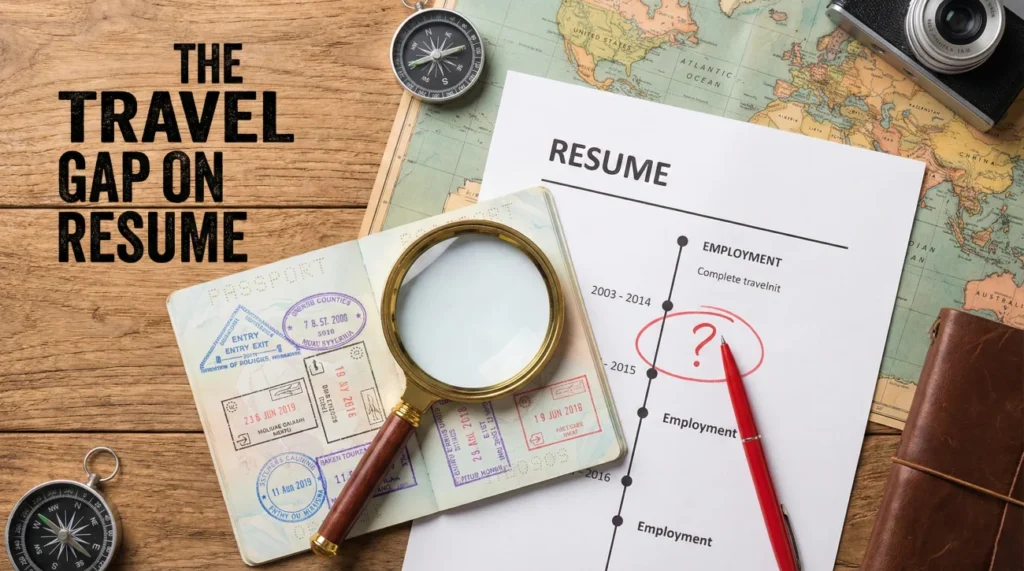
- A travel break rarely hurts because you traveled. It hurts when your wording sounds open-ended or unsettled.
- Recruiters look for two safety signals: A clear closure and a calm re-entry plan.
- Use one framing angle, keep it factual, and borrow the example lines to avoid “flight risk” vibes.
Why “A Year Off to Travel” Can Sound Risky on a Resume
One of the most talented candidates I met last year was named Elise. She had the kind of experience hiring managers say they want: steady growth, clean metrics, and strong cross-team work. Her resume should have been an easy yes. But she kept getting polite rejections that felt strangely fast.
When we looked at her resume together, the “problem” was not her skills. It was a single line in her timeline that read like an unfinished story. It was personal, poetic, and vague. It also accidentally made her sound like she might disappear again right when things get busy.
That is the hidden issue behind most travel gaps. People think the gap is the red flag. In practice, the red flag is uncertainty. Recruiters are asking themselves two quiet questions: “Is this person truly back?” and “Will this person stick around?”
If you are trying to learn how to explain a travel gap on a resume, you do not need to turn travel into a fake job. You need to make the chapter feel closed, stable, and compatible with long-term work.
⚠️ Warning: The more your travel line reads like a life philosophy, the more it invites doubt. Your goal is calm clarity, not a dramatic arc.
What Recruiters Actually Scan For in the First 10 Seconds
When your resume hits an inbox, nobody starts by appreciating the beauty of your travel story. They scan for timeline continuity, role fit, and risk. A travel break can be totally fine, but it becomes a “think harder” moment if your wording suggests any of the following:
| Recruiter worry | What triggers it | What fixes it |
|---|---|---|
| Flight risk | Open-ended language, dreamy tone, “still exploring” vibes | Clear end date plus a grounded next step |
| Availability risk | Unclear location, unclear readiness, “transitioning” forever | One-line availability signal: back, settled, ready |
| Focus risk | Travel becomes the headline, career target feels fuzzy | Target role appears early and stays consistent |
| Currency risk | No mention of staying sharp, long gap with silence | Small proof of recency: projects, practice, learning |
🗝️ Key Point: A travel gap reads safest when it sounds finished, intentional, and boring in the best way.
The Two Safety Signals That Make a Travel Gap Feel “Normal”

Signal 1: Closure
Closure is not an emotion. It is structure. Closure tells the reader: The travel happened, it ended, and you are not still half-living in that chapter.
Closure usually includes a timeframe and a return marker. That return marker can be as simple as “Returned and resumed full-time search,” or “Returned to [City] and available for onsite or hybrid roles.”
Signal 2: Re-entry plan
A re-entry plan is one sentence that makes your next move feel intentional. Not “I am figuring things out.” More like “Now targeting [Role] roles in [Industry] and actively interviewing.”
One of my former coworkers, Daniel, used to call this “answering the unasked question.” If you do not answer it, the recruiter answers it for you, and their version is rarely flattering.
💡 Pro Tip: If you can only add one extra detail beyond dates, add your re-entry target. It keeps travel from becoming your identity on paper.
Where to Put the Travel Break Without Making It the Main Story
Placement is strategy. The goal is to prevent “mystery gaps” while keeping the spotlight on your professional impact.
Option A: One line in your timeline
This is the most common choice. It works best when your travel break is recent and obvious. One neutral line stops the recruiter from guessing something worse.
Option B: A small “Career Break” section
If your path is non-linear or you have more than one break, a tiny section can keep your Work Experience clean. Keep each entry to one line and do not turn it into a novel.
Option C: Minimal mention
If the travel happened long ago and you have strong recent continuity, you may not need to foreground it. Your resume is not a biography. It is evidence for this job.
| Your situation | Best placement | Why |
|---|---|---|
| Recent 8 to 18 month travel break | Option A | Prevents guessing and speeds up trust |
| Several breaks or a messy timeline | Option B | Keeps Work Experience readable and ATS-friendly |
| Travel break is old and you are stable now | Option C | Stops an old gap from stealing attention |
❌ Note: Avoid inflating travel into a fake employer. Background and application forms can force consistency, and “creative job titles” are where trust breaks.
Five Framing Angles That Work (Pick One and Stay Consistent)
Most low-quality advice says “Highlight transferable skills.” That is not wrong, but it is incomplete. A better approach is to pick one framing angle so your wording feels coherent, not scattered.
- Planned sabbatical framing:
Use this when you saved for it, planned it, and ended it on purpose. This angle reads stable because it implies discipline.
[Dates] + [Planned Travel Sabbatical] + [Returned / Available]
💡 Pro Tip: Mention the planned nature in one neutral phrase, not a long story.
- Milestone timing framing:
Use this when the travel was tied to a specific window: before relocating, after a long project cycle, or before starting a new chapter. It answers “Why then?” without oversharing.
Keep the milestone practical. Avoid emotional language that sounds like you are still in transition.
- Skills and portfolio framing:
Use this if you kept your hands on tools, shipped projects, or took structured learning seriously. It reduces currency risk fast, especially for technical roles.
⚠️ Warning: Only choose this if you can name real outputs. Vague “self-improvement” reads like fluff.
- Reset after intensity framing:
Use this when you are coming off a high-pressure stretch: startup, major launches, or sustained overtime. The story is: Reset, returned, now ready.
Do not turn it into a health disclosure. Keep it professional and brief.
- Location and availability framing:
Use this when travel creates a location question. This framing is great for hybrid or onsite roles because it eliminates “Where are they really?” confusion.
[Returned to City] + [Available for Onsite/Hybrid/Remote] + [Start timing]
Travel Words That Quietly Increase “Flight Risk”
I have seen candidates sabotage themselves with lovely language. The words are not “bad.” They are just ambiguous. Ambiguity makes recruiters invent stories you did not intend.
| Avoid (sounds ongoing) | Use instead (sounds closed) |
|---|---|
| Exploring the world, finding myself | Planned travel sabbatical, completed on schedule |
| Chasing freedom, escaping the grind | Career break, returned and re-entered full-time work |
| Open-ended travel | Fixed timeframe travel break (Month Year – Month Year) |
| Seeing what is next | Now targeting [Role] and actively interviewing |
| Living my dream | Personal milestone travel, now focused on long-term growth |
“So are you settled now, or is this the kind of role you would leave to travel again?”
If your resume accidentally invites that question, your wording needs a reset, not your life choices.
Eight Resume Lines You Can Copy (Stable, Honest, Not Cringe)
Pick the example that matches your situation. Each one includes a small “closure signal” so the reader does not wonder if you are still half-away.
🧭 The safest one-liner for most people
Use this if you just want the gap explained cleanly with zero extra drama.
Completed a planned one-year break; returned and fully available for full-time work.
⚡ Quick tweak: Swap “planned” with “fixed end date” if you want it to sound even more structured.
🎯 If you want to name your target role (reduces “drifting”)
Use this when you want the reader to instantly see what you are aiming for now.
Returned in Jul 2024 and resumed full-time job search; now actively interviewing for [Target Role] roles.
⚡ Quick tweak: Replace [Target Role] with the exact job title used in the posting.
🛠️ If you stayed sharp with real practice or projects
Use this only if you can back it up with a portfolio, cert, or consistent work sample.
Maintained professional currency through weekly portfolio work and structured learning; now focused on [Target Role] roles.
Watch out: If you did not actually do this, do not claim it. Keep it simple instead.
📍 If location and availability might be questioned
Use this for onsite or hybrid roles, or if your travel makes your current location unclear.
Fixed end-date sabbatical; returned to [City] and available for onsite or hybrid roles.
⚡ Quick tweak: Add “available to start within [X] weeks” if timing is a concern.
🏁 If the travel happened after a major work cycle
Use this when you want the break to read like a planned reset after intense work.
Traveled after completing a major project cycle; returned and committed to long-term growth in [Function/Team].
⚡ Quick tweak: Keep [Function/Team] aligned with the role you are applying to.
🧩 If you want “planned” without sounding like a speech
Use this if you want structure, but you prefer neutral tone over personal explanation.
One-year travel break with a planned end date; re-entered market with a clear target and updated toolkit.
⚡ Quick tweak: Replace “updated toolkit” with a concrete item if you can: “refreshed SQL and Tableau.”
⏱️ If you want to signal start date and readiness fast
Use this when the recruiter may worry you are not ready to start soon.
Returned and settled; currently available to start within two weeks for full-time roles.
⚡ Quick tweak: Swap “two weeks” to match your real timeline.
🤝 If you are pivoting into Customer Success or similar
Use this when your next step is people-facing and you want the resume to feel forward-looking.
Planned sabbatical completed; now actively pursuing Customer Success roles and interviewing weekly.
⚡ Quick tweak: If “interviewing weekly” feels too specific, use “actively interviewing.”
💡 Pro Tip: If your break was exactly the scenario people Google as took a year off to travel resume, the safest move is still the same: Dates, neutral label, closure, and target role.
Six Honest Principles That Keep You Out of Trouble
Travel gaps are rarely “illegal” to write. The risk is credibility. The fastest way to lose credibility is to exaggerate travel into employment, then get caught in a background check or an application form mismatch.
| Principle | What it means on paper | Why it works |
|---|---|---|
| Be factual | Dates, label, one neutral detail | Reduces interpretation and drama |
| Do not invent employers | No fake “self-employed traveler” roles | Keeps forms and verification consistent |
| Signal closure | Returned, available, settled | Directly reduces flight risk |
| Protect privacy | No oversharing mental or family details | Stops bias and keeps it professional |
| Prove currency lightly | One small proof of staying sharp | Defuses “skills got rusty” anxiety |
| Match the job target | Travel line supports your next role, not your identity | Keeps the resume about hiring, not storytelling |
One candidate I coached, Vanessa, took a long backpacking trip after a brutal stretch at a startup. Her first resume draft read like a personal reinvention. It was honest, but it sounded like she was still searching. We rewrote it into a calm closure statement and a clear target. The interviews came back quickly because the resume stopped raising “Are you really ready?” doubts.
Three Real-World Cases Where Travel Gaps Get Misread
Case 1: You did freelance or remote work while traveling
If you actually worked, list the work honestly as work, and keep travel separate. Trying to blend everything into one “travel job” entry is where credibility gets messy.
This is where people searching for career break to travel on resume advice get conflicting answers. The clean rule is: Work is work, travel is travel, and the timeline stays consistent.
Case 2: You are re-entering after an “adult gap year” with a career pivot
If you are pivoting, your travel line is not the main thing to explain. Your target role and your proof of fit are. Keep the travel explanation short, then spend your resume space on the pivot evidence.
When people search adult gap year resume, they often want permission to talk about personal growth. You can, but the hiring decision still relies on role fit. Put the growth into skills and outcomes, not poetic wording.
Case 3: You worry that travel makes you look unserious
This is the most emotional case, and it is also the easiest to fix. Your resume should not try to convince someone that travel is “serious.” Your resume should show that you are serious now.
A colleague named Luca once told me he used a simple rule: “If a sentence could be read as ongoing, rewrite it until it cannot.” That is basically the whole game for travel gap resume wording.
A Fast Self-Check Before You Hit Apply
Before you send your resume, read your travel line like a skeptical stranger. If you want a quick checklist, use this:
- ✅ Do the dates make the break feel finished?
- ✅ Does the wording say you are back and available?
- ✅ Is your target role visible within the first half of the resume?
- ✅ Do you have one small proof of recency if the gap is long?
- ✅ Would this line still make sense if you removed all emotion words?
⚠️ Warning: If your travel line is longer than a normal job line, it is probably stealing attention from your qualifications.
Final: The Calm, Recruiter-Friendly Way to Write It
The goal is not to make travel look like employment. The goal is to make your timeline easy to trust. When your travel break reads as planned, closed, and followed by a clear re-entry plan, it stops being a red flag and becomes a neutral detail.
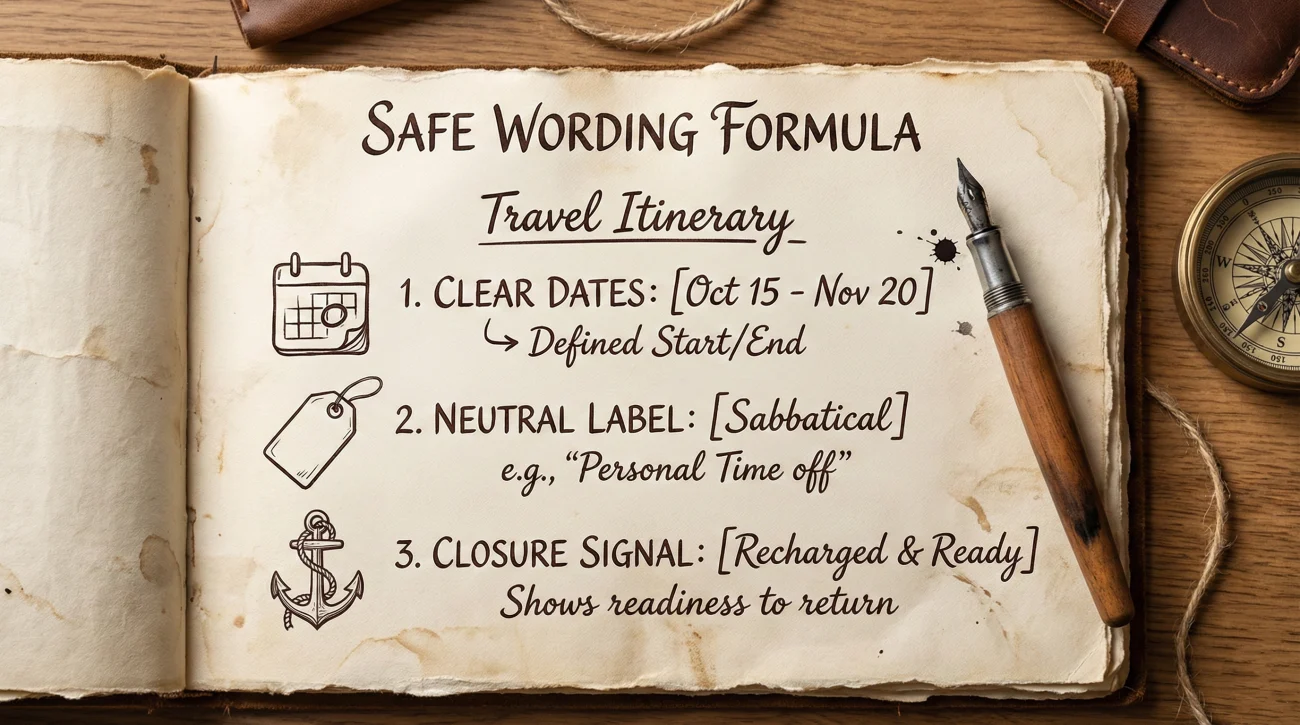
If you want one sentence to guide you, use this: Dates, neutral label, closure, and target role. That formula works whether your break was five months or a full year, whether you call it a travel sabbatical on resume line or a career break entry.
Most importantly, make the story feel finished. That is what lowers flight risk and gets the recruiter back to the part of your resume that should matter: Your work.
❓ FAQ
🧭 Should I list travel as a job on my resume?
Usually no. If you did not have an employer, do not create one. Use a neutral timeline line like “Sabbatical (Travel)” with dates and a closure signal. If you worked during the period, list the work honestly as work, and keep travel separate.
🧩 What if recruiters think I will leave again to travel?
That fear is real, and your wording can reduce it. Add closure language that makes the chapter feel finished, plus a re-entry plan that shows a long-term target. Avoid open-ended phrases that sound like you are still exploring.
🛠️ Do I need to include bullet points under the travel entry?
Not usually. Bullet points are only helpful if they contain verifiable, role-relevant outputs like projects, certifications, or consistent freelance work. Otherwise, keep the travel line short and let your work achievements carry the resume.
🌿 Is it okay to say travel helped my personal growth?
You can mention growth, but keep it professional and concrete. “Improved communication” is vague. “Completed structured learning” or “Maintained weekly portfolio work” is clearer. If it sounds emotional or ongoing, it can backfire.
📍 How do I handle location questions after traveling?
Use the location and availability framing. One line like “Returned to [City] and available for onsite or hybrid work” removes uncertainty fast, especially for roles where location matters.
🎯 What is the simplest safe wording for a one-year travel gap?
Use dates, a neutral label, and closure. Example: “Career Break (Travel) | 2023 – 2024. Returned and fully available for full-time work.” Simple wording is not boring here, it is trustworthy.
⚠️ Disclaimer: ResumeSolving provides resume, cover letter, and job search communication guidance for informational purposes only. It is not legal, medical, financial, or professional counseling advice. Hiring decisions vary by company, role, location, and individual circumstances, so we do not guarantee interviews, offers, or outcomes. Always use your own judgment, verify requirements directly with the employer, and follow local laws and workplace policies. When a situation is sensitive, we prioritize privacy-safe, recruiter-appropriate wording, and you never need to share personal details you are not comfortable disclosing.